Buying Cleaning Robot Cable for Washdown and Chemical Duty: What to Specify
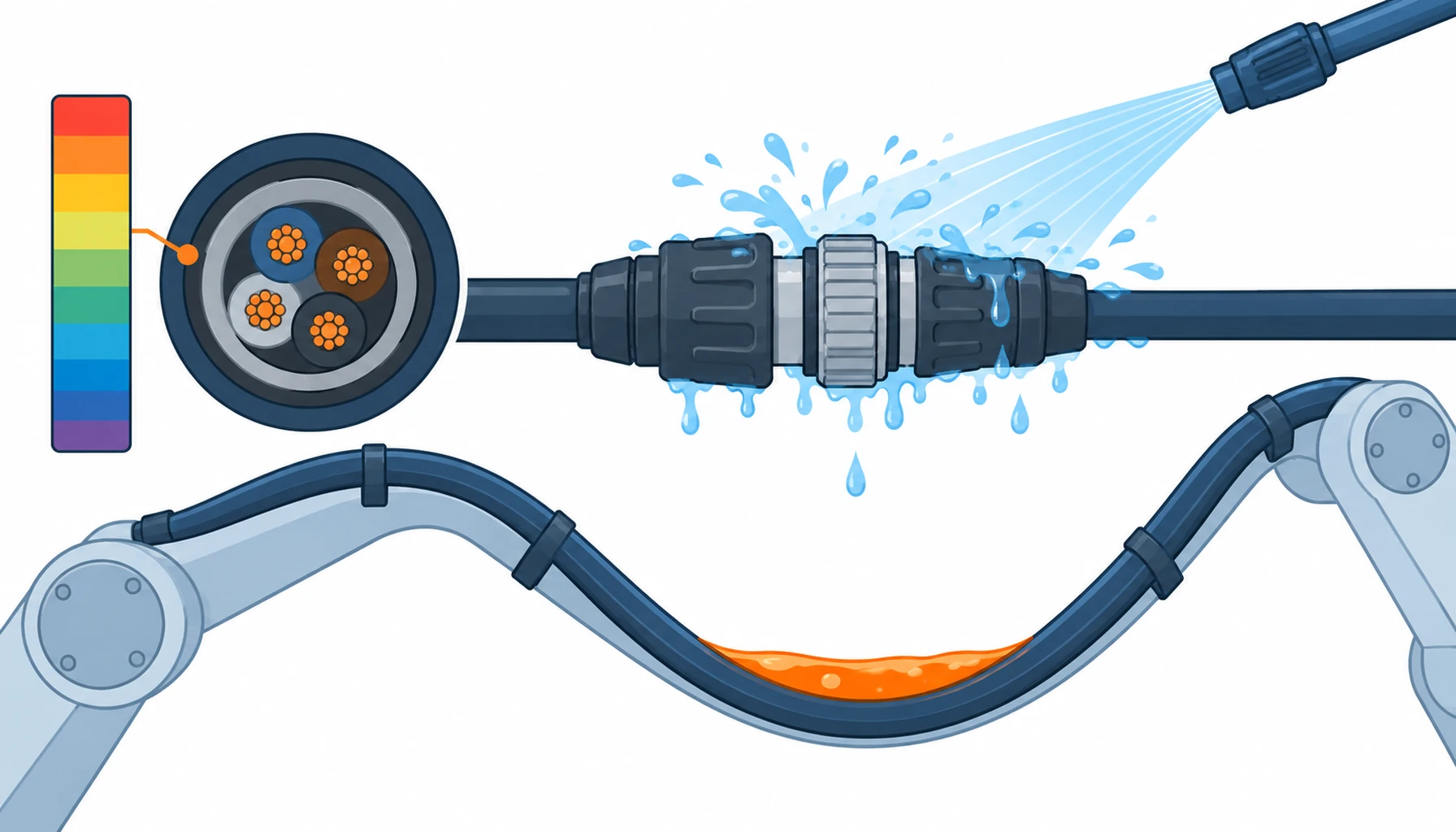
Quick Answer: A cleaning robot gets a different chemical every quarter, because the facilities contractor changes and the chemistry changes with it. The specification that survives that is not a single ingress rating but three things: the agent list with concentrations, the pH range the sheath has to tolerate, and a route that keeps water out of the places it can collect. Get those three into the RFQ and the rest is a durability decision rather than a lottery.
Introduction
Mobile cleaning equipment has become one of the largest robot categories in commercial buildings. Floor scrubbers, restroom machines, façade and window units, pool cleaners and disinfection robots all share one property: their cable lives in a wet chemistry environment while the machine moves.
The fixed-line case is different and is covered in our note on food grade machinery cable, where a conveyor or a filler is washed down in place. What follows is the mobile version, where the cable is carried through the wet environment rather than being installed in it.
The Agent List Is the Real Specification
Buyers who ask for a chemically resistant cable get a compound chosen for general resistance, which is close to saying nothing. The useful request names each agent, its concentration and the contact duration. An alkaline degreaser at working strength, a quaternary ammonium disinfectant, a hypochlorite solution, a descaling acid and an alcohol sanitiser are five different problems, and a compound that handles two of them may be poor on the other three.
pH range is the shorthand that makes the list manageable. Ask for the lowest and highest pH the sheath is expected to meet, at the temperature of use, and ask whether the figure is supported by a soak test or by a general statement. Where a machine has to work across a wide range, the answer is usually a heavier compound rather than a thin flexible one, and the cost shows up as a larger bend radius.
Disinfection robots deserve a separate line. Ultraviolet lamps degrade polymers in the same way sunlight does, ozone and peroxide vapour are oxidising, and a machine that runs a disinfection cycle in a bathroom is exposing its own harness to the treatment. If the robot disinfects the room it is standing in, the cable is inside the treatment.
Water, Pressure and the Places It Collects
Washdown pressure matters more than the number on an ingress certificate. A rating describes a test at a defined distance, angle and duration with the joint mated, and a cleaner who points a jet at an open connector has voided it. Ask where water actually reaches the harness, whether the jet is pressurised, and whether anyone opens a connector during cleaning, because the last question decides whether a sealed construction helps at all.
On a floor scrubber the cable shares its route with a suction hose and a recovery tank, so it is wet most of the day rather than briefly. The route matters as much as the sheath: a low point in the run becomes a water trap, and the trap delivers water to a connector that would otherwise stay dry. Check the drawing for low points and require a drain wherever water can collect.
The construction that handles a permanently wet environment is similar to the one used in submersible work, and the logic behind it is set out in our note on ROV cable. A splash-resistant rubber construction such as the splash resistant rubber cable family is a reasonable baseline for a machine that is wetted but not submerged, and a heavier chemical-resistant build is the answer where the agent list is aggressive.
The Construction Trade Nobody Enjoys
Chemical resistance and flexibility pull in opposite directions. The compounds that resist aggressive chemistry are usually stiffer, so the minimum bend radius grows and the harness becomes harder to route through a machine that was designed around a soft jacket. Buying the most resistant compound available therefore trades a chemical problem for a mechanical one, and on a compact scrubbing head the mechanical one fails first.
Two partial answers exist. The first is to protect only the exposed sections with a replaceable sleeve and leave the rest of the harness flexible, which puts the resistant material where the chemistry actually lands. The second is to accept a shorter replacement interval and buy the flexible construction with a scheduled change, which is often cheaper over five years than a stiff cable that damages its own terminations. The wear patterns that tell you which sections are actually being attacked are set out in our note on cable damage wear patterns.
The Contamination Nobody Puts on the Datasheet
Chemistry is only half of what a cleaning machine throws at a cable. Floor scrubbers collect hair, fibres, food debris and grit in the brush housing and around anything running near it, and that mixture wraps itself around a cable the same way it wraps a brush. The load is not chemical and it is not ordinary jacket abrasion; it is a slow, uneven tension that deforms the sheath at one point and then holds moisture against it.
Docking is where it collects hardest. A machine that parks wet on a pad leaves a damp, dirty interface for hours, and the tail entering the dock sits in it. That is a fouling problem before it is an electrical one, and cleaning the tail is a maintenance task nobody writes down.
Biofilm matters in restroom and kitchen machines. Warm, wet, nutrient-rich surfaces grow a film that holds chemistry and moisture in place long after the wash has finished, so the effective contact time on the sheath is longer than the cleaning cycle itself. It also hides early jacket damage from the person inspecting the machine.
Two things help and neither is expensive. Route the harness away from the brush and suction path so it is not the component that collects the debris, and include the tail and the connector faces in the routine cleaning instructions. Where the machine works in a food or healthcare setting, the biofilm question also belongs in the replacement interval, which is why a written inspection routine pays for itself here. What that routine should cover is set out in our note on robot cable inspection standards.
The Decision Table: Four Cable Strategies for Cleaning Machines
| Strategy | What to specify | Evidence to demand | Cost and lead time | Where it fails |
|---|---|---|---|---|
| Standard rubber flexible sheath | pH range, agent list and the bend radius | A soak test against the named agents | Lowest cost, standard lead time | A swollen jacket after a change of cleaning supplier |
| Chemical-resistant heavy sheath | Agent list, concentration, temperature and dwell time | A resistance statement per agent, plus a soak result | Higher cost, longer lead time | A bend radius the machine cannot accommodate |
| Sleeved exposed sections only | Which sections are covered and how the sleeve is renewed | An abrasion and chemical statement for the sleeve | Add-on cost at assembly | Water trapped under a sleeve against the sheath |
| Submersible-grade construction | Immersion depth, duration and the sealed termination | An immersion test on the terminated assembly | Highest unit cost, longest lead time | Paying for immersion grade on a machine that is only sprayed |
| Fixed dock with a protected tail | Tail length, strain relief and the dock entry seal | A docking temperature record plus an entry seal detail | Moderate cost, standard lead time | A tail that is wet every day and never inspected |
What to Freeze Before the Order
| Item | What to state | Evidence to attach | Cost of leaving it open |
|---|---|---|---|
| Agent list | Every chemical the machine will meet, with concentration | A resistance statement for each agent named | A sheath that fails after the first supplier change |
| pH range | Lowest and highest pH at the temperature of use | A soak result across that range | Buying compound performance on an assumption |
| Washdown pressure | Whether the jet is pressurised and from what distance | An ingress test at the mated joint under that jet | A rating that was true on a bench and not in a washroom |
| Ingress level | Where water reaches the harness, and in which state | An ingress test at the mated joint, not on a plug | Water entering at the one connector nobody sealed |
| Low points | Where the route can collect water and how it drains | A route drawing with drains shown at every low point | A water trap feeding a dry connector |
| Disinfection exposure | Ultraviolet, ozone, peroxide or none of these | A polymer statement for the exposure named | A jacket that embrittles while the machine disinfects |
| Bend radius | The figure for the assembled harness at the scrub head | A flex figure at the tightest point of travel | A stiff cable loading its own terminations |
| Sleeve coverage | Which sections are protected and how they are renewed | A chemical and abrasion statement for the sleeve | Chemistry sitting under a sleeve nobody removes |
| Docking tail | Tail length, seal arrangement and strain relief at the dock | A docking temperature record plus an entry detail | A wet tail that fails where it enters the machine |
| Replacement interval | Whether the harness is replaced on a schedule | A spares level and a planned change interval | An unplanned failure during a cleaning contract window |
When a Fully Specified Cleaning Robot Cable Is Not the Answer
When the site’s chemistry is genuinely unknown. Buying a heavy resistant compound against an unknown agent makes the harness stiff and can create a routing problem worse than the chemical one. State the assumption in writing, buy a mid-range compound with a good soak record, and plan an inspection after the first quarter so the assumption can be corrected with evidence.
When the failures are at the connector, not on the jacket. If jackets look sound and connectors keep failing, the problem is water reaching a joint that was not sealed, or a connector opened during cleaning. A heavier sheath will not fix either, and the reasoning is the same as in our note on IP ratings for robot connectors.
When the machine is only ever damp. A restroom machine that is wiped rather than hosed does not need an immersion-grade construction. Buying one adds stiffness and cost for a property the machine never uses, and the lighter build will usually outlast it because it loads its terminations less.
When a fleet mixes cleaning and other service duties. Where the same machine type also serves as a lobby or delivery unit, the harsher chemistry governs, and the selection logic for the mixed fleet is set out in our note on service robot cable. Buying two sheath specifications for one building is usually more expensive than buying one that covers both.
RFQ Checklist
- Every cleaning agent named, with concentration and contact duration for each
- Lowest and highest pH at the temperature of use, backed by a soak result
- Washdown pressure stated, with an ingress test at the mated joint under that jet
- Route drawing marked with every low point and the drain provided for it
- Disinfection exposure listed where the robot treats the room it stands in
- Bend radius given as a harness figure at the tightest point of travel
- Sleeve coverage defined as replaceable sections, with a chemical statement for the sleeve
- Docking tail length, seal arrangement and strain relief specified at both ends
- Termination sealing method stated, with a test on the terminated end rather than the cable
- Replacement interval and spares level agreed with the cleaning contractor
Conclusion
A cleaning robot cable is bought on three things a general datasheet will not give you: the agent list, the pH range and the low points in the route. Those three decide the compound, the sleeve and the drain detail, and every one of them is cheap to fix while the machine is still a drawing. Leave them out and the chemistry will change under you, because it will.
Kexingyu Cable Group (KXYE) has supplied water-blocking, splash-resistant and chemical-resistant cable constructions since 1996, and can build harnesses with sealed terminations for machines that are wet most of the day. Send us the agent list, the washdown method and the route drawing, and we will return sheath options and sample assemblies for a washdown trial; the fastest route is a request for quotation.