Robot Cable Inspection: The Checklist to Run on Every Delivery
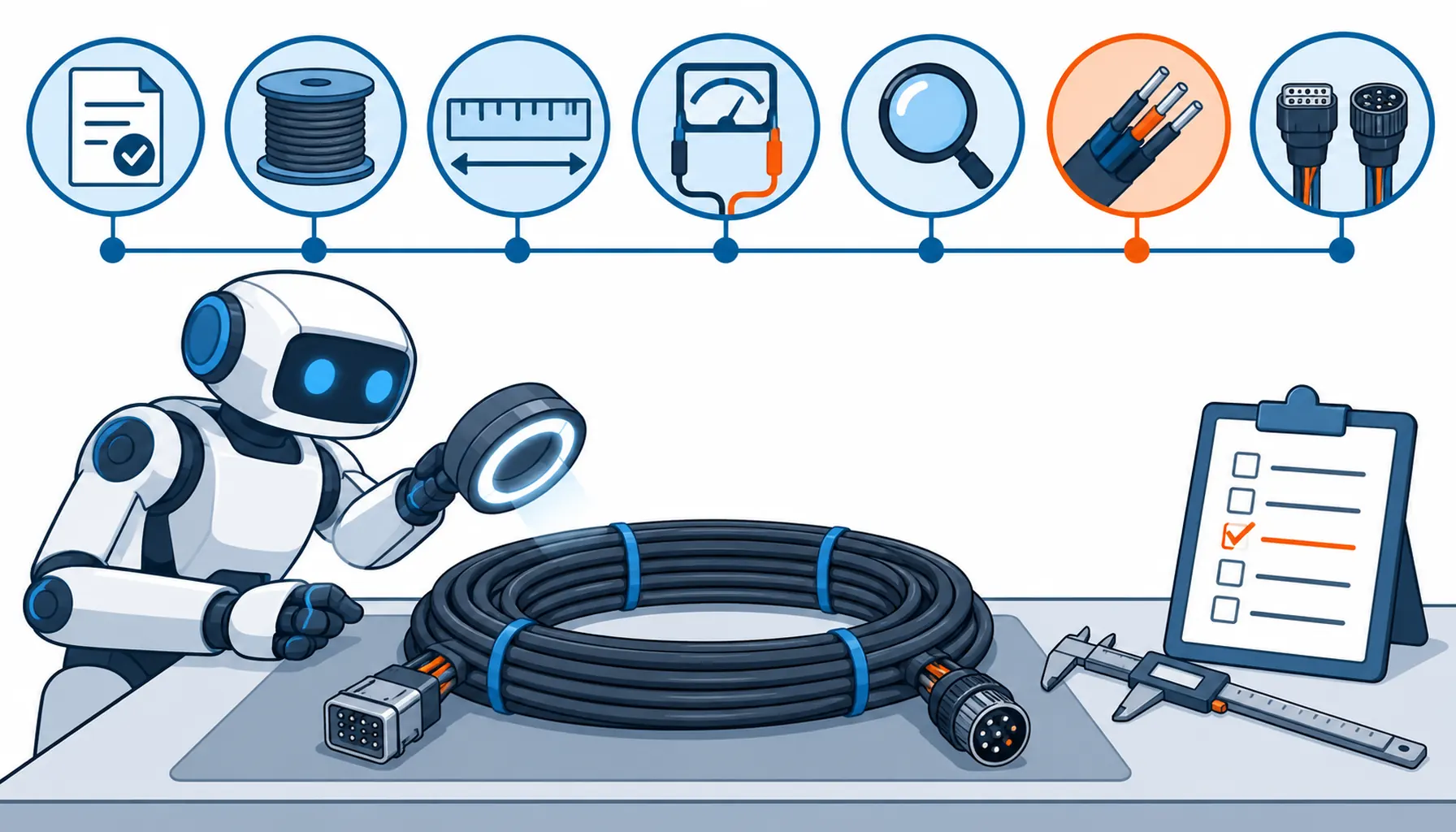
Quick Answer: Most cable quality problems are findable at the receiving dock in twenty minutes, and unfindable a week later under production pressure. This guide gives the inspection checklist for every robot cable and harness delivery, documents, dimensions, construction, marking, packaging and sample tests, with pass criteria, reject actions and the retention rules that keep claims alive.
Introduction
Acceptance testing for dynamic cable, the full protocol run before a new design enters service, is the subject of our note on motion cable acceptance testing. This guide covers the routine end of the same discipline: what to check on every delivery, of every lot, forever, in the twenty minutes that separate a caught defect from a commissioning surprise. The checklist is deliberately short, because the inspection that runs forever is worth more than the thorough one that runs twice.
The economics favour the dock. A defect caught at receiving is a rejected carton, a photographed record and a replacement on the supplier’s account. The same defect caught at installation is a delayed cell, and caught in service it is the full downtime stack from our note on robot downtime cost. Nothing in the checklist requires a laboratory; it requires a table, a caliper, a camera, the delivery drawings and the discipline to run it before the forklift moves on.
Documents First, Before the Packaging Is Opened
The paper rejects more lots than the caliper does. Check the delivery note against the order, part numbers, quantities and revision level, because a harness built to a superseded drawing revision is a defect no measurement will reveal. Verify the certificates: material and construction conformity, flame and safety marks where the specification calls them, with currency dates rather than mere presence, per the certificate landscape in our note on robot cable certification. And check the batch identification on both paperwork and cable, because the traceability that a field investigation needs later starts with the tag someone reads or photographs today.
Photograph the paperwork before it disperses into the filing system. A delivery record that exists as three images in a shared folder has survived every reorganisation; one that exists as a sheet in a cabinet has survived until the claim, which is when it is needed.
The Physical Check: What Twenty Minutes Catches
With the packaging open, the sequence runs from general to specific. Packaging condition first: crushed reels and pinched coils predict damage that shows up later, and photographing them before unpacking protects both sides. Jacket surface next, inspected over its full length for cuts, abrasion, blisters and colour variation, at a table under decent light rather than balanced on a pallet. Diameter and ovality at three points with a caliper, against the datasheet tolerance, catches compound or tooling drift that the eye forgives. Marking then: the printed legend should carry the manufacturer, specification and batch, at the intervals the standard requires, and legibly.
For harnesses, the check extends to the terminations: connector seating, keying, crimp visual consistency, strain-relief geometry and the service loop coiled at its designed radius. The termination failure modes that make this worth checking every time are catalogued in our note on why robot connectors fail, and the crimp geometry the eye is checking for is set out in our note on terminating robot harnesses.
The Decision Table: The Delivery Checklist, Item by Item
| Check | Method | Pass criterion | Action on failure | Time |
|---|---|---|---|---|
| Order match | Delivery note versus order and revision | Part, quantity, revision all current | Quarantine, notify supplier same day | 2 min |
| Certificates | Read for scope and currency | All specified marks, in date | Hold lot until documents arrive | 3 min |
| Batch identity | Cable legend versus paperwork | Batch traceable on both | Photograph and query before stocking | 2 min |
| Packaging | Visual before unpacking | Undamaged reels, sealed coils | Photograph damage, inspect contents first | 2 min |
| Jacket surface | Full-length visual at a table | No cuts, blisters, abrasion, discolouration | Segment reject, sample retention | 5 min |
| Dimensions | Caliper at three points | Within datasheet tolerance | Quarantine, dimensional query to supplier | 3 min |
| Terminations | Visual on harnesses: seat, crimp, relief | Consistent with the drawing pack | Unit reject with photographs | 5 min |
Sample Tests: When the Routine Check Goes Deeper
The whole table is twenty-odd minutes per delivery, and it runs before anything is put away, every time, without exception. The action column matters as much as the check column: every failure has a next step, written in advance, so the dock’s decision is a procedure rather than a negotiation with a waiting forklift.
Retention and Records: What to Keep, and Why
The visual and dimensional check catches most defects, but two triggers justify a deeper sample. The first is a new supplier or a changed construction, where the first lot earns the full sample battery, conductor count and stranding against the datasheet, a strip check of insulation and jacket, and continuity through every conductor, as our note on robot cable sample testing details. The second trigger is statistical: a one-in-ten lot sample of continuity and dimensions, rotated across lots, keeps the supplier’s process honest without a laboratory in the warehouse, and it is the sampling rhythm our note on the cable sample approval process recommends for ongoing lots.
Insulation resistance belongs at the dock only for harnesses and only at the in-service test voltage the supplier states, not at commissioning levels on every coil. The distinction between commissioning tests and dock-appropriate tests is drawn in our note on insulation resistance testing, and applying commissioning voltages to every delivered coil is a way of damaging good cable at the one place it should be safe.
Judge what the sample tests are for, and they earn their slot. They are not there to re-prove the design; qualification did that once. They are there to catch process drift between what was qualified and what is shipping, and drift announces itself in the cheapest measurable places first: dimensions, strand counts, marking quality, crimp consistency. A sample battery aimed at those four reads a supplier’s process honestly in minutes, which is more than an hour of electrical testing on one coil will ever say.
Before the First Delivery: What to Freeze
The inspection produces two artefacts worth keeping. The first is the record: photographs of paperwork, marking and any anomaly, filed against the batch, forming the evidence base that a warranty claim runs on months later, per the claim terms in our note on the robot cable warranty. The second is the physical sample: a short length from any lot that failed a check, and a sample from every new supplier’s first lot, retained in dry storage. The wear-pattern reading that diagnoses a field failure starts with something to compare against, as our note on cable wear patterns shows, and the comparison is only possible if the reference length exists.
Feed the results back, both directions. Cumulative inspection results, good and bad, go to the supplier on a schedule, because a supplier who hears about every clean lot as well as every defect prices and prioritises the customer who measures. And the results go to the specification owner, because three lots drifting toward the tolerance edge is a construction conversation, not three coincidences, and the drift is exactly what the RFQ’s change-control clause is for.
The record also earns its keep inside the plant. When two cells run the same harness and only one fails, the inspection histories of the two deliveries are the first documents anyone opens, and the answer is often visible in minutes: one lot dressed differently, one terminated by a different hand, one shipped through a colder month. Plants that keep per-batch inspection records solve those comparisons in an afternoon; plants without them run parallel theories for a quarter.
When More Inspection Is Not the Answer
| Item | What to state | Evidence to attach | Cost of leaving it open |
|---|---|---|---|
| Checklist owner | Who runs the check, on every delivery | A named role | Inspections that happen when convenient |
| Checklist sheet | The seven checks, with criteria | A printed or digital form | Checks by memory and mood |
| Datasheet access | Tolerances on file at the dock | A drawing pack per part | Dimensions judged by eye |
| Reject action | Quarantine, photograph, notify, dates | A written procedure | Defects negotiated into the warehouse |
| Sample plan | Which lots get the deeper battery | A sampling rule | Sampling by suspicion |
| Test limits | Dock-appropriate voltages per circuit | Supplier limits on file | Good cable damaged at receiving |
| Retention rules | What samples and records are kept, how long | A retention note | Claims without evidence |
| Feedback route | Who receives results, supplier and internal | A distribution list | Drift discovered at the failure |
| Escalation path | When a defect stops the lot, not the unit | A written threshold | One bad unit released as an exception |
| Annual review | Checklist updated against failure history | A calendar owner | A checklist frozen in year one |
RFQ Checklist
When the same defect keeps passing the dock. A defect class that inspection catches repeatedly is a specification or supplier problem wearing an inspection costume. Three catches of the same defect in a year should end in a corrective action request and a specification review, not a fourth check added to the sheet, as the wear-pattern logic implies.
When inspection replaces qualification. No dock checklist can tell a good construction from a merely plausible one; that is the sample stage’s job, done once properly, as the acceptance protocol sets out. Loads of dock checks on an unqualified design inspect a guess.
When the checks cost more than the risk. A low-volume, low-criticality cord does not need the full seven checks. Match the checklist to the part’s downtime cost, and spend the saved minutes on the harnesses that run the critical cells, along the triage in our note on robot cabling serviceability.
When the dock is inspecting what the process should prevent. If incoming findings are the only quality signal a supplier relationship produces, the relationship has no quality system, only a gate. The findings belong in a supplier conversation with the sample and consistency data, as our note on production consistency describes, not in a bigger reject pile.
Conclusion
- Batch identification and marking required on every delivery, in legible form
- Certificates with scope and currency required per lot, not per contract
- Datasheet tolerances supplied in the delivery pack for dock use
- Dock-appropriate test limits stated per circuit type, in writing
- First-lot sample battery agreed for new suppliers and changed constructions
- Corrective action expectations and response times written into the contract
- Termination drawing packs supplied with every harness delivery
- Packaging standards stated: reels, coil radius, protection
- Delivery records and anomaly photographs retained per the claim terms
- A periodic results review scheduled with the supplier, both directions