Acceptance Testing for Motion Cable Deliveries: A Practical Protocol
Quick Answer: Acceptance testing confirms that the drum you received matches the order, the certificate and the standard. It reliably catches mix-ups, print errors, dimensional drift and shipping damage. It cannot measure flex life.
Most cable failures that reach the plant floor were never manufacturing defects. They were delivery errors. The wrong cross-section went onto the reel, the jacket print names a different temperature rating than the datasheet, the replacement order arrived with a standard PVC sheath instead of the oil-resistant compound, or the drum sat in the loading yard through a wet week and the outer layers took on moisture. None of these faults need a laboratory to detect. All of them need somebody to look, and looking has to be organised or it does not happen.
Introduction
Acceptance testing sits between two other activities and gets squeezed by both. Upstream is the factory acceptance process, where a third party may attend the supplier’s plant before shipment. Downstream is installation, where the cable goes into a carrier, a dress pack or a harness and stops being easy to inspect. Arrival is the only moment when the product is stationary, accessible, documented and still somebody else’s responsibility.
The protocol below is written for motion cable specifically, which changes the emphasis. A static power cable arriving on a drum is usually verified by document and insulation resistance, and that is sufficient. A drag chain or robot cable has more ways to be subtly wrong, because its value lives in construction details a casual look will not reveal: stranding class, shield coverage, sheath compound, the style number in the print legend. Those details are exactly what the arrival check should target.
What Arrival Checks Can and Cannot Establish
Be honest about the boundary. Incoming inspection is very good at confirming identity, integrity and consistency. It answers whether this drum is the product that was ordered, whether it survived transport, and whether its dimensions and electrical properties fall inside the specified window. It is poor at predicting endurance. Bending a sample by hand tells you almost nothing about fatigue life, and a passing insulation resistance reading is entirely compatible with a construction that will delaminate in a carrier after a few hundred thousand cycles. Flex life belongs to the test rig, and treating arrival checks as a proxy for durability is how plants end up surprised nine months after a successful inspection.
Where the checks earn their keep is in closing the gap between specification and shipment. That gap is wider than it looks, because the specification passes through the buyer’s engineer, the buyer’s purchasing team, the supplier’s sales engineer, the supplier’s planner and the shipping desk. Every hand-off is a chance for a compound to change, a core count to slip, or a style to be substituted with a similar-looking one. Arrival inspection is the cheapest place in the chain to catch that, since reworking an installed cable costs orders of magnitude more than rejecting a drum.
Documents First, Before the Drum Is Opened
Start with paper, because paper is fast and it eliminates whole classes of problem before anyone cuts a wrap. A motion cable delivery should arrive with a packing list, a certificate of conformity or quality certificate, the test report for the batch or lot, and the material compliance declarations your market requires. Compare the construction before the quantity: take the purchase order line and read it against the delivery documents field by field, covering type designation, conductor class, core count and cross-section, shield type, sheath compound, voltage rating, temperature rating, standard of manufacture, and per-reel lengths. A surprising number of disputes trace back to a line where the buyer wrote one type designation and the supplier shipped a close relative, differing by a suffix that decides whether the sheath meets the application. Then read the test report the way you would read any technical claim, checking that it states what was tested, on what, and under what conditions, in the same way the guide to reading technical documentation sets out.
| Check | Method | Acceptance basis | Record produced |
|---|---|---|---|
| Construction identity | Read delivery documents against the order line by line | Type, core count, cross-section, shield, sheath, voltage and temperature all match | Signed-off receiving comparison sheet |
| Certificate and test report | Check number, batch reference, issuing body and stated test conditions | Document names the delivered batch and states conditions for every figure quoted | Copy filed against the batch number |
| Length | Read the counter or measure during transfer for short lengths | Per-reel and total within the tolerance agreed for the order | Reel-by-reel length log |
| Jacket print legend | Read a two-metre section at three positions along the reel | Type or style, size, voltage, temperature, standard and manufacturer all present and legible | Photograph with the reel number |
| Drum and shipping condition | Visual, with the outer wrap removed for the inspection | No crush, moisture ingress, UV damage, flange damage or exposed conductor ends | Condition note, with photographs of any damage |
| Conductor resistance | Four-wire measurement per core, corrected to reference temperature | Within the standard's maximum for the size and class | Per-core resistance sheet |
| Insulation resistance | Measured at the agreed DC test voltage for a stated duration | Above the minimum agreed in the specification, recorded per core | Insulation resistance sheet |
| Continuity and identification | End-to-end check of every core, shield and drain wire | No open or crossed core, shield continuous to each end | Continuity matrix against the wiring schedule |
The Print Legend Is the Cheapest Evidence You Own
If a receiving team had time for only one physical check, the print legend would be the right choice. The legend on the jacket is the supplier’s own declaration of what the cable is, applied at the moment of extrusion, and it is the only marking that travels with every metre rather than with the paperwork. Read it at three positions along the reel, not one, because print quality varies and a short section can hide a spacing change or a fade. Confirm that it carries the type or style designation, the cross-section and core count, the voltage rating, the temperature rating, the standard or approval reference, and the manufacturer’s name or mark. A motion cable sold against a specific flex classification should name that classification or the style number that identifies it, because the designation is what ties the drum to the certificate.
Then compare the legend to the documents, and treat a mismatch as a stop rather than a note. If the jacket says a different temperature rating than the datasheet, one of the two is wrong and the installation decision depends on which. If the legend carries a style number the certificate does not cover, the qualification you are relying on may not apply to this product. Print errors are not cosmetic when the print is the identification system.
Electrical Checks That Repay the Time
Conductor resistance is the single most informative cheap measurement on a cable drum, and the reason is simply that copper costs money. A conductor that is undersized, made from an inferior grade of copper, or deliberately short-counted in strands will show its hand immediately, because resistance is inversely proportional to the amount of conducting metal present. Measure every core with a four-wire method at a known temperature, then correct to the reference temperature the standard uses before comparing against the maximum. Insulation resistance follows, at the DC voltage and duration your specification names and recorded per core. Two cautions apply: a very long reel and a very short sample do not give comparable readings, so state the length, and insulation resistance is sensitive to moisture and temperature, so a reading taken on a cold drum in an unheated warehouse is worth less than one taken after the drum has equalised to indoor conditions.
Continuity and identification close the electrical set. Every core, shield and drain wire gets checked end to end against the wiring schedule, and the result goes into a matrix rather than a pass stamp. For servo and encoder constructions, pair identification matters as much as continuity, because a swapped pair produces a machine that runs badly in ways nobody attributes to the cable. Shield continuity deserves its own line, since a shield that is electrically continuous but badly terminated at one end will still pass a continuity test while doing nothing for interference. The mechanics behind that failure mode, and the wider catalogue of mechanisms that shorten cable life, are covered in the guide to common cable failure causes.
What to Send to a Laboratory, and How Often to Inspect
Three sample tests are worth budgeting for on a motion cable programme. A dimensional and material check on a short sample covers insulation and sheath thickness by microsection, concentricity, and tensile and elongation of the compounds, and it is the check that catches compound substitution, where a sheath looks right and measures right on the outside but is not the oil-resistant or low-temperature compound the application needs. A short flex run at or near the application radius, using a sample from the delivered batch rather than the qualification sample, is a consistency check rather than a life test and should never be presented as one. A first article inspection report on the first shipment of a new design or supplier, carrying actual measured values rather than pass-fail stamps, gives you the baseline against which later shipments are compared. Without it, every subsequent inspection lacks a reference point.
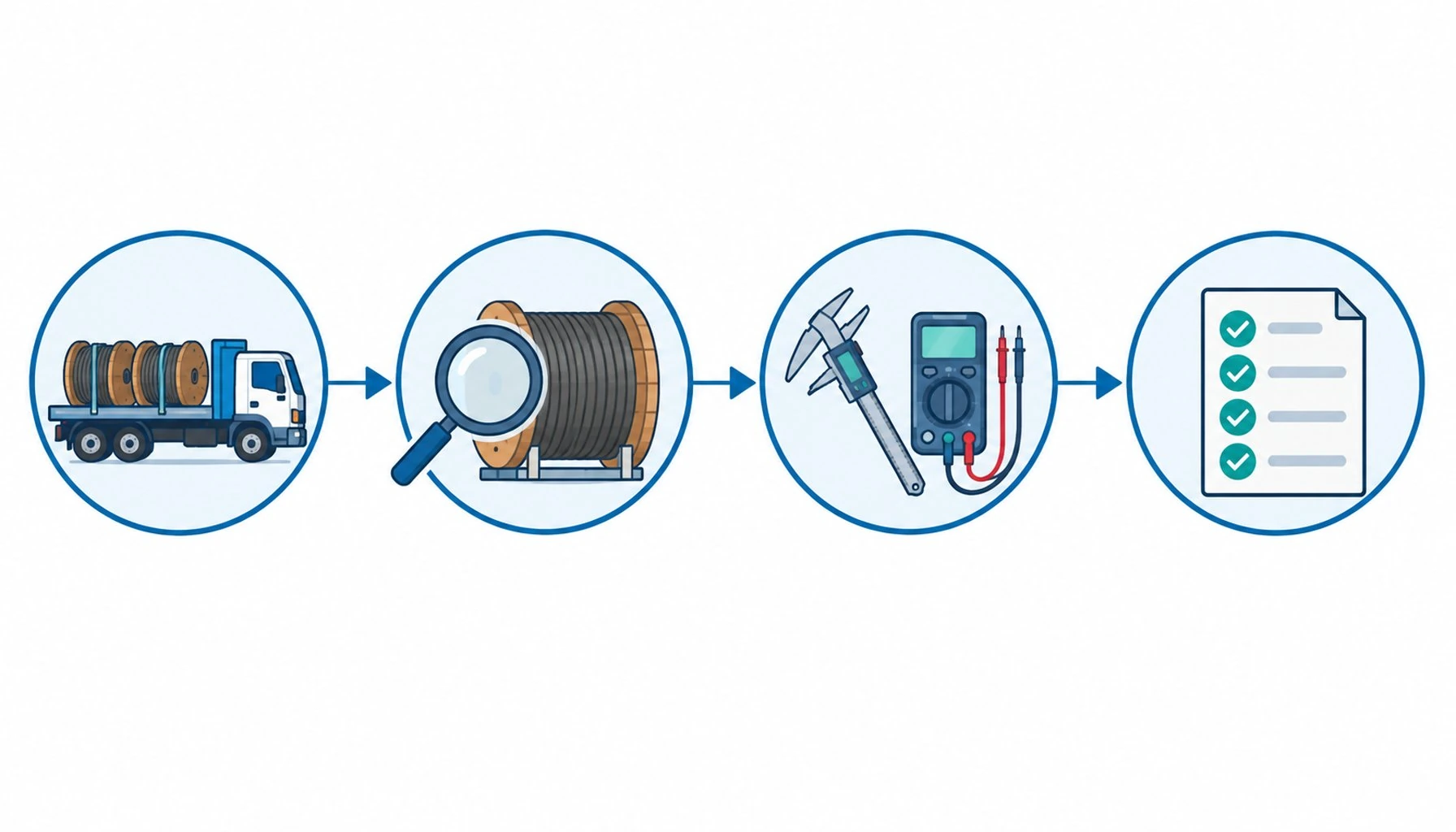
Full inspection of every drum is neither affordable nor necessary, so the workable structure is tiered, with depth driven by how much confidence the supplier has earned. Tier one applies to every shipment and covers documents, print legend, drum condition, length, continuity and insulation resistance, which catches most real defects for a modest amount of labour. Tier two adds conductor resistance on every core, full dimensional measurement and a laboratory sample for material checks, and applies to a new supplier, a new construction, a critical axis or any supplier with a recent quality event. Tier three is the one-time qualification cost per design: sample flex run, environmental tests and a first article report. The direction of travel matters. Start strict and relax on evidence; never start relaxed and tighten after a failure, because the tightening always arrives after the downtime. Establishing whether a supplier can sustain that standard is the subject of the guide to vetting equipment manufacturers.
| Finding | Immediate action | Follow-up |
|---|---|---|
| Construction does not match the order | Quarantine the reel, do not cut or install | Raise a non-conformance and confirm replacement lead time in writing |
| Print legend missing a field or naming a different rating | Hold the reel pending supplier explanation | Establish which document is correct, then correct the order specification for future shipments |
| Conductor resistance above the standard maximum | Reject the affected reel and test the remainder of the batch | Request mill certificates for the batch and a re-test at an agreed laboratory |
| Insulation resistance below specification | Condition the sample and re-measure before rejecting | If it repeats, investigate moisture exposure in transit, drum sealing and storage |
| Shield continuity intermittent | Locate the fault by progressive test along the reel | Review termination and drain wire construction with the supplier, since this is a build issue |
| Shipping damage to the drum or outer layers | Cut back to undamaged cable and re-measure | Raise a claim with the carrier and specify packaging changes for the next order |
When Acceptance Testing Is Not the Answer
Three limits deserve stating plainly. First, incoming inspection cannot compensate for a specification that was never precise enough to test against; if the order line says a flexible control cable without naming the standard, the stranding class, the sheath compound and the temperature range, no receiving team can decide whether the delivered drum is correct. Second, arrival checks are blind to installation practice, which is where a large share of motion cable failures originate, because a fully compliant and correctly tested drum can be destroyed by clamping it at the wrong point or running it through a tight radius transition. Third, acceptance testing does not replace maintenance evidence, since it describes one moment in the cable’s life. Connectors, strain reliefs and glands age on their own schedules and fail their own ways, which is why an arrival check for a complete assembly extends to the accessories that travel with it, as the guide to cable accessories sets out, and why the logic for separating shipment verification from installation testing is explained in the comparison of factory and site acceptance testing. The wider discipline of holding an assembly to its written evidence is set out in the guide to factory acceptance testing.
RFQ Checklist: What to Agree Before the First Delivery
Negotiate these points before the order, because they are all harder to settle once a drum is on the dock:
- Full construction description in the order line, not a type nickname: stranding class, core count, cross-section, shield, sheath compound, voltage and temperature
- Documents accompanying each shipment, and what each one must state
- Required content of the jacket print legend, field by field
- Acceptance criteria for conductor resistance and insulation resistance, with test voltage, duration and temperature reference
- Length tolerance per reel and the measurement method that settles a dispute
- Whether a first article inspection report accompanies the first shipment, and in what format
- Sample plan for laboratory material and environmental checks, and who pays for the samples
- Packaging and sealing requirements for the drum, including moisture protection for long sea transit
- The non-conformance route: who is contacted, what evidence is required, and the replacement timeline
Conclusion
Acceptance testing for motion cable is not a search for manufacturing genius. It is a check that the drum in front of you is the product described by the order, the certificate and the standard, and that it survived the journey. Documents first, print legend second, electrical checks third, and a laboratory sample on a sensible schedule. Run that sequence and the great majority of costly surprises get caught while the cable is still on the reel, where rejecting it is cheap and unremarkable.
Kexingyu Cable Group (KXYE) supplies motion cable with the documentation an incoming inspection needs: batch-linked test reports, print legends that identify the construction, and material declarations for the compounds we use. Send your acceptance criteria and the checks you intend to run through the RFQ page, and we will confirm which documents we provide, what the test reports will state, and how the drums will be packed and sealed for the transit route.