Robot Cabling Serviceability: What to Specify for Access, Swap and Downtime
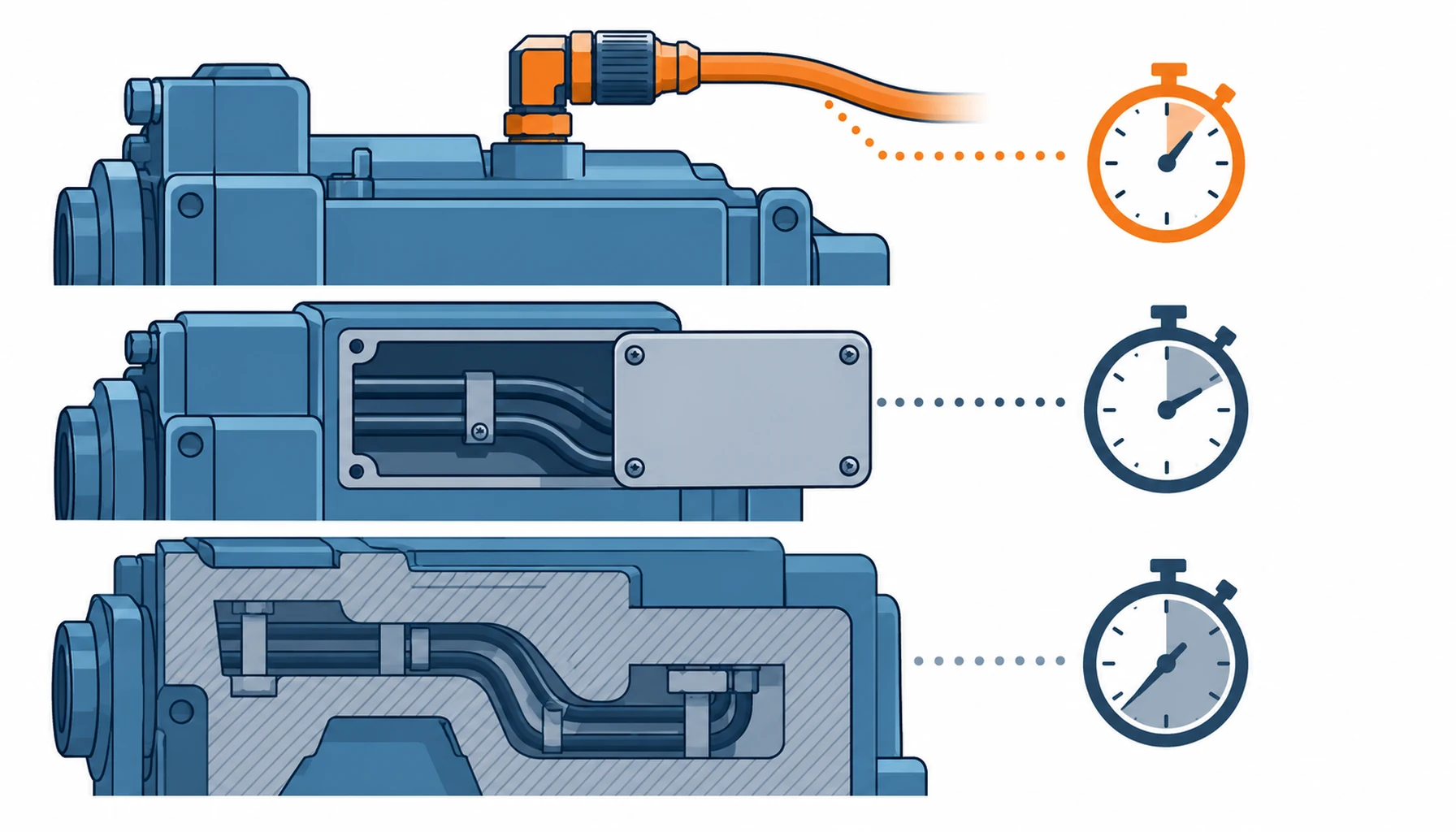
Quick Answer: Serviceability is not about whether a cable can be replaced. It is about how long the machine is stopped while it happens. A harness that needs three connectors undone and a joint opened is a different purchase from one that unplugs in two places, even if the cable inside is identical. What you specify is the disassembly path, the split points, what counts as a replaceable unit, and the tools and spares that go with it.
Introduction
Harness cost sits in the bill of materials, and service cost does not. That is why the two get weighed differently at design review, even though on a production machine the second number is usually the larger one. A cable that fails once a year and takes a shift to change costs more than a cable that fails twice a year and takes twenty minutes.
Serviceability is decided by layout, and layout is decided before the order. The routing choices that feed into it are covered in our notes on internal wiring versus a dress pack and on multi-axis cable bundle management. This guide is about what a buyer of the harness can ask for so that the service visit is bounded rather than open-ended.
What Serviceability Costs Over a Machine's Life
The direct cost is labour, and it is easy to underestimate because it is counted in a way that hides the bad cases. A planned swap of an accessible pack takes one person and a short window. The same failure inside a casting can take two people, a partial teardown and a realignment check on the way back together.
The indirect cost is the line. A machine stopped for a shift does not just lose the maintenance hours, it loses everything the machine would have produced, and on a line that feeds other stations it stops them too. That number is usually an order of magnitude larger than the labour, which is why serviceability is worth specifying. The structure of that cost, including how to put a number on an hour of stopped production, is set out in our note on the real cost of robot downtime.
The third cost rarely appears in a plan. A rushed swap in a tight space is where cables get pinched and connectors get forced, and the repair becomes a new fault a month later. A harness designed to be swapped in a defined way is also less likely to be damaged during its own replacement.
The Three Levels of Access
Every cable run sits at one of three levels, and the level is a design decision rather than a consequence. At the first level, the run can be disconnected and replaced from outside the machine, using connectors that are reachable with the arm in a defined position. This is the level to aim for wherever a function is expected to be serviced.
At the second level, the run is inside the structure, but one joint or one cover gives access, and the swap is a defined procedure with a known set of steps. This is a reasonable answer for a run that should last the life of the machine but might need attention once. The constraints that come with routing inside a link are covered in our note on cable routing through robot joints.
At the third level, the run is buried and the machine has to be partly dismantled to reach it. That is a legitimate answer for a run that will never be touched, and it is the wrong answer for anything else. The mistake is rarely choosing the third level deliberately. It is not noticing that the design landed there, which is why the level belongs in the harness documentation rather than in someone’s head.
The Decision Table: Serviceability Options and What Each One Costs
| Option | What to Specify | Evidence to Demand | Cost and Lead Time | Where It Fails |
|---|---|---|---|---|
| Externally replaceable section | Connector type, reachable position, and the arm pose for access | A timed trial swap on the first unit | Extra connectors and a longer harness, best service time | A connector that is only reachable with the tool fitted |
| Single split point per run | Where the run separates and what stays on the machine | A drawing of the split with its access envelope | Small cost, moderate service time | A split placed where the cable has to be pulled through a bore |
| Local cover access | Which cover comes off, with the fasteners and the sequence | A written procedure with a time estimate | Low cost, needs design space for the cover | A cover that shares fasteners with the structure |
| Jointed access | The joint to open, the realignment check, and the tools needed | A trial teardown and rebuild on the first unit | Higher labour, longer planned window | A realignment step that needs equipment the site does not have |
| Buried, life-of-machine | That it is buried, and the expected life behind that decision | A note on the drawing with the assumption stated | Lowest build cost | A failure that arrives before the assumed life |
Proving the Swap Before the Machine Ships
The cheapest way to find out that a harness takes a shift to change is to try it once, on the first unit, with a stopwatch. A trial swap is not a full commissioning test and it does not need to be. Take one harness, disconnect it, remove it, fit the spare and reconnect it, with the machine in the state a service technician would find it, then write down what it took.
What the trial usually reveals is on the drawing. A connector that can only be reached after removing the tool, a clamp that needs a socket the technician does not carry, a run that has to be pulled out in a direction the surrounding parts block. Each of those is a small fix at the design stage and a permanent tax once the machine is installed. Where the harness has to come out through a bore route, the direction it can be withdrawn in is the first thing to check, and the constraints are set out in our note on hollow shaft cable routing.
The other thing the trial produces is a number for the maintenance plan. A swap with a measured time can be scheduled into a window, and a swap with no measured time is planned as “some hours”, which on a production line is the same as unplanned. Length and access interact here as well, because a harness with a generous tolerance may be easier to fit but a harness with a measured loop is quicker to align, and the trade-off is covered in our note on cable length tolerance and service loops.
Two more items make the procedure repeatable. A labelling scheme that identifies every connector at both ends, so the person doing the swap is not tracing cables by hand. And a spare part that is actually a spare, meaning a complete harness held on the shelf rather than a drum of cable and a plan to make one. Where the run includes a wear item that is replaced on an interval rather than on failure, the interval and the part belong in the same list, and the same logic applies to the wear parts of a rotating joint, which our note on slip rings and rotary unions covers from the other side.
What to Freeze Before the Order
| Item | What to State | Evidence to Attach | Cost of Leaving It Open |
|---|---|---|---|
| Access level | Which of the three levels each run sits at | A harness schedule with the level marked per run | A buried run that was expected to be accessible |
| Split points | Where each run separates and what stays on the machine | A drawing with the access envelope at each split | A swap that opens more of the machine than planned |
| Arm pose for service | The position the machine is put in to reach the connectors | A procedure that names the pose | Access found only in a position nobody recorded |
| Fasteners and tools | The tools the swap needs, and that standard tools will do | A tool list in the procedure | A special tool that is not on site when it is needed |
| Trial swap | That one timed trial is done on the first unit | A record with the time and the steps | A service time discovered on a live line |
| Labelling | Identification at both ends and at every split | A labelled sample on the first article | A swap that begins with tracing cables by hand |
| Spare harness | Whether a complete spare is delivered with the machine | A packing list entry and a part number | A line waiting for a harness to be made |
| Wear items | Parts replaced on an interval, with the interval stated | A parts list with intervals | An interval item treated as permanent |
When Maximum Serviceability Is Not the Answer
Where the run will never be touched. A cable buried in a casting that is expected to last the life of the machine does not need a split point, and adding connectors to it adds joints that can fail. Where the assumption is stated and the life is realistic, buried is the cheaper and more reliable answer.
Where every connector added is a new failure point. Serviceability is bought with connectors, and connectors are the parts that fail most often on a moving machine. A design that splits every run three times for the sake of access has traded a rare cable failure for a routine connector problem. The split points should follow the parts that will really be serviced, not the parts that might be.
Where the swap has to preserve calibration. On a machine where opening a joint means realigning an axis, an accessible harness can still cost a full recalibration. Where the accuracy budget is tight, the better answer may be a route that avoids entering the calibrated assembly at all, even if the cable route is longer.
Where the procedure exists only in someone’s memory. A swap that only one technician knows how to do is not serviceable, it is dependent. Without a written procedure, a tool list and a labelled harness, the machine’s service time depends on who is on shift, which is the same as having no plan. Where the fault that triggers the swap is intermittent and hard to find in the first place, the tracing sequence is set out in our note on robot cable field diagnostics.
RFQ Checklist
- Access level stated for every harness, with the runs that are treated as buried named explicitly
- Split points shown on a drawing, each with the access it needs
- Arm pose for service given as part of the procedure, not left to be found
- Tool list included, with a note that standard tools are sufficient
- One timed trial swap required on the first unit, with the record handed over
- Labelling scheme defined at both ends and at every split point
- Connector types chosen for the access they allow, not only for their rating
- Complete spare harness quoted as a line item for each serviceable run
- Wear items listed with intervals, including any replaced on a schedule
- Strain relief specified at every connector that will be handled during a swap
Conclusion
Serviceability is a design outcome, not a maintenance attitude, and it is worth buying deliberately. Put each run at a stated access level, place the split points where they can be reached, do one timed trial swap on the first unit, and hand over a labelled harness with a procedure and a spare. None of that changes the cable, and together they turn a fault that stops the line for a shift into a job that fits inside a planned window.
Kexingyu Cable Group (KXYE) supplies the harness cable behind that plan: continuous flex and screened constructions, including the robot composite cable, cut and prepared to a stated length with the labelling and spares you need for a repeatable swap. Send us the access level, the split points and the swap procedure you have in mind, and we will return constructions and harness details that fit it; the fastest route is a request for quotation.