Internal Wiring or External Dress Pack: Choosing Where Robot Cables Belong
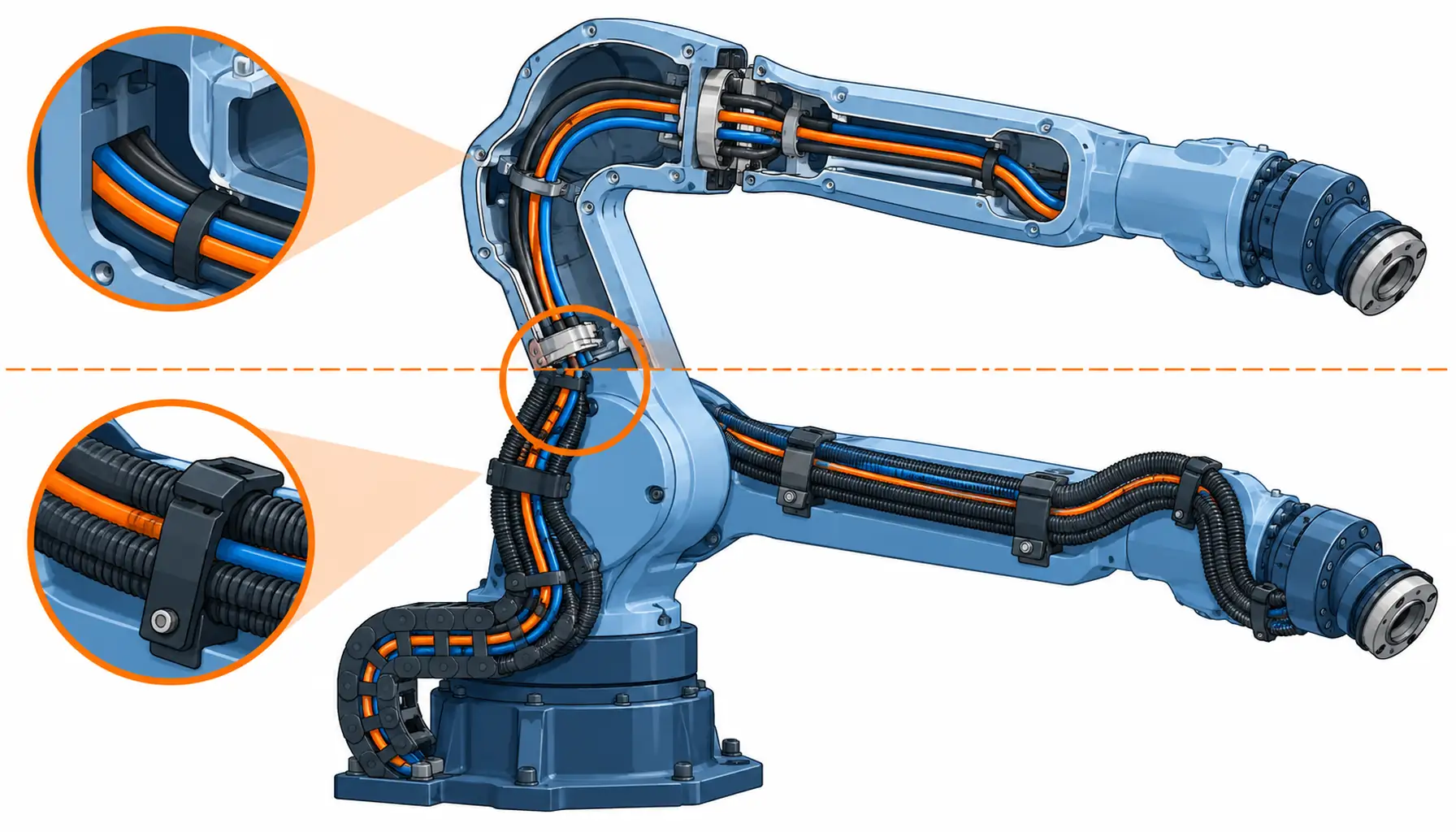
Quick Answer: Cables can live inside the arm or ride outside it in a dress pack, and the choice is not a preference. Inside, they are protected but hard to reach, and the casting fixes their path. Outside, they are easy to inspect, swap and extend, and they are exposed to everything the cell can throw at them. Most machines need both, and the real work is deciding where the line between them runs.
Introduction
This decision is usually made early, by whoever draws the arm, and then lived with for the life of the machine. It shows up later as a service visit that needs half the arm dismantled to reach one connector, or as a dress pack that has been replaced three times because it runs through a chip shower. Neither outcome is a cable problem, and both were decided at layout time.
The mechanics of an external route and the mechanics of an internal one are each covered on their own in our notes on dress pack cable and on hollow shaft cable routing. This guide compares them, because on a real arm the question is not which is better but where the boundary sits.
What Each Approach Actually Buys You
An internal route uses the structure as the cable’s protection. Impact, swarf, coolant and washdown all stop at the casting, the machine looks clean, and nothing has to be carried alongside the arm. The cost is fixed geometry: the path is decided by the casting, the assembly order is decided by the casting, and a cable that has to be replaced may need the joint opened to reach it.
An external route trades that protection for access. A dress pack can be inspected along its whole length, a damaged run can be swapped in a shift, and a cable for a new sensor can be added later without touching the kinematics. In exchange, the pack sees the cell environment directly, adds mass to the moving parts, and needs guides or a carrier to keep it out of trouble.
A third option is often the right one and rarely gets named: a hybrid, where power and critical signal run inside while serviceable or expandable functions ride outside. Splitting the run this way keeps the protected core where it benefits most and leaves the part that is most likely to change where it can be reached. Where an external run has to follow a long, repetitive motion, the carrier that guides it becomes a design in its own right, and the comparison is set out in our note on continuous flex versus drag chain cable.
The Five Tests That Decide It
The first test is motion. A joint that sweeps or twists within a limited angle suits either approach, and the deciding factor becomes something else. A joint that rotates continuously cannot be served by cable at all, and neither an internal nor an external route changes that. The routing that survives each kind of motion is covered in our note on cable routing through robot joints.
The second is service frequency. A function that is expected to fail and be replaced, such as a tool-side run that takes hits, belongs where it can be reached. A run that should last the life of the machine can be buried, because nobody will be looking for it. The design side of that trade-off, including how access is planned rather than discovered, is the subject of our note on robot cabling serviceability.
The third is environment, the fourth is assembly order and the fifth is growth. Environment asks what the cell throws at a cable, and a route exposed to metal chips, weld spatter or high-pressure wash is a different proposition from one in a clean assembly cell. Assembly order asks whether the cable has to be installed before the parts that close the route, which is a delivery constraint rather than a design preference. Growth asks whether functions will be added after the machine ships, and a route that cannot accept another cable will be cut open in the field to fit one.
The Decision Table: Three Approaches and What Each One Costs
| Approach | What to Specify | Evidence to Demand | Cost and Lead Time | Where It Fails |
|---|---|---|---|---|
| Fully internal | Path through the castings, entry treatments, assembly order | A route drawing with clearances and bend radii at full travel | Low material cost, high assembly and service labour | A swap that needs the joint opened, or a path that was never drawn |
| Fully external dress pack | Pack layout, guides or carrier, fixing schedule, service splits | A layout drawing at full travel plus a wear point list | Higher material cost, quick to build and to service | Exposure to chips, spatter or wash that the jacket cannot take |
| Hybrid split | Which functions stay inside and which ride outside, and where they cross | A drawing showing both routes and the crossing point | Highest design effort, best fit to the cell | A crossing point that becomes the weak spot if left unresolved |
| External carrier or chain | Carrier size, bend radius, travel and cable fill | A cycle test with the real fill and the real travel | Carrier hardware plus longer build time | A carrier loaded past its fill limit, or a cable not rated for it |
| Retrofit external run | A spare route or tray left in the design, with fixings | A drawing showing the spare path as built | Low cost if designed in, high if added later | A retrofit that has to be clipped to a moving link |
Designing the Crossing Point
Whichever way the boundary runs, there is a place where the cable leaves the structure and becomes an external run, and that place deserves more attention than it usually gets. It is a transition from a fixed, protected path to a moving, exposed one, and it is where the run changes from being held to being free.
Three things belong there. A defined fixing point, so the cable is held firmly on the structure side and free on the moving side, with the movement starting after the fixing rather than at it. A service split, meaning a connector or a junction where the external section can be separated from the internal one without opening the arm, because the external section is the part that will be replaced. And a bend that the cable is rated for at full travel, which is easier to arrange at a transition than in the middle of a link if it is drawn early.
Where the external run is long or repetitive, the transition is also where a guide or carrier begins, and the cable that goes into it has to be rated for the motion the carrier imposes rather than for the motion of the arm. For runs that are wound and unwound rather than carried, the construction of the cable matters in the same way, and the options are set out under our reeling composite cable range.
What to Freeze Before the Order
| Item | What to State | Evidence to Attach | Cost of Leaving It Open |
|---|---|---|---|
| Boundary line | Which functions run inside the arm and which ride outside | A drawing with both routes and the boundary marked | A pack carrying cables that never needed to be exposed |
| Motion per section | The motion each section sees, as bend, twist or continuous rotation | A motion profile for the axis | A cable rated for the arm, not for the section it is in |
| Service splits | Where the run can be disconnected without opening the arm | A drawing with the split points and their access | A service visit that becomes a partial rebuild |
| Environment | Chips, coolant, spatter, washdown and UV along each route | An environmental note with the jacket requirement | A jacket chosen for the wrong exposure |
| Assembly order | When the harness has to arrive relative to the closing parts | A build sequence note | An internal run fitted after the casting is closed |
| Guides and carriers | Guide type, positions and the cable fill allowed | A layout plus a fill figure for any carrier | A carrier run past its fill limit, or a cable not rated for it |
| Spare capacity | A spare way or a spare route for functions added later | A drawing showing the spare path as built | A retrofit clipped to a moving link in the field |
| Replacement plan | Which section is treated as a replaceable item, and its interval | A parts list with the swap procedure | A wear section treated as permanent |
When One Approach Is Not the Answer
Where the cell is dirty and the pack is unprotected. A dress pack in a chip shower or under weld spatter will fail ahead of anything inside the arm, and the maintenance saving disappears the first time it is replaced. Where the environment is aggressive, the exposed section should be as short as the machine allows, and the rest should be inside.
Where the machine is expected to grow. A fully internal design is a closed system, and adding a function means opening the arm. If the product roadmap includes new sensors or a different tool, leaving one external route designed in at the start costs a bracket and saves a redesign.
Where the arm is small and the pack is heavy. On a lightweight cobot, a pack carried outside adds mass where it hurts most, at the end of the arm, and changes the dynamics the machine was tuned for. A small arm usually wins by keeping the run inside and the mass off the wrist.
Where the boundary was never drawn. The most expensive outcome is a route that is partly internal and partly external with nobody owning the crossing, so the transition is invented at assembly. If the boundary is on the drawing with its fixing point and service split, either answer works; without it, neither does. Where the fault that eventually appears is intermittent rather than obvious, the sequence for tracing it is set out in our note on robot cable field diagnostics.
RFQ Checklist
- Boundary line stated, with the functions running inside and outside listed separately
- Motion profile given for each section, noting any continuous rotation
- Service split points identified, with the access needed to reach each one
- Environment along each route described, with the jacket requirement that follows
- Assembly order written down, including when the harness must be delivered
- Guide or carrier type named, with the cable fill and bend radius it allows
- Spare way or spare route shown on the drawing for later additions
- Replaceable sections named, each with an interval and a spare part number
- Crossing point detailed, with the fixing that separates the fixed and moving parts
- Flex evidence requested for the section with the worst motion, not for the average
Conclusion
Internal wiring and a dress pack are not competing philosophies so much as two tools with different failure modes. The question to settle at layout time is where the boundary runs, and the answer follows from five things that are all knowable before the order: the motion of each section, how often it will be serviced, what the cell throws at it, when it has to be installed, and whether the machine will grow. Draw the line, detail the crossing, and either approach will hold up.
Kexingyu Cable Group (KXYE) supplies cable for both sides of that boundary: continuous flex and screened constructions for internal runs, and reeling composite and control constructions for external and carrier routes, all part of the special wire and cable range. Send us the boundary drawing, the motion of each section and the environment, and we will return constructions that suit the route they are actually in; the fastest route is a request for quotation.