Continuous Flex Cable vs Drag Chain Cable: Which One Does Your Machine Need
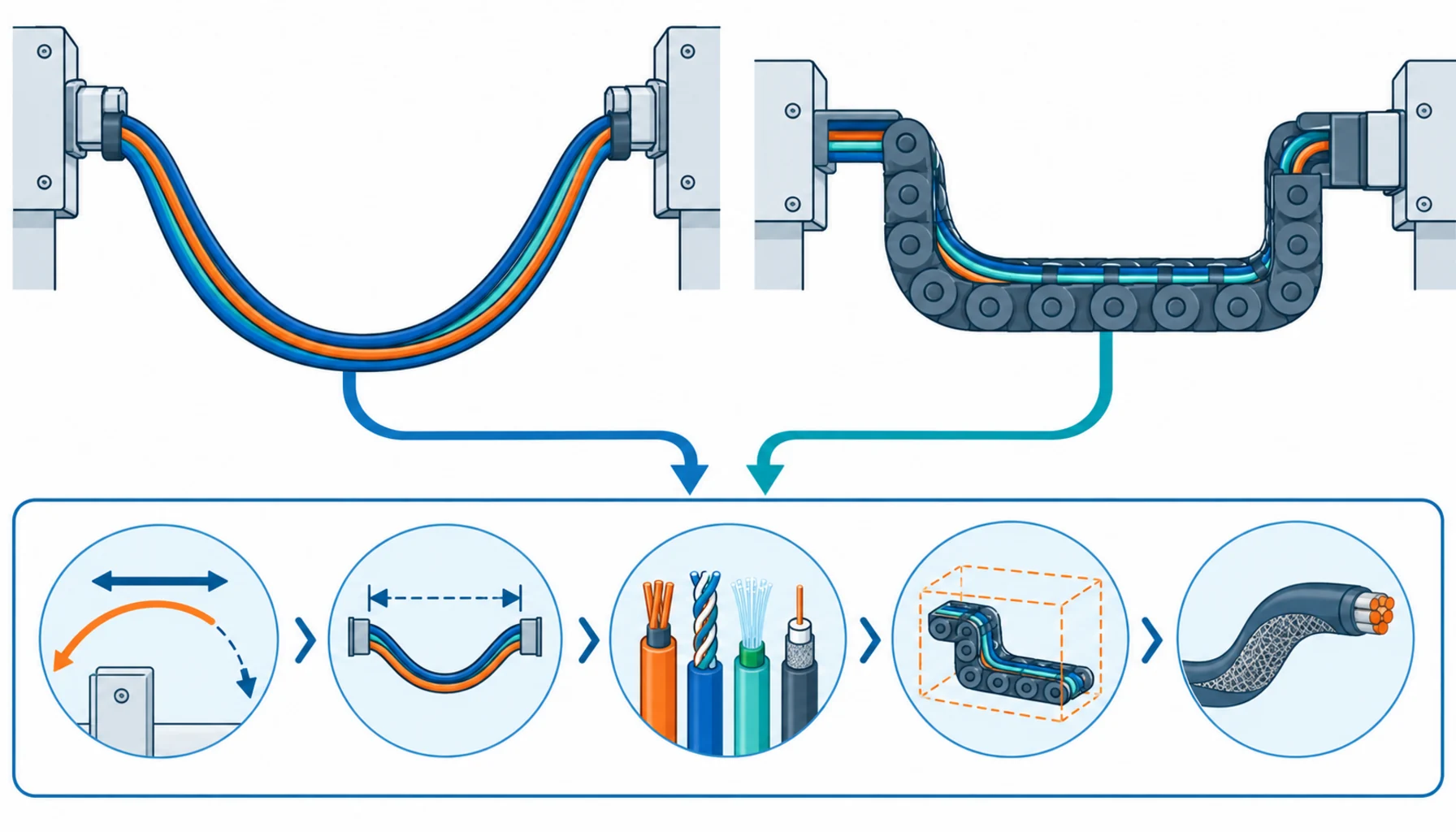
Quick Answer: Continuous flex cable loops freely and holds its own natural bend without a carrier; drag chain cable rides inside a guided chain. Travel length, speed and space decide which construction wins.
Two philosophies dominate moving cable design, and they get confused with each other constantly because both involve a cable that bends millions of times. One philosophy says: control the cable’s path with hardware — put it in an energy chain that dictates the radius, the fill and the geometry. The other says: engineer the cable so well it needs no hardware — let it hang in a free loop and hold its own bend through every cycle. Continuous flex constructions and drag chain constructions both deliver millions of cycles; they deliver them under completely different assumptions. Choosing wrong is not a disaster on day one, which is exactly why it keeps happening. This article separates the two philosophies, shows how the constructions differ internally, maps where each one wins, and gives a short decision path you can run against any axis.
Introduction
The confusion is understandable. Catalog pages overlap, both products are called “high-flex” by someone, and a cable buyer handed a new machine project has to make the call with incomplete information about travel and space. But the engineering distinction is clean. A drag chain cable assumes its path is controlled: the chain fixes the minimum radius, supports the cable’s weight on long runs, and enforces separation between members. The cable is a component inside a system. A continuous flex cable assumes nothing external will help: it must carry its own weight, hold its own bend radius and tolerate its own motion — typically in a free-hanging loop between two connection points — without migrating, kinking or fatiguing.
Both approaches trace their failures to the same root cause documented across motion applications in the common causes of cable failure: a cable used outside the assumptions it was built on. A free-loop cable that loops tighter than its natural radius fails exactly like a chain cable forced into an undersized chain. The difference is that the chain makes the assumption visible — you can measure the radius — while the free loop hides it in gravity and geometry. Start there, and the choice becomes practical rather than philosophical.
How the Constructions Differ
Open both cables and you find the same motion-cable fundamentals — fine short-lay stranding, strain-bearing center elements, motion-grade shields and jackets — arranged with different priorities:
Self-supporting geometry vs guided geometry. Continuous flex cables are built to be self-supporting: their center elements and symmetric lay are tuned so the cable holds a stable, natural loop, and their weight distribution keeps the loop from migrating over millions of cycles. Drag chain cables are built to be guided: their construction assumes the chain carries bending loads in a known direction and keeps members from wandering, so the design concentrates on the bend itself and on surviving the chain’s clamping and acceleration.
Behavior at the ends. In a free loop, the cable’s own stiffness shapes the bend all the way into the terminations — the ends are part of the motion system, and strain relief design is inseparable from the loop geometry. In a chain, the ends meet fixed strain relief clamps at the chain entries, and the bend happens in the middle where the chain controls it. Two different terminations problems, solved two different ways.
Material emphasis. Both classes use PUR or equivalent jackets when oil and abrasion are present, and the compound logic follows the same reasoning as any sheath decision, as the comparison in XLPE versus PVC lays out. But continuous flex designs put extra emphasis on memory and recovery — the compound must let the loop return to shape, cycle after cycle, without taking a set — while chain designs put it on abrasion resistance against the chain’s internal dividers and neighbors.
Signal members. Both carry power, control and data constructions, and the same separation and shielding discipline applies in either world; the grounding rules for shielded signal runs described in the control versus instrumentation guide do not change with the routing philosophy. What changes is how much the routing itself contributes to separation: a chain with dividers enforces it, while a free loop depends on the bundle’s internal construction and the loop’s geometry.
Where Each One Wins
Drag chain cable wins when travel is long, speed is high, or multiple members must share one path with discipline. The chain’s hardware earns its keep in exactly the situations where a free loop becomes unreliable: long unsupported spans that sag, high acceleration that whips an uncontrolled loop, crowded axes where power and data cables must keep their distance, and applications where cables need to be added or replaced without redesigning the routing. Long-travel gantries, multi-axis machine tools, dense automation lines — the chain is the infrastructure, and chain-rated cable is its matching component.
Continuous flex cable wins when space is tight, motion is short and fast, or the hardware would be more burden than benefit. Short-stroke pick-and-place units, small robotic modules, sliding doors and covers, compact dispensing heads — anywhere a chain would double the footprint, add weight the machine does not have, or slow an axis that needs to be quick. A well-specified free loop is lighter, quieter, cheaper to install and one less wear item. The trade is discipline: the loop must be designed — length, sag, clearance, radius at rest and at full stroke — because nothing external will correct it later.
| Factor | Continuous Flex (Free Loop) | Drag Chain (Guided) |
|---|---|---|
| Travel length | Short strokes — the loop must stay stable | Long travel — the chain supports the span |
| Speed and acceleration | Moderate; whipping limits free loops | High — the chain controls the path |
| Space budget | Minimal — no hardware footprint | Chain width and clearance required |
| Member count | Few members; bundle carries itself | Many members with dividers and separation |
| Design effort | Loop geometry and terminations, engineered once | Chain sizing plus cable selection as a system |
| Wear and service | Cable is the only wear item | Chain hardware and cable share the duty |
The Decision Path in Five Steps
Run any axis through this sequence and the choice makes itself; the errors happen when buyers skip to step five and shop by price.
Measure the motion, not the machine. Stroke length, speed, acceleration, cycles per hour — at the cable’s actual path, including any compound motion from linkages. The numbers from this step decide everything downstream, and the sizing habits they feed follow the same discipline as any conductor selection in the cable size selection guide.
Check the span. If the unsupported length between fixing points would sag, whip or swing under the motion measured in step one, a free loop is out — that is chain territory. If the stroke is short and the fixing points are solid, the loop stays a candidate.
Count the members. One power cable and a sensor line loop happily; eight members of mixed power, encoder and Ethernet need enforced separation. Member count pushes crowded axes toward chains with dividers, and the separation requirement is a functional one — noise problems get specified here or debugged later, exactly as servo cable applications make plain in the drive feeding context.
Audit the space. A chain needs a footprint — width, bend clearance, service access. Tight envelopes that cannot host hardware push toward continuous flex; generous envelopes let the application, not the space, decide.
Choose the construction honestly. Whichever routing wins, buy cable rated for that philosophy — a genuine continuous flex construction for the loop, a genuine chain-rated construction for the carrier — and demand the test evidence behind the rating. Half-measures here have a recognizable signature: the loop that takes a set after a season, the chain cable that spirals at the entries, each traceable to a construction asked to work outside its assumptions.
When Continuous Flex Is Not the Answer
Three situations end the free-loop conversation quickly. Long unsupported travel — beyond what a loop can hold stable — needs the chain’s support, full stop. High acceleration at speed turns uncontrolled loops into whips that destroy terminations and sometimes nearby hardware; the chain exists to prevent exactly that. And compound motion — travel plus rotation on the same member — exceeds what a simple loop can absorb; that is torsion-rated territory, or in the worst cases a slip ring, and no loop geometry will fix it. There is also a quieter limit worth respecting: applications where the cable must be serviceable without engineering involvement. Chains standardize replacement — drop in the same cable, same clamps — while every free loop is a small custom design, so a maintenance team that swaps cables on routine may prefer the chain for that reason alone. Continuous flex is the elegant answer to a narrow, well-defined problem: short, fast, light motion that a well-made cable can carry entirely by itself.
| Step | Question Asked | Answer Points To |
|---|---|---|
| 1. Measure motion | Stroke, speed, acceleration, cycles — at the cable path? | The duty numbers everything else consumes |
| 2. Check the span | Would an unsupported loop sag or whip? | Yes — chain; no — loop stays in play |
| 3. Count the members | How many cables share the path, and what separation do they need? | Crowded — chain with dividers; light — loop |
| 4. Audit the space | Is there footprint and service access for hardware? | Tight — loop; generous — decide on the merits |
| 5. Match the construction | Is the cable genuinely rated for the chosen philosophy? | Rated construction plus test evidence, or keep looking |
RFQ Checklist: Making the Two Quotes Comparable
Whatever the routing decision, put these lines into the RFQ:
- Motion data: stroke, speed, acceleration, cycles per hour, at the cable path
- Routing philosophy stated: guided chain with geometry, or free loop with fixing points
- Loop geometry supplied for continuous flex: length, sag, radius at rest and stroke
- Chain geometry supplied for guided runs: inner radius, fill, divider plan
- Member list with separation and shielding requirements per line
- Environment: oil, chips, washdown, temperature at the motion path
- Flex test evidence required, with the radius and speed it was run at
Conclusion
Continuous flex and drag chain cable answer the same question — how does a cable survive millions of bends — from opposite directions: one by being engineered to need nothing else, the other by being the matched component of a system that controls everything. Measure the motion, check the span, count the members, audit the space, and buy the construction that genuinely fits the philosophy your axis chose. The cables rarely fail on their own merits; they fail on mismatched assumptions.
Kexingyu Cable Group (KXYE) supplies both motion classes and will tell you plainly which one your axis is asking for — loop or chain, rated construction and test evidence either way. Send the motion data through the RFQ page and get a proposal that respects the geometry you measured, not the product we had on the shelf.