Robot Dress Pack Cables: Protecting Wiring on Moving Arms
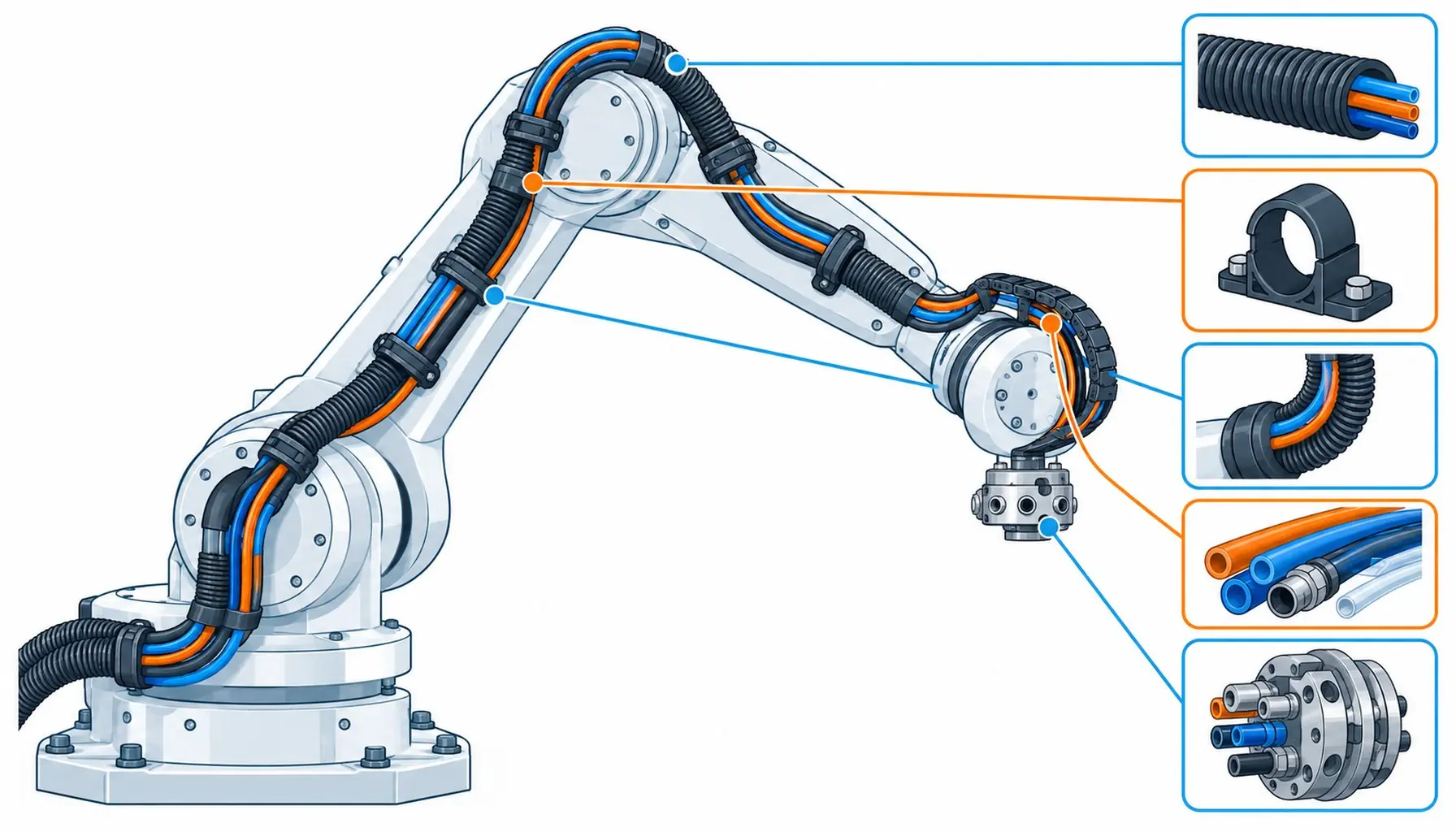
Quick Answer: A dress pack is the cable management system on a robot arm — brackets, conduits, clips and chains that route power, signal and air through every joint while the arm works at full speed.
Watch an industrial robot work and your eye follows the arm. Now imagine the wiring following it too: power to six motors, feedback from six encoders, a braking circuit, process media — welding current, air lines, glue hoses, camera cables — all of it sweeping through the same joints, a hundred times an hour, in a space the size of a wrist. Left loose, that loom would snag, crush, abrade and tear itself apart in days. The dress pack is the engineering answer: a purpose-built routing system that rides the arm and turns chaotic motion into controlled motion. This article explains what a dress pack contains, the three failure engines that destroy the unprotected versions, how to choose between routing types, and the maintenance habits that keep the line running.
Introduction
The term confuses newcomers because a “dress pack” is not a cable. It is a system: the cable set plus everything that guides, protects and terminates it along the arm — hollow sections and corrugated tubes, clips and brackets sized to each joint, strain reliefs, sometimes a miniature energy chain on the wrist axis, and the dressing hardware that keeps the bundle’s geometry stable through every pose. The cables inside are motion-rated products in their own right — bending cable for the linear-ish runs, torsion-rated constructions for the wrist where rotation dominates — and the pack is what lets them reach their rated life instead of dying at month three.
The economics are blunt. A robot line stop costs production by the minute, and the most common robot wiring failures — snagged cables, abraded jackets, crushed hoses — are dress pack failures, not cable failures. That is why fleet operators treat dress packs as wear items with planned replacement intervals, and why the cable constructions inside deserve the same specification discipline as any motion product, including the failure awareness documented in the common causes of cable failure. A robot that moves without a designed dress pack is not saving cost; it is borrowing it at interest.
What Goes Inside a Dress Pack
Every robot application has its own mix, but the inventory of what rides the arm falls into six groups, and each group has a distinct failure personality:
Motor power. Feeds to each axis motor — the thick, high-current members of the bundle, usually bundled along the arm’s outer, low-strain path. Built as bending-rated motion cable; on wrist sections where rotation accumulates, torsion-rated constructions take over.
Feedback and brake. Encoder bundles and 24 V brake pairs for each axis — the small, shielded members that carry the arm’s nervous system. Their worst enemy is EMC from the power members beside them, handled by construction and separation, with the grounding discipline described in the control and instrumentation cable guide.
Process media. Application-dependent: welding power and gas, air lines for grippers, glue or paint lines, water for spot welding guns. These ride the same geometry as the electrical bundle, which is why hose and cable layouts get designed together — a hose that kinks is as much a line stop as a broken conductor.
Data and sensing. Camera and sensor cables for vision-guided work, safety circuit runs, sometimes industrial Ethernet to end-of-arm tooling. Light, fragile, and usually the first casualty of a snag.
The guidance hardware itself. Corrugated conduit or hollow sections, clips and brackets, strain reliefs at every termination, and — on some wrists — a small energy chain. This is the part most people photograph, and the part whose geometry actually decides the cables’ fate.
The Three Failure Engines
Post-mortems on failed robot wiring keep finding the same three mechanisms, and all three are geometry problems before they are electrical ones.
Abrasion at the joints. Wherever the bundle flexes around a joint, something rubs. A cable clipped too tight against its neighbor, a conduit edge, a sharp bracket corner — the jacket wears through at the same spot on every cycle, and the insulation beneath gets the next thousand cycles to itself. Poorly dressed bundles multiply contact points; well-dressed ones eliminate them.
Snagging and overstretch. A loop that hangs loose at one pose gets caught on fixtures at another; a bundle routed with too little slack gets pulled taut at full reach. Snags break the lightest members first — sensor and camera cables — and overstretch pulls cores out of glands. Both failures trace to routing that worked on the poses the integrator checked and failed on the one they did not.
Crush and over-bend. The wrist is where everything happens at once: rotation, tight radii, tooling nearby. Bundles crushed between arm and fixture, or bent below their minimum radius at the wrist entry, fail there — which is why serious dress packs treat the wrist as its own design problem with its own strain relief, rather than the end of a long tube.
Choosing the Routing Type
Dress pack practice has converged on a few routing styles, and the choice is driven by application intensity, environment and the robot’s motion envelope more than by brand preference.
| Part | Function on the Arm | What Fails Without It |
|---|---|---|
| Corrugated conduit / hollow sections | Holds the bundle's shape and spacing along the arm | Members rubbing each other and snagging on structure |
| Joint clips and brackets | Set the flex geometry at each joint's working angles | Over-bending at wrist entries; crush at arm roots |
| Miniature energy chain | Guides the wrist bundle where rotation allows it | Uncontrolled wrist flexing and tangling |
| Strain reliefs and glands | Tie tension to the jacket, not the cores, at every end | Core breakage two centimeters from every termination |
| Media lines bundled to match | Air, gas and fluid lines sharing the same geometry | Hose kinks that stop the process, not just the signal |
| Quick-change couplings | Let the whole pack swap as a unit at service time | Multi-hour re-dressing jobs for a routine wear item |
Maintenance: Treating the Dress Pack as a Wear Item
Corrugated conduit systems are the workhorse: cheap, light, easy to re-dress, honest protection for medium-duty arms. Hollow-section and molded dress packs — often application-specific kits from robot OEMs or specialists — cost more and earn it on high-cycle applications where geometry stability is everything, particularly in automotive spot-welding and heavy handling. Miniature chains appear on wrists and on telescoping sections where a guided path beats a free loop. The wrong choice is less about picking a bad product and more about matching intensity: a light conduit kit on a 24/7 spot-welding gun wears out as a design decision, not an accident.
When a Dress Pack Is Not the Answer
Fleets that stay productive inspect dress packs on a schedule instead of waiting for the line to schedule it for them. The inspection is quick and visual: jacket wear at the known flex points, spiral patterns that signal torsion stress, clips that have migrated, hoses that have taken a set, connectors that show pull on their strain reliefs. Split dress packs — the kind that open along their length without unwiring the robot — turn a re-dress from a day’s job into an hour’s, which is why they dominate retrofit and replacement decisions. Keep a dressed spare pack on the shelf for critical cells: the swap is minutes, the downtime otherwise is a shift. And file what you find — wear locations repeat between robots of the same model doing the same job, so the third inspection should be confirming the fixes the first two suggested. The structure behind that habit is the same one behind the general industrial power distribution checklist: scheduled observation, recorded findings, corrections that compound.
RFQ Checklist: What to Send When Ordering a Dress Pack
Dress packs solve routing on multi-axis arms, and three neighboring problems belong to other tools. Long external cable runs between the robot base and the controller or process equipment are ordinary motion-cable engineering — energy chains, proper strain relief, sized conductors — not arm dressing. Continuous internal rotation through many turns exceeds any cable’s twist budget and belongs to slip rings, which trade cable wear for a brush maintenance schedule. And single-axis linear motion around a fixed path is classic energy chain territory, where the chain — not a dress pack — is the guiding system. The dress pack earns its place exactly where multiple axes, tight joints and process media share one moving arm; outside that envelope, use the simpler tool. When a new application does land in that envelope, the quickest sanity check is to plan the pack with the protection mindset of the armor-versus-unarmored decision: protection where the environment attacks, freedom where the motion demands it, and no rigid hardware where the arm needs to articulate.
| Application Profile | Recommended Dressing | Watch-Out |
|---|---|---|
| Light handling, low duty cycles | Corrugated conduit, standard clips | Upgrading silently when cycle counts creep up |
| High-cycle spot welding, heavy handling | Molded or hollow-section kit, quick-change couplings | Media lines bundled without their own strain relief |
| Vision-guided pick and place | Conduit plus dedicated light sensor routing | Camera cable snag at full reach — the first casualty |
| Wrist-intensive articulation | Miniature chain or molded wrist section, torsion-rated members | Wrist entry radius and crush against tooling |
| Harsh environment — weld spatter, washdown | Protected conduit, abrasion jackets, spatter shields | Heat damage hiding under intact-looking clips |
Conclusion
Whether ordering a kit or specifying cables for a custom pack, these lines make the quote fit the arm:
- Robot make, model and axes — plus any non-OEM tooling on the wrist
- Application: welding, handling, dispensing, with cycle counts per hour
- Member inventory: power, feedback, brake, data, media — with sizes
- Worst-case pose or the motion program file, so flex points can be verified
- Environment: spatter, washdown, chips, temperature at the arm
- Split-dress requirement for serviceability, and spare pack policy
- Quick-change coupling standard if the fleet shares spares