Cable Length Tolerance and Service Loops on Robots: Buying to a Millimetre Budget
Quick Answer: Cable length is the quietest variable in a robot harness and one of the most expensive when it drifts. A run that is twenty millimetres short arrives in tension and loads the connector; twenty millimetres long and it swings, rubs and snags. Nothing about the cable has changed, but the machine now builds differently from unit to unit. Length tolerance and service loop size are specification items, and both are cheap to state and expensive to omit.
Introduction
A harness drawing usually describes the cable, the connectors and the route, and then leaves the length as a single figure with no tolerance beside it. On the first article it fits, because the person cutting it made it fit. On the fiftieth unit the same figure produces a run that is tight at the joint and a loop that hangs differently, and the difference is put down to assembly quality rather than to the specification.
The route itself, including where a loop should sit, is covered in our note on cable routing through robot joints. This guide stays on the number that gets written next to the route: how long the run is, how much loop it carries, and how much of that is allowed to vary.
Where Length Errors Actually Come From
The first source is the cut itself. A cable cut to length by hand and a cable cut on a machine with a length encoder do not produce the same spread, and the difference is not visible on a finished harness. The second source is the termination: how much jacket is stripped, how far the contact sits inside the housing and whether the screen is folded back all change the finished length of the assembly without changing the cut length.
The third source is the route as built. A run that passes through a bore and around two guides does not have the same as-built length as the drawing suggests, because the path follows the cable rather than the centre line of the drawing. The fourth is the branch point, which is the same problem as in our note on multi-axis cable bundle management: if the point where a cable leaves the main run moves, every length that was calculated from it moves too.
None of these is exotic, and all four are normal in cable assembly. The point for a buyer is that a harness length is not a manufacturing dimension like a machined slot. It has a spread, and if the spread is not written into the specification, it will be discovered at the machine rather than at the supplier.
What a Service Loop Is For
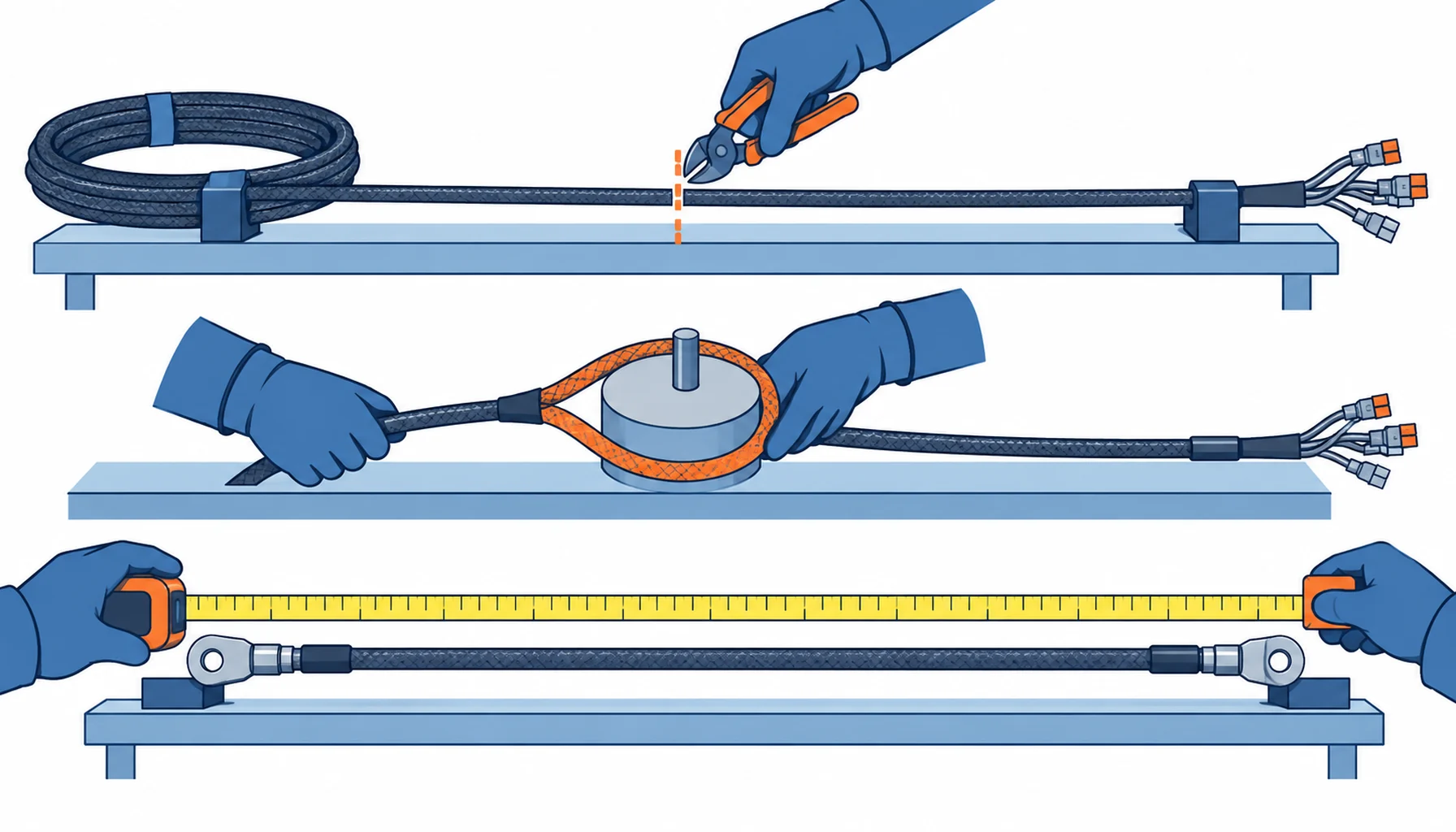
A service loop is not spare cable, and treating it as spare is where most of the trouble starts. It has three jobs: it absorbs the accumulated length error of the assembly so the connector never takes the difference in tension, it gives a technician something to work with during a swap, and it keeps the clamped point away from the point where the cable has to move.
Sizing it is a three-input problem. The loop has to be long enough to hold the bend radius at full travel, which depends on the radius the route needs. It has to be short enough that it does not swing into the machine or rub on a link, which depends on the clearance around the joint. And it has to absorb the tolerance of the run, which depends on how tightly the rest of the harness is controlled. Where those three pull in different directions, the loop is usually too long rather than too short, and a loose loop is the version that fails.
The measurement itself has a method, and the details of how a flexible run behaves when it is bent past its limit are set out in our note on cable minimum bend radius. What matters at order time is simpler: the loop is formed to a template or a gauge rather than to an opinion, and the formed length is measured on the first article.
The Decision Table: Length Control Options and What Each One Costs
| Option | What to Specify | Evidence to Demand | Cost and Lead Time | Where It Fails |
|---|---|---|---|---|
| Length only, no tolerance | A single figure per run | Nothing beyond the drawing | Lowest unit price | Units that build tight or slack from the same drawing |
| Toleranced length | Plus and minus on every run and on the overall assembly | A first article measurement record | Small cost, no lead time change | Tolerance quoted but never measured on later batches |
| Toleranced length with loop gauge | Loop formed on a gauge, formed length stated | Gauge record plus a photo of the formed loop | Small tooling cost, short lead time | A gauge that is worn or checked only at the start |
| Cut on a machine with encoder | Cut length control plus a procedure for the termination | Cut records and a periodic length audit | Higher unit cost, better consistency | Termination spread that the cut control does not cover |
| Length set at the machine | A field length plus a trim-and-terminate procedure | The procedure and the tooling to do it properly | Lowest harness cost, highest site labour | Trim and terminate done in the field without the right tooling |
Verifying Length Before You Accept
Length is easy to check and rarely checked. A first article record should show the cut length, the finished length after termination, the formation of the service loop and the measurement method used, because a length figure without a method is not a specification. Two suppliers can both claim a run of 1,200 millimetres and deliver assemblies that differ by a centimetre, simply because one measures along the cable and the other measures the straight-line distance between end fittings.
The method should match how the harness is used. A run that will be installed around a curved path should be measured in a jig that follows that path rather than laid flat on a bench, and a loop should be checked against its gauge with the harness in its installed orientation. Where the harness has to be pulled through a bore before anything else is fitted, the handling length at each end belongs in the measurement as well, and the constraints that go with it are set out in our note on hollow shaft cable routing.
For repeat orders the useful control is not a tighter tolerance but a shorter feedback loop. A length audit on a sample from each batch catches drift long before a machine does, and it costs a tape measure and a few minutes. Where the harness carries a service requirement, the access the swap needs is worth checking at the same time, and the design side of that is the subject of our note on robot cabling serviceability.
What to Freeze Before the Order
| Item | What to State | Evidence to Attach | Cost of Leaving It Open |
|---|---|---|---|
| Cut length | A figure and a tolerance for every run | A cut record or a measurement on the first article | A harness that only fits the unit it was built on |
| Finished length | Length after termination, with the strip and contact method | A measured record on the first article | A run that shortens or lengthens with the termination |
| Measurement method | Whether length is measured along the cable or end to end | A written method with the jig described | Two suppliers, two lengths, one drawing |
| Loop length | Formed length plus a tolerance, and the gauge to form it | A gauge record and a photo of the formed loop | A loop that hangs differently on every unit |
| Loop position | Where the loop sits and which way it opens | A layout drawing at full travel | A loop that swings into the machine or rubs a link |
| Clamp positions | Where the run is fixed and where it stays free | A drawing with every clamp dimensioned | Movement that migrates onto an edge |
| Handling length | Extra length needed at each end for the build and for service | A note on the drawing plus a first article check | A harness that cannot be pulled through or swapped |
| Batch audit | Whether a sample length check is done per batch | A periodic measurement record | Drift that is found by the machine, not the supplier |
When a Tight Tolerance Is Not the Answer
Where the route cannot hold a tight figure. If the run passes around guides, through a bore and across a moving joint, a very tight length tolerance buys nothing, because the path itself varies more than the tolerance does. A slightly wider tolerance with a properly sized loop and a defined clamp position controls the outcome better than a number nobody can hold.
Where the loop is being used to absorb a design gap. A long loop can hide an undersized service space or a route that was never resolved, and it works until the loop swings into something. Where the loop is holding the design together, the fix is on the route and the access, not in the harness.
Where length is set at the machine with no procedure. Field trimming is a legitimate way to fit a harness, but only with the right tooling and a written procedure. Trimmed by hand with pliers and a twist joint, it trades a small harness saving for a field failure that appears months later, and the fault will not look like a length problem.
Where the tolerance is quoted but never measured. A tolerance that is not checked is a number on a page. If a batch audit is not part of the agreement, the spread will grow quietly, and the first sign of it will be a service call rather than a rejection. How an intermittent fault from that drift is finally traced is set out in our note on robot cable field diagnostics.
RFQ Checklist
- Cut length and tolerance stated for every run on the harness
- Finished length after termination stated, with the strip and contact method
- Measurement method written down, including whether length is taken along the cable or end to end
- Service loop formed length and tolerance given, with the gauge used to form it
- Loop position and opening direction shown on a drawing at full travel
- Clamp positions dimensioned, with the free section marked
- Handling length at each end stated for the build and for service access
- First article record required, covering cut, finished and formed lengths
- Batch length audit agreed, with the sample size and the record kept
- Termination method named for the harness, since it changes the finished length
Conclusion
Length is the part of a harness specification that looks too small to matter and then decides whether fifty units build the same way. Put a tolerance on every run, write down how it is measured, form the service loop on a gauge instead of by eye, and ask for a first article record that shows all three. It costs a line on a drawing and it removes the class of fault that is hardest to explain, because the harness on the bench is always the right length.
Kexingyu Cable Group (KXYE) supplies the cable side of these assemblies: continuous flex and torsion rated constructions, including the robot composite cable, cut and prepared to a stated length rather than to a nominal one. Send us the route, the loop requirement and the tolerance you need to hold, and we will return constructions and sample lengths that build consistently; the fastest route is a request for quotation.