Reading Cable Damage: What Wear Patterns on a Failed Robot Harness Tell You Before You Reorder
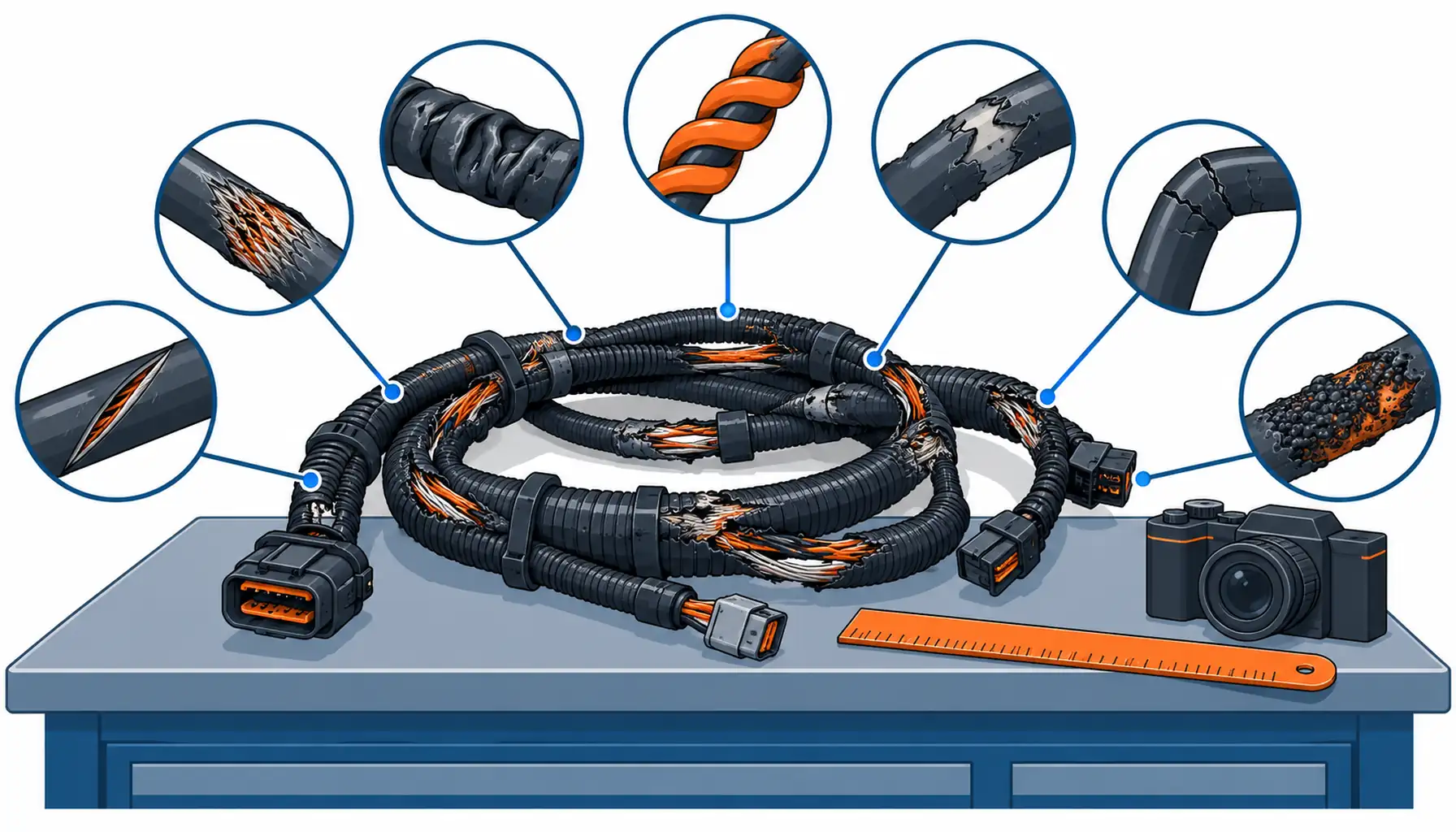
Quick Answer: A failed robot harness is evidence, and the wear pattern is the testimony. Abrasion says routing or clearance, corkscrewing says torsion, hardening says heat, and breakage at the termination says the crimp not the cable. This guide maps each pattern to its cause and to the specification change that belongs in the replacement order.
Introduction
Most failed harnesses leave a plant the same week they fail, usually in a skip, and with them goes the cheapest reliability engineering any cable buyer will ever get. Our note on robot cable failure modes explains the mechanisms; this one is about reading the physical evidence, pattern by pattern, before the replacement is ordered. The payoff is direct: a correctly read failure changes the specification, and a misread one reorders the same cable to fail the same way on the same axis.
The skill needs no laboratory. It needs a ruler for scale in every photograph, a bag for the failed sample, a note of the machine cycles since installation, and about ten minutes with the tables below before the purchase requisition goes out. Ten minutes against the cost of a wrong reorder is the easiest trade in maintenance.
Outer Jacket Damage: Abrasion, Cuts and Crushing
Uniform wear along one face, at the point where the harness crosses a fixture or rides a guide, is abrasion, and it says the routing is the problem before the cable is. The jacket was asked to slide against an edge at every cycle, and no jacket compound survives that indefinitely. The fix is a reroute, a sleeve, or a guide surface, and only then a jacket review. The interrogation of abrasion data itself is covered in our note on the cable abrasion test standard, because datasheet abrasion figures are earned on specific counterfaces that may not resemble yours.
Cuts and nicks with clean edges tell a sharper story: a burr, a dropped tool, or a pinch point that acts once per cycle. Crushing with flattened conductor positions under an otherwise intact jacket points at clamps over-torqued or a carrier squeeze. All three are installation findings, and ordering a tougher jacket without fixing the fixture merely schedules the next failure for a month later.
Deformation: Corkscrewing, Kinking and Bulges
A harness that has taken a set like a twisted ribbon, jacket ridges running in a helix, is corkscrewing, and it is the signature of torsion the construction was never rated for. It appears at wrists and on rotating fixtures, and it will not be argued away by re-dressing. The construction answer is a true torsion-rated design, and the mechanics are set out in our note on torsion cable construction. Kinks with sharp local bends indicate the opposite, slack that was never managed, and a bulge under the jacket where the cable otherwise looks healthy usually means conductor strands broken and bunched inside, which is the late stage of flex fatigue.
Colour and hardness belong in this section too. A jacket that has darkened and stiffened along its whole length has been running hot, either from ambient, from a heat source it was routed past, or from conductor heating inside. The thermal mechanics are covered in our note on thermal paths inside robot arms, and the reading changes the reorder conversation from jackets to conductor sizing.
The Decision Table: Wear Patterns and What Each One Means for the Reorder
| Pattern | Likely cause | What it says about the spec | Change for the replacement | Risk of misreading |
|---|---|---|---|---|
| Face abrasion, uniform | Rubbing against a fixture or guide | Jacket asked to do a sleeve's job | Reroute or sleeve first; abrasion-rated jacket second | Buying tougher jackets forever |
| Cuts, clean edges | Burr, pinch, or impact | Installation hazard, not a cable duty | Deburr and guard the path | Claiming against the supplier |
| Corkscrew set | Torsion beyond rating | Flex rating quoted where torsion governs | Torsion-rated construction at the joint | Same failure on the next harness |
| Kinks, sharp local bends | Unmanaged slack | Service loop not engineered | Designed loop with fixed length and clamp | Blame lands on the wrong end |
| Bulge under intact jacket | Strand fatigue bunched inside | Flex cycles beyond the construction | Higher-flex construction, real cycle count stated | Replacement fails at the same cycle count |
| Break at the termination | Crimp or relief failure | Termination practice, not cable | Crimp spec and relief geometry reviewed | Paying to replace healthy cable |
| Hardened, discoloured jacket | Heat, ambient or internal | Temperature band never stated | Conductor sizing and routing heat review | Jacket compound changed, cause kept |
Inside the Jacket: Conductor and Shield Evidence
Read the table top to bottom against the failed sample and one row will usually fit within a minute. Two rows fitting at once is common, abrasion over torsion, heat over fatigue, and that is fine: each contributing factor has its own specification change, and the reorder should carry both. The expensive mistake is not reading two causes, it is reading none and ordering by part number.
Making the Reading Count in the Supplier Conversation
Stripping a short section at the failure point tells you what the jacket concealed. Strands broken in a cone shape, longer at the outside of the bundle than the centre, are classic flex fatigue, and their position along the cable marks the section doing the most work. Strands fractured flush at the crimp barrel are a termination signature and shift the finding to the process, as set out in our note on terminating robot harnesses. Braided shields that have unraveled into a birdcage indicate repeated twisting or an outside diameter riding a tight bend, and the construction comparison in our note on high-flex versus standard cable covers what changes at that point.
Insulation that has degraded without mechanical damage, discoloured, brittle, or tracking between cores, moves the finding to electrical or thermal duty: voltage spikes, a drive-side problem, or sustained over-temperature. That harness does not need a tougher jacket either; it needs the electrical environment examined before anyone reorders, because the replacement will read the same insults the same way.
One field shortcut earns its place here. Compare the failed section with the same cable where duty was lighter, a twin harness on a slower axis, or the slack length coiled in the panel of the same machine. The differences between a worked section and a rested one isolate the duty’s contribution from the construction’s, and they photograph well. Two sections of the same harness, one failed and one sound, have settled more supplier arguments than any datasheet.
Before the Reorder: What to Freeze From the Evidence
A correct reading only pays when it survives transmission. The package that suppliers act on quickly has three properties: photographs with scale, a stated duty history and one named conclusion. Photographs with a ruler or a coin let the supplier’s engineer judge severity from a desk. The duty history, cycles per shift, shift count, months in service, turns the reading from an opinion into arithmetic against the rated life. The named conclusion, even a soft one such as torsion suspected at the wrist, gives the supplier something specific to confirm or correct.
Send the reading even when the harness is out of warranty and you owe nobody anything. Suppliers track failure patterns across customers, and a well-documented field failure on one axis often returns as a construction recommendation that benefits every harness you buy afterward. The plants suppliers call first with improved constructions are the ones that send readable evidence, and that channel is worth more than the discount list. It also costs nothing beyond the photograph habit this guide has already asked for.
Finally, close the reading with a check on the fix. If the conclusion was abrasion and the fix was a sleeve, inspect the sleeved section at the next scheduled maintenance and record what the new surface looks like after a month. A reading that gets verified once becomes calibration for the next reading; a reading that never gets checked stays an opinion with a photograph attached.
When a New Specification Is Not the Answer
| Item | What to state | Evidence to attach | Cost of leaving it open |
|---|---|---|---|
| Pattern identification | The dominant wear pattern, named | Scaled photos, retained sample | Reorder by part number alone |
| Cycle count at failure | Machine cycles since installation | Controller logs | No way to rate the replacement |
| Bend radius measured | Actual installed radius at the failure point | Photo with ruler | Radius assumed from the drawing |
| Torsion exposure | Degrees per metre at the joint | Axis motion data | Flex cable bought for torsion duty |
| Termination findings | Crimp condition and photos | Disturbed-last evidence | Cable blamed, process kept |
| Thermal history | Enclosure and ambient temperatures | Logged values or estimates | Heat cause travels to the new harness |
| Warranty position | Age versus warranty period | Delivery records | Claimable failure scrapped unclaimed |
| Specification changes | Each pattern mapped to one change | A written delta on the RFQ | Same failure scheduled again |
| Verification method | How the fix will be proven | A check interval and measure | Opinions instead of evidence next time |
| Fleet scan | Which other axes share the profile | An asset list | Failures arriving one per quarter |
RFQ Checklist
When the damage is clearly installation damage. A cut from a burr or a crushed section under an over-torqued clamp is a maintenance finding. Reordering to a heavier construction hides the defect for a while and costs more forever; fix the fixture and keep the cable you chose.
When the harness died young and the pattern is ambiguous. A failure in the first months with no readable pattern is worth a supplier conversation before a reorder, because young failures can be lot defects, and the samples prove or clear that quickly. The claim path in our note on the robot cable warranty is the right channel, and the retention rules in our note on robot cable inspection standards keep you ready for it.
When one axis keeps failing and no pattern fits. After two or three unreadable failures on the same axis, stop reading harnesses and instrument the axis: measure the real radii, twist and cycle count in service. The duty, not the cable, is the unknown, and the measurement beats a fourth guess.
When the fleet is old enough that everything shows wear. Cosmetic wear on an end-of-life fleet is not a specification signal. Match the analysis effort to the remaining life; deep diagnostics on a machine scheduled for decommissioning is engineering spent against a closing door.
Conclusion
- Actual installed bend radius at the failure point stated, not the drawing radius
- Machine cycle count to failure attached to the reorder
- Torsion exposure in degrees per metre stated separately from flex cycles
- Termination crimp specification and relief geometry included in the replacement order
- Operating temperature band, including hot spots at the routing, declared
- Dominant wear pattern named in the RFQ with the failed sample available
- Higher-flex or torsion construction justified by the measured duty, not by habit
- Verification interval agreed for the replacement harness
- Fleet-wide axes sharing the duty profile listed for the same change
- Warranty evidence retained for any harness that fails inside its period