High-Flex Cable vs Standard Flexible Cable: Where the Difference Shows Up
Quick Answer: Standard flexible cable bends a few hundred times during installation; high-flex cable is engineered for millions of working cycles. The difference lives in stranding, lay length, shield design and jacket compound.
Two cables sit on the supplier’s shelf. Both bend nicely in your hand. Both get described as “flexible” on page one of the catalog. One of them will survive a million bending cycles inside your machine and the other will be back on your desk as a warranty claim before the year is out — and nothing about the outer appearance tells you which is which. That gap is the subject of this article: what “high-flex” actually means as an engineering statement, where the two products genuinely differ, when the cheaper standard cable is the smarter buy, and how to verify a flex claim before it costs you a production line.
Introduction
The confusion starts with language, because “flexible” describes how a cable feels and “high-flex” describes how a cable ages. Standard flexible cable — the general-purpose control and power cable sold everywhere — is designed around installation: it tolerates being pulled through ducts, bent around corners and terminated in tight cabinets. After installation it holds still for the rest of its life. High-flex cable is designed around motion: continuous bending cycles at a defined radius and speed, millions of them, in oil or coolant, at temperature extremes. The skins are similar; the skeletons are not.
The practical stakes are easy to state. Put a standard flexible cable on a moving axis and the failure clock starts immediately: copper work-hardens at the bend point, foil shields crack, jackets split at the same spot on every stroke. The machine keeps running, the signals get noisier, and someone eventually chases an intermittent fault for weeks before tracing it to a cable that was never built for the job. The sections below walk through the construction differences, the honest decision boundary between the two, and the verification steps that keep a supplier’s “high-flex” label from being the only evidence in the file. The failure signature of the wrong cable in motion is a special case of the patterns documented in the common causes of cable failure.
What Actually Differs Inside the Two Cables
Four construction layers separate the products, and each one maps to a specific failure you have probably seen on a static cable pressed into motion duty.
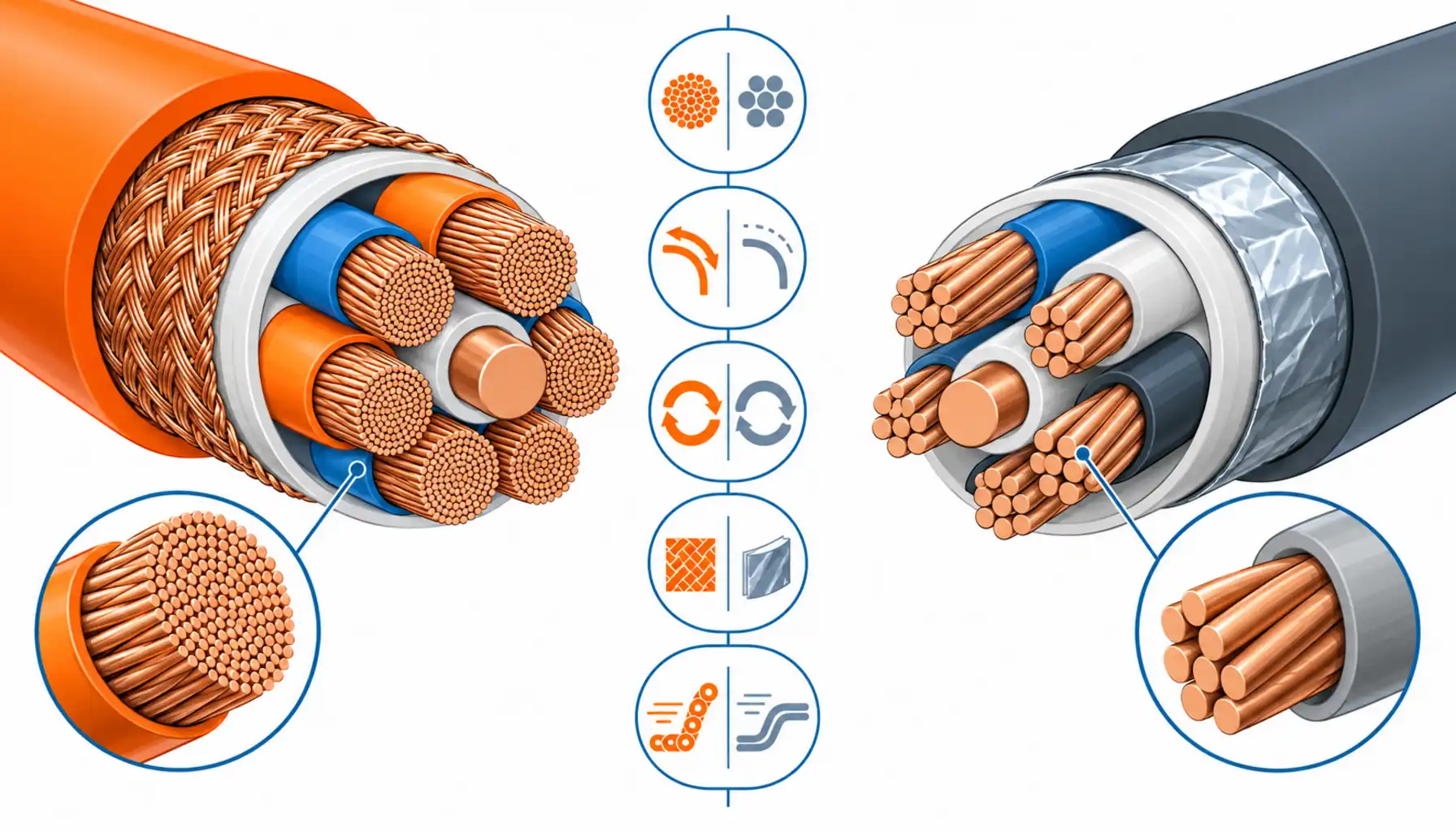
Conductor stranding and lay. Standard flexible cable typically uses Class 5 copper — fine enough to handle, coarse enough to keep cost down. High-flex constructions go finer (Class 6 or beyond) and, critically, close the stranding lay much tighter. Short lay means each wire in the bundle can slip against its neighbors as the cable bends, spreading the strain instead of concentrating it at a single point. Long-lay copper in motion is a fatigue test with a known end date.
Core arrangement and center elements. High-flex cables cable their cores around a central member — often aramid — with short, even lay so the bundle stays round and tension-free through each cycle. The center element carries pulling loads so the copper carries none; in a standard cable, jacket grip and core friction are what hold the cable together under tension, and both are wearing processes.
Shield design. This is where most quiet failures start. Foil shields — perfectly adequate on a stationary cable — crack after a few thousand cycles and drag EMC performance down with them. Motion-grade designs use optimized braids, sometimes with short-pitch application and coverage monitoring, so the shield flexes with the cable instead of folding. If your moving cable feeds encoders or industrial Ethernet, the shield decision is the signal integrity decision, and the grounding rules that make it work are the same ones covered in the control versus instrumentation cable guide.
Jacket compound. A standard PVC jacket is a cost decision, and in gentle chains or low-speed axes it can be the right one. Real motion duty usually calls for PUR — oil-resistant, abrasion-resistant, stable across temperature — with TPE and specialty compounds filling the gaps. The chemistry logic behind that choice follows the same reasoning as the insulation comparison in XLPE versus PVC: the compound has to match the environment it actually lives in, not the catalog average.
Where Standard Flexible Cable Is the Right Choice
High-flex cable costs more — sometimes three to five times more per meter — and paying that premium where motion never happens is waste dressed up as caution. Standard flexible cable remains the correct answer in most of a machine: cabinet wiring, fixed runs through conduit, connections to components that are serviced more often than they move, and any axis that shifts position a few times a year. If the cable’s total lifetime bend count is measured in dozens, standard is not a compromise; it is the specification. Even inside moving systems, the static segments — from the cabinet to the chain entry, for example — are standard cable territory.
The decision boundary is frequency and severity of motion, and it is sharper than most buying habits assume. A rough screen used by practical machine builders: under a few thousand bends over the machine’s life, standard; thousands to tens of thousands with gentle radii, better-grade flexible may still hold; anything that bends daily as part of the work cycle earns a genuine motion construction. When in doubt, count cycles per shift and multiply by shifts per year — the arithmetic is more reliable than intuition, and it is the first thing a serious supplier will ask for.
The Cost Math Over Five Years
The premium for genuine high-flex construction looks painful per meter and wins comfortably per machine. Three replacements of a failed standard cable — plus the labor to re-route it, plus the downtime it caused — usually erases the price gap in the first year of a demanding axis. The table puts the two products side by side on the lines that actually drive the decision.
| Line | Standard Flexible Cable | Genuine High-Flex Cable |
|---|---|---|
| Designed motion | Installation bends; static in service | Millions of dynamic cycles at a stated radius and speed |
| Conductor | Class 5 copper, standard lay | Class 6 or finer, short-lay anti-fatigue stranding |
| Shield | Foil or light braid — fine when stationary | Motion-optimized braid that flexes without cracking |
| Jacket | PVC by default; environment-limited | PUR or TPE matched to oil, coolant, abrasion, temperature |
| Price per meter | Baseline | Roughly 2-5×, construction-dependent |
| Five-year cost on a moving axis | Replacements, downtime, fault-chasing labor | The cable — usually the whole story |
How to Verify a High-Flex Claim
Because the premium is real, so is the temptation to sell ordinary cable with the right adjective. Verification is not complicated; it is mostly refusing to accept the label as data. Ask for the flex test report and read three things from it: the cycle count, the bend radius it was tested at, and the speed. A cable tested to five million cycles at a generous radius says nothing about your tight chain at high speed. Ask which construction details produce the life — stranding class, lay pitch, center element, shield type — and check the delivered cable matches, using the reading discipline in the datasheet guide. And ask how traceability works: a supplier who can tie your drum to a test batch is a different risk class from one selling from an anonymous warehouse, a distinction the factory verification logic in the manufacturer checklist turns into concrete questions.
When High-Flex Cable Is Not the Answer
The mirror-image error also costs money: specifying high-flex everywhere because motion exists somewhere in the machine. Static runs dressed in PUR and Class 6 copper are over-specification — no harm to the machine, real harm to the budget, and a quotation that loses to a better-specified competitor. The mature specification reads like a map: motion zones get motion cable, static zones get standard, transitions get strain relief and proper glands, and the bill of materials reflects the difference. That is also the honest boundary of this guide: if your application is continuous rotation rather than back-and-forth bending, torsion-rated construction is a different subject; if the cable runs free without a carrier, continuous-flex products answer a different question. High-flex cable is the answer to one specific problem — surviving millions of guided bend cycles — and naming the problem precisely is what makes the premium worth paying.
| Question | If Yes | If No |
|---|---|---|
| Does the cable bend daily as part of the work cycle? | High-flex required | Standard is fine |
| Is the bend radius tight relative to cable diameter? | Favor genuine motion construction | Standard may hold at gentle radii |
| Oil, coolant or abrasion in the path? | PUR or matched compound mandatory | PVC acceptable on cost |
| Do encoder or data signals ride the same run? | Braid shield quality is critical | Shield choice less critical |
| Can the supplier show a flex test report? | Proceed and file it | Treat "high-flex" as unproven |
RFQ Checklist: Splitting the Two Products Honestly
Put these lines in the RFQ so quotes come back comparable:
- Bend cycles per shift, shifts per year, and expected machine life stated per axis
- Bend radius and speed at the worst point of travel
- Stranding class, lay pitch and center element required — named, not implied
- Shield type specified for any signal-carrying cable in motion
- Jacket compound matched to the actual coolant and temperature range
- Flex test report with test radius required as a delivery document
- Static runs identified separately so they are quoted as standard cable
Conclusion
High-flex and standard flexible cable share a look and differ in purpose: one is built for how a cable is installed, the other for how a cable works. The construction differences — stranding, lay, shield, jacket — are specific and verifiable, and so is the decision between them: count the bends, respect the radius, check the chemistry, demand the test report.
Kexingyu Cable Group (KXYE) quotes both classes honestly and marks which is which in every offer, with construction details and test evidence behind each flex claim. Send your axis data through the RFQ page and the quote will tell you where standard cable wins — and where it would be the expensive choice.