Humanoid Assembly Yield Starts With Cable Consistency: What to Specify
Quick Answer: A humanoid carries hundreds of harness terminations, and a few millimetres of cable variation between batches shows up as rework at the end of the line. This guide sets out the tolerances to write into the order, the inspection evidence to demand at incoming, and the capacity guarantees that keep unit ten thousand identical to unit ten.
Introduction
The humanoid industry has crossed from showcases into shipments. Counterpoint Research counted more than 22,000 units shipped globally in the first half of 2026, nearly triple the year before, and published teardown write-ups of mass-market Chinese humanoids, such as Unitree’s R1, list roughly 2,000 to 3,000 components per machine. Somewhere in that bill of materials sits a dozen or more harnesses, and each one is an opportunity for a tolerance to be loose.
Cable rarely stops a humanoid program the way a motor shortage does. What it does instead is leak yield: a harness that arrives twenty millimetres long forces an awkward route, a jacket that runs thick fights the channel, an exit angle that drifted loads its connector sideways. None of it is scrap. All of it is minutes at stations that were costed assuming none, multiplied across every unit. This guide is about buying consistency, which is a different purchase from buying cable.
Where Variation Actually Enters
Most harness variation is not exotic. It enters at cutting, at routing, at termination and at handling. Cut lengths drift when the machine is set up by feel; route geometry drifts when harnesses are dressed by hand; crimp heights drift with tooling wear; and exit angles drift when the fixture is adjusted between orders. Each drift is small, which is why it survives a sample approval and then compounds across a production run.
The assembly line amplifies all of it. A humanoid torso or limb has channels designed with just enough clearance, so a bundle at the top of its tolerance still fits but needs persuasion, and persuasion at a station is time, variability and occasional damage. The assembly planner’s complaint is never “the cable failed”; it is “this batch doesn’t go in the way the last one did”, and that complaint is a specification failure that happened months earlier.
That is why the harness order needs tolerances with the same seriousness as the mechanical parts list. Length, route shape, exit angle, jacket diameter and termination geometry each deserve a stated band, and the bands should match what the fixture actually accepts, which means the fixture drawing and the harness drawing get reviewed together before the order, not after the first rework report.
Two quieter channels deserve a mention because they masquerade as production faults. The first is packaging: a harness that ships coiled too tight arrives pre-stressed and dresses differently from one that ships in its designed shape, so the pack-out belongs in the specification. The second is storage: jackets take a set over months in a hot or compressed state, and first-in-first-out discipline at the warehouse is part of the same consistency system, even though neither step happens at the supplier or the line.
What Consistency Looks Like in the Order
Start with length. A cut-length tolerance is cheap to state and expensive to omit, because every downstream fitting operation assumes it. For harnesses that route through fixtures, the useful form is not just total length but datum-to-datum: distance from the fixed point to each branch point and each exit, with the slack allocated explicitly. Our note on cable length tolerance sets out the dimensioning method.
Then fix the geometry. Exit angle, branch orientation and the position of the strain relief are all production characteristics, and they belong on the drawing with tolerances. An overmolded assembly holds these far better than taped hand-dressing, which is one reason molded harnesses dominate at volume; the trade-offs are covered in our note on overmolded harness assemblies.
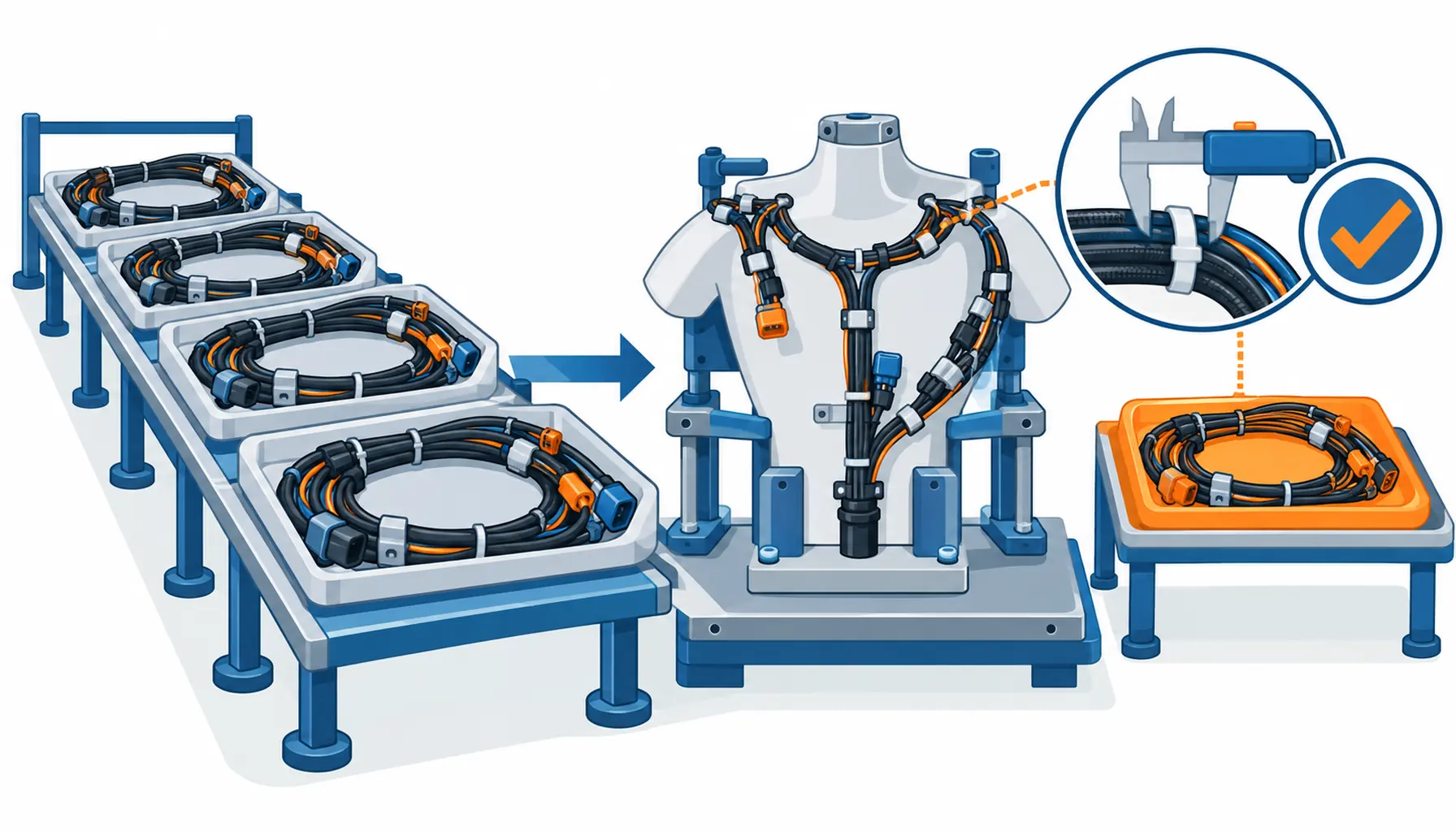
Finally, bind consistency to evidence. First-article approval establishes what “right” looks like; change control keeps it right. The order should state that any change in cutting setup, material lot or tooling triggers re-verification against the first article, with the buyer’s signature required before shipment. The mechanics of that approval, from sample build to sign-off, are described in our note on the cable sample approval process.
The Decision Table: Four Consistency Controls and What Each Costs
| Control | What to specify | Evidence to demand | Cost and lead time | Where it fails |
|---|---|---|---|---|
| Dimensional tolerancing | Length, datum-to-datum, with bands per run | Measurement records from each production lot | Low cost, added design effort | Bands wider than the fixture accepts |
| Molded termination geometry | Exit angle and mold dimensions with tolerance | First-article report with measured geometry | Tooling cost, longer first lead | Mold cost committed before design freeze |
| Change control | Re-verification triggers on lot, tooling or setup | A signed change procedure with named owners | Low cost, process discipline | Approved sample drifting into production |
| Incoming inspection | AQL sample plan and the checks at each receipt | Inspection records accompanying each lot | Moderate cost, permanent routine | Sampling that stops when schedules tighten |
Incoming Inspection Without Becoming a Bottleneck
The four controls are not alternatives; they stack. Tolerancing defines the target, molding holds the geometry, change control protects the approval and incoming inspection catches what slips through. A program that adopts two of the four usually discovers which two it needed by reading its own rework log, but the reading comes months late and the rework has already been paid for.
Capacity: Consistency's Quiet Half
Inspection at receipt is where consistency is enforced, and where well-meaning programs strangle their own line. The useful version is small and non-negotiable: a fixed sample per lot checking the handful of characteristics that actually predict assembly fit, which for harnesses are length at datum, exit geometry, jacket diameter at the channel sections and continuity of every conductor. Ten minutes per lot beats a full inspection that only happens when the line has already complained.
The checks and their acceptance criteria should live in a document the supplier has also seen and signed, so a rejected lot is a contractual event rather than a discussion. Our note on robot cable inspection standards sets out the checklist item by item, and the termination-specific checks, crimp height and pull-off force chief among them, are covered in our note on terminating robot harnesses.
Keep the economics honest while you are at it. A harness defect caught at incoming costs a quotation; the same defect caught at final assembly costs an hour of a expensive station plus a technician’s diagnosis, and the arithmetic only favours skipping inspection when volumes are tiny. Our note on the real cost of robot downtime walks through that calculation for the field, and the same structure applies at the line.
What to Freeze Before the Order
A supplier who cannot hold the schedule becomes the source of variation, whatever their process capability says. Rushed setups, untested substitute materials and second shifts of untrained hands all show up as lot-to-lot drift, so the order should ask for capacity evidence, not just price: current volume by part family, surge arrangements and the lead time at your expected quarterly quantity, stated in writing.
The humanoid market’s growth makes this concrete. Forecasts cluster in the tens of thousands of units for 2026, with several houses expecting multiples of that by the decade’s end, and a harness supplier sized for hundreds of units a month will meet your growth with exactly the improvisation your yield cannot afford. Ask how your volume ramp changes their process, and weight the answer more heavily than the unit price. Where the program expects to scale hard, our note on the humanoid cable supply opportunity walks the sourcing stages end to end.
Dual sourcing is the standard hedge, but its timing is easy to get wrong. Qualifying a second supplier costs sample builds, approvals and early lots watched closely, which is affordable in calm quarters and nearly impossible during a ramp. The practical rule is to start the second-source qualification when the first supplier’s capacity answer stops being comfortable, not when the shortage has already arrived.
When Tight Tolerances Are Not the Answer
| Item | What to state | Evidence to attach | Cost of leaving it open |
|---|---|---|---|
| Length tolerances | Band per run, datum to datum | Fixture drawing reviewed together | Fit-by-persuasion at the stations |
| Geometry tolerances | Exit angle and branch orientation bands | First-article measurements | Hand-dressing variability at volume |
| Crimp specification | Height band and pull-off force minimum | Cross-section and pull records per lot | Intermittents that surface in the field |
| First article | Which build is the reference, and where it is kept | Signed first-article report | Nothing to re-verify against |
| Change control | What triggers re-verification | A procedure with named approvers | Silent drift between lots |
| Incoming plan | AQL sample and the four fit checks | Records with every receipt | Defects found at final assembly |
| Labeling | Part number, revision and lot on every harness | A photo of the standard label | Mixed stock and untraceable lots |
| Capacity statement | Lead time at your quarterly quantity | A written capacity response | Improvised lots at the worst moment |
| Warranty terms | What is covered and the claim route | Signed terms referencing the lot records | Arguments instead of replacements |
| Revision rule | When the harness may be re-spun, and who signs | A change procedure | Uncontrolled mass or geometry growth |
RFQ Checklist
When the fixture has the clearance to absorb variation. Tightening a tolerance costs the supplier setup discipline and costs you money, and if the mechanical design already tolerates the natural spread, the money is better spent elsewhere. Specify the band the design needs, not the tightest band the supplier can advertise.
When the volume does not justify tooling. Molded geometry and fully instrumented lots make sense at hundreds of units a month. A pilot program buying them pays tooling amortisation on quantity it will never reach; hand-dressed samples with honest tolerances and a good first article serve the early builds, as our note on humanoid power harness architecture also argues for the power side.
When the variation is coming from your own assembly. If the same harness fits easily on some stations and fights on others, the fixtures are the variable. Measure the stations before penalising the supplier, because a tolerance dispute aimed at the wrong party burns the relationship that capacity and consistency depend on.
When the defect is a design issue, not a production issue. If every lot fails the same way, the drawing is wrong, and tightening production control just makes non-conforming parts more consistently. Route the failure back to design first; the warranty route then handles what was actually promised, which is the subject of our note on robot cable warranty terms.
Conclusion
- Length tolerances stated datum to datum, reviewed against the fixture drawing
- Exit angle and branch geometry toleranced on the harness drawing
- Crimp height band and pull-off force minimum stated, with per-lot records
- First article approved and retained as the reference build
- Change control procedure naming the re-verification triggers and approvers
- Incoming AQL plan defined, with the four fit checks at every receipt
- Labeling standard covering part number, revision and lot
- Written capacity statement covering lead time at the expected quarterly quantity
- Warranty terms signed, referencing the lot and inspection records
- Revision rule for harness changes, with named approvers