Overmolded Cable Assemblies for Mobile Robots: Tooling, Sealing and What to Specify
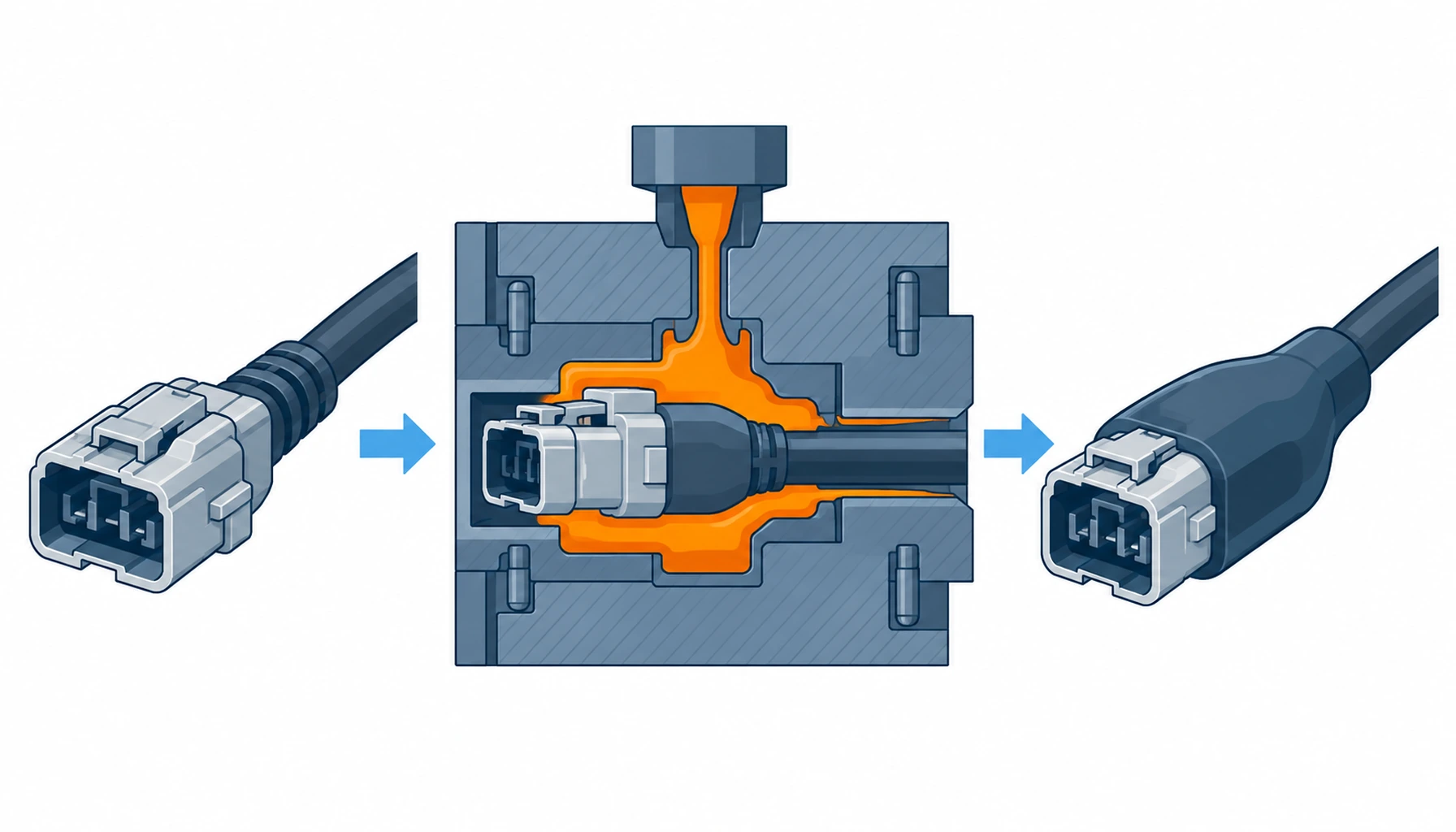
Quick Answer: Overmolding bonds the connector, the cable entry and the cable jacket into a single sealed part. On a mobile robot that gets rained on, sprayed down or run into things, that one part replaces a connector, a seal and a strain relief boot, and removes the three ways those usually fail. The trade is tooling: a mould per variant, a lead time to first article, and an assembly you cannot open for repair. Buy overmolding when the environment is wet or rough and the volume justifies the tool; buy field-assembled connectors when it does not.
Introduction
A mobile robot is a harsh place for a cable termination. It is driven into kerbs and doorframes, cleaned with a hose, and left outdoors between shifts. Every entry that is assembled from a connector, a gland and a boot has three joints that can leak, and each of them is a place an operator can leave loose. Overmolding removes the joints by making the entry one continuous part, which is why it dominates on AGVs and AMRs, delivery robots and any machine that sees washdown.
The harness overview in our note on robot harnesses and connectors treats the assembly element by element. This guide stays on the moulded assembly: what it buys, what it costs, and the material and tooling decisions that decide whether the moulding stays bonded for the life of the machine.
What Overmolding Buys You
Four things, and they are worth pricing against the alternative. The first is sealing: a moulding that bonds to both the jacket and the shell removes the cable-entry leak path entirely, so the assembly’s ingress protection no longer depends on a gland being tightened correctly. The second is strain relief: the moulded boot is long enough and shaped enough to spread bending over a controlled length, which is the same job a separate relief does, done in the same part. The third is tamper resistance: an operator cannot loosen, re-clamp or mis-assemble something that has no fasteners. The fourth is repeatability at volume, because a mould produces the same entry every cycle instead of depending on the bench.
What It Costs
The costs are equally concrete. A mould is a tool, so each connector family, cable diameter and boot geometry is a tooling line, and a change to any of them can mean another tool or another insert. Lead time includes the tool and the first article, which is measured in weeks rather than days. And serviceability goes down: a moulded entry cannot be opened, so a damaged contact usually means replacing the whole assembly rather than re-terminating one end. On a machine where that assembly is cheap and reaches a serviceable location, overmolding is a clear win; on a high-value harness buried inside an arm, the same decision can be wrong.
The Decision Table: Assembly Options and Where Each Belongs
| Option | Where It Belongs | What to Specify | Evidence to Demand | Where It Fails in Service |
|---|---|---|---|---|
| Fully overmolded | Mobile robots, washdown machines and any entry that must never be opened | Moulding material and hardness, bond to jacket and shell, boot length, tooling ownership | Sectioned first-article sample and a pull test on the finished moulding | Voids or weak adhesion at the shell, letting water track in behind the moulding |
| Moulded backshell | Assemblies that must stay mated in the field but be serviceable at the connector | Moulded entry with a demountable coupling, sealing at both the entry and the coupling face | First-article with the coupling cycled to its rated mates | A moulding that seals the entry but a coupling face that is opened and re-mated dry |
| Low-pressure potting | Small junction housings where the whole cavity is filled instead of bonded | Potting compound hardness, thermal range, cure shrinkage, rework policy | Sectioned sample and a thermal cycle test on the potted part | A rigid potting that cracks under thermal cycling and lets water along the crack |
| Heat shrink and moulded transition | Retrofits and low volumes where a full tool is not justified | Shrink ratio and adhesive lining, moulded boot length over the shrink, bond at the shell | A fitted sample and a bend cycle test at the transition | The shrink ending inside the bend zone, so the cable fatigues at a hard edge |
| Field assembled | High-value harnesses serviced in place, low volumes and prototypes | Connector, gland and boot specified separately, with torque and clamp ranges | First-article fit on production jacket diameters | Assembly left loose by an operator, and a leak that only appears under a hose |
The Material and the Bond
An overmoulding only works if it stays bonded to two different materials at once, the cable jacket and the connector shell, and that is a materials decision more than a moulding one. The moulding compound has to be compatible with the jacket polymer, because a bond that is chemically weak will delaminate at the first temperature swing and open a path for water along the interface. Hardness matters too: a soft compound flexes with the cable and spreads bending, while a hard one transfers load to the shell and can crack at the transition. Where the machine sees oils, coolants or cleaning chemicals, the compound’s resistance to those fluids is a separate line on the datasheet and a separate test. Where the duty also means dragging or scraping, the jacket has to resist abrasion on its own, which our note on cable abrasion testing covers.
The bond is also the part of the assembly you cannot inspect once it is made, which is why the section sample matters. Ask for a sectioned first article that shows the moulding thickness, the bond line to the jacket and the bond to the shell, and treat that document as the acceptance record rather than a photograph of a finished part.
What to Freeze Before the Order
| Item | What to State | Evidence to Attach | Cost of Leaving It Open |
|---|---|---|---|
| Moulding material | Compound and hardness matched to the jacket and the chemicals in the duty | A material datasheet naming fluid and temperature resistance | A bond that delaminates in service, or a boot that cracks at the entry |
| Bond to jacket and shell | Bond requirement at both interfaces, with surface preparation described | A sectioned first article showing both bond lines | A water path along the interface that only shows under a hose test |
| Boot length and shape | Length that puts the flex point beyond the rigid shell zone | A dimensioned drawing and a bend cycle test on the finished part | A cable that fatigues at a hard edge just outside the moulding |
| Tooling ownership | Who owns the tool and whether the part can be re-sourced | A tooling agreement and a copy of the moulded-part drawing | Single-source lock-in on a part only one supplier can make |
| Jacket diameter window | The production jacket range the tool is designed for, with tolerance | First-article fit across the diameter range, not one nominal sample | A tool that only seals the middle of the tolerance band |
| Ingress class | IP class required of the finished assembly, not the bare connector | IP test evidence on the assembled and moulded part | A connector datasheet IP that the moulding does not actually deliver |
| Serviceability policy | What may be repaired and what must be replaced as a whole assembly | A written repair policy with the tooling it needs | Field repairs that cut into a moulding the specification sealed |
| First-article standard | What the first article must prove: dimensions, bonds, pull test, IP | A first-article report against a named checklist | A sample approved on appearance, with the real risks unproven |
When Overmolding Is Not the Answer
Where the volume does not carry the tool. A mould is a fixed cost, and on a few dozen assemblies the tooling and lead time can exceed everything the moulding saves. At low volume a field-assembled entry with a properly specified gland and boot is the cheaper answer, and it can be serviced, which the moulded part cannot.
Where the assembly has to be serviced in place. If a contact has to come apart at the machine, a sealed moulding turns a re-termination into a cable replacement. On a high-value harness that difference is the whole buying decision, and it is covered from the other side in our note on terminating robot harnesses.
Where the real problem is the routing, not the entry. A moulded boot is not a substitute for a correct bend radius; if the cable is being bent inside the rigid zone, the moulding will crack there rather than protect it. The entry geometry is judged on its own in our note on strain relief at the connector interface.
Where only the connector is wet, and the machine is dry. Sealing costs money, and paying for IP-rated mouldings on an assembly that lives in a dry cabinet is spend the project does not recover. Where the duty really is wet, the rating has to be judged for the assembly as fitted, not for the bare connector, as our note on IP ratings for robot connectors explains.
RFQ Checklist
- Moulding compound named with hardness, temperature range and resistance to the fluids in the duty
- Bond requirement stated for both the jacket interface and the shell interface, with surface preparation described
- Sectioned first article required, showing moulding thickness and both bond lines
- Boot length dimensioned so the flex point falls beyond the rigid shell zone, proved by a bend cycle test
- Jacket diameter window stated with tolerance, and first-article fit proved across that range
- IP class specified for the finished assembly, with test evidence on the assembled and moulded part
- Pull test on the finished moulding, with the force and the sample size written into the order
- Tooling ownership agreed, with the moulded-part drawing available for a second source
- Serviceability policy written, stating what may be repaired and what is replaced as a whole
- First-article checklist agreed before the tool is cut, covering dimensions, bonds, pull test and IP
Conclusion
Overmolding is the right answer when a mobile robot needs an entry that will not leak, will not loosen and will not depend on how carefully someone assembled it. It is the wrong answer when the volume is low or the assembly has to come apart in the field. Decide those two questions first, then put the material, the bond and the boot geometry into the specification, because those are the three things a finished moulding cannot show you afterwards.
Kexingyu Cable Group (KXYE) supplies the cable side of moulded assemblies: the continuous flex, abrasion-resistant and outdoor-rated constructions whose jacket polymer is chosen to bond to a moulding compound rather than fight it. For mobile platforms that carry power, signal and data on one reel, a composite reel cable is often the right starting point. Send us the routing, the washdown duty and the jacket data, and we will return constructions and sample lengths that take a moulded entry cleanly; the fastest route is a request for quotation.