
YJV vs YJY: Reading Chinese Cable Designations Like a Local
YJV vs YJY: Reading Chinese Cable Designations Like a Local
Quick Answer: YJV and YJY share XLPE insulation and differ only in sheath — V is PVC, Y is polyethylene: PVC brings flame retardancy, PE brings moisture resistance. Ask a Chinese engineer what cable the feeder should be and the answer is a letter string: YJV, YJY, WDZ-YJY, ZR-YJV-22. To an outsider it looks like a part number; to a local it's a sentence — insulation, sheath, fire behavior and armor, read left to right. This article teaches that sentence, using the YJV-versus-YJY pair as the doorway.
Introduction
International buyers lose money on Chinese designations in two directions: quoting the wrong cable because a letter got misread, or paying for letters the application never needed. Both losses are avoidable with one decoding skill, because the Chinese designation system is systematic — every letter holds a fixed meaning across every product line. Master the decoder once and WDZ-YJY, ZR-YJV-22 and YJV22 all become transparent. The deeper fire-behavior prefixes are covered in our LSZH and fire-resistant guides, and the insulation platform in our XLPE primer.
The Decoder: Every Letter, One Meaning
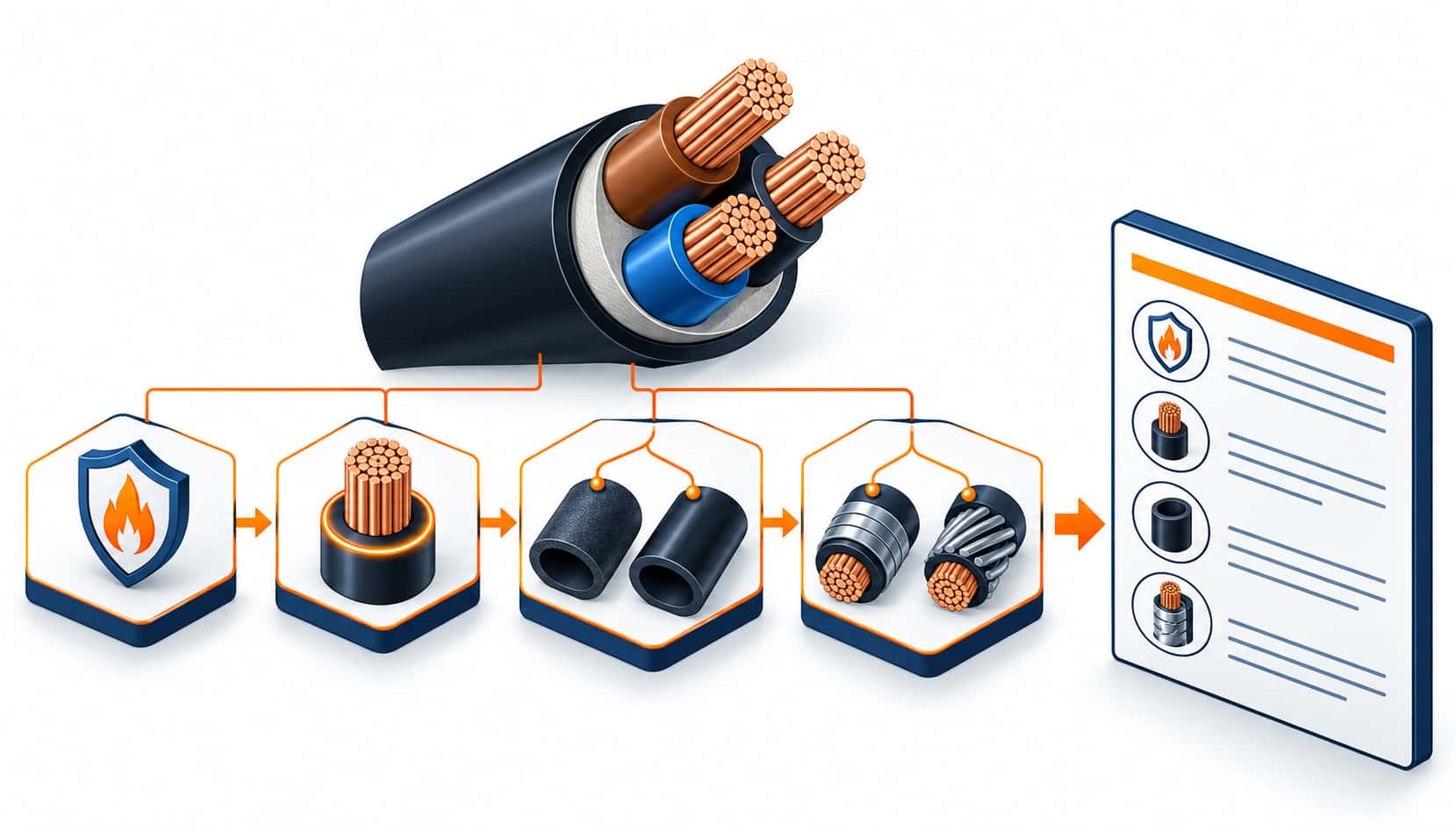
Chinese designations read in a fixed order: fire-behavior prefix, insulation, sheath, then armor. YJV reads as YJ (cross-linked polyethylene insulation) plus V (PVC outer sheath). YJY swaps the final letter for Y (polyethylene sheath). These aren’t mnemonics to guess at — V stands for PVC and Y for PE across the whole system, so the same decoder works on control cable, building wire and MV feeder alike.
| Letter | Chinese | Meaning | Notes for Buyers |
|---|---|---|---|
| YJ | 交èèä¹ç¯ | XLPE insulation, 90°C conductor | The standard insulation everywhere |
| V | èæ°¯ä¹ç¯ | PVC outer sheath | Flame-retardant grades available |
| Y | èä¹ç¯ | Polyethylene outer sheath | Moisture and low-temperature performer |
| ZR | é»ç | Flame retardant (ZA/ZB/ZC grades) | Grade letter follows: ZR-YJV / WDZ series |
| WDZ | æ å¤ä½çé»ç | Low smoke halogen-free, flame retardant | See our WDZ-YJY guide for the full decode |
| N | èç« | Fire resistant (mica tape) | Life-safety circuits: WDZN-YJY |
| 22 | é¢å¸¦é è£ | Steel tape armor | Suffix; mechanical protection, buried routes |
| 32 | é¢ä¸é è£ | Steel wire armor | Vertical runs and high pull tension |
YJV vs YJY: The Sheath Is the Whole Argument
Neither YJV nor YJY carries a voltage claim — the designation names materials only. The class rides alongside: 0.6/1 kV for the common LV workhorse, up through 6/10, 8.7/15, 12/20 and 26/35 kV for MV feeders, each with screen constructions and test requirements per the Chinese standards aligned to IEC 60502. An export RFQ that writes “YJV, 3×300 mm², 8.7/15 kV” is complete and quotable. One that writes only “YJV cable” is an invitation to guess. The standards landscape behind the voltage classes is mapped in our IEC, GB and BS standards guide.
Voltage Classes: What the Letters Do Not Say
Neither YJV nor YJY carries a voltage claim — the designation names materials only. The class rides alongside: 0.6/1 kV for the common LV workhorse, up through 6/10, 8.7/15, 12/20 and 26/35 kV for MV feeders, each with screen constructions and test requirements per the Chinese standards aligned to IEC 60502. An export RFQ that writes “YJV, 3×300 mm², 8.7/15 kV” is complete and quotable. One that writes only “YJV cable” is an invitation to guess. The standards landscape behind the voltage classes is mapped in our IEC, GB and BS standards guide.
Armor Suffixes: When Two Letters Become Four
Chinese schedules often run the designation into armor: YJV22 adds steel tape armor for buried routes needing rodent and mechanical protection; YJV32 adds steel wire armor for vertical risers and high-tension pulls. The armor conversation is the same one international buyers have with SWA and STA — the decision framework is laid out in our armored versus unarmored guide. Note that armor adds its own corrosion-protection layer (typically a PVC over-jacket), so an armored YJV22 is a three-layer polymer story — worth remembering when drum labels and sheath printing disagree at the dock.
| Aspect | YJV (PVC sheath) | YJY (PE sheath) |
|---|---|---|
| Insulation | XLPE, 90°C â identical | XLPE, 90°C â identical |
| Flame behavior | Inherently flame-retardant grades | Weaker; needs ZR/WDZ prefix for fire duty |
| Moisture resistance | Good | Excellent â buried and ducted default |
| Low temperature | Brittles in deep cold | Stays flexible â cold-region routes |
| UV exposure | Moderate with stabilization | Needs stabilization for open sun |
| Termination feel | Easy to gland and strip | Tougher jacket, standard tooling still works |
| Default habitat | Indoor trays, risers, buildings | Buried, ducted, outdoor, cold regions |
Export Mapping: Translating YJV and YJY
The translation is mechanical once the decoder is in hand: YJV becomes “XLPE insulated, PVC sheathed power cable, 0.6/1 kV (or the stated class), per IEC 60502”; YJY becomes the same sentence with a polyethylene (ST-type) sheath. Add the conductor class per IEC 60228, the cross-sections in mm² — the sizing logic is in our cable size selection guide — and any fire-behavior prefix restated as its IEC test (60332, 60754, 61034). With those elements, any destination-market inspector can verify the cable without ever meeting the letters.
The remaining risk is supplier-side, not vocabulary-side: two factories’ YJV differ in compound quality, copper content and test discipline. Supplier verification stays the load-bearing step — the checklist is in our power cable manufacturer checklist.
When the Designation Is Not the Answer
Reading letters correctly cannot rescue a specification built on the wrong electrical arithmetic — voltage class, derating and voltage drop still need engineering, and the designation system carries none of it. Nor can it substitute for test evidence: a designation is a claim, and claims cross borders as paper. And where a project’s fire code demands the halogen-free story, the YJV-versus-YJY question dissolves into the WDZ family entirely. Knowing when the letters are the wrong question is part of reading them like a local.
RFQ Checklist: Ordering by Designation
Make the letters quotable by writing these into the RFQ:
- Full designation with fire-behavior prefix: YJV / YJY / ZR-YJV / WDZ-YJY
- Voltage class stated explicitly (0.6/1 kV through 26/35 kV)
- Core counts and cross-sections per circuit, in mm²
- Armor suffix where needed: 22 steel tape, 32 steel wire
- Sheath environment described: indoor, buried, ducted, outdoor, cold
- IEC test references for any fire-behavior claims
- Conductor class per IEC 60228
- Batch test reports and copper certificates keyed to drum IDs
- Copper price linkage across the delivery calendar
- Destination-market certification needs stated up front
Conclusion
YJV versus YJY is a one-letter question with a one-sheath answer — PVC for the building, PE for the ground — and behind it sits a designation system that turns transparent the moment you learn each letter’s fixed meaning. Decode it once, and every Chinese cable schedule reads like a specification instead of a riddle.
Kexingyu Cable Group (KXYE) supplies the full designation family — YJV, YJY, armored and fire-behavior grades — with batch test reports and export-ready documentation, so the letters arrive with evidence attached. The choice costs nothing at the design stage and is expensive to reverse after termination, so the sheath letter belongs in the RFQ, not in an afterthought.
Recent Posts
Thermal Runaway in Lithium Batteries: What BESS Buyers Should Understand
Thermal Runaway in Lithium Batteries: What BESS Buyers Should Understand How thermal runaway starts, how it propagates, and which evidence buyers should require before approving
Energy Storage for Data Centers: A Growing Backup Power Option
Energy Storage for Data Centers: A Growing Backup Power Option Batteries have always backed up data centers in the form of UPS strings. Grid-scale BESS
NG-A (BTLY) Flexible Fire-Resistant Cable: A Complete Buyer’s Guide
NG-A (BTLY) Flexible Fire-Resistant Cable: A Complete Buyer’s Guide Quick Answer: NG-A (BTLY) is the flexible fire-resistant cable that made mineral-family protection installable — mineral