
Generator-Storage Hybrid Systems for Remote and Off-Grid Sites
How batteries reduce generator runtime, stabilize difficult loads, and improve the operating economics of isolated power systems.
What Is a Generator-Storage Hybrid System?
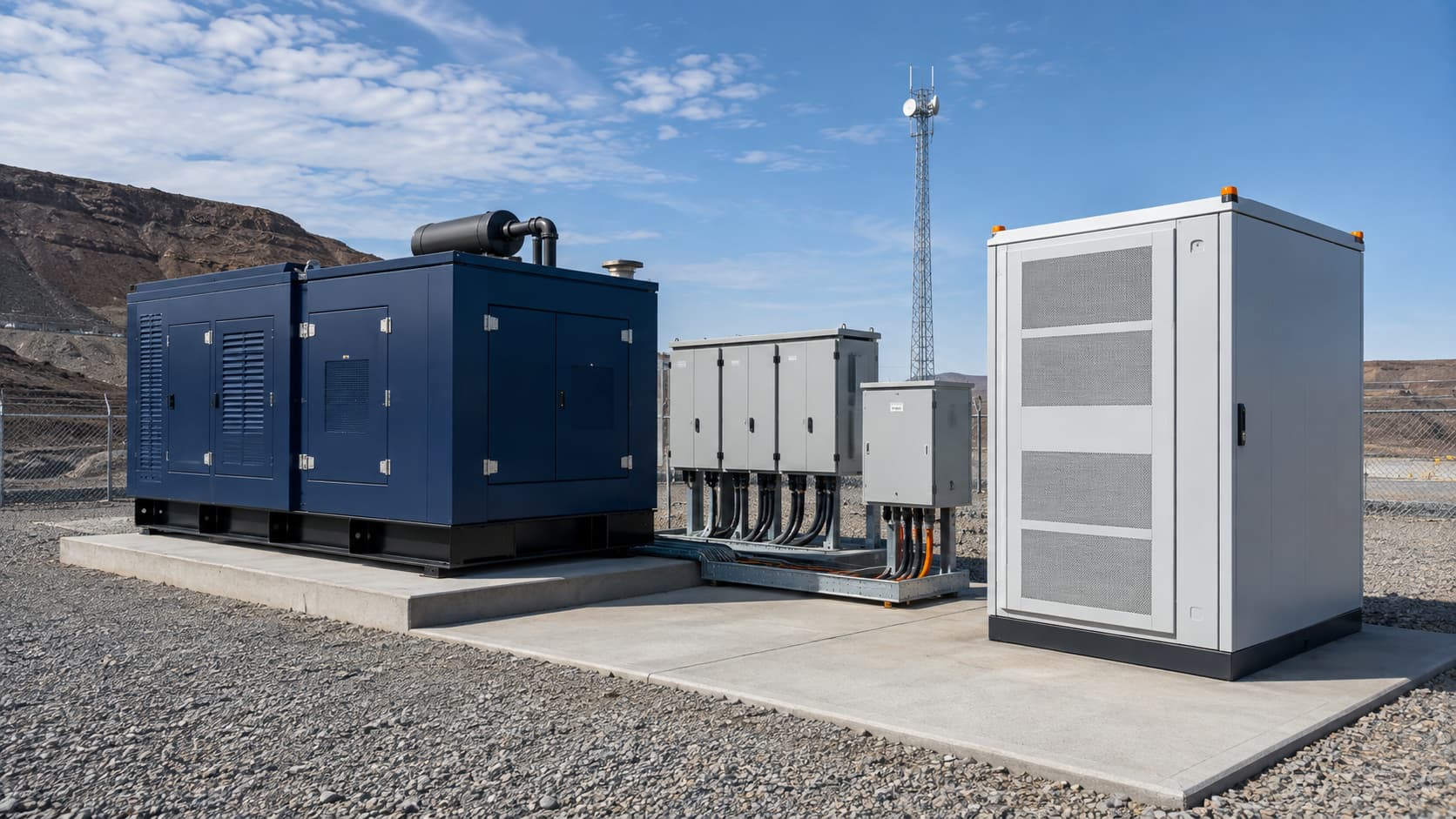
A generator-storage hybrid system combines one or more diesel or gas generator sets with a battery energy storage system (BESS), a bidirectional power conversion system (PCS), switchgear, protection, metering, and a supervisory controller. Together, these assets form a small isolated power network for a site that has no reliable utility supply.
The generator remains the dispatchable source for long-duration energy, while the battery handles short-duration power changes and selected generator-off periods. A well-designed controller decides when to start or stop the generator, when to charge or discharge the battery, and how much reserve must remain for the next load step or contingency.
If BESS terminology is new to your team, start with our guide to What Is a Battery Energy Storage System (BESS)? The PCS is equally important because it converts energy in both directions and, in an islanded system, may need to establish voltage and frequency rather than follow an existing grid.
Why Generator-Only Power Becomes Expensive
Remote mines, construction camps, telecom sites, farms, islands, and rural facilities often have a large difference between peak and minimum demand. A generator selected for the peak may spend many hours carrying only a small fraction of its rating. Fuel consumption per delivered kWh can then worsen, and some diesel engines may suffer from prolonged low-load operation if the manufacturer’s minimum-loading and maintenance requirements are not followed.
The correct operating range is generator-specific. Procurement teams should request the OEM fuel-consumption curve, minimum stable loading, allowable low-load duration, step-load capability, derating data, and maintenance schedule. A universal “best percentage” should not be used as a design rule.
How the Hybrid Operating Sequence Works
Generator-on mode
During a high-load period, the generator supplies the site and may charge the battery at the same time. The controller must limit charging so the combined site load and charging demand stay within the generator’s kW, kVA, current, temperature, and transient limits.
Battery-only mode
When demand is low and the battery has sufficient state of charge (SOC), the generator can stop and the PCS supplies the local bus. This creates quiet operating windows, removes low-load generator hours, and can reduce fuel deliveries and hour-based maintenance.
Peak and transient support
The battery can respond quickly to a motor start or sudden load step while the generator follows more slowly. This can reduce voltage and frequency excursions, but only when PCS overload capability, battery current limits, reactive-power demand, cable voltage drop, and the actual motor-starting method have been verified.
Renewable-first mode
If solar or wind is added later, available renewable energy can serve the load and charge the battery before the generator is dispatched. See Solar Plus Storage for the broader energy-flow options; the controller still needs a clear hierarchy for curtailment, reserve SOC, generator start, and recovery after an event.
Core Equipment and Responsibilities
- Generator set(s): supply long-duration energy and recharge the battery.
- Battery system: stores energy and includes modules, racks, thermal management, protection, and a BMS.
- Bidirectional PCS: converts AC and DC power; in islanded operation it may need grid-forming capability.
- Microgrid controller or EMS: coordinates dispatch, SOC limits, generator sequencing, reserve, alarms, and communications.
- Switchgear and protection: isolate faults, provide synchronization and interlocking, and support safe maintenance.
- Meters and sensors: provide the data required for dispatch, performance verification, and diagnostics.
The distinction between BMS and EMS matters: the BMS protects the battery, while the EMS coordinates the wider site. Neither should be assumed to replace generator controls, protective relays, or a certified safety system.
Do Not Size the Generator from Average Load Alone
A battery can sometimes allow a smaller generator than a generator-only design, but the reduction is not automatic. The generator must still cover the required operating cases, including periods when the BESS is unavailable or at its reserve SOC. Average demand minus battery power is not a valid sizing shortcut.
Check peak kW and kVA, power factor, the largest motor start, simultaneous load steps, nonlinear loads and harmonics, generator short-circuit contribution, protection coordination, charger demand, altitude and temperature derating, redundancy, and the site’s maximum acceptable unserved energy. Critical sites may retain N+1 generation even when the battery supports normal operation.
A Practical Sizing Workflow
- Measure the load. Collect interval data across normal shifts, nights, weekends, seasonal peaks, and abnormal operating states. Use faster logging where motor starts or short spikes matter.
- Define operating objectives. State whether the priority is fuel reduction, quiet hours, emissions, generator redundancy, renewable integration, power quality, or a combination.
- Size battery energy. Calculate the kWh needed for the target generator-off window, then account for usable SOC range, conversion losses, auxiliary consumption, temperature, degradation, and end-of-life capacity.
- Size PCS power. Check continuous kW/kVA, overload duration, reactive power, step response, grid-forming function, motor-start performance, and fault-current behavior.
- Verify generator duty. Model the site load plus battery charging, minimum stable loading, start/stop limits, warm-up and cooldown, fuel curve, maintenance intervals, and contingency cases.
- Simulate dispatch. Test the complete duty cycle with SOC limits, reserve, renewable variability if applicable, and realistic equipment availability.
- Validate the design. Use FAT and SAT scenarios that reproduce normal transitions and credible failures.
SOC Strategy and Generator Dispatch
Start and stop thresholds should not be based on SOC alone. A robust controller also considers predicted load, available PCS headroom, generator minimum runtime, cooldown, spinning reserve, renewable forecast, battery temperature, and communications status. Hysteresis between start and stop thresholds helps prevent rapid cycling.
Keep a defined reserve for black start, sudden load increases, or delayed generator availability. The reserve value depends on site criticality and the time required to start, synchronize, and load the generator. It should be documented as an operating requirement, not left as an installer default.
Grid-Forming Operation and Black Start
When the generator is off, an islanded AC bus needs a source that establishes voltage and frequency. The PCS must therefore be specified and tested for grid-forming operation if it is expected to energize the site. A standard grid-following inverter cannot create a stable dead bus by itself.
Black start is a system function, not just a battery feature. The design must define how control power, HVAC, fire protection, communications, switchgear, transformers, and priority loads are energized; how the generator starts and synchronizes; and how loads are restored in stages. Confirm that adequate battery energy remains after auxiliaries and transformer inrush are considered.
Generator and PCS Compatibility
The generator governor, automatic voltage regulator, excitation system, PCS control mode, and protection settings must work as one system. Clarify droop versus isochronous operation, real- and reactive-power sharing, reverse-power protection, synchronization, ramp rates, frequency ride-through, and the controller’s response when a device stops communicating.
A stable simulation does not remove the need for testing. Firmware versions, measurement delays, transformer impedance, long feeder voltage drop, and real motor starts can expose interactions that are not visible in a simplified model.
How to Build the Economic Case
Fuel savings and payback should be calculated from the site’s measured load profile, the generator fuel map, the proposed dispatch simulation, local fuel price including transport, maintenance cost per running hour or service event, battery degradation, auxiliary energy, and expected equipment availability. A fixed fuel-saving percentage is not transferable between sites.
Compare delivered energy and service quality as well as fuel. A hybrid scenario that reduces fuel but increases unserved energy, excessive cycling, or operator intervention is not an equivalent replacement. The following template keeps assumptions visible.
Generator–Storage Hybrid Evaluation Template
Replace every placeholder with site data. Compare equivalent reliability and delivered-energy requirements.
| Metric | Generator-only baseline | Hybrid scenario | Calculation / evidence |
|---|---|---|---|
| Annual fuel use | [L/year] | [L/year] | Hourly dispatch × OEM fuel curve |
| Generator runtime | [h/year] | [h/year] | Simulated start/stop schedule |
| Average generator loading | [%] | [%] | Generated kWh ÷ rated kW-hours |
| Starts per year | [count] | [count] | Include minimum runtime and cooldown |
| Maintenance cost | [currency/year] | [currency/year] | Hour- and event-based service plan |
| Battery throughput | Not applicable | [MWh/year] | Charge/discharge simulation |
| Auxiliary energy | [kWh/year] | [kWh/year] | Cooling, controls, heaters and pumps |
| Unserved energy | [kWh/year] | [kWh/year] | Reliability simulation with outages |
| Delivered site energy | [MWh/year] | [MWh/year] | Use the same load requirement |
| Total operating cost | [currency/year] | [currency/year] | Fuel + transport + service + replacements |
| Annual savings | — | [currency/year] | baseline cost − hybrid cost |
| Simple payback | — | [years] | incremental CAPEX ÷ annual savings |
Remote-Site Design Conditions
Remote projects often operate outside the comfortable conditions implied by catalog ratings. Confirm altitude, ambient-temperature range, dust, humidity, salt mist, rainfall, flooding, seismic conditions, wildlife, fuel quality, access roads, and maximum service response time. Apply manufacturer derating and check whether battery HVAC and other auxiliaries create a material parasitic load.
Communications should support remote monitoring, but essential dispatch and protection must continue safely if the external network fails. Define local data retention, alarm escalation, time synchronization, user permissions, secure remote access, firmware control, and a manual operating mode for trained site personnel.
FAT and SAT Scenarios to Specify
- Generator start, warm-up, synchronization, loading, unloading, cooldown, and stop.
- Transition from generator-forming to PCS grid-forming operation and back.
- Largest credible load step and motor start at minimum and normal SOC.
- High and low SOC limits, battery temperature limits, and charger curtailment.
- Loss of EMS, meter, BMS, PCS, generator, auxiliary supply, and communications.
- Black start, staged load restoration, emergency stop, and recovery after a trip.
- BESS unavailable operation, including the loads that must be shed or served by backup generation.
Questions to Ask a Supplier
- Which operating modes are included, and which require optional controls or engineering?
- Is the PCS verified for grid-forming operation, overload duty, and the site’s motor-start profile?
- What load data and assumptions were used for the fuel and payback model?
- What usable battery capacity is guaranteed at commissioning and end of life?
- How are generator minimum loading, charging limits, and start/stop cycling enforced?
- What happens after loss of the BESS, controller, meter, or communications link?
- Which spare parts, remote diagnostics, commissioning support, and local service resources are available?
Where Kexingyu Power Fits In
Kexingyu Power can support generator-storage projects with BESS, PCS, switchgear, controls, and application engineering configured around the customer’s load data and site conditions. Final scope, certifications, grid-forming functions, environmental ratings, and service arrangements should be confirmed in the project specification and technical offer.
For procurement planning, prepare a load profile, single-line diagram, generator data sheets, motor list, environmental conditions, fuel and maintenance costs, target autonomy, critical-load list, and required redundancy. These inputs allow suppliers to compare technically equivalent solutions rather than competing on battery kWh alone.
Frequently Asked Questions
Recent Posts
Energy Storage for Data Centers: A Growing Backup Power Option
Energy Storage for Data Centers: A Growing Backup Power Option Batteries have always backed up data centers in the form of UPS strings. Grid-scale BESS
Thermal Runaway in Lithium Batteries: What BESS Buyers Should Understand
Thermal Runaway in Lithium Batteries: What BESS Buyers Should Understand How thermal runaway starts, how it propagates, and which evidence buyers should require before approving
Switchgear Lead Times in 2026: A Buyer’s Planning Guide
Switchgear Lead Times in 2026: A Buyer’s Planning Guide Realistic timelines vary significantly by voltage class and type — here’s how to plan procurement without