
What Is BESS? A Guide to Battery Energy Storage Systems for C&I Buyers
Understand how a commercial battery energy storage system works, what each component does, and what buyers must define before requesting a quotation.
What Does BESS Mean?
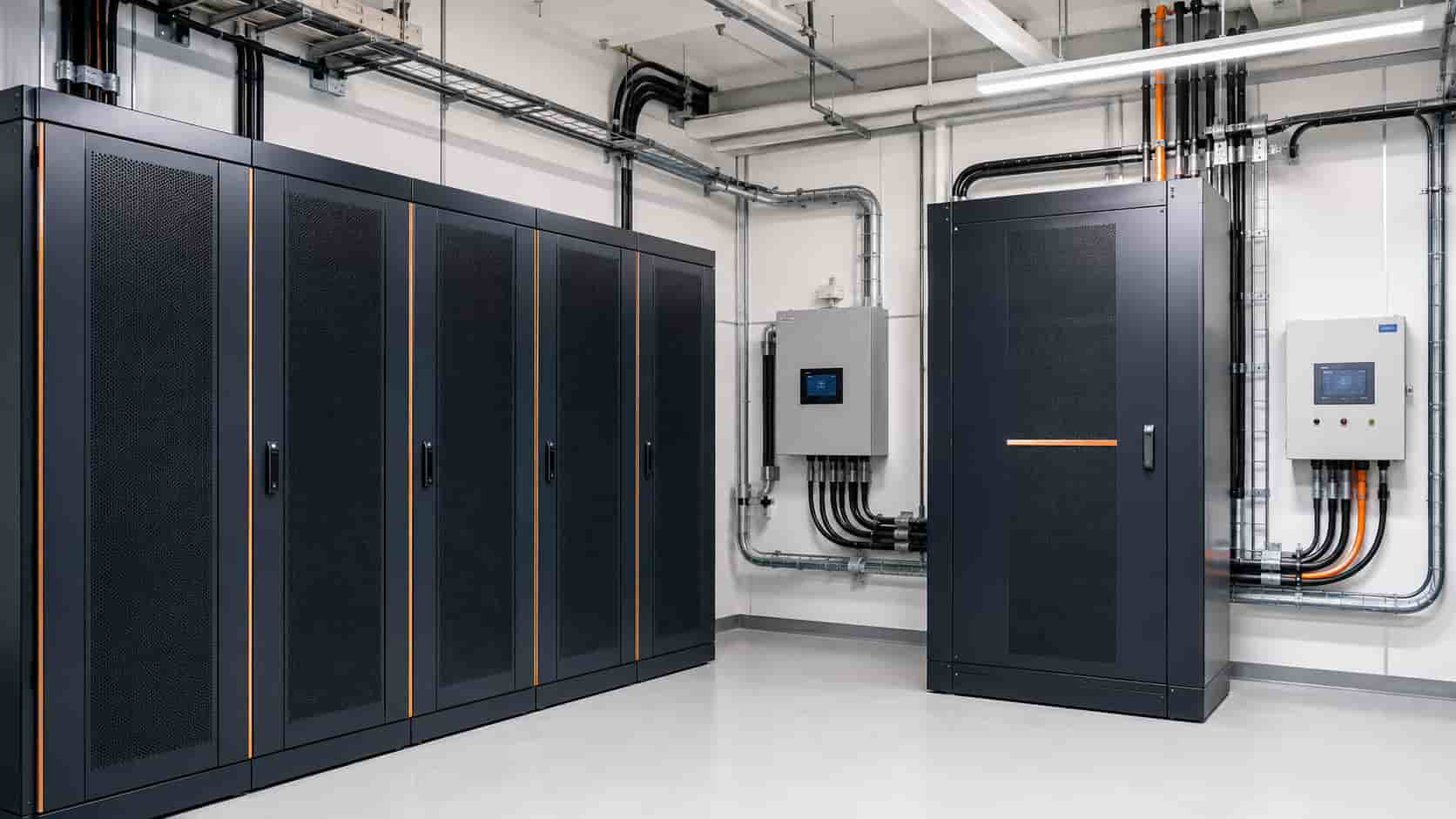
BESS stands for Battery Energy Storage System. It is an integrated electrical system that stores energy in batteries and delivers it later when a facility, microgrid, or utility needs it. A complete BESS is more than a battery cabinet: it combines battery modules, controls, power conversion, protection, thermal management, communications, and site-level electrical equipment.
Commercial and industrial buyers use BESS for peak shaving, solar energy shifting, backup of selected loads, demand response, power-quality support, or combinations of these services. The intended use case matters because it determines the required power, energy, control strategy, switching arrangement, safety design, and commercial return.
A useful procurement rule is to define the operating duty before selecting equipment. “We need a 1 MWh battery” is not a complete specification unless the supplier also knows the required output power, duration, cycle profile, grid connection, environmental conditions, and backup expectations.
How a BESS Works
During charging, the power conversion system changes AC electricity from the grid or a solar installation into controlled DC power for the battery. The battery management system supervises cell and module conditions while the energy management system decides when charging is economically or operationally appropriate.
During discharge, the process reverses. The PCS converts battery DC into AC that can serve site loads or export to the grid when permitted. Switchgear, transformers, meters, protection relays, and the site controller determine how that power is connected and controlled.
The system may be AC-coupled, with the battery PCS and solar inverter connected on an AC bus, or DC-coupled, with solar and storage sharing part of the DC-side power conversion architecture. Neither arrangement is automatically superior; the right choice depends on whether the project is new or retrofitted, operating priorities, clipping recovery, conversion losses, voltage architecture, controls, and maintenance strategy.
The Main Components of a Commercial BESS
Battery cells, modules, and racks store the energy. Lithium iron phosphate, commonly abbreviated LFP, is widely used in current stationary projects, but cell chemistry alone does not define safety or performance. Cell quality, pack design, thermal control, protection, manufacturing consistency, operating limits, and system integration all matter.
The battery management system, or BMS, measures cell and module conditions such as voltage and temperature, estimates state of charge and state of health, controls contactors, balances cells where supported, and communicates permissible charge and discharge limits. It protects the battery subsystem; it does not replace the site EMS or electrical protection system.
The power conversion system, or PCS, is the bidirectional conversion stage between the DC battery and the AC system. It controls charging and discharging power, voltage, current, power factor, and—in suitable designs—grid-support or grid-forming functions. See our energy storage PCS guide for a deeper explanation of PCS architecture and selection.
The energy management system, or EMS, applies the operating strategy. It can use tariff periods, site load, solar output, demand limits, state of charge, weather forecasts, market signals, and reserve requirements to schedule the system. A capable EMS cannot compensate for an undersized battery or an incompatible PCS, so controls and hardware must be engineered together.
Thermal management keeps cells and power electronics within their permitted temperature range. Depending on the system, it may use air cooling or liquid cooling. Fire detection and mitigation, ventilation, gas detection, emergency shutdown, isolation monitoring, DC protection, AC switchgear, transformers, meters, and communications complete the installation. The exact design is governed by the destination jurisdiction, product listing, hazard assessment, site layout, and authority requirements.
| Component | Primary function | Key buyer checks |
|---|---|---|
| Battery system | Stores DC energy in cells, modules, and racks. | Usable kWh, chemistry, voltage range, cycle duty, degradation warranty, thermal limits. |
| BMS | Monitors and protects cells, modules, racks, and battery strings. | Measurement coverage, protection hierarchy, SOC/SOH method, balancing, logs, redundancy. |
| PCS | Converts power bidirectionally between the DC battery and AC system. | kW rating, voltage, efficiency boundary, overload, grid code, grid-forming and backup capability. |
| EMS | Schedules charging and discharging according to site and market objectives. | Dispatch logic, tariff support, interfaces, data ownership, cybersecurity, remote updates. |
| Thermal system | Maintains batteries and power electronics within permitted temperatures. | Air or liquid cooling, temperature uniformity, auxiliary demand, redundancy, maintenance. |
| Safety systems | Detect, isolate, and mitigate electrical, thermal, gas, and fire hazards. | Detection, shutdown, ventilation, fire testing, separation, emergency response, local approval. |
| Balance of system | Connects the BESS safely to the facility or grid. | Transformer, switchgear, protection, metering, cabling, earthing, auxiliary supply, communications. |
Power, Energy, and Duration: kW vs kWh
Power, measured in kilowatts or megawatts, describes how quickly the BESS can charge or discharge. Energy, measured in kilowatt-hours or megawatt-hours, describes how much usable energy it can deliver. A 500 kW / 1,000 kWh system has a nominal two-hour duration at full rated power because 1,000 kWh divided by 500 kW equals two hours.
That simple calculation is only the starting point. Buyers should distinguish nameplate capacity from usable capacity and confirm whether the rating is measured on the DC or AC side. State-of-charge limits, end-of-life guarantees, temperature, auxiliary loads, PCS efficiency, power factor, and degradation can reduce delivered energy.
For backup applications, size against a time-based critical-load profile rather than one peak number. For peak shaving, analyze interval data and tariff rules. For solar shifting, compare surplus production with evening demand. The required kW and kWh should come from the duty cycle, not from a standard container size.
What Can a C&I BESS Do?
Peak shaving reduces the facility’s grid demand during short high-load periods. The EMS monitors load and discharges before the site crosses an agreed threshold. Savings depend on the tariff’s demand-charge method, the shape and predictability of peaks, available battery power, and retained state of charge.
Energy arbitrage charges the battery when electricity is less expensive and discharges it when prices are higher. The business case must include round-trip losses, degradation, auxiliary consumption, export restrictions, and applicable tariff rules—not just the difference between two energy prices.
Solar self-consumption stores surplus daytime generation for later use. The solar array, inverter, battery power, usable capacity, site load, and interconnection limit must be modeled together. Our guide to on-grid, off-grid, and hybrid inverter systems helps distinguish these operating architectures.
A BESS can also participate in demand response or grid services where market rules permit. Required response speed, telemetry, availability, metering, and aggregator arrangements vary by market and should be confirmed before assigning revenue.
Backup power is possible only when the complete system is designed for it. The PCS must support the required operating mode; suitable isolation and transfer equipment must separate the backed-up system from the utility; protection must work in islanded conditions; and the BESS must have enough instantaneous power, motor-starting capability, and usable energy for the critical loads.
BESS Is Not Automatically a UPS
A standard grid-connected BESS may stop operating when the utility supply fails because anti-islanding protection requires disconnection. A UPS is normally designed to maintain defined loads through a tightly controlled transfer or no-break topology. A BESS can provide backup or UPS-like functions only if those capabilities are explicitly engineered and verified.
Ask about transfer time, grid-forming capability, black start, neutral and earthing behavior, short-circuit contribution, overload duration, motor starting, protection coordination, restoration sequence, and how solar operates while islanded. Critical process loads may still require a dedicated UPS even when a site has a larger BESS.
Efficiency, Degradation, and Availability
Round-trip efficiency compares the energy delivered during discharge with the energy used to charge the system over a defined test boundary. A cell-only efficiency figure is not the same as AC-to-AC system efficiency. Confirm whether PCS losses, transformers, cooling, controls, standby consumption, and auxiliary loads are included.
Battery capacity decreases with calendar time and cycling. Temperature, average state of charge, depth of discharge, charge and discharge rate, and operating pattern affect degradation. Request a warranted usable-energy curve tied to a defined duty cycle and operating conditions rather than a single beginning-of-life capacity figure.
Availability guarantees should define excluded events, planned maintenance, grid outages, communications loss, response time, calculation period, and remedies. High component efficiency has limited value if the system is frequently unavailable or constrained by thermal or control faults.
Safety and Compliance Are System-Level Questions
Stationary battery safety cannot be reduced to “LFP is safe” or one certificate. Thermal runaway propagation, combustible gases, ignition, electrical faults, ventilation, separation distances, fire-service access, emergency response, drainage, environmental exposure, and nearby occupied spaces must be evaluated for the complete installation.
In North American projects, UL 9540 addresses energy storage systems and equipment, while UL 9540A is a test method used to evaluate thermal-runaway fire propagation. NFPA 855 provides installation requirements for stationary energy storage systems. These documents have different purposes: a test report is not itself an installation approval, and requirements vary by adopted code edition and authority having jurisdiction.
For any destination, ask for the exact product certificates and test reports, applicable standard editions, installation limitations, fire and explosion analysis, emergency-response documentation, and evidence that the proposed cabinet spacing and site layout match the evaluated configuration. Engage the local authority, fire consultant, utility, insurer, and owner’s engineer early.
How to Size a BESS for a C&I Site
First define the objective and success metric: maximum grid demand, hours of backup, solar export reduction, market dispatch, or resilience target. Trying to optimize every service at once can produce conflicting state-of-charge requirements.
Second collect adequate data. Use interval load data, tariff information, solar generation or forecast, outage history, critical-load profiles, power-quality events, expansion plans, and site electrical drawings. Short data samples can miss seasonal peaks.
Third simulate dispatch across representative periods. The model should include usable state-of-charge window, efficiency, auxiliary loads, degradation, availability, import and export limits, and service priorities. Test sensitivity to tariff changes, load growth, and worse-than-expected degradation.
Finally translate the model into equipment and site requirements: battery kWh, PCS kW and overload, number of enclosures, transformer and switchgear ratings, interconnection, controls, communications, thermal design, foundations, cable routes, access, fire separation, commissioning, and maintenance.
Questions to Ask Before Requesting a Quote
What application, load profile, required power, usable energy, and discharge duration is the proposal based on?
Are kW and kWh ratings stated at the battery DC terminals or at the AC point of connection, and at what operating conditions?
What usable energy and power are warranted at beginning and end of life for the agreed duty cycle?
Which battery cells, modules, BMS, PCS, EMS, cooling system, switchgear, transformer, and safety systems are included?
Can the system operate during an outage, and what switching, grid-forming, black-start, overload, and protection capabilities are included?
Which product certifications, fire-propagation reports, installation codes, and grid requirements apply to the exact proposed configuration?
Who is responsible for integration, site studies, commissioning, monitoring, software support, spares, warranty labor, and end-of-life handling?
Where Kexingyu Power Fits In
Kexingyu Power can support commercial and industrial energy storage projects with battery cabinets, power conversion, controls, electrical distribution equipment, and project-specific integration discussions. The final configuration must be engineered around the destination grid, site conditions, operating duty, safety requirements, and authority approvals.
To receive a useful proposal, provide the single-line diagram, voltage and frequency, load data, application priority, required power and duration, solar capacity, installation environment, communications needs, target standards, delivery location, and preferred scope of supply. This produces a much more reliable comparison than requesting a price for an unspecified number of kilowatt-hours.
Final Takeaway
A BESS is an integrated power system, not simply a large battery. Its value depends on how well the batteries, BMS, PCS, EMS, thermal management, protection, switching, site electrical design, and operating strategy work together.
For C&I buyers, the correct starting point is the business and operational duty. Define what the system must do, when it must do it, and how performance will be measured. Only then compare capacity, power, safety evidence, guarantees, and supplier scope.
Frequently Asked Questions
Key questions C&I buyers ask about battery energy storage systems.
A battery stores DC energy. A BESS integrates batteries with a BMS, PCS, EMS, thermal management, protection, communications, switching, and other equipment needed to operate safely as part of an electrical system.
kW is the charging or discharging power rate. kWh is the usable amount of stored energy. Dividing usable kWh by discharge kW gives an approximate full-power duration before losses and operating limits are considered.
Only when the complete installation is designed for backup. It needs suitable isolation or transfer equipment, an appropriate PCS operating mode, islanded protection, sufficient power and energy, and a defined critical-load system.
No. A grid-connected BESS may disconnect during an outage, while a UPS is designed around continuity for defined loads. A BESS can provide UPS-like service only when transfer time, grid-forming, protection, overload, and load requirements are engineered accordingly.
The PCS is the bidirectional power-conversion stage. It converts AC to DC during charging and DC to AC during discharge, while controlling power, voltage, current, power factor, and supported grid functions.
Service life depends on cell chemistry, temperature, state of charge, depth of discharge, cycling rate, maintenance, and system design. Buyers should request warranted usable energy over time for the project’s specified operating duty.
Request certificates and test reports for the exact proposed configuration, applicable installation requirements, thermal-runaway propagation evidence where relevant, hazard and fire analyses, emergency procedures, installation limitations, and local authority approvals.
Recent Posts
Switchgear Lead Times in 2026: A Buyer’s Planning Guide
Switchgear Lead Times in 2026: A Buyer’s Planning Guide Realistic timelines vary significantly by voltage class and type — here’s how to plan procurement without
What Is BESS? A Guide to Battery Energy Storage Systems for C&I Buyers
What Is BESS? A Guide to Battery Energy Storage Systems for C&I Buyers A clear explainer on what BESS systems actually are, how the pieces
Switchgear vs Transformer Lead Times: What EPC Contractors Need to Know
Switchgear vs Transformer Lead Times: What EPC Contractors Need to Know A practical breakdown of why these two equipment categories behave differently in procurement, and