
What Is a UPS System and How Does It Work?
A UPS is the only piece of the power chain that reacts in milliseconds—and that reaction is what keeps servers, processes and safety systems alive between the fault and the backup source
Introduction
Every electrical load lives one grid event away from trouble. A voltage sag on a stormy evening, a generator that takes nine seconds to start, a utility transfer that trips a line—any of these can reboot a server hall mid-transaction, spoil a batch in a controlled process, or drop the safety systems in a plant at the worst possible moment. An uninterruptible power supply (UPS) exists for exactly this gap: it stands between the load and the grid, watching the incoming power and taking over instantly when it degrades.
Yet “UPS” is often bought as a black box. Buyers know they need one, quote a kVA number, and hope the internals sort themselves out. That habit works until the day a unit transfers the load on battery, runtime runs out sooner than expected, or a topology mismatch leaves sensitive equipment exposed to the very sags the UPS was meant to absorb. Understanding what is inside the cabinet is not academic—it is what makes the difference between a system that rides through the event and one that merely watches it happen.
This guide explains what a UPS system actually does, walks through the power path step by step—rectifier, battery, inverter, bypass—compares the three main topologies, and closes with a practical specification checklist. For how the UPS fits into a complete facility solution, start from our data center power equipment range, where the UPS sits alongside switchgear, transformers and transfer systems.
What Power Problems Does a UPS Actually Solve?
“Power cut” is the obvious threat, but it is not the most common one. Utility power degrades in ways that are brief, invisible and expensive. A sag—a short dip in voltage when a large motor starts or a fault occurs elsewhere on the feeder—is the single most frequent power quality event, and sensitive IT hardware treats a deep sag exactly like a blackout. Surges and transient overvoltages arrive from lightning and grid switching and stress insulation long before they fail it. Brownouts are deliberate utility voltage reductions during peak stress. Frequency excursions appear when a weak or islanded grid struggles to balance generation and load. And then there is the outage itself: the total loss of supply lasting seconds, minutes or hours.
A UPS answers all of these with one mechanism—energy continuity. For the sub-cycle and second-scale disturbances, it isolates the load from the mains and supplies power from its own conversion chain, so the load never notices. For longer outages, it holds the load while slower backup sources start: a standby generator takes 8–15 seconds to accept load, and a battery energy storage system transfers in its own timeframe—our overview of data center energy storage and backup covers that tier. The UPS is the bridge across every one of those gaps, which is why runtime requirements are always defined by what is expected to start next.
How a UPS Works: The Power Path, Step by Step
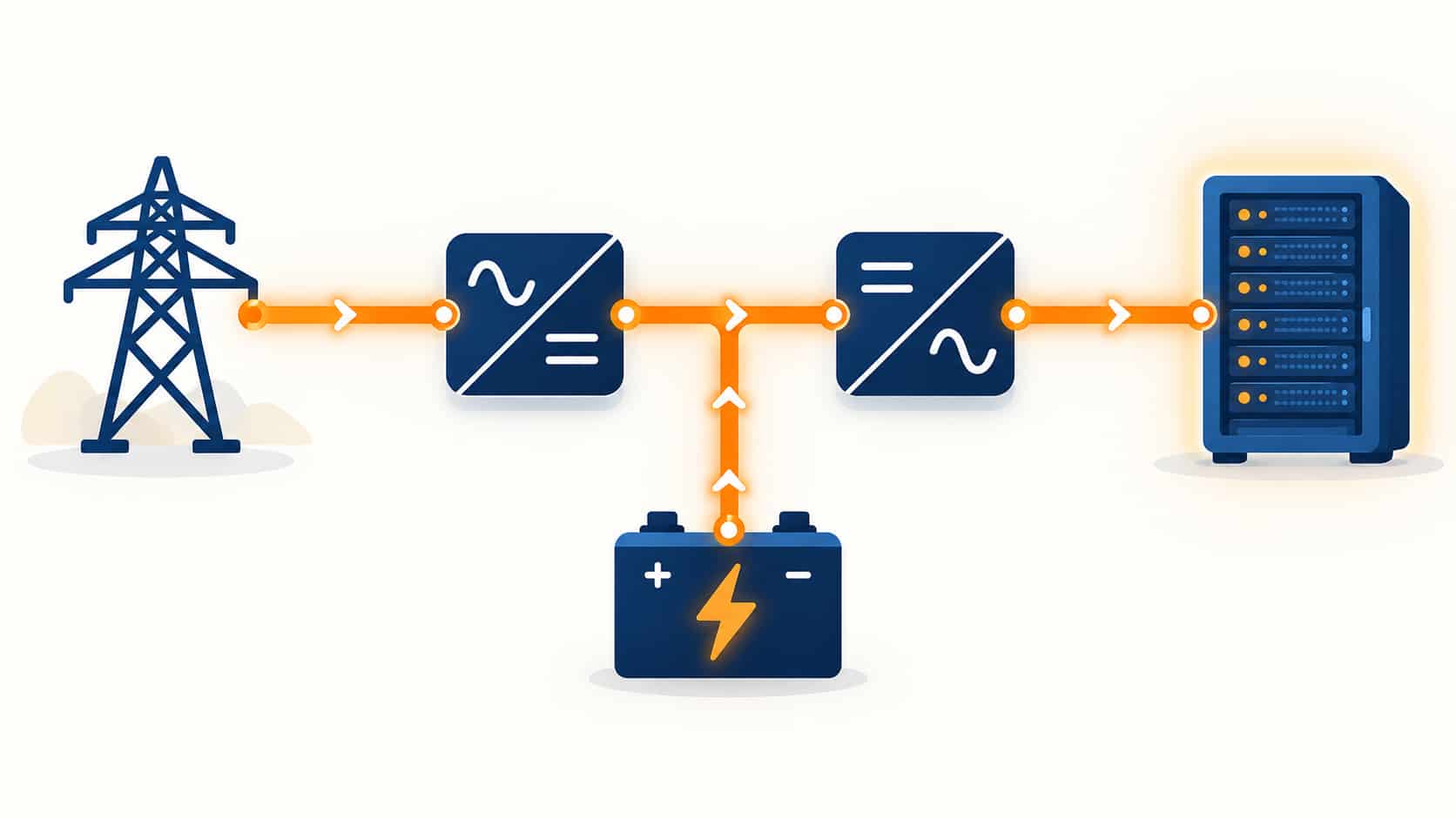
The heart of a modern UPS is a short, elegant chain. Incoming AC power first meets the rectifier, which converts it to DC. That DC bus does two jobs: it feeds the inverter, and it keeps the battery charged, floating at full readiness. The inverter then rebuilds an AC output from the DC bus—synthesizing a clean, tightly regulated sine wave at exactly the nominal voltage and frequency. The load, in other words, is not powered by the grid at all; it is powered by a machine that manufactures better power than the grid delivers.
When the mains fails, nothing dramatic happens inside an online UPS. The battery, already connected to the DC bus, simply becomes the energy source—the rectifier drops out of the picture and the inverter keeps spinning (electronically speaking) without a single interruption to the load. There is no relay to close, no contactor to bounce. This is why double-conversion UPS transfer time is measured in microseconds, effectively zero. When mains returns and stabilizes, the rectifier resumes feeding the bus and the battery recharges, sized by a charge curve that protects battery life.
Around that core sits the bypass. If the inverter overheats, overloads or fails, the static bypass switch transfers the load directly to the mains within milliseconds—imperfect power, but power, beats a dark rack. For service work, a manual maintenance bypass lets technicians isolate the UPS electronics entirely while the load runs from the grid. The control system orchestrates all of this, managing mode transitions, alarm handling and communication with the site’s monitoring platform.
The Core Components of a UPS System
Every quotation names these blocks, and knowing what each one does makes a quotation readable—and comparable:
| Component | What It Does | Why It Matters to the Buyer |
|---|---|---|
| Rectifier | Converts incoming AC to DC; feeds the inverter and floats the battery | Determines input power quality (THDi), efficiency and how gently the unit loads the generator upstream |
| Inverter | Rebuilds a regulated sine-wave AC output from the DC bus | Defines output voltage/frequency stability and overload capabilityâthe quality the load actually sees |
| Battery and management | Stores DC energy (VRLA or Li-ion) for the runtime window; monitors block health | Runtime, service life and the largest maintenance itemâask what the monitoring actually reports |
| Static bypass switch | Transfers the load to raw mains in milliseconds if the inverter fails or overloads | The safety net for the load; check its continuous rating and transfer logic, not just its existence |
| Maintenance bypass | Manual panel that powers the load from mains while the UPS is serviced | Determines whether battery or inverter service means downtime or not |
| Control and monitoring | Manages modes, alarms, battery testing and communications (SNMP, Modbus, dry contacts) | How your operations team sees the unitâintegration here decides how problems get noticed |
Two of these deserve special attention in procurement. The battery is typically 30–40% of system cost and the first thing to age, so battery chemistry, monitoring depth and warranty terms say a lot about how a manufacturer builds the rest of the unit. And the bypass train—static plus maintenance—is what the load experiences on the UPS’s worst day; a specification that omits bypass ratings is a specification that has not been tested by reality.
The Three UPS Topologies: Offline, Line-Interactive, Online
Not every load needs factory-grade power, and manufacturers price their designs accordingly. The offline (standby) topology is the simplest: the load runs on raw mains through a transfer switch, and the inverter starts only when mains fails. Transfer takes a few milliseconds—fine for desktop loads, a risk for servers that ride close to their tolerance limits. The line-interactive design adds an autotransformer with taps that can boost sagging voltage or trim surges without going to battery, which makes it a strong fit where brownouts are frequent but power is otherwise decent.
The online double-conversion topology is the standard for anything critical. The load is always supplied through the full rectifier–DC bus–inverter chain, so it never sees the grid at all: sags, surges, frequency wander and electrical noise are all absorbed by the conversion, and the transfer to battery is instantaneous by construction. The cost is higher conversion losses (heat, which costs cooling energy), but for data centers, medical imaging, semiconductor processes and telecom cores, it is the only topology worth quoting.
Within the online family sits one more architectural choice: the modular design, where power modules slot into a shared frame and can be added or hot-swapped without powering the load down. Modular versus monolithic standalone architecture is a procurement decision in its own right—one we compare in detail in a dedicated buyer’s guide for data center projects.
| Topology | How It Powers the Load | Transfer Time | Voltage Regulation | Best Suited For |
|---|---|---|---|---|
| Offline (standby) | Load runs on raw mains; inverter starts on mains failure | 2â10 ms typical | None (pass-through) | Single workstations, POS terminals, non-critical peripherals |
| Line-interactive | Autotransformer taps boost or trim voltage without transferring to battery | 2â6 ms | Moderate (tap-changing) | Network closets, industrial control panels, sites with frequent sags |
| Online double-conversion | Load always fed by the rebuilt sine wave from rectifier, DC bus and inverter | 0 ms (no transfer) | Fullâregenerates the waveform | Data centers, medical, telecom cores, precision manufacturing |
| Online modular | Double conversion in parallel hot-swappable modules inside one frame | 0 ms | Full | Growing facilities needing scale-out capacity and redundancy without downtime |
Runtime, Ratings and What the Numbers Actually Mean
UPS ratings trip up more buyers than the technology does. The headline figure is usually in kVA, but real loads are specified in kW, and the relationship between them—the power factor—decides whether a unit can actually carry the load. A 100 kVA UPS rated at 0.9 power factor delivers 90 kW; quoting against a 95 kW load on nameplate kVA alone is how systems end up in bypass during the first real test. Modern units advertise power factors of 0.9–1.0, which makes the kW rating, not the kVA, the figure to compare first.
Runtime is the second half-truth. Battery runtime is not linear: a battery that holds a light load for 30 minutes may hold the full design load for 8. Runtime curves also age—VRLA batteries deliver their promised window for a few years and then decline quickly, while Li-ion carries a higher first cost for longer, monitored service life. In practice, most data center designs specify 5–10 minutes of UPS runtime, just enough to start a generator or transfer to storage—not to run the facility on batteries. Sizing the system properly is a calculation, not a guess; we walk through the full method in our guide to UPS sizing for data centers.
Where the UPS Fits in a Data Center Power Train
A UPS never works alone; it is one station in a relay race. Utility power arrives at the main switchgear and transformer, where it is stepped down and distributed. A transfer system—generator or storage-backed—provides the long-duration tier. The UPS takes its feed from that train and delivers conditioned power to the PDUs, which carry it to the racks. Each link covers the others’ weaknesses: transformers and switchgear for voltage transformation and protection, generators and BESS for hours of energy, the UPS for seconds of absolute continuity.
This is why hybrid designs are becoming the default for new builds. A generator–storage hybrid system can cover the long-duration tier with lower fuel burn and emissions than generators alone, while the UPS keeps its short, sharp role. And where the facility’s critical load profile makes batteries doubly useful, battery energy storage serves both peak management and backup duty. The UPS specification should always be written after this power-train architecture is settled—otherwise runtime, battery type and even topology get designed around assumptions that the rest of the system later contradicts.
When a UPS Is Not the Answer
A UPS is a bridge, not a power plant. The most common misuse is expecting it to cover a long outage: a system sized for 30 minutes of full-load runtime needs a battery bank so large that a generator or storage tier becomes the cheaper, more maintainable answer hours before the battery math closes. The second misuse is treating it as a power quality cure-all. A UPS conditions voltage and frequency at its output terminals; it does not fix chronic harmonics from your own drives, does not correct a badly balanced distribution board, and does not make up for an undersized transformer running hot upstream.
The third mistake is ordering light. Loads grow—data centers routinely add IT capacity within two years of commissioning—and a UPS specified at today’s load with no margin and no expansion path ends up running at overload, spending its life in bypass, which silently cancels the entire investment. If the load is genuinely tolerant of interruptions, a simpler transfer scheme with a generator may be the honest answer; buying an online UPS for a load that does not need it is spending capital to heat the room.
UPS Specification Checklist for Buyers
Whether the quote is for one cabinet or a parallel system, these line items make quotations comparable and catch the gaps early:
- Load definition: kW (not just kVA) present and future, power factor, load type (IT, motor, mixed), and expected growth over the system’s life.
- Topology and rating: online double-conversion confirmed; kW rating at stated power factor; overload capability (typically 105–110% continuous, higher short-time).
- Runtime and battery: minutes at stated kW; battery chemistry (VRLA/Li-ion); monitoring depth (block-level or string-level); warranty and expected service life.
- Efficiency: double-conversion efficiency at 25/50/75/100% load—most systems live at partial load, where efficiency differences compound.
- Bypass train: static bypass rating and logic, maintenance bypass arrangement, and whether service means downtime.
- Architecture: single unit or parallel (N+1/2N); modular or monolithic; footprint and weight; front or rear access.
- Input compatibility: input voltage range and frequency tolerance, generator compatibility (THDi, input filter), upstream breaker coordination.
- Communications: SNMP/Modbus/BMS integration points, dry contacts, and what the monitoring platform actually reports.
- Standards and testing: IEC 62040 series compliance, factory test scope witnessed before shipment, FAT report format.
- Support: commissioning scope, spare parts availability, response commitments, and training for site staff.
Conclusion
A UPS system is a machine for manufacturing continuity: it converts, stores and rebuilds power so precisely that the load never learns there was a problem. The rectifier, battery and inverter chain does the work; the bypass train carries the load on the UPS’s worst day; and the topology—offline, line-interactive or online double-conversion—determines how much protection the load actually receives. None of this is complicated once the power path is clear, and every line of a serious quotation becomes readable.
The discipline is in the specification: size in kW with real growth margin, define runtime as a bridge to the next power source, and settle the facility’s full power-train architecture before freezing the UPS design. When you are ready to price a system, the team at KXY E-Power Group supplies UPS systems as part of a coordinated power chain—switchgear, transformers, transfer and storage designed to work as one system rather than as a cabinet and a hope.
Frequently Asked Questions
Recent Posts
Voltage Stabilizers vs UPS: Do You Need Both?
Voltage Stabilizers vs UPS: Do You Need Both? One device fixes how high or low the voltage is; the other fixes whether there is voltage
Energy Storage for Data Centers: A Growing Backup Power Option
Energy Storage for Data Centers: A Growing Backup Power Option Batteries have always backed up data centers in the form of UPS strings. Grid-scale BESS
Thermal Runaway in Lithium Batteries: What BESS Buyers Should Understand
Thermal Runaway in Lithium Batteries: What BESS Buyers Should Understand How thermal runaway starts, how it propagates, and which evidence buyers should require before approving