
Backup Power Planning for Hospitals and Critical Facilities
A hospital is not a building with a generator bolted on; it is a set of loads with radically different tolerances, and every one of them has a different definition of downtime
Introduction
Hospitals are the hardest backup power clients in the electrical industry. Not because the technology is exotic—the components are the same switchgear, transfer switches, generators and UPS systems sold everywhere—but because the consequences are different in kind. In a data center an outage costs money; in an operating theatre it costs a life. That asymmetry drives a design culture where redundancy tiers, transfer times and battery runtime are specified by code and clinical procedure rather than by the finance department, and where the electrical room is inspected, tested and documented on a schedule that no commercial building would tolerate.
The practical difficulty for contractors and buyers is that “hospital backup power” is not one system. Modern healthcare facilities are among the most thoroughly layered power architectures in existence, and the layers serve different loads with different tolerances. A radiology suite, an ICU ventilator and a corridor socket are all “hospital loads,” yet their acceptable interruption durations span milliseconds to “until we can move the patient.” Planning badly means either gold-plating the corridors or, far worse, undersizing the branch that keeps a ventilator running.
This guide lays out how hospital and critical-facility power is actually structured, how to classify loads before sizing anything, how the redundancy tiers map onto budgets, and what equipment set an EPC contractor has to coordinate. It assumes an international project context—IEC-based equipment, local code overlay, and a mix of imported and locally sourced components—and it links to the wider range on our data center and critical power page where relevant.
Why Hospitals Are a Different Class of Project
Clinical consequences replace financial ones. The industry’s usual risk calculus—cost per minute of downtime—does not translate. An interruption in an operating theatre during surgery may be unrecoverable in a way that no SLA captures. This shifts the design target from “minimize expected cost” to “make the specific failure modes that harm patients essentially impossible,” which is a much more expensive and much more prescriptive brief.
Code dictates architecture, not just components. In the United States, healthcare facilities are governed by NEC Article 517 with its Essential Electrical System concept; internationally, IEC-based requirements combine with national health ministry regulations and accreditation rules. The consequence for procurement is that the electrical architecture—not merely the equipment rating—is auditable. Inspectors ask why a branch was classified the way it was, and the answer must reference a standard, not a preference.
Loads are heterogeneous to an unusual degree. A hospital contains resistive heating, large motor loads (chillers, air handling, vacuum and medical air compressors), imaging equipment with pulsed high-current demand, sensitive electronics, and life support devices on battery themselves. No single protection device serves that spread well, which is precisely why the sector developed a branched architecture rather than a single critical bus.
The facility never stops. Unlike a data center that can schedule maintenance windows, a hospital cannot evacuate to perform a busbar change. Redundancy must therefore be maintainable while live—which is a design constraint that eliminates many otherwise attractive single-point-optimized topologies and pushes toward parallel, isolatable, bypassable arrangements.
Classifying Loads: The Branch Concept
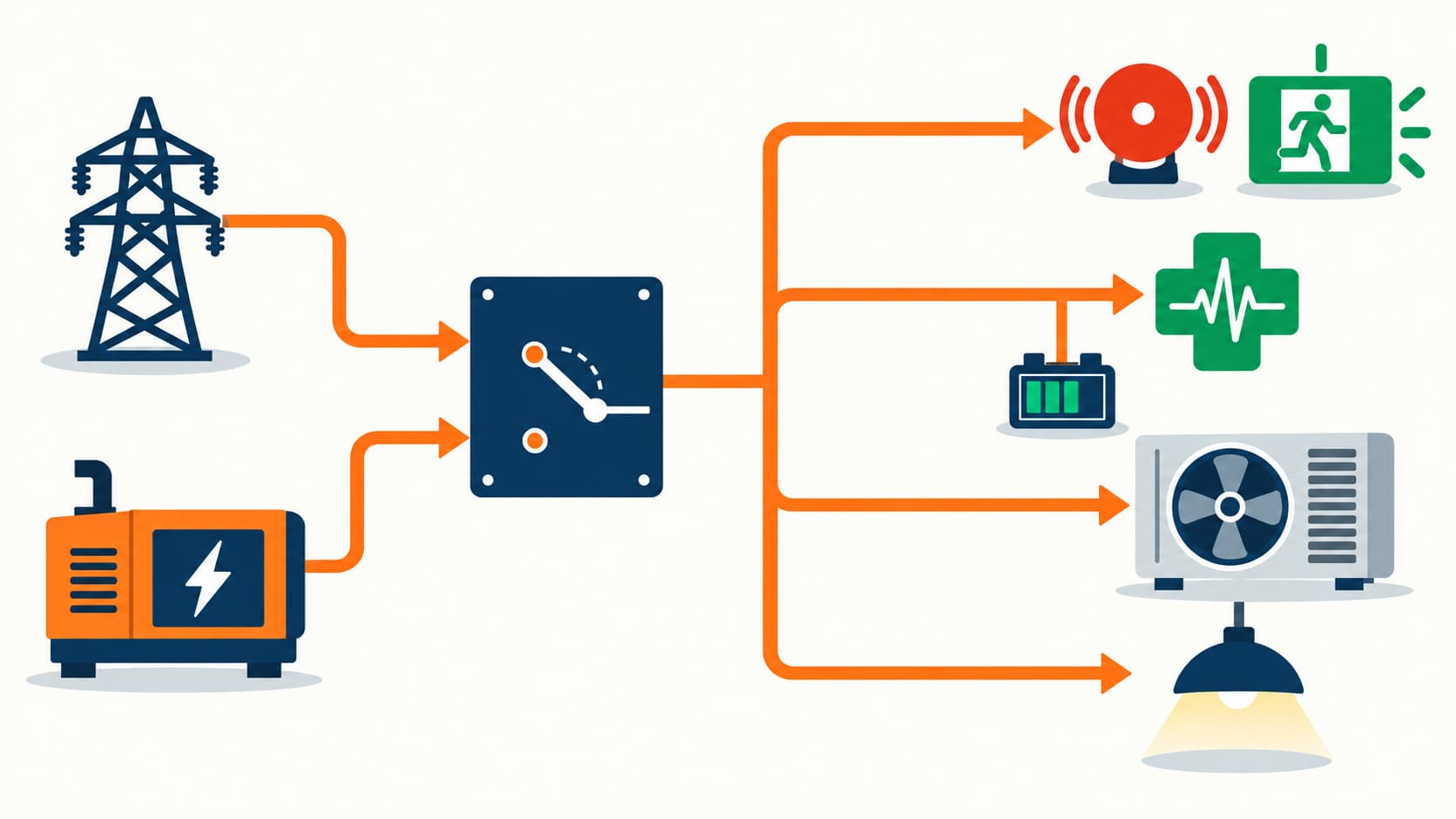
Every credible hospital backup design begins the same way: sort the loads by how long they can tolerate being unpowered, and only then choose equipment. The familiar US three-branch model is a useful mental template that maps cleanly onto international practice, even where the local code names and boundaries differ:
Life safety. Loads whose failure immediately threatens life during egress and firefighting: egress lighting, fire alarms and detection, fire pumps, elevators designated for fire service, alarm and communication systems. These must transfer quickly—well under ten seconds in the codes that quantify it—and they are the loads you can never trade away for budget.
Critical branch. The clinical core: operating and delivery rooms, ICU and NICU, anesthesia and ventilator equipment, blood banks and refrigeration, nurse call, medical records, selected imaging, and the sockets and lighting that support them. Transfer must be fast enough that no procedure is interrupted; in practice this branch is where the generator and UPS deadlines collide, because some of these loads also need uninterruptible quality.
Equipment branch. Large mechanical and support loads that can tolerate a longer transfer: chillers, air handling, central plant pumps, sterilizers, some kitchen and laundry equipment. These may be delayed or staged onto the generator deliberately to avoid a step load the generator cannot absorb in a single hit.
Classifying loads this way immediately produces the two numbers that drive the whole procurement: the instantaneous transfer requirement (which decides ATS versus static transfer versus UPS) and the sequenced load profile (which decides generator sizing and staging logic). A mistake in branch classification is far more expensive than a mistake in equipment brand, because it propagates into every downstream decision.
Where Each Device Earns Its Place
Generators supply duration; UPS supplies continuity. A hospital generator set with fuel for 48 to 96 hours answers “how long can we be off-grid,” but it takes seconds to start and accept load. That gap—the ten seconds between outage and generator acceptance—is why UPS systems exist in the architecture. The UPS does not compete with the generator; it covers the generator’s startup, rides through the transfer, and retires gracefully once the generator is stable.
Automatic transfer switches define the facility’s interruption profile. Open-transition ATS breaks before it makes, leaving a gap of tens of milliseconds to seconds. Closed-transition and static transfer switches overlap or switch in a few milliseconds. For operating theatres and imaging suites the choice is not a preference but a clinical requirement, and it is also where the cost difference lives—the same engineering that governs low voltage and medium voltage switchgear selection applies to the transfer equipment.
UPS redundancy decides whether maintenance is possible. A hospital cannot shut down a UPS to replace a battery module if that UPS is the sole supply to ICU. This is the point at which the abstract redundancy discussion becomes concrete: a redundant topology lets the facility work on one module while the other carries the load, and only then does the battery maintenance program become feasible. The wider question of how long the batteries must carry the load is covered in our guide to energy storage and backup for data centers, which applies equally to hospital critical buses.
Energy storage is joining the architecture. Where diesel fuel logistics, emissions rules or grid instability make generators awkward, hybrid generator-and-storage arrangements increasingly serve the same bridging and peak-smoothing functions with less fuel burned. Our overview of generator-storage hybrid systems sets out how those arrangements are put together for facilities that cannot tolerate a gap.
Equipment Set: What an EPC Actually Coordinates
| Branch | Typical Loads | Backup Arrangement | Transfer / Ride-Through Target |
|---|---|---|---|
| Life safety | Egress lighting, fire alarm and detection, fire pumps, fire-service elevators, communications | Generator-backed ATS dedicated to the branch; no dependence on the clinical bus | Fast ATS transfer, typically under 10 s; fire pump arrangements per local code |
| Critical (clinical) | OR, ICU and NICU, anesthesia and ventilators, blood bank, nurse call, selected imaging | UPS on the interruption-intolerant subset, behind a fast or static transfer switch | Milliseconds for the UPS-fed subset; seamless across generator transfer |
| Equipment (support) | Chillers, air handling, central plant pumps, sterilizers, laundry, kitchen | Generator-backed, often with delayed or staged reconnection | Seconds to minutes, sequenced to respect generator step-load limits |
| Non-essential | General office sockets, lobby lighting, convenience loads | Normally unbacked; may be shed automatically on generator operation | Not protectedâdeliberate, and documented as such |
Building the Load Schedule Before You Buy Anything
Everything above converges on one deliverable that the buyer, not the supplier, must own: a branch-resolved load schedule. It is unglamorous and it is where projects are won or lost. The schedule lists every significant load with its kW and power factor, its starting characteristic if motor-driven, its branch classification, and its interruption tolerance in plain language agreed with the clinical or operations team. Only when that sheet exists can anyone answer the questions suppliers actually ask—largest motor start, simultaneous versus staged equipment restart, UPS bus kW, required transfer type—without guessing.
| Field | Why It Matters | Common Error |
|---|---|---|
| Branch classification | Sets which protection path the load is entitled to | Classifying by department budget instead of clinical tolerance |
| Interruption tolerance | Decides UPS versus transfer versus generator-only | Assuming every "critical" load needs a UPS |
| Starting characteristic | Drives generator step-load rating and staging logic | Sizing the generator on running load alone |
| Simultaneity factor | Prevents overload when the whole branch reconnects at once | Assuming all loads restart in the same instant |
| Growth allowance | Leaves headroom for new imaging or ward capacity | Designing to today's nameplate with no margin |
| Duty and duration | Distinguishes momentary from continuous demand | Treating intermittent loads as continuous |
Runtime, Fuel and the Autonomy Question
Runtime is the parameter hospitals argue about most and understand least. Generator fuel autonomy—how long the site can run on stored fuel—is governed by code minimums in some jurisdictions (commonly expressed in hours under design load), by the reliability of resupply in others, and by clinical evacuation planning in all of them. The honest method is to define an autonomy target from an operational scenario: not “how many hours does the code require,” but “how long would it take to evacuate or resupply this facility, and what happens if resupply is delayed by the same event that caused the outage?”
UPS runtime answers a different question entirely: it must cover generator startup, transfer, and stabilisation with a comfortable margin—typically a few minutes, not hours—plus whatever ride-through is required during generator-to-generator or bus maintenance transitions. Sizing UPS batteries for hours of load is a common and expensive error; the batteries are there to bridge to the generator, and the generator is there to run for hours. The sizing logic for that bridging role is set out in our guide to energy storage and backup for data centers.
Redundancy Tiers and What They Cost
Redundancy is where hospital projects most often over- or under-spend. The tiers are not a menu of good-better-best; they are answers to specific availability questions, and the correct level differs branch by branch within the same building.
N—no spare module. Acceptable only for loads where the outage consequence is tolerable and maintenance can be scheduled. Rarely appropriate for clinical branches.
N+1—one spare module or unit, so any single unit can be taken out for service while the load stays live. This is the workhorse tier for hospital clinical buses, and its real value is not surviving a failure but enabling maintenance without a shutdown—which is what keeps a ten-year-old UPS actually maintained rather than merely present.
2N—two fully independent paths, each capable of carrying the whole load, ideally with physical and route separation. Reserved for the smallest, most critical bus where even a momentary single-path exposure is unacceptable. Applying it facility-wide is how budgets collapse before the switchgear is even ordered.
2N+1—2N plus an additional spare, used where maintainability of the redundant system itself is required. Genuinely rare, and worth questioning whenever it appears in a specification.
The practical test for any redundancy claim is the same: can the load be maintained while it stays live, and can the system survive the failure it was designed around? A drawing that answers neither is redundancy on paper only. Redundancy also depends on topology rather than label alone, as our guide to switchgear selection shows when the distribution path itself is the weak point.
Testing, Commissioning and the Load Bank
Acceptance testing is not optional here. A hospital generator that starts on the first outage but fails on the fifth—a cold-start-versus-hot-start difference, or a fuel or battery issue—is worse than no generator, because the facility has built procedures around it. Commissioning must include full-load bank testing, not just no-load start verification, and it must include the transfer sequence under realistic conditions: what happens when the generator is already running and the utility dips, what happens on a failed transfer, what happens when one UPS module is out for maintenance.
Documented periodic testing is the real deliverable. Monthly generator runs, annual load bank tests, battery impedance and capacity checks, ATS transfer tests, breaker and protection checks—an auditable test log is what accreditation and insurance inspectors actually ask for. For the buyer, this means the equipment specification should anticipate testing, not merely tolerate it: test ports, bypass provisions, metering granularity and alarm integration all make the difference between a test that takes an afternoon and one that requires a shutdown.
Failure modes deserve explicit write-ups. The systems that fail in hospitals are usually not the headline devices but the supporting ones—a battery string aged beyond its warranty, a transfer switch whose control contacts have never been exercised, a fuel system whose polishing regime no longer matches the fuel being delivered. A commissioning package that names the top failure modes and the check that catches each is more valuable than a longer equipment list.
Common Planning Mistakes
Running a single transfer switch for the whole facility, which collapses three different clinical tolerances into one compromise and typically under-protects the theatre while over-protecting the car park. Treating the generator as the whole answer and omitting UPS ride-through, then discovering the ten-second gap during the first real commissioning test. Sizing UPS batteries for hours of autonomy because the runtime discussion was transferred from the generator to the UPS without understanding the division of labour. Classifying loads by which department paid for them rather than by clinical tolerance. Ignoring step-load behaviour and starting the entire equipment branch onto the generator simultaneously, which stalls or trips the set. Specifying 2N redundancy for the entire hospital because redundancy sounds safe, and then being unable to maintain any of it because the budget ran out at the switchgear line item.
Specification Checklist
Quotations from different suppliers become comparable only when these are pinned down:
- Load classification: life safety / critical / equipment / non-essential lists signed off with the clinical team and referenced to the governing standard.
- Transfer requirement per branch: specified transfer time, transition type (open, closed, static), and the failure mode if the transfer does not complete.
- Generator: continuous and standby ratings, step-load acceptance capability and the largest single motor start, fuel autonomy hours at design load, fuel storage and polishing, paralleling and load-sharing provisions, emissions compliance for the jurisdiction.
- UPS: topology (online double-conversion for clinical loads), redundancy level per bus, runtime at design load with end-of-life margin, battery chemistry and monitoring depth, maintenance bypass arrangement.
- Switchgear and distribution: ATS/STS ratings and configurations, branch separation integrity, protection coordination study, arc-flash and clearance requirements, metering and monitoring points.
- Testing and documentation: FAT scope at the factory, site acceptance with load bank, periodic test schedule, as-built documentation language, and training for facility staff.
Conclusion
Hospital backup power planning is a classification exercise before it is an equipment exercise. Decide what each load can tolerate, assign it to a branch, and the architecture largely designs itself—the fast transfer switches and UPS land where the tolerances are tight, the generator and staged equipment branch cover the long duration, and the redundancy level is set by whether the system must be maintainable while live. Get the classification wrong and no amount of premium equipment repairs it; get it right and most of the subsequent decisions become straightforward engineering.
For EPC contractors and healthcare developers working across borders, the practical advantage is a supplier who can supply the whole chain—switchgear, transfer switches, UPS, generator interface and the distribution between them—against one coordinated set of ratings, rather than components from five vendors who have never seen each other’s data sheets. The team at KXY E-Power Group supplies critical power equipment for hospitals, data centers and industrial facilities as one architecture; send us your branch schedules and we will price the set against them rather than against a brochure.
Frequently Asked Questions
Recent Posts
Voltage Stabilizers vs UPS: Do You Need Both?
Voltage Stabilizers vs UPS: Do You Need Both? One device fixes how high or low the voltage is; the other fixes whether there is voltage
Energy Storage for Data Centers: A Growing Backup Power Option
Energy Storage for Data Centers: A Growing Backup Power Option Batteries have always backed up data centers in the form of UPS strings. Grid-scale BESS
Thermal Runaway in Lithium Batteries: What BESS Buyers Should Understand
Thermal Runaway in Lithium Batteries: What BESS Buyers Should Understand How thermal runaway starts, how it propagates, and which evidence buyers should require before approving