
Grid Expansion Equipment for Rural Electrification Projects in Africa
Electrifying a village is not a scaled-down city project—load density, distance, terrain and maintenance reality rewrite the equipment list from the first pole to the last meter.
Introduction
Africa’s electrification programmes are among the largest infrastructure undertakings on the continent: national utilities extending feeders toward unserved districts, rural electrification agencies tendering hundreds of village connections at a time, and private developers building solar mini-grids where the grid will not arrive for a decade. Behind every connection rate statistic sits a very concrete shopping list—poles and conductors, distribution transformers, ring main units or fuse-cutouts, metering, and increasingly solar and storage hardware bolted onto the same network.
This guide is written for the people who buy that list: utility procurement teams, rural electrification agency engineers, EPC contractors executing donor-funded lots, and mini-grid developers. It covers what makes rural African projects different from ordinary grid expansion, how to choose between feeder extension and mini-grid architectures, which equipment each architecture needs, and the practical sizing, logistics and procurement questions that decide whether the hardware serves a village for twenty years or disappoints within two. The core MV equipment is treated only at selection level here—our transformers and substations overview carries the deeper engineering detail.
What Makes Rural African Electrification Different
Urban distribution design assumes many customers per kilometre, balanced three-phase load, and a maintenance crew within driving distance. Rural Africa breaks all three assumptions, and each break changes the hardware.
- Low load density over long distances. A feeder may run thirty kilometres to serve a few hundred households scattered along a road. Line losses and voltage drop dominate the design, pushing toward higher distribution voltages, larger conductor than the load alone suggests, and voltage regulation equipment that city networks rarely need.
- Single-phase and phase-to-phase loads. Most village loads are lighting, phone charging, small motors and evening cooking. Single-phase tap-offs from a three-phase spine, single-phase transformers on long spurs, and SWER-style or split-phase arrangements appear throughout the continent, and the equipment standard must match the local utility’s practice exactly.
- Sharp evening peaks. Rural demand is a narrow spike after sunset—lighting, TVs, charging—all at once. A transformer that looks generously sized against daily energy can saturate on the evening peak, so peak-based sizing beats energy-based sizing.
- Thin maintenance capacity. The nearest qualified crew may be hours away. Equipment that needs frequent attention—oil checks, relay recalibration, elaborate switching sequences—costs more in logistics than in purchase price. Sealed, maintenance-free and simple-to-operate hardware earns its premium here.
- Security exposure. Remote sites face theft of copper, batteries, solar panels and even transformer units. Enclosure design, anti-vandal hardware and community engagement are procurement-relevant, not afterthoughts.
Choosing Between Grid Extension and Mini-Grids
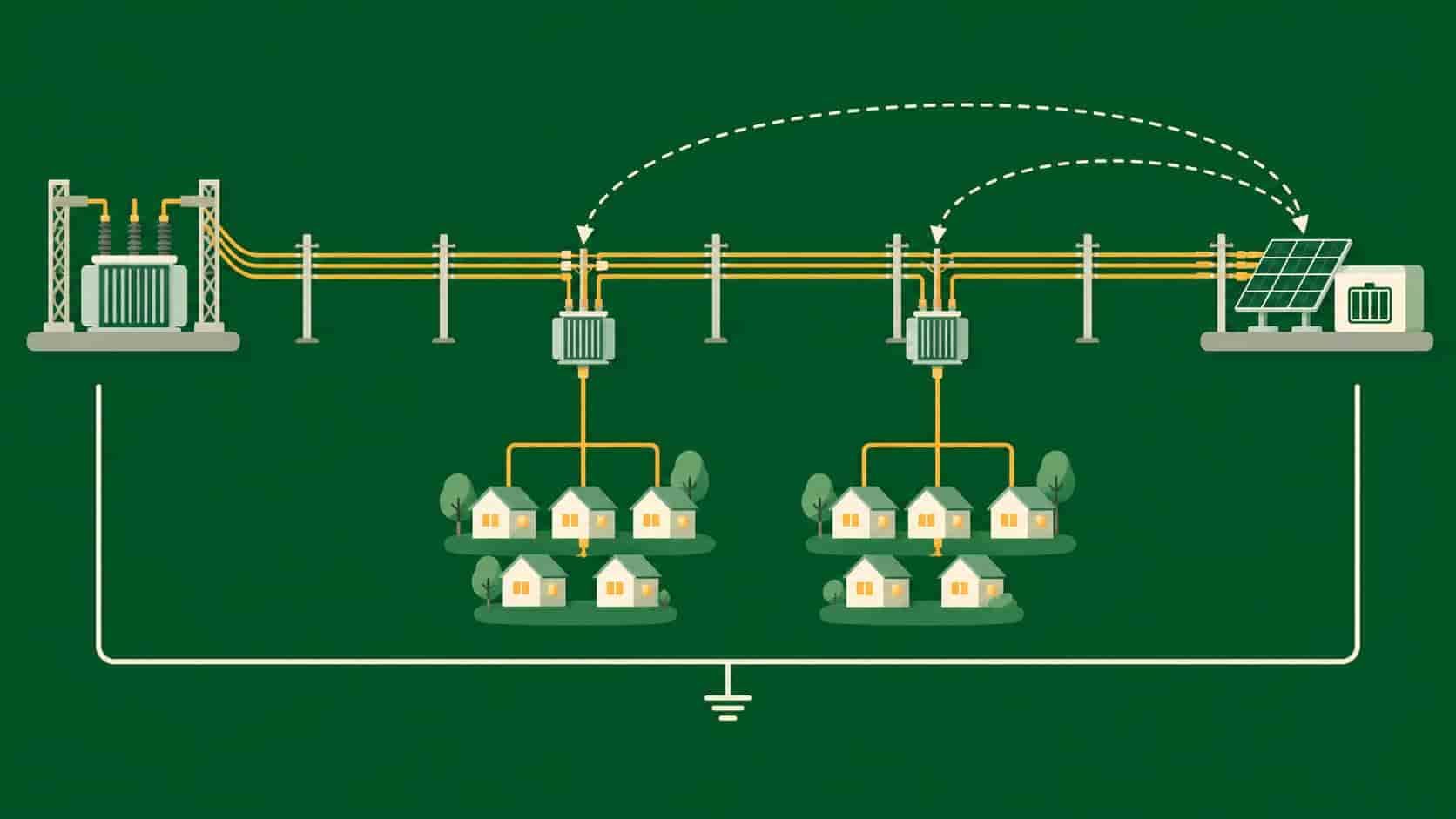
The first architecture decision shapes everything downstream. Grid extension makes sense where the existing MV network passes within a few kilometres of the community and the utility can guarantee operations—villages get utility-grade supply and standard tariffs. Solar mini-grids win where extension distance is long, load is small, and sunshine is reliable: generation, storage and distribution are built and owned as one local system, often with diesel backup. Hybrid arrangements—extension now, PV and storage bolted on later—are increasingly common as donors fund phased upgrades.
For buyers the practical consequence is that two different equipment catalogues apply. Extension projects buy conventional distribution hardware engineered for utility networks; mini-grids buy generation-plus-storage plants with a small distribution layer attached. The mistake to avoid is buying either one with the other’s assumptions—utility switchgear specified into a mini-grid that has no operating crew, or household-scale solar parts specified into a feeder that will carry a maize mill.
The Equipment Set for a Rural Feeder Extension
A typical extension lot—say, a 33 kV or 11 kV spine with village tap-offs—breaks into the categories below. Quantities vary by programme; the specification questions repeat from project to project.
| Equipment | Role in the Programme | Selection Points for Rural Service |
|---|---|---|
| Poles, conductors and line hardware | The physical feeder: spine, tap-offs and service drops | Conductor sized for voltage drop at the far end, not ampacity alone; pole class for terrain and transport routes; hardware galvanisation matched to coastal or inland corrosion zones |
| Distribution transformers | Step down to LV at every village or cluster | Pole-mounted or compact plinth type per utility standard; sealed or conservator-free designs where maintenance is scarce; losses class priced into evaluation, not ignored |
| Switching and protection | Isolate faults without trips to the whole spine | Fuse cutouts for small taps; RMUs or auto-reclosers on longer spinesâour RMU versus switchgear comparison covers the choice; ratings matched to utility coordination study |
| LV boards and metering | Connect households and bill energy | Prepayment or standard meters per programme policy; boards with headroom for connection growth; approved-pattern certification for the utility's revenue system |
| Solar-hybrid add-ons | PV, storage and controls layered onto the feeder or village node | Grid-forming storage for weak-feeders; containerised BESS sized for evening peak shift; EMS able to coordinate with diesel where backup exists |
| Earthing and lightning protection | Protect people and equipment across storm-prone terrain | Earthing resistance targets achievable in local soil; surge arresters at transformers and line ends; lightning density data driving the arrester budget |
Two selection notes deserve emphasis. On transformers: rural programmes buy hundreds of units, and the losses class you accept is multiplied across every unit and every year—our guide to pad-mounted versus pole-mounted transformers explains the mounting decision, and loss evaluation methodology should be written into every tender. On switching: the simplest device that the coordination study supports is usually the right one for rural service; every layer of sophistication you add must be matched by the crews who will operate it.
Sizing for Today's Load and Tomorrow's Connection
Rural sizing is a bet on growth. Connections arrive in waves—first the near households, then shops and schools, then productive users like mills, irrigation pumps and cold storage that transform the load profile. Sizing only for connection-day demand strands capacity economics; sizing for an imagined city bankrupts the programme.
The discipline that works: size conductors and the spine for the ten-year connection plan, but size transformers in steps—initial rating plus a documented upgrade path (parallel capability, spare plinth, standardised bushings) so a growing village gets capacity without redesigning the network. Programmes that standardised one or two transformer platforms across hundreds of villages report faster installation, simpler spares and lower total cost than those that optimised each site individually. Measure the evening peak where an existing feeder nearby offers data; where it does not, use programme benchmarks from comparable regions rather than optimistic national averages. And where an extension includes underground segments—township mains, workshop connections, river crossings—order the cable, joints and terminations as one matched system; our guide to MV cable standards across IEC, GB and BS explains why mixing standards multiplies accessory failures.
Solar-Hybrid Design: PV and Storage on the Feeder
Across the continent, the line between “grid extension” and “solar project” is blurring. Utilities add PV and battery storage at weak feeder ends to shore up voltage and defer upgrades; mini-grids add diesel for cloudy weeks; donors fund battery retrofits to extend supply hours. The equipment question is integration: storage must operate grid-forming when the feeder is dead and grid-following when it is live, and the control layer must treat generation, storage and any diesel as one system. Our articles on battery storage fundamentals and generator-storage hybrid systems cover the control architecture; for rural programmes the added requirements are heat, dust and remoteness—thermal design rated for site conditions, not laboratory ones, and remote monitoring because the site visit is expensive.
Logistics, Terrain and the Last Mile
More rural electrification schedules die in logistics than in engineering. The second table lists the recurring challenges and the countermeasures that experienced programme teams build into supply contracts.
| Challenge | What Happens Without Planning | Countermeasure to Write into the Contract |
|---|---|---|
| Poor access roads and bridge limits | Transformer and pole deliveries stall at the last river; cranes cannot reach site | Route survey before order confirmation; delivery in transport-sized modules; manual-handling and small-crane installation methods agreed up front |
| Port congestion and customs delays | Equipment sits at the port while the dry-season construction window closes | Clearance responsibility and demurrage allocation stated; delivery phased to the construction calendar; documentation handled by a named agent |
| Seasonal construction windows | Rainy season halts civil works and strands partially built lines | Batch deliveries aligned to the works programme; storage-in-transit and weatherproof packing specified; buffer stock for the critical path items |
| Theft and vandalism en route and on site | Copper, panels and batteries vanish between compound and pole | Anti-vandal enclosures and locking hardware in the scope; delivery-to-incident responsibility clear; community liaison budgeted as programme cost |
| Thin local spares | A single failed cutout idles a village until a part arrives from the capital | Commissioning spares package per lotâfuses, arresters, insulators, joint kitsâdelivered and stored with the operating utility |
Buying Under Donor and Agency Procurement Rules
Much rural electrification hardware is bought under donor-funded frameworks—World Bank, African Development Bank, national agencies—whose rules shape the transaction as much as the engineering does. Bidders should expect: eligibility and origin requirements verified at bid stage; type-test certificates from accredited laboratories matched to the exact variant offered; factory inspections and witnessed routine tests as conditions of shipment; and evaluation on total cost of ownership, with losses and operational life priced into the comparison rather than stripped out. Suppliers experienced with these frameworks produce compliant documentation as a matter of course; suppliers new to them discover the requirements at the worst possible moment—after delivery. Ask for references from completed donor-funded lots and check the paperwork quality as carefully as the product.
When Grid Extension Is Not the Answer
Extension is not automatically the default. It fails as a strategy when: the distance from the existing network exceeds what losses and capex can justify against the village’s realistic revenue; the utility’s operating budget cannot sustain the added maintenance footprint; or productive load is too thin to anchor the evening economics. In these cases solar mini-grids—or interim solar home systems with a planned migration path—deliver connections years earlier. The honest procurement test is total delivered cost per connection over ten years, including operations, compared across architectures with the same growth assumptions.
Conclusion
Rural electrification in Africa rewards programmes that respect the environment they build in: long distances, evening peaks, thin maintenance, real logistics. The equipment list is not exotic—it is distribution hardware chosen with rural discipline. Conductor sized for voltage drop, transformers sized for peaks with upgrade paths, switching simple enough to operate, solar-hybrid layers designed for integration, and contracts that carry the spares and packing decisions the schedule depends on.
Buyers who pin those disciplines into tenders get networks that are still energising new connections a decade later. The suppliers worth shortlisting are the ones who ask about your terrain, your evening peak and your maintenance reach before they quote—because those answers, more than any datasheet, decide whether the hardware fits.
Frequently Asked Questions
Quick answers to the questions programme teams ask about rural electrification equipment.
Recent Posts
Energy Storage for Data Centers: A Growing Backup Power Option
Energy Storage for Data Centers: A Growing Backup Power Option Batteries have always backed up data centers in the form of UPS strings. Grid-scale BESS
Thermal Runaway in Lithium Batteries: What BESS Buyers Should Understand
Thermal Runaway in Lithium Batteries: What BESS Buyers Should Understand How thermal runaway starts, how it propagates, and which evidence buyers should require before approving

What Cables Does a Data Center Need? The Complete Cable List
What Cables Does a Data Center Need? The Complete Cable List Quick Answer: A data center needs eight cable families — medium voltage feeders, low