
What Cables Does a Data Center Need? The Complete Cable List
Quick Answer: A data center needs eight cable families — medium voltage feeders, low voltage distribution, UPS and battery cables, fire-rated mineral insulated circuits, LSZH wiring, control cables, grounding and bonding, and structured copper plus fiber — each governed by its own standard.
Introduction
Data center construction is growing faster than almost any infrastructure category, and the cable bill reflects it. Market analysts put data center cable demand on a multi-year growth trajectory as AI clusters raise rack densities and new campuses come online across Southeast Asia, the Gulf and North America — a buildout we track in more detail in our review of data center power demand growth. More megawatts per hall means more copper per hall, and more distinct cable families per project.
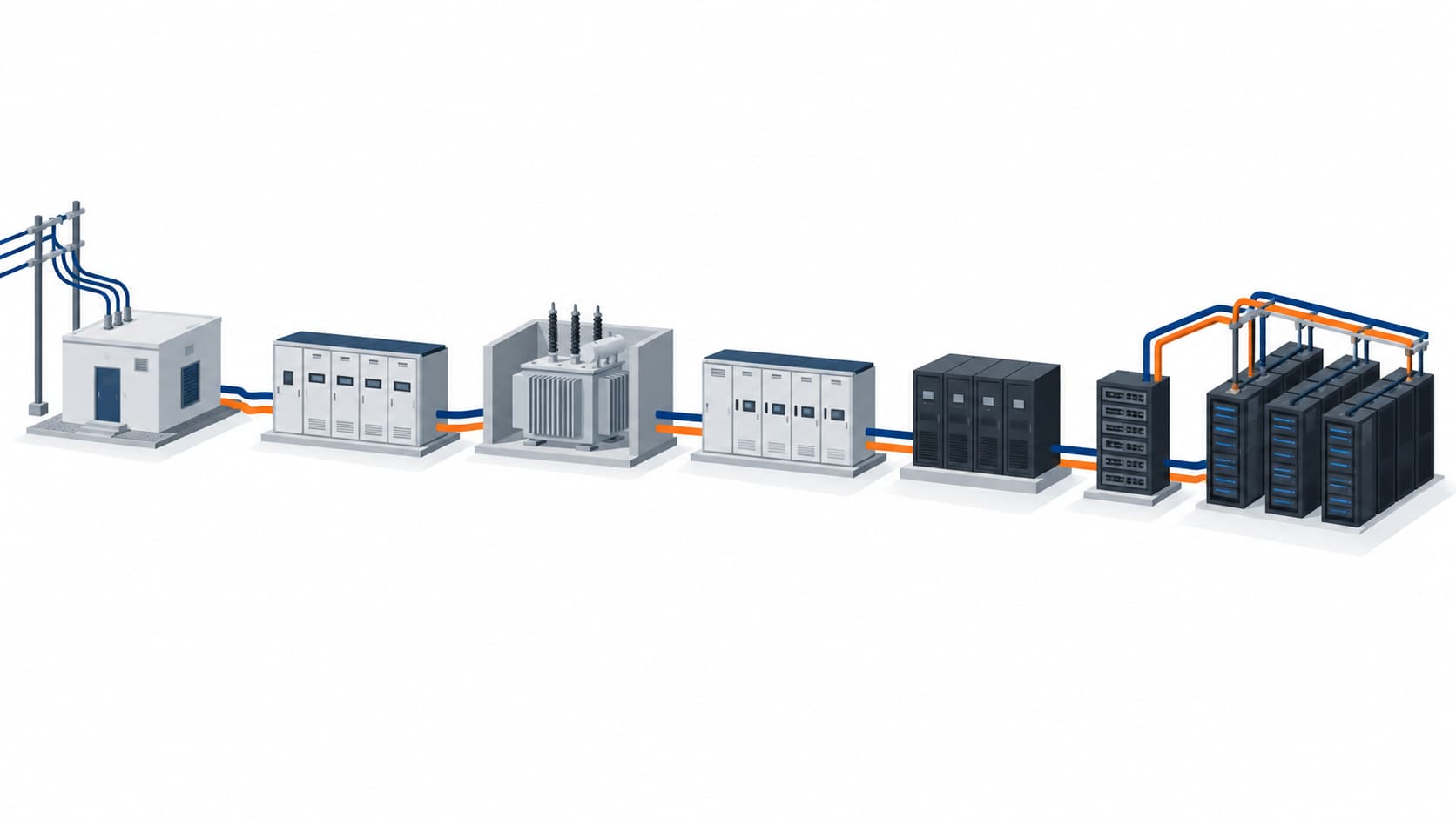
This article is the pillar reference for that topic. It lists every cable family a modern facility needs, the standard that governs each one, and where each family physically runs. If you are building out the complete equipment scope alongside cable, our data center power collection covers the switchgear, UPS and transformer side of the same power chain.
The Seven Cable Families Every Facility Shares
Strip away the brand names and every data center — from a 2 MW edge site to a 100 MW hyperscale campus — is wired from the same seven or eight cable families. What changes between projects is voltage class, conductor size, fire performance and sheath material, not the families themselves. The table below is the complete list, ordered roughly in the direction power flows.
| Cable Family | Typical Products and Sizes | Where It Runs | Governing Standards |
|---|---|---|---|
| Medium voltage feeders | 8.7/15 kV to 26/35 kV single-core XLPE, copper 185-630 mm2 | Utility intake or on-site substation to main MV switchgear | IEC 60502-2 |
| Low voltage distribution | 0.6/1 kV XLPE (YJV / WDZ-YJY), copper 95-400 mm2, single-core or multi-core | MV switchgear to busway, PDUs and distribution boards | IEC 60502-1 |
| UPS and battery cables | Flexible 0.6/1 kV, copper 25-500 mm2, Class 5 fine-stranded | UPS to battery strings, UPS output to distribution | IEC 60228 Class 5 |
| Fire-rated circuits | BTTZ rigid MI, BBTRZ / NG-A (BTLY) flexible MI, WDZN-YJY | Fire pumps, alarms, smoke extraction, emergency lighting | BS 6387; GB/T 19216 |
| LSZH general wiring | WDZ-YJY 0.6/1 kV, 1.5-300 mm2 | Lighting, small power and mechanical services in technical rooms | IEC 60332-3; IEC 60754; IEC 61034 |
| Control and BMS | KVV multi-core 0.75-2.5 mm2; RVVP shielded variants | BMS panels, alarm interfaces, metering and monitoring | IEC 60502-1 |
| Grounding and bonding | Bare copper 25-120 mm2; insulated green-yellow | Cable trays, ladders, rack bonding, lightning earth | IEC 62305; IEEE 1100 |
| Structured cabling | Cat6A U/FTP, Cat8 S-FTP copper; OM4 and OS2 fiber | Switch to server links, inter-room backbone, campus entry | ISO/IEC 11801; TIA-568 |
Two of these families are code-driven rather than design-driven. Fire-rated circuits and LSZH wiring are not efficiency choices; they are what the authority having jurisdiction will inspect for, and they are the two categories most often left off early cable schedules. Reputable Chinese manufacturers such as Kexingyu Cable Group (KXYE) produce the full LSZH and mineral insulated range — WDZ-YJY, WDZN-YJY, BTTZ, BBTRZ and NG-A (BTLY) — specifically because data center and infrastructure buyers now demand certified fire performance as standard.
Medium Voltage Feeders: From the Grid to the Intake Room
A hyperscale campus usually takes supply at 33 kV or higher and steps down on site; most individual halls are fed at 11 kV or 20 kV. That makes 8.7/15 kV and 12/20 kV XLPE cable the top of the medium voltage shopping list, with 26/35 kV products appearing where the utility connection lands deeper inside the campus. Large feeders are built from single-core cables — one per phase, plus a neutral where the design requires it — because single-core construction carries more current per cross-section and is easier to pull into ducts and trays.
Specification attention at this level goes to three details. First, the earthing of the metallic screen: single-core feeders need a screen bonding scheme (solid bonding at both ends, single-point bonding, or cross-bonding) sized against circulating currents, and the screen cross-section must survive the single-phase fault level. Second, armor: steel wire armor is standard for buried three-core runs, but single-core AC circuits need non-magnetic armor to avoid induced heating. Third, the standard edition — our overview of MV cable standards across IEC, GB and BS explains how the same voltage class maps across the three rulebooks. Where the intake is a compact integrated substation rather than a built room, the MV cable scope shrinks but never disappears, as we describe in compact substations for data centers.
Low Voltage Distribution and the UPS Chain
Below the MV switchgear, everything moves at 400/230 V or 415/240 V on 0.6/1 kV cable. Feeders from the LV board to busway risers, PDUs and distribution boards are typically 95 to 400 mm2 copper, run as multi-core products where routing is simple and as parallel single-core sets where currents exceed what a single multi-core can carry. XLPE insulation is universal at these sizes because it tolerates 90 °C continuous operation — the physics behind that rating, and why it outperforms PVC, are explained in what XLPE cable is and how it works.
The UPS chain has its own personality. Battery cables between the UPS and battery strings carry very high DC currents over short distances, so they are fine-stranded Class 5 flexible products, sized as much for termination flexibility and heat as for ampacity. Ampacity itself must be recalculated for the grouping and ambient conditions of the UPS room — a run that looks adequately sized on paper at 30 °C can be undersized once ten circuits share a tray at 45 °C. Our guide to UPS sizing for data centers covers the load side of that calculation.
Fire-Rated and LSZH Cabling: The Life-Safety Layer
Every data center has a set of circuits that must keep working while everything else is burning: fire pump supplies, fire alarm and detection loops, smoke extraction fans, and emergency lighting. These are specified as fire-resistant cable, tested to survive flame at around 750-950 °C while carrying current — the BS 6387 C, W and Z categories are the reference most international buyers use. Rigid mineral insulated BTTZ cable is the classic answer and still the most robust; flexible mineral insulated designs such as BBTRZ and NG-A (BTLY) make installation dramatically easier in congested risers while holding the same fire survival rating, and WDZN-YJY provides a low smoke sheath where fire resistance and halogen-free behavior are both required.
Away from the life-safety circuits, the general wiring inside technical rooms is increasingly LSZH — low smoke zero halogen. The reasoning is simple: a cable fault in an enclosed hall should not fill that hall with dense smoke and corrosive halogen acid gas, which destroys electronics far beyond the point of origin and blocks evacuation routes. LSZH products pass IEC 60754 for halogen content and IEC 61034 for smoke density on top of the IEC 60332 flame spread category. Buyers frequently conflate flame retardant and fire resistant cable — the difference and its cost implications are laid out in LSZH versus fire retardant cable.
Control, Monitoring and Structured Cabling
Every data center has a set of circuits that must keep working while everything else is burning: fire pump supplies, fire alarm and detection loops, smoke extraction fans, and emergency lighting. These are specified as fire-resistant cable, tested to survive flame at around 750-950 °C while carrying current — the BS 6387 C, W and Z categories are the reference most international buyers use. Rigid mineral insulated BTTZ cable is the classic answer and still the most robust; flexible mineral insulated designs such as BBTRZ and NG-A (BTLY) make installation dramatically easier in congested risers while holding the same fire survival rating, and WDZN-YJY provides a low smoke sheath where fire resistance and halogen-free behavior are both required.
Away from the life-safety circuits, the general wiring inside technical rooms is increasingly LSZH — low smoke zero halogen. The reasoning is simple: a cable fault in an enclosed hall should not fill that hall with dense smoke and corrosive halogen acid gas, which destroys electronics far beyond the point of origin and blocks evacuation routes. LSZH products pass IEC 60754 for halogen content and IEC 61034 for smoke density on top of the IEC 60332 flame spread category. Buyers frequently conflate flame retardant and fire resistant cable — the difference and its cost implications are laid out in LSZH versus fire retardant cable.
Control, Monitoring and Structured Cabling
A data center that cannot be monitored cannot be operated. Multi-core control cables in the KVV family carry signals between BMS panels, alarm interfaces, metering units and motorized dampers, typically at 0.75 to 2.5 mm2 with anything from 7 to 61 cores. Where the signal environment is electrically noisy — near VFDs, switchgear or busway — shielded RVVP variants are specified, and physical separation from power circuits follows the earthing and EMC rules of the project standard.
The network layer is its own discipline. Fiber carries the campus backbone and inter-room links as OM4 multimode or OS2 single-mode, while copper still owns the last metres: Cat6A for 10GBASE-T server links and out-of-band management, Cat8 S-FTP for 25G and 40G short runs inside the cage. Two procurement traps dominate this category: conductor material, where copper-clad aluminum masquerades as bare copper in low quotations, and jacket material, where PVC is offered where the hall specification calls for LSZH. Both traps are caught by writing the conductor class and jacket compound explicitly into the cable schedule.
| Zone | Recommended Cable | Specification Anchors |
|---|---|---|
| Utility intake and on-site substation | 8.7/15 kV to 26/35 kV single-core XLPE, copper | IEC 60502-2; screen bonding scheme; non-magnetic armor on single-core AC runs |
| MV switchgear to transformer | 12/20 kV three-core or single-core XLPE | IEC 60502-2; LSZH sheath for indoor routes; fault level on the screen |
| Generator to ATS | 0.6/1 kV flexible copper, single-core parallel sets | Class 5 stranding; 90 C rating; fire performance where routed through risers |
| UPS and battery rooms | Fine-stranded flexible 0.6/1 kV, 25-500 mm2 | IEC 60228 Class 5; battery room temperature; grouping derating |
| Data hall LV distribution | WDZ-YJY LSZH feeders to busway and PDUs | IEC 60332-3 Cat B; IEC 60754-1; IEC 61034-2 |
| Life-safety circuits | BTTZ rigid or BBTRZ / NG-A (BTLY) flexible MI | BS 6387 C-W-Z; GB/T 19216 fire survival |
| Rack and backbone network | Cat6A / Cat8 copper; OM4 / OS2 fiber | ISO/IEC 11801; bare copper conductors; LSZH jackets in halls |
When a Standard Cable List Is Not the Answer
A complete cable list is a starting point, not a specification you can order from. The first thing it cannot encode is site reality: ambient temperature, tray grouping, routing length and installation method all apply derating factors that change conductor sizes by one or two steps. A list copied from a previous project and dropped into a 45 °C climate with congested trays will be undersized before the first drum is cut.
The second limitation is jurisdiction. IEC-based standards govern most export markets, but NEC-based markets, Gulf utility codes and Chinese GB requirements each attach their own fire performance, marking and certification conditions to the same nominal product. A cable that is compliant in one market may need a different sheath compound, fire category or certification paper in the next — which is why the RFQ must name the destination market and the applicable code edition, not just the voltage class.
Finally, the list cannot protect you from quality shortcuts. Conductor material, copper purity, insulation compound grade and the presence of genuine type test reports are all invisible once a drum is packed. The defenses are contractual: named standards with editions, factory test reports per batch, third-party pre-shipment inspection where the project warrants it, and a supplier with the production depth to hold both the power and fire-rated families in one quality system.
RFQ Checklist: What to Send Your Cable Supplier
When the list is ready to price, a complete RFQ is what separates a quotable enquiry from a guess. Send the supplier the following:
- Single-line diagram and load schedule showing voltage classes at each level
- Cable schedule with route lengths, routing method (duct, tray, direct buried) and terminations
- Standards and editions the offer must satisfy: IEC, BS, GB or destination-market codes
- Conductor material and cross-sections, including Class 5 stranding where flexibility matters
- Fire performance requirements: IEC 60332 category, IEC 60754 halogen class, IEC 61034 smoke class, and fire-resistance rating where applicable
- Sheath material (LSZH or PVC), color and UV or rodent protection requirements
- Ambient and installation conditions: temperature, grouping, altitude, indoor or outdoor
- Drum lengths, packing and any drum-return expectations
- Delivery schedule, quantities per milestone and Incoterms
- Test documentation required: routine tests per batch, type test report copies, third-party inspection scope
One commercial note belongs in the same envelope: cable offers age quickly because copper moves. A supplier who can quote against a copper price linkage — price fixed at order plus the prevailing metal basis — keeps your budget honest between approval and delivery, which on a 12-month project is often worth more than a marginal difference in the per-metre rate.
Conclusion
The complete data center cable list is not exotic: medium voltage feeders, low voltage distribution, UPS and battery cables, fire-rated mineral insulated circuits, LSZH wiring, control cables, grounding and structured cabling. What separates a smooth project from a delayed one is whether each family was specified with its standard, its fire performance and its site-specific derating before the purchase orders went out.
If you are assembling that specification, work with a manufacturer that can cover the power and fire-rated families in one quality system and support export documentation for your destination market. Kexingyu Cable Group (KXYE) supplies the full range — WDZ-YJY, WDZN-YJY, BTTZ, BBTRZ, NG-A (BTLY), KVV control cables and YJV power cables — from a single factory group, with copper price linkage available for project-scale orders. Send us your cable schedule and we will return a line-by-line offer with the standards named.
Recent Posts
Energy Storage for Data Centers: A Growing Backup Power Option
Energy Storage for Data Centers: A Growing Backup Power Option Batteries have always backed up data centers in the form of UPS strings. Grid-scale BESS
Thermal Runaway in Lithium Batteries: What BESS Buyers Should Understand
Thermal Runaway in Lithium Batteries: What BESS Buyers Should Understand How thermal runaway starts, how it propagates, and which evidence buyers should require before approving

Requesting a Quote for Power Equipment: What Information Suppliers Need From You
Requesting a Quote for Power Equipment: What Information Suppliers Need From You A quotation is only as complete as the enquiry behind it—give a supplier