
LSZH Cable Requirements for Data Centers: What Specifiers Miss
Quick Answer: LSZH cable in a data center must pass three separate tests — IEC 60332 flame spread, IEC 60754 halogen content and IEC 61034 smoke density — and getting only one of them right still leaves the specification exposed.
Introduction
The case for halogen-free cable in an enclosed computing space is physical, not fashionable. A power cable fault releases enormous energy in seconds; if the jacket burns, the combustion products decide what happens to the rest of the hall. PVC releases dense black smoke and hydrogen chloride gas, which combines with moisture to form hydrochloric acid — corrosive to server contacts, connectors and steel structures far beyond the room where the fire started. LSZH compounds are formulated to burn with light smoke and to release essentially no halogen acid gas, protecting both evacuation routes and the equipment that survives the event.
That logic is now written into most consultant specifications for data centers, and the market context reinforces it: as the growth in data center power demand pushes new halls into dense urban and tropical sites, authorities increasingly apply the same life-safety expectations used in tunnels, airports and high-rise buildings. Reputable manufacturers such as Kexingyu Cable Group (KXYE) have responded by making WDZ-YJY — the Chinese-designated LSZH power cable — a standard catalogue item rather than a special order.
The Three Tests Behind Every Genuine LSZH Claim
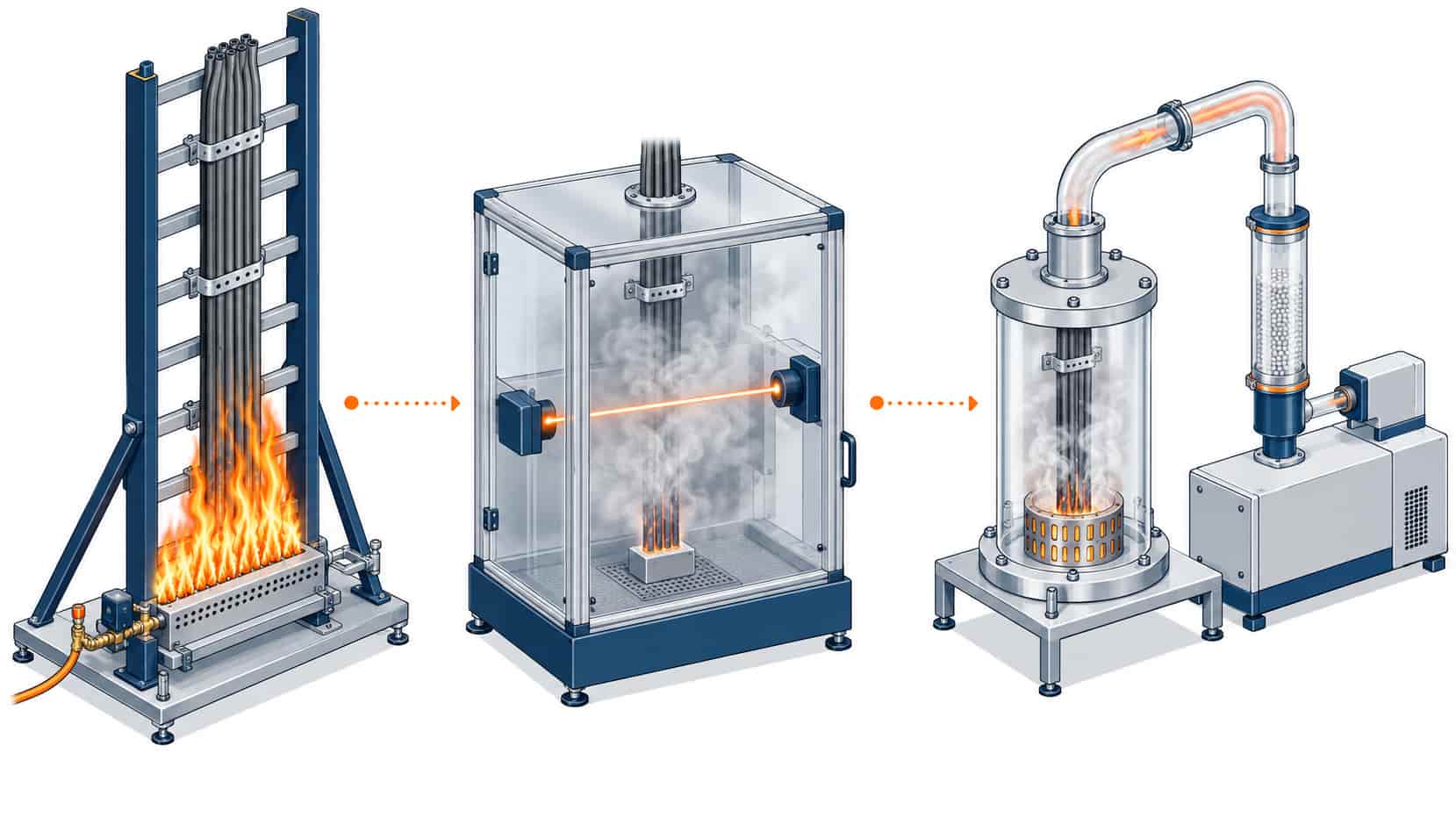
The term LSZH is not a single certificate. It compresses three independent test regimes, each with its own apparatus, sample conditioning and pass criteria, and a cable is only as strong as the weakest of the three. The first is flame spread under IEC 60332, which for data centers almost always means the bundled vertical category IEC 60332-3: a ladder of cables is burned under a controlled flame and the spread of char along the bundle must stay within limits. The category letter matters — Category A uses 7 litres of propane per minute on a denser bundle, Category B 5 litres, Category C 1.5 litres — and specifying “IEC 60332-3 compliant” without the letter invites the supplier to quote the cheapest category they hold.
The second regime is halogen content under IEC 60754. Part 1 measures the total hydrochloric acid evolved during combustion; the halogen-free threshold most specifications use is below 0.5 percent by weight, and many consultants now tighten this with IEC 60754-2, which additionally caps corrosivity by measuring pH and conductivity of the gas evolved. The third regime is smoke density under IEC 61034: cables burn in a closed three-metre chamber while a photometer measures light transmission through the smoke, and the transmittance must stay above 60 percent. A cable can pass flame spread beautifully and still fill a corridor with opaque smoke; only the full trio defines LSZH performance.
The Specification Gaps That Cost Projects
The most common gap is the one we see on nearly every troubled order: the buyer wrote “LSZH cable” in the general clause but never named the flame spread category, so the offer came back against Category C while the design assumed Category B. The second is confusing flame retardant with fire resistant — a topic we treat at length in the difference between LSZH and fire retardant cable. A flame retardant LSZH cable will not feed a fire; a fire resistant cable will keep conducting during one, and the life-safety circuits need the latter on top of the former.
The third gap is insulation versus sheath. LSZH appears on the outer jacket, but the insulation compound inside the cable matters just as much for the fire case, and cross-linked polyethylene — the workhorse insulation explained in our guide to XLPE insulation — is not halogen-free by itself. On WDZ-YJY both layers are halogen-free compounds; on some imported or mixed offers, a low-smoke sheath is wrapped around ordinary XLPE and the whole assembly is sold as LSZH. The remedy is contractual: the purchase order should name both the insulation and the sheath compound as halogen-free, with test reports for each.
The fourth gap is mechanical reality. Early halogen-free compounds were stiffer and less abrasion-resistant than PVC, which produced job-site failures during pulling — and some buyers reacted by quietly accepting PVC substitutes. Modern LSZH compounds have closed most of that gap, but it remains fair engineering to review pulling tensions, bend radii and tray friction for large feeders, and to match the compound to the installation method rather than assuming one size fits all.
Reading the Categories: ZA, ZB, ZC and GB 31247
Chinese designations add a second layer of naming that international buyers should learn to read, because most export projects source from Chinese factories. The letters ZR traditionally mean flame retardant, and the refined classes ZA, ZB and ZC correspond to progressively stricter bundled burning performance — ZA aligning with the most demanding IEC 60332-3 Category A conditions. WDZ therefore reads as low smoke plus halogen-free, and WDZ-YJY means exactly that construction over a XLPE-insulated, XLPE-or-LSZH-sheathed cable. The national standard GB 31247 goes further and grades burning behavior of cables as B1 or B2 classes with additional smoke, toxicity and droplet sub-indices; a B1(d0,s1,t0) rating is the closest thing the Chinese system offers to a holistic fire grade, and it is increasingly cited in Chinese-funded data center projects overseas.
For buyers who must satisfy both an IEC-based consultant specification and a Chinese-funded EPC, the practical answer is to ask the factory to declare both frameworks explicitly. A capable manufacturer will hold type test reports covering IEC 60332-3 Category B or A, IEC 60754-1 and -2, IEC 61034-2, and GB 31247 where relevant — four separate regimes, four separate reports. Where verification needs go deeper than paper, third-party inspection and witness testing fit naturally into the quality plan, and our checklist on auditing a Chinese power cable manufacturer lists the documents to request.
| Test Regime | What It Measures | Typical Benchmark for Data Centers | Specification Wording to Demand |
|---|---|---|---|
| IEC 60332-3 | Flame spread on a bundled vertical cable ladder | Category B on power feeders; Category C acceptable on small wiring where the consultant agrees | Name the category letter explicitly, with the test report number on file |
| IEC 60754-1 / -2 | Halogen acid gas evolved during combustion; corrosivity by pH and conductivity | Below 0.5 percent HCl equivalent; pH above 4.3, conductivity under 10 microsiemens per IEC 60754-2 | Both parts cited; halogen-free claimed for insulation and sheath compounds separately |
| IEC 61034-1 / -2 | Smoke density in a closed three-metre chamber | Minimum light transmittance above 60 percent | Part 2 procedure cited for cables; report per construction, not per compound family |
| GB 31247 | Overall burning behavior grade used in Chinese projects | B1 class with d0, s1, t0 sub-indices where the EPC demands it | Grade and sub-indices named; certificate issued by an accredited body |
| Fire resistance (separate regime) | Ability to keep conducting during fire, per BS 6387 or GB/T 19216 | Required only on life-safety circuits, in addition to LSZH | State circuit-by-circuit; do not fold into the general LSZH clause |
Where LSZH Belongs — and What Each Zone Needs
Paper first: a genuine LSZH offer arrives with type test reports from an accredited laboratory, one per construction, each naming the exact standard edition and category. Batch-level routine tests then confirm conductor resistance and voltage withstand on the drums you actually receive, and the mill test trail ties each drum to a production date and compound batch. Buyers who accept a single glossy “LSZH certificate” covering an entire product family are accepting the weakest construction in that family as the guarantee for every drum on site.
Physical spot checks close the loop. Flame and smoke behavior cannot be judged by eye, but compound substitution often can: a suspiciously light drum weight on a copper-quoted order suggests conductor substitution, and jacket markings can be cross-checked against the purchase order — genuine factory cable carries the manufacturer name, standard, voltage class and year printed or embossed along the sheath at regular intervals. Where the project scale justifies it, witnessed testing at the factory before shipment converts trust into evidence, and the framework for that evidence chain mirrors what we recommend for factory acceptance versus site acceptance testing on the equipment side.
| Zone | LSZH Requirement | Engineering Notes |
|---|---|---|
| Data halls and rack aisles | Full LSZH, IEC 60332-3 Cat B minimum | Power feeders and structured cabling jackets both halogen-free; highest density of combustible jacket material |
| Technical corridors and risers | Full LSZH, Category B | Evacuation routes; smoke transmittance matters as much as flame spread here |
| UPS and battery rooms | Full LSZH on AC and DC cabling | Fine-stranded battery cables in halogen-free construction; grouping derating reviewed separately |
| Fire pump and life-safety circuits | Fire resistant plus LSZH where sheathed runs pass through occupied areas | Mineral insulated products carry the fire survival duty; LSZH covers the general wiring around them |
| Outdoor routes and campus ducts | PVC or PE sheath generally acceptable and more robust | UV, moisture and rodent resistance dominate; smoke behavior irrelevant in open air |
| Generator yard and plant rooms with open ventilation | Compromise allowed by most codes | Mechanical robustness and oil resistance may justify non-LSZH sheaths; confirm with the AHJ |
Verifying the Claim: From Certificates to Drums
Paper first: a genuine LSZH offer arrives with type test reports from an accredited laboratory, one per construction, each naming the exact standard edition and category. Batch-level routine tests then confirm conductor resistance and voltage withstand on the drums you actually receive, and the mill test trail ties each drum to a production date and compound batch. Buyers who accept a single glossy “LSZH certificate” covering an entire product family are accepting the weakest construction in that family as the guarantee for every drum on site.
Physical spot checks close the loop. Flame and smoke behavior cannot be judged by eye, but compound substitution often can: a suspiciously light drum weight on a copper-quoted order suggests conductor substitution, and jacket markings can be cross-checked against the purchase order — genuine factory cable carries the manufacturer name, standard, voltage class and year printed or embossed along the sheath at regular intervals. Where the project scale justifies it, witnessed testing at the factory before shipment converts trust into evidence, and the framework for that evidence chain mirrors what we recommend for factory acceptance versus site acceptance testing on the equipment side.
When Full LSZH Specification Is Not the Answer
The first honest exception is the outdoor and buried plant. A cable tray crossing a campus between buildings gains nothing from halogen-free chemistry and loses rodent, moisture and abrasion resistance that polyethylene delivers better and cheaper. Writing LSZH into those routes wastes budget that the indoor specification actually needs.
The second exception is mechanical duty in plant rooms. Oil-resistant, tough-sheathed cables around generators and fuel systems may reasonably stay on elastomer compounds with better chemical performance; codes in most jurisdictions accept this where ventilation dilutes any smoke event. The third is retrofit economics: replacing serviceable PVC cable in an existing hall purely to modernize the compound creates downtime without a life-safety gain the authority can enforce. The discipline is the same as everywhere else in cable engineering — apply the requirement where the failure scenario exists, and spend the remainder of the budget on verification.
RFQ Checklist: Ordering LSZH Cable for a Data Center
Send the supplier these items and the quote you receive will be comparable line by line:
- Cable schedule listing each construction, voltage class and cross-section
- Flame spread category per route: IEC 60332-3 Category A, B or C, stated explicitly
- Halogen requirements: IEC 60754-1 below 0.5 percent, IEC 60754-2 pH and conductivity limits, applied to insulation and sheath separately
- Smoke requirement: IEC 61034-2 with 60 percent minimum transmittance
- GB 31247 grade where a Chinese EPC or Chinese-funded project requires it
- Sheath color, printing text and drum lengths per route
- Type test report copies per construction, with laboratory accreditation named
- Batch routine test certificates accompanying each drum at shipment
- Destination market, applicable code edition and any third-party inspection scope
- Pricing basis: copper price linkage or fixed metal basis, with validity across the delivery window
That last line is not decoration. Compound-grade LSZH production lines run at different speeds than PVC lines, and project-scale LSZH orders lock factory capacity for weeks; a quote that goes stale while the metal market moves serves nobody. Kexingyu Cable Group (KXYE) quotes WDZ-YJY and the full fire-performance range against a copper price linkage, so the commercial basis survives the schedule.
Conclusion
LSZH in a data center is a trio of tests, not a label: flame spread category, halogen content and smoke density, each named in the specification and each evidenced by a report. The specifier’s job is to close the gaps this guide lists — category letters unnamed, insulation confused with sheath, fire resistance folded into the wrong clause — before they become site findings.
Work with a manufacturer that treats these as separate, documented regimes. Kexingyu Cable Group (KXYE) produces WDZ-YJY, WDZN-YJY, BTTZ, BBTRZ and NG-A (BTLY) under one quality system, with type test reports per construction and copper price linkage on project-scale orders. Send the cable schedule and the applicable code edition, and we will return an offer with every requirement mapped to a test report.
Recent Posts

Power Cable Warranty Terms: What to Demand and What to Watch For
Power Cable Warranty Terms: What to Demand and What to Watch For Quick Answer: A usable warranty names its scope, duration, evidence standard, exclusions and
The Cable Sample Approval Process: What to Test Before Mass Production
The Cable Sample Approval Process: What to Test Before Mass Production Quick Answer: Sample approval tests the supplier’s claims while changes are still cheap —
Cable Drum Packaging for Export: Specs, Marking and Transit Protection
Cable Drum Packaging for Export: Specs, Marking and Transit Protection Quick Answer: Export packaging is a technical specification: drum size for weight and bend radius,