
WDZ-YJY Cable Explained: China's Low Smoke Zero Halogen Standard
Quick Answer: WDZ-YJY is China's workhorse low smoke zero halogen power cable: WDZ marks low-smoke halogen-free construction, YJ cross-linked polyethylene insulation, Y a polyethylene sheath. Any international buyer sourcing cable from China meets WDZ-YJY within the first week. It appears in every tender for a public building, every metro package and most modern data center projects — usually with no explanation, because to a Chinese engineer the designation is a complete specification in nine characters.
Introduction
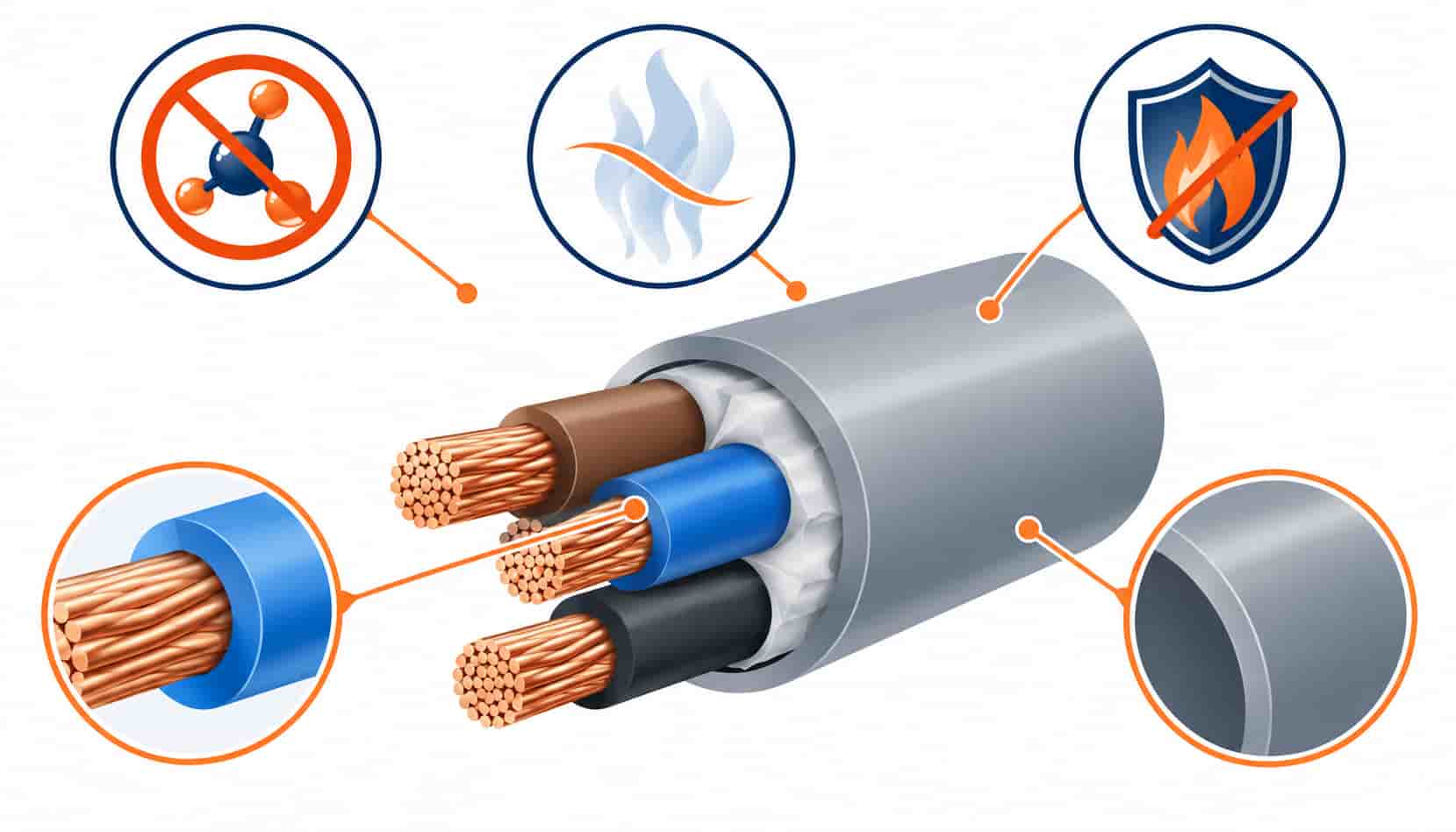
Chinese cable designations look like part numbers but work like compressed standards: each letter is a verifiable claim about materials and fire behavior. WDZ-YJY packs five of them, and once decoded it maps almost one-to-one onto the LSZH constructions international buyers already know from IEC-based specs. This article decodes it letter by letter, explains what the construction actually delivers, digs into the flame-retardant grades hidden inside the Z, and shows how to turn a WDZ-YJY requirement into an export RFQ a factory can quote without guessing. The insulation system underneath starts with XLPE, and the fundamentals are covered in our guide to what XLPE cable actually is.
The Designation, Letter by Letter
Chinese designations read from the prefix (fire behavior) through the insulation to the sheath. In WDZ-YJY, W stands for wu halogen (halogen-free), D for di yan (low smoke), Z for zu ran (flame retardant), YJ for cross-linked polyethylene insulation and Y for a polyethylene outer sheath. Read it together and you get a cable that emits little smoke and no corrosive halogen acid gas when burning, self-extinguishes, insulates with XLPE at a 90°C continuous rating, and wears a tough polyethylene jacket.
| Element | Chinese | Meaning | International Equivalent Language |
|---|---|---|---|
| W | æ å¤ | Halogen-free â no chlorine or fluorine released in fire | IEC 60754-1/2: HCl < 0.5% |
| D | ä½ç | Low smoke â thin, visible-through smoke in combustion | IEC 61034 smoke density |
| Z | é»ç | Flame retardant â self-extinguishing, spread limited | IEC 60332 flame spread class |
| YJ | 交èèä¹ç¯ | Cross-linked polyethylene insulation, 90°C conductor | XLPE insulation (IEC 60502 class) |
| Y | èä¹ç¯ | Polyethylene outer sheath | ST2/PE sheath per IEC 60502 |
What the Construction Actually Delivers
Electrically, WDZ-YJY is a standard XLPE low-voltage cable: 0.6/1 kV classes in the common grades, 90°C continuous conductor temperature, the same ampacity and voltage-drop arithmetic as any XLPE construction. The difference sits entirely in the polymer choices around the conductor — halogen-free sheath and insulation compounds that behave in fire. The sheath-versus-insulation trade space between PVC and PE families is compared in our XLPE versus PVC guide, and the fire-behavior case for halogen-free construction is argued in detail in our LSZH versus fire-retardant comparison.
In a fire, a WDZ-YJY tray releases thin smoke that leaves escape routes visible, and no hydrogen chloride to corrode the switchgear two rooms away. In normal service, the PE sheath resists moisture well and handles buried or ducted routes, though it’s less flame-retardant than PVC. That’s exactly why the Z in the prefix matters — and why it gets verified by test rather than assumed.
Where WDZ-YJY Gets Specified by Name
Chinese codes push halogen-free construction wherever people concentrate: metros and rail stations, hospitals, schools, airports, high-rise public buildings and, more and more, data centers — the same occupied-building logic covered in our data center power collection. So a tender line reading “0.6/1 kV WDZ-YJY, 4×185 mm²” isn’t a factory part number. It’s a fire-safety specification, and any compliant factory has to back it with test reports to the flame-retardant and smoke standards behind each letter.
For export buyers that pattern matters twice. It tells you what the factory’s routine production already achieves, and it tells you which tests to demand in your own documents.
The Grades Nobody Mentions: WDZA, WDZB, WDZC
Real Chinese schedules rarely say bare WDZ — they grade it: WDZA, WDZB or WDZC, where A, B and C are flame-retardant categories describing how much cable may burn in the bundled fire test. Category A tolerates the highest loading of cables per unit of tray volume; C the least. The grade has to match the tray density. Specify WDZC for a densely packed riser and you’ve silently under-specified; specify WDZA everywhere and you’re buying fire performance the route doesn’t need. Ask which category the test report supports — the letter in the order and the letter in the report must match.
| Check Item | Requirement | Why It Matters |
|---|---|---|
| Grade letter stated | WDZA / WDZB / WDZC matched to tray density | Bare "WDZ" hides the fire-test claim |
| Test reports per letter | Smoke, halogen, flame spread per batch | Each letter is a testable promise |
| Voltage class explicit | 0.6/1 kV stated, not implied | The designation does not carry voltage |
| Sheath environment | PE suits buried/ducted; verify UV exposure | PE needs protection in open sun routes |
| Fire resistance decided | Critical circuits move to WDZN-YJY | WDZ-YJY retards fire; it does not survive it |
| Export mapping done | Equivalents stated to IEC 60332/60754/61034 | Local inspectors read tests, not pinyin |
Export Mapping: Translating WDZ-YJY for Your Market
Three steps make a WDZ-YJY requirement portable. First, state the IEC behavior equivalents: flame spread class per IEC 60332, halogen acid gas per IEC 60754, smoke density per IEC 61034 — the standard families mapped in our IEC, GB and BS standards guide. Second, restate the electrical spec in destination-market language: voltage class, conductor class per IEC 60228, cross-sections in mm². Third, demand batch test reports keyed to each claim, so the designation arrives with evidence instead of transliteration.
Don’t treat the Chinese letters as a brand. Two factories’ WDZ-YJY can differ in compound quality, copper content and test discipline — which is why supplier verification, covered in our power cable manufacturer checklist, remains the load-bearing step in any export purchase.
When WDZ-YJY Is Not the Answer
WDZ-YJY retards fire; it does not survive it. Circuits that must keep carrying current during the fire — fire pumps, smoke extraction fans, emergency lighting, fire alarm loops — need fire-resistant construction, and in the Chinese designation system that means the N: WDZN-YJY, whose mica-tape layer holds insulation together at flame temperature. Specifying plain WDZ-YJY on those circuits is the most common translation error international buyers make, and no sheath upgrade fixes it.
The other boundary is environmental. Open-air routes with strong UV exposure, or installations that need armored mechanical protection, take the conversation beyond the plain PE-sheathed construction — armor and sheath choices are compared in our armored versus unarmored guide.
RFQ Checklist: Ordering WDZ-YJY for Export
Make the designation quotable and verifiable by writing these into the RFQ:
- Voltage class and conductor cross-sections stated per circuit
- Flame-retardant grade letter (A/B/C) matched to tray density
- IEC behavior targets: 60332 class, 60754 halogen limit, 61034 smoke
- Batch test reports covering each letter’s claim, keyed to drum IDs
- Conductor class and stranding per IEC 60228
- Sheath specification: PE grade, UV stabilization for exposed routes
- Copper price linkage across the delivery calendar
- Batch copper certificates and weight verification rights
- Drum labeling by circuit and length, both ends marked
- Destination-market certification needs stated up front
Conclusion
WDZ-YJY is not a mystery part number. It’s a five-claim fire-safety specification compressed into nine characters, backed by one of the most routine production lines in Chinese cable manufacturing. Decode it, grade it, demand the test reports behind each letter, and it translates cleanly into any IEC-speaking market.
Kexingyu Cable Group (KXYE) supplies WDZ-YJY across all flame-retardant grades with batch test reports to smoke, halogen and flame-spread standards, copper price linkage and export-ready documentation — so the nine characters arrive with evidence attached.
Recent Posts
Thermal Runaway in Lithium Batteries: What BESS Buyers Should Understand
Thermal Runaway in Lithium Batteries: What BESS Buyers Should Understand How thermal runaway starts, how it propagates, and which evidence buyers should require before approving
Energy Storage for Data Centers: A Growing Backup Power Option
Energy Storage for Data Centers: A Growing Backup Power Option Batteries have always backed up data centers in the form of UPS strings. Grid-scale BESS
YJV vs YJY: Reading Chinese Cable Designations Like a Local
YJV vs YJY: Reading Chinese Cable Designations Like a Local YJV vs YJY: Reading Chinese Cable Designations Like a Local Quick Answer: YJV and YJY