The Chinese Cable Part Number Decoder: WDZ, NH, ZR, WDZB Explained
Quick Answer: ZR adds flame retardancy, WDZ adds low-smoke halogen-free behavior, WDZB pins the class to B1, NH keeps circuits live through flame — four prefixes read left to right. Ask for a cable by its insulation letters and you have described what it is. Ask for one with the right prefix and you have described what it does when the building around it burns — which is the half of the specification that fire codes, insurers and occupants actually care about. The Chinese system encodes that behavior in a short chain of prefixes, and this article decodes the chain.
Introduction
International buyers meet the fire-behavior prefixes at the worst possible moment: a comment review, a fire marshal’s letter, or a substituted drum at the dock. The prefixes are not decorative — each one names a family of tests, and each family ladders into grades that cost real money and copper real estate. Read them correctly and you pay only for the behavior your code demands; misread them and you either overspecify by two grades or discover at handover that the cable on the drum cannot pass the test the schedule referenced. The base-letter system underneath the prefixes — insulation, sheath, armor — is decoded separately in our XLPE insulation primer, and this article builds the fire layer on top of it.
The Four Prefixes at a Glance
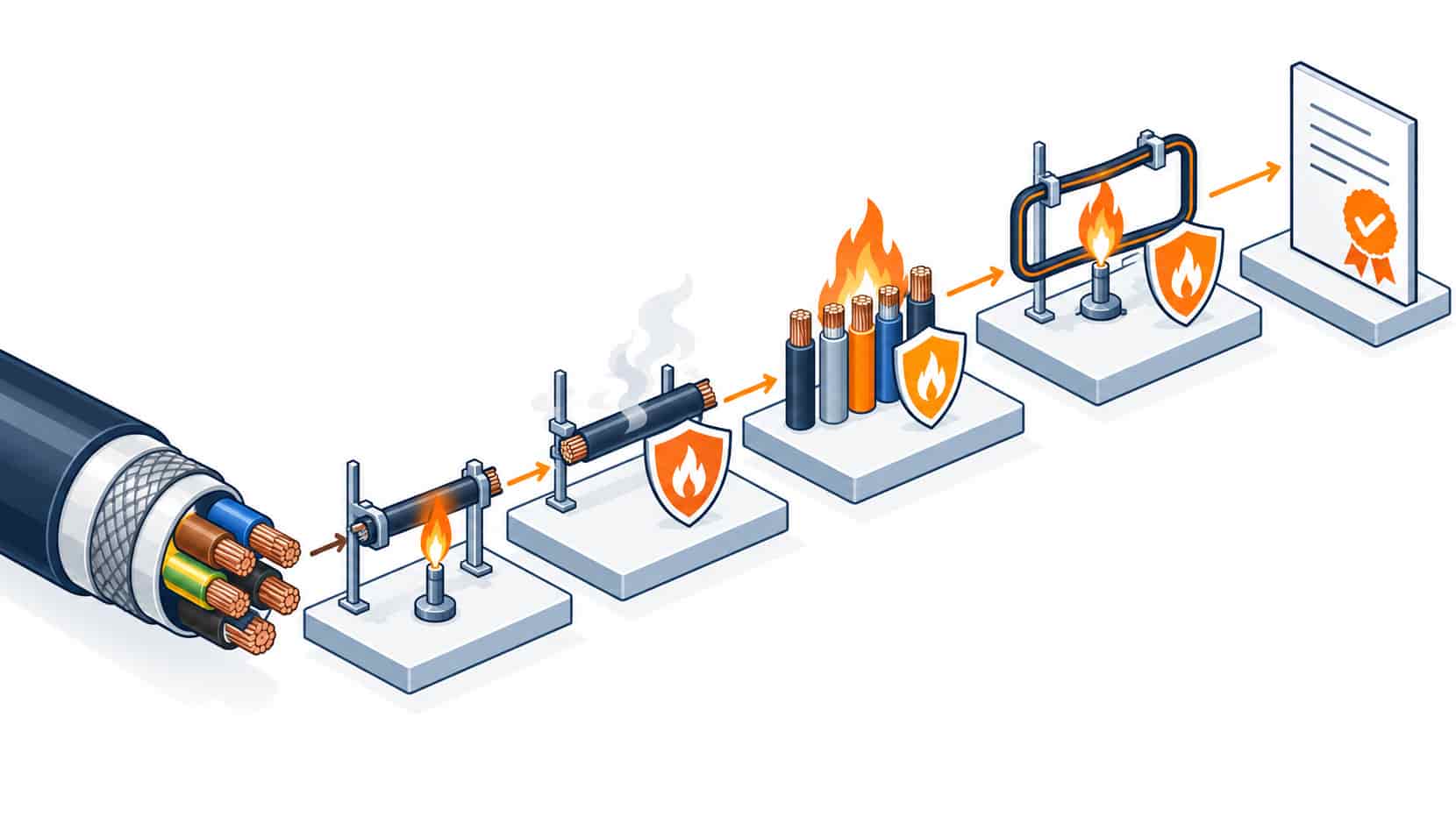
Chinese part numbers read from left to right, fire behavior first. ZR (zu ran, flame retardant) means the cable resists flame spread; WDZ (wu di yan, low smoke halogen-free) means it also emits little smoke and no halogen acid gas; WDZB is a WDZ cable whose burning behavior has been graded — the B marking a class under GB 31247; and NH (nai huo, fire resistant) means the conductor keeps carrying current through flame, using mica tape under the insulation. The prefixes stack: WDZN-YJY is the full fire-safety sentence — halogen-free, flame retardant, fire resistant, XLPE insulated, PE sheathed.
| Prefix | Chinese | What It Demands | Typical Habitat |
|---|---|---|---|
| ZR | é»ç | Flame spread self-extinguishes; graded ZA/ZB/ZC by bundled-cable test | General indoor trays and risers |
| WDZ | æ å¤ä½çé»ç | Flame retardant plus low smoke (IEC 61034 analog) and zero halogen acid gas (IEC 60754 analog) | Occupied buildings, transit, data halls |
| WDZB | æ å¤ä½çé»ç B 级 | WDZ behavior with a declared burning-behavior class B under GB 31247 | Code-driven public and high-value buildings |
| NH | èç« | Circuit integrity in flame: mica tape barrier keeps insulation live through the burn | Fire pumps, alarms, emergency lighting |
| WDZN | æ å¤ä½çé»çèç« | The stack: halogen-free, low smoke, flame retardant and fire resistant in one cable | Life-safety circuits in modern buildings |
ZR: Flame Retardant and Its Grade Ladder
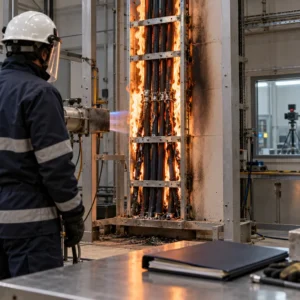
ZR is the baseline prefix, and it is not one property but a ladder. Chinese practice grades flame retardancy as ZA, ZB and ZC according to how much bundled cable the sample must survive the vertical flame test with — ZA with the largest bundle and the harshest test, ZC with the smallest. A ZC cable is perfectly legitimate on a small tray; the mistake is letting a ZC drum stand in where the schedule said ZA, because the letters differ by test severity and price alike. The full logic of matching flame-retardant class to installation density is worked through in our LSZH and flame-retardant comparison, and the rule of thumb is simple: the more cable shares the tray, the higher the grade you owe.
Note what ZR does not promise: no smoke limit, no halogen limit, no circuit integrity. It is a spread-control claim, nothing more — which is exactly why the other prefixes exist.
WDZ: Low Smoke, Halogen-Free
WDZ takes the flame-spread requirement and adds the two properties that decide whether people escape: smoke that lets them see the exit, and combustion gases that will not poison or corrode on contact. Halogen-free compounds trade some handling ease and flame retardancy per millimeter for those life-safety behaviors, which is why WDZ cables cost more and why codes increasingly mandate them anyway — occupied buildings, tunnels, transit systems and data halls have converged on the WDZ family as the default — the power-dense halls behind the shift are covered in our data center power guide. In the Chinese letter system WDZ is one prefix, but under the skin it is three test families — flame spread, smoke density, halogen content — and an export spec should restate all three as their IEC equivalents: 60332 for spread, 61034 for smoke, 60754 for halogen.
WDZB: When the Prefix Carries a Grade
GB 31247, the burning-behavior standard for power and control cable, grades cables B1, B2 and B3 by heat release, flame spread, smoke and toxicity measured together. A WDZB cable is a WDZ cable that has been tested to that standard and declared class B1 — the top rung below which B2 and B3 follow. The grade rides on the prefix like an honorific: WDZB-YJY outperforms plain WDZ-YJY on the same insulation platform because its compound system passed the heavier test battery. For export buyers the practical meaning is documentation: a WDZB claim must arrive with a GB 31247 test report naming the class, and a schedule that cites the class without the report is a claim, not a fact. The discipline of demanding paperwork with the letters is the one in our power cable certifications checklist.
NH: Fire Resistance Is a Different Question
Flame retardancy and fire resistance answer different questions and are not interchangeable. ZR and WDZ ask how the cable behaves as it burns; NH asks whether the circuit survives the burn — fire pumps must pump, alarms must announce, emergency lighting must light, while the fire is still burning around them. NH cables achieve this with a mica-glass tape wound under the insulation, a ceramic barrier that holds dielectric strength at flame temperatures long after any polymer would fail. The mica tape demands installation discipline — tight bend radii, no mechanical damage before pull — because the barrier is thin and unforgiving. The fire-resistant family, from rigid mineral insulated constructions down to flexible BTLY, is a product conversation of its own; the selection question is which circuits must live through the fire.
| Project Situation | Sensible Prefix | Why |
|---|---|---|
| Small trays, unoccupied plant rooms | ZR (grade per bundle size) | Spread control is the code need; smoke and halogen margins add cost without a driver |
| Occupied floors, corridors, transit | WDZ | Evacuation visibility and gas toxicity drive the specification |
| Public, high-value or code-graded buildings | WDZB / WDZC per GB 31247 schedule | The burning-behavior class is written into the fire design and must be evidenced |
| Fire pumps, alarms, emergency circuits | NH or WDZN | Circuit integrity under flame; WDZN when the same route also needs halogen-free behavior |
| Data halls and dense cable fields | WDZ family, grade per density | Huge bundled loads plus occupancy push both smoke behavior and spread class up |
Stacking Prefixes and Reading the Whole Number
Prefixes compose in a fixed order: fire resistance last in the chain but first in importance — WDZN, never NWDZ. A WDZN-YJY part number therefore reads: halogen-free, low smoke, flame retardant, fire resistant, XLPE insulated, PE sheathed. When a quotation arrives with a prefix missing or reordered, treat it as a different cable, because functionally it is; when a datasheet carries the prefix but no test reports behind it, treat the prefix as marketing until proven. The reading skill compounds: once the prefix layer and the base-letter layer are both transparent, any Chinese schedule becomes a specification you can verify line by line.
Export Mapping: From Letters to Test Evidence
The translation into international language is mechanical. ZR becomes the relevant IEC 60332-3 bundled-flame-spread test at the matching category; WDZ adds IEC 60754 halogen content and IEC 61034 smoke density; WDZB maps to the GB 31247 class with its report attached; NH becomes an IEC 60331 or BS 6387 circuit-integrity test depending on destination expectations. State the mapping in the RFQ and the letters stop being a translation risk — the standards landscape across IEC, GB and BS is mapped in our MV and LV standards guide.
When the Prefix Is Not the Answer
No prefix rescues a cable routed wrong: fire performance assumes installation per the design — sealed penetrations, respected bend radii, supported trays — and a WDZB cable in a crushed conduit performs like a plain one. No prefix substitutes for electrical sizing either; the ampacity and voltage-drop arithmetic is in our cable size selection guide. And where a project’s fire strategy genuinely needs graded behavior, the answer is evidence, not vocabulary: the prefix names the test, and only the test report proves the drum. Buying letters without reports is paying for a story.
RFQ Checklist: Specifying by Prefix
Make the fire layer quotable, so include:
- Full designation with prefix order stated: WDZN-YJY, not “WDZN type”
- Flame-retardant grade where applicable: ZA, ZB or ZC per bundle density
- GB 31247 class (B1/B2) where the code requires a burning-behavior grade
- IEC test mapping: 60332 for spread, 60754 halogen, 61034 smoke, 60331/BS 6387 for circuit integrity
- Test reports required per drum batch, keyed to shipment IDs
- Installation constraints stated: bend radii for mica-tape constructions, pulling tensions
- Base letters complete: insulation, sheath, voltage class, armor suffix
- Copper content and price linkage across the delivery calendar
- Destination-market certification needs stated up front
Conclusion
The prefix chain is the most information-dense few letters in any cable schedule: ZR controls spread, WDZ adds the low-smoke halogen-free story, WDZB pins the graded burning behavior, NH keeps the circuit alive, and together they tell an inspector everything the fire strategy assumed. Read them as tests, not labels, and every Chinese part number becomes a specification you can hold to evidence.
Kexingyu Cable Group (KXYE) manufactures the full prefix family — ZR, WDZ, WDZB and NH grades — with batch test reports for every claim and export-ready documentation, so the letters on the drum arrive with the proof behind them.