
IEC 60228 Conductor Classes 1, 2, 5 and 6: Stranding Matters
Quick Answer: IEC 60228 grades conductors by flexibility — solid, stranded, flexible, extra-flexible — and naming the class in the RFQ is the difference between clean terminations and fatigue at the gland. Two cables can carry the same cross-section, the same insulation and the same price — and behave completely differently at the termination, because the copper inside is built differently. A solid rod snaps where a fine-stranded bundle bends; a coarse stranded bundle splays under a screw where a flexible one holds. IEC 60228 exists to make that difference sayable in one number, and this guide makes the numbers chooseable.
Introduction
Conductor class is the specification detail most often left to chance. Schedules state “4 × 16 mm²” and stop, treating all 16 mm² copper as equal — then the installation reveals the gap: solid conductor fighting every conduit bend, or flexible cord work-hardening in a fixed gland. The class system costs nothing to specify and decides pulling behavior, terminal hardware, vibration tolerance and flex life. It is also a verification point at the factory, because stranding is where marginal production quietly saves money. This article maps the four classes that matter and the discipline of stating them.
The Four Classes, Decoded
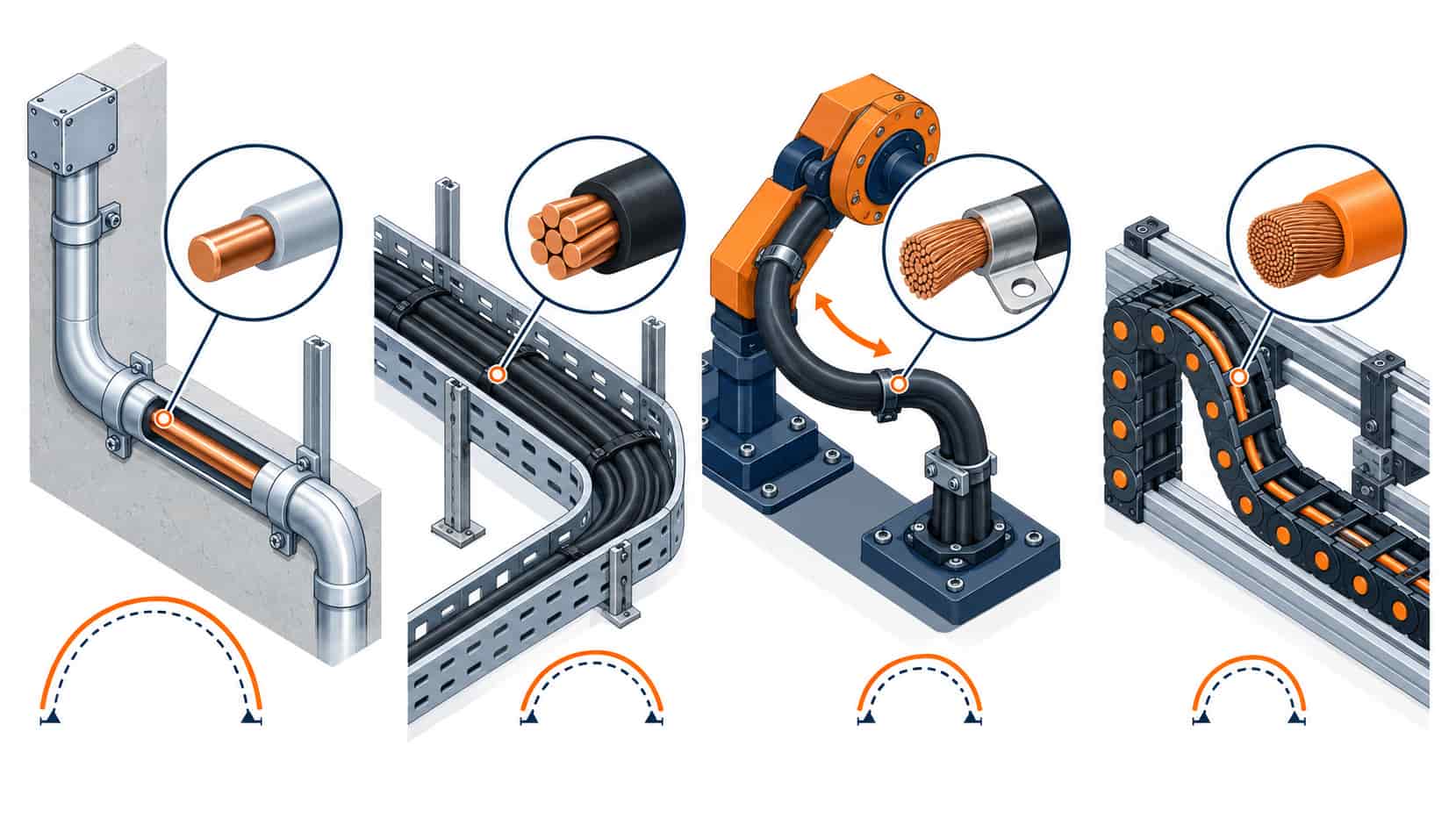
IEC 60228 defines conductors by construction, and in practice four classes carry nearly all real work. Class 1 is solid: a single copper rod, cheapest and stiffest, the classic building-wire conductor for fixed conduit runs. Class 2 is stranded: seven or more wires twisted together, still for fixed installation but far easier to pull around bends. Class 5 is flexible: many fine wires in a bundled-rope lay, built for cords, connections to equipment and anything that moves. Class 6 is extra-flexible: the same idea with finer wires and tighter lays yet, for continuous-flex and severe-duty applications. (Classes 3 and 4 exist as intermediate stranded grades but appear rarely in modern schedules.) The same 2.5 mm² exists in all four — the area is identical, the behavior is not.
| Aspect | Class 1 (Solid) | Class 2 (Stranded) | Class 5 (Flexible) | Class 6 (Extra-Flexible) |
|---|---|---|---|---|
| Construction | Single rod | 7+ wires, concentric lay | Fine wires, rope lay | Finer wires, tight rope lay |
| Typical strands at 2.5 mm² | 1 | 7 | 50 | ~100+ |
| Flexibility | None | Low | High | Highest |
| Bend radius tolerated | Largest | Large | Small | Smallest |
| Termination | Direct under screw | Direct or ferruled | Ferrules below 10 mm² | Ferrules always |
| Motion tolerance | None â work-hardens | Poor | Good | Excellent |
| Cost per meter | Lowest | Low | Higher | Highest |
| Typical duty | Fixed conduit wiring | Fixed feeders and trays | Cords, equipment connections | Continuous-flex, robotics |
Class 1 vs Class 2: The Fixed-Installation Choice
For anything that never moves again, the choice is solid versus coarse-stranded, and it is a route decision more than an electrical one. Class 1 solid is cheaper, terminates directly under screw terminals without ferrules, and holds its shape permanently — virtues in straight conduit runs and panel risers. Its stiffness fights long pulls with bends, and its single wire work-hardens and fatigues wherever vibration exists, which is why solid copper near vibrating equipment is a recurring entry in the failure catalogs. Class 2 stranded pulls easily through bends, shrugs off minor vibration, and terminates nearly as cleanly; its premium over solid is modest, which is why many feeders and most tray work default to class 2 even where solid would technically serve.
Class 5 vs Class 6: The Flexible Trade
Below 10 mm² the flexible classes live in cords, control pendants and equipment tails; above it they serve mobile equipment, generator sets, crane and reeling duty. Class 5 is the general flexible answer — appliance cords, RVV-family conductors, panel-to-equipment connections. Class 6 buys finer stranding for continuous-flex life: drag chains, robotic arms, reeling drums where the cable bends millions of times. The trade is copper packing and lay complexity, which cost money and slightly increase surface resistance per given area. The fine strands also demand ferrules at every termination — stranded copper splayed under a screw is the classic loose-connection factory, and the hot-spot failures it seeds are catalogued in our cable failure causes guide. For the specialty end of continuous-flex duty, the construction conversation extends beyond class 6 into dedicated high-flex designs, covered in our control and instrumentation cable guide only as far as standard products go.
| Application | Class | Why |
|---|---|---|
| Building wire in conduit | 1 or 2 | Fixed forever; solid wins on cost, stranded on pulling |
| Feeders and tray runs | 2 | Easy pulls, vibration tolerance, small premium |
| Panel interior wiring | 2 or 5 | Bends and terminal access favor stranded |
| Appliance and equipment cords | 5 | Motion and handling are the duty |
| Pendant and portable tools | 5 | Repeated flex with moderate severity |
| Drag chains, reeling, robotics | 6 (or dedicated high-flex) | Millions of bend cycles demand fine stranding |
Stranding, Resistance and the Verification Point
Stranding has one electrical cost: fine strands pack less copper into the same area because of the air between wires, so class 5 and 6 conductors carry a slightly higher DC resistance than class 1 at the same nominal size — IEC 60228 publishes a separate, higher resistance limit for the flexible classes, and compliant factories test to it. That is the verification opening: batch resistance reports per kilometer reveal a factory that shorted on copper or strand count long before the cable fails in service. Stranding is also where substitution happens silently — a class 2 drum delivered where class 5 was specified looks similar at the gland and fails in motion. The supplier verification discipline for catching exactly this class of substitution is the one in our power cable manufacturer checklist, and the datasheet fields where class should appear are marked in our equipment datasheet reading guide.
Specifying the Class: RFQ Discipline
The class belongs in the part number’s shadow, not in a footnote: “4 × 16 mm², class 2” is a complete conductor specification; “4 × 16 mm²” is half of one. Where conversion from AWG schedules is involved, the class matters doubly, because American flexible classes and IEC classes do not map one-to-one — state the IEC class explicitly rather than translating from the American construction description. And where terminations are pre-engineered, match the class to the hardware: set-screw terminals want solid or coarse stranded, ferruled or clamp terminals want the flexible classes, and the mismatch discovered on site costs a day of electricians’ time per panel. The sizing arithmetic that runs alongside the class choice is the one in our cable size selection guide.
When Class Selection Is Not the Answer
No class choice rescues a conductor sized wrong: class 6 does not make a too-small cable safe, and class 1 does not make an oversized one cheap in the ways that matter. Nor does class substitute for duty-matched construction at the extremes — continuous-flex applications past standard class 6 need dedicated high-flex designs with different metallurgy and geometry, and reeling duty needs its own engineering. Class selection is a construction decision inside a sizing decision that has already been made correctly; it sharpens specifications, it does not replace engineering.
RFQ Checklist: Ordering by Conductor Class
Make the conductor quotable, so include:
- Class stated with every cross-section: e.g. 3 × 95 mm², class 2
- IEC 60228 as the governing standard named explicitly
- Flex duty described: static, occasional handling, continuous flex cycles
- Termination hardware matched: screw, ferrule or clamp terminals
- Resistance limits per class acknowledged in the acceptance criteria
- Batch resistance reports required, keyed to drum IDs
- Strand counts spot-checked at delivery against the class
- Converted sizes double-marked: AWG in parentheses, class in IEC terms
- Copper price linkage keyed to the class-adjusted construction
Conclusion
Conductor class is the cheapest sentence in a cable specification and the one with the most visible consequences: it decides how the cable pulls, how it terminates, and how long it survives the motion it was bought for. Four classes cover the real world — solid, stranded, flexible, extra-flexible — and a schedule that names the class turns conductor copper from a commodity into a verified component.
Kexingyu Cable Group (KXYE) manufactures across all IEC 60228 classes with strand counts and resistance limits tested per batch, so the class on the schedule is the construction on the drum — verified, documented and export-ready.
Recent Posts

Power Cable Warranty Terms: What to Demand and What to Watch For
Power Cable Warranty Terms: What to Demand and What to Watch For Quick Answer: A usable warranty names its scope, duration, evidence standard, exclusions and
The Cable Sample Approval Process: What to Test Before Mass Production
The Cable Sample Approval Process: What to Test Before Mass Production Quick Answer: Sample approval tests the supplier’s claims while changes are still cheap —
Cable Drum Packaging for Export: Specs, Marking and Transit Protection
Cable Drum Packaging for Export: Specs, Marking and Transit Protection Quick Answer: Export packaging is a technical specification: drum size for weight and bend radius,