
IEC 60332 Flame Spread Tests: Categories A, B and C Compared
Quick Answer: IEC 60332 measures how far flame travels along cable before self-extinguishing — Part 1 a single cable, Part 3 bundles graded A to D — chosen by installed cable density, not preference. Every cable datasheet carries a flame-spread claim, and most of them trace back to one test family: IEC 60332. But the family is a ladder with distinct rungs — a single-cable test that proves very little about a full tray, and a bundled test whose categories differ only in how much neighboring cable joins the fire. Buyers who read the rungs specify cables that match their installations. Buyers who read only the datasheet headline buy test evidence that answers a question their building never asked. This guide takes the test apart and puts the categories back in order of real-world severity.
Introduction
Cable is the one building material that connects every room to every other room through the same shafts and trays, which is why flame spread along cable is treated as its own fire problem. A burning cable carries flame deeper into a building than any other route, and a tray of cables feeds itself once ignition takes hold. The IEC 60332 series exists to measure exactly this behavior: mount the cable vertically, apply a standard flame, and see whether the fire stops or climbs. The series has evolved over decades — single-cable and bundled tests, density categories, and parallel national systems like the Chinese grade letters — but the physics and the pass criteria have stayed stable enough to compare installations across decades of installed cable. Understanding the test is the first step toward specifying it well.
Part 1: The Single-Cable Test
IEC 60332-1 is the simplest rung: one cable specimen mounted vertically in an enclosure, a propane burner flame applied at its lower end for a fixed time, and the pass condition being char damage that stops well short of the top plus no flame persisting beyond a minute after the burner cuts. It answers a narrow question — does this cable, alone in air, carry flame? — and it’s the entry-level evidence for any self-extinguishing claim. Its limits matter as much as its use. A cable alone in free air has a completely different fire story from the same cable banded between two hundred neighbors that share and spread the flame. Specifying Part 1 evidence for a dense tray application is a category error the inspector will eventually catch — the single-cable pass says nothing about the bundle.
| Test | Specimen | Fuel Load | Severity / Use |
|---|---|---|---|
| 60332-1 (Part 1-2) | Single cable | One cable in free air | Entry evidence; small installations, single runs |
| 60332-3 Category A | Bundled on ladder | Highest cable volume per meter (7 L/m) | Dense trays: data halls, main risers, trunk routes |
| 60332-3 Category B | Bundled on ladder | 3.5 L/m | General distribution trays, multi-circuit runs |
| 60332-3 Category C | Bundled on ladder | 1.5 L/m | Light commercial trays, moderate density |
| 60332-3 Category D | Bundled on ladder | 0.5 L/m | Smallest bundles; residential and light duty |
Part 3: The Bundled Test and Its Categories
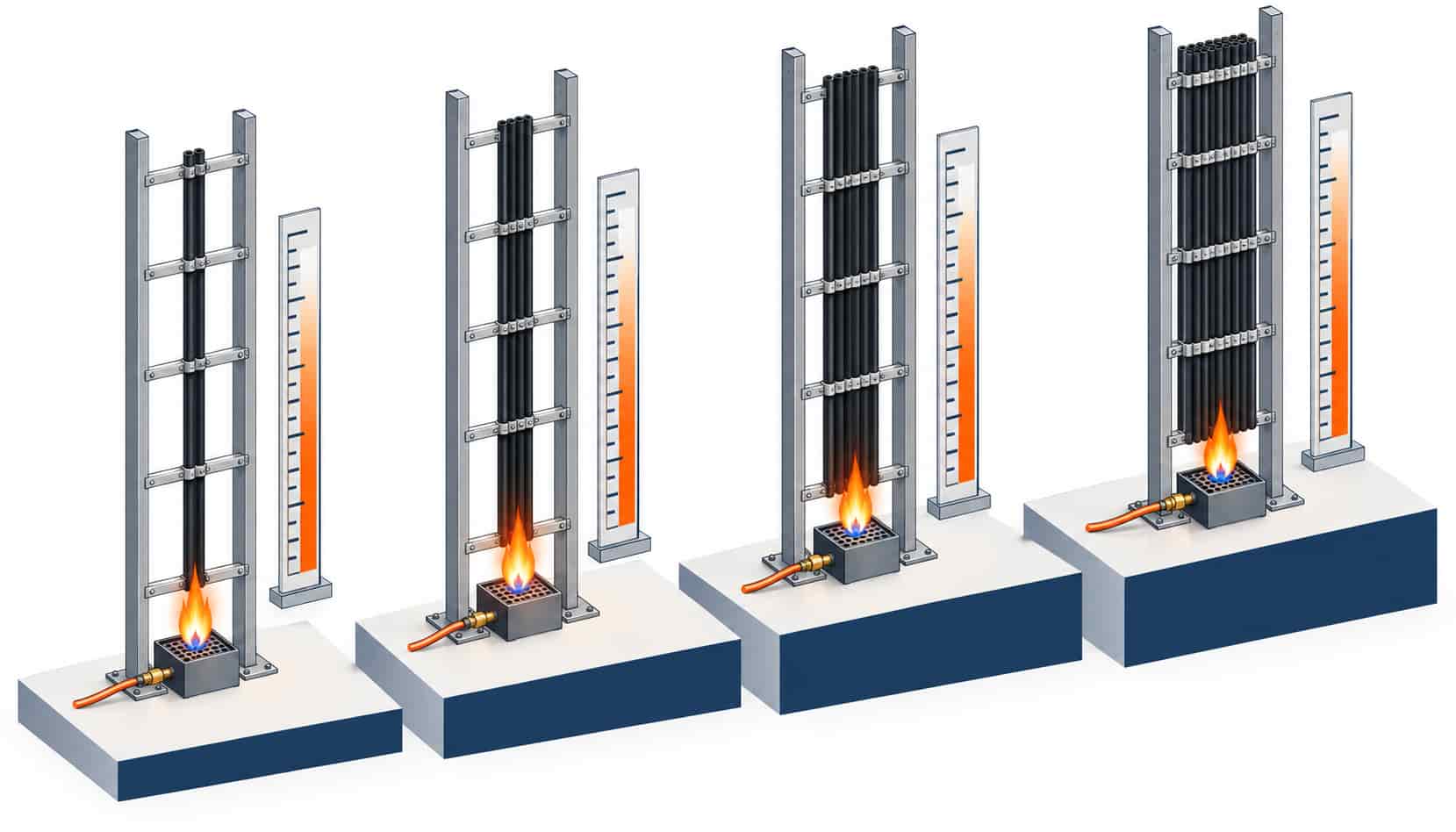
IEC 60332-3 is where real installations live. The specimen is a set of cables banded onto a vertical ladder, with the quantity of combustible cable material per meter of ladder — the fuel load — defining the category: A mounts the heaviest bundle, B and C step down, and D covers the lightest. The burner runs at the bottom for a fixed time, then the pass condition is the same across categories: flame must not spread beyond a stated height, and it must self-extinguish after the burner stops. So the category letters measure installation density, not product quality. A category A cable and a category C cable may share identical materials, but only the A-rated evidence covers the fire a packed tray actually presents. That’s why the categories map directly onto the tray-density logic fire designers use, and why the matching decision belongs in the specification, not the quotation. And because cross-border schedules must translate the category into national grade vocabularies, the wider landscape is mapped in our MV and LV standards guide.
Matching Category to Installation
The matching rule is fuel-load arithmetic: estimate the worst-case volume of cable per meter of tray in the finished installation, then choose the category whose test bundle equals or exceeds it. Main cable fields in data halls — hundreds of cables on deep trays — present category-A densities, and the power-dense halls behind that profile are covered in our data center power guide. General distribution trays with mixed circuit types usually justify category B. Light commercial runs and small risers sit at C. Where the calculation is close, the fire design document’s clause overrides defaults — the designer’s assumption about tray fill is the binding one. And where an installation is genuinely uncertain at specification time, choosing one category up costs a modest premium and buys permanent headroom. Choosing one down converts an audited fire property into an unaudited hope.
The Evidence Chain: Reading the Test Report
A flame-spread claim is only as good as the report behind it, and three details decide whether the report supports your schedule. First, the part and category must match the specification line — a category C report doesn’t evidence a category A requirement, whatever the brochure says. Second, the tested construction must be the offered construction: flame performance is material-and-geometry specific, so a type test on one size does not automatically cover every size in the family. Third, the laboratory must be accredited for the test — the certificate evaluation discipline is the one in our power cable certifications checklist. Batch-level routine production adds no flame tests (the type test qualifies the design), so the report to demand is the valid type-test certificate with its test date, category and construction named — the evidence-review habits that keep fire claims honest follow the same pattern as the failure-analysis discipline in our cable failure causes guide.
60332 Beside the Other Fire Tests
Flame spread is one axis of fire behavior, and 60332 deliberately says nothing about the others. Smoke density is measured by IEC 61034, gas corrosivity and halogen content by IEC 60754 — the two tests that define what the fire’s atmosphere contains, covered together in the halogen-and-smoke testing guide that pairs with this one. Circuit integrity under fire — the cable staying live while burning — is a different and harsher regime entirely, addressed by fire-resistance standards and their own test rigs. Heat release and the graded systems that combine several behaviors belong to the performance-based classification frameworks modern codes increasingly reference. A complete fire specification cites each axis separately: flame spread category from 60332, smoke and halogen limits from their tests, circuit integrity from the fire-resistance standard where the design demands it — and the material-level choices that satisfy the smoke-and-halogen axes are compared in our LSZH and flame-retardant guide.
| Installation | Suggested Category | Evidence to Demand |
|---|---|---|
| Data hall main cable fields, trunk risers | Category A | 60332-3 Cat A type test, named construction |
| General distribution trays, multi-circuit runs | Category B | 60332-3 Cat B type test |
| Light commercial trays, small risers | Category C | 60332-3 Cat C type test |
| Residential and light-duty bundles | Category D | 60332-3 Cat D type test |
| Single runs in free air | 60332-1 | Single-cable type test |
When IEC 60332 Is Not the Answer
The test family has edges. It doesn’t measure circuit integrity — a cable can pass category A and still die in the first minute of a fire; if the circuit must survive, fire-resistance testing is the requirement, not flame spread. It doesn’t measure smoke or toxicity — a dense plastic cable can self-extinguish beautifully and fill a stairwell with opaque acid smoke. It doesn’t cover the fire load of the installation beyond the tested bundle — adding cable to a tray after installation invalidates the density assumption. And it isn’t a substitute for the fire design: the designer’s category decision, written into the fire document, is the specification; the test standard is only the measuring instrument. Projects that treat 60332 as the whole fire story under-protect the building exactly where its people are.
RFQ Checklist: Specifying Flame Spread
Make the flame requirement auditable, so include:
- Part named: 60332-1 for single-cable duty, 60332-3 with category for bundled
- Category letter explicit: A, B, C or D — matched to worst-case tray density
- Fire design document clause cited where the category is code-driven
- Type-test report required naming the tested category and construction
- Test laboratory accreditation stated on the report
- Construction identity confirmed: report’s size and build match the offer
- Smoke and halogen requirements cited separately with their own standards
- Circuit-integrity requirement cited separately where the design demands it
- Tray-fill control stated in installation documents to protect the density assumption
- Destination-market national grade equivalents stated for the inspector
Conclusion
IEC 60332 gives the industry a common ruler for flame spread — one cable in Part 1, bundles in Part 3, categories set by fuel load — and the ruler only works when the specification reads it in order: measure your tray, pick the category, demand the matching report. The categories are density matches, not quality ranks, and the honest match costs no more than the wrong one at specification time.
Kexingyu Cable Group (KXYE) manufactures across the full 60332-1 and 60332-3 category range with accredited type-test evidence per construction, so the category in your schedule arrives proven by the test that matches the installation — verified and export-ready.
Recent Posts

Power Cable Warranty Terms: What to Demand and What to Watch For
Power Cable Warranty Terms: What to Demand and What to Watch For Quick Answer: A usable warranty names its scope, duration, evidence standard, exclusions and
The Cable Sample Approval Process: What to Test Before Mass Production
The Cable Sample Approval Process: What to Test Before Mass Production Quick Answer: Sample approval tests the supplier’s claims while changes are still cheap —
Cable Drum Packaging for Export: Specs, Marking and Transit Protection
Cable Drum Packaging for Export: Specs, Marking and Transit Protection Quick Answer: Export packaging is a technical specification: drum size for weight and bend radius,