
BS 6387 and Fire Survival Cable: C, W, Z Categories Decoded
Quick Answer: BS 6387 grades circuit-integrity cable with three tests — C fire alone, W fire with water, Z fire with shock — each with a time suffix; CWZ passed all three. Circuit integrity is the harshest promise a cable can make: stay live while burning, not just stop burning. BS 6387 answers that promise with a letter grammar — C, W and Z — that reads as three different fire scenarios rather than three quality levels. Projects that specify it without decoding the letters regularly buy evidence for the wrong scenario. This guide decodes the tests, the time suffixes and the combinations, then places the standard among the other fire-survival regimes an international buyer will meet.
Introduction
Some circuits must not merely be fire-safe; they must function through the fire — fire alarm loops, smoke extraction drives, sprinkler pumps, emergency lighting, lift command circuits. For these, the flame-spread categories that govern ordinary cable are irrelevant: a cable can self-extinguish beautifully and still go dead in the first minute. The fire-survival standards test exactly the property the fire designer needs — voltage maintained through the conductor while the sample burns — and BS 6387 is the most-cited grammar for that property, not only in its home market but across the Middle East, Asia and export projects that inherited British specification practice. Its letter system maps to three fire scenarios that real buildings present, and reading the scenarios — not just the letters — is what makes the specification honest.
The Three Tests: Fire, Water, Shock
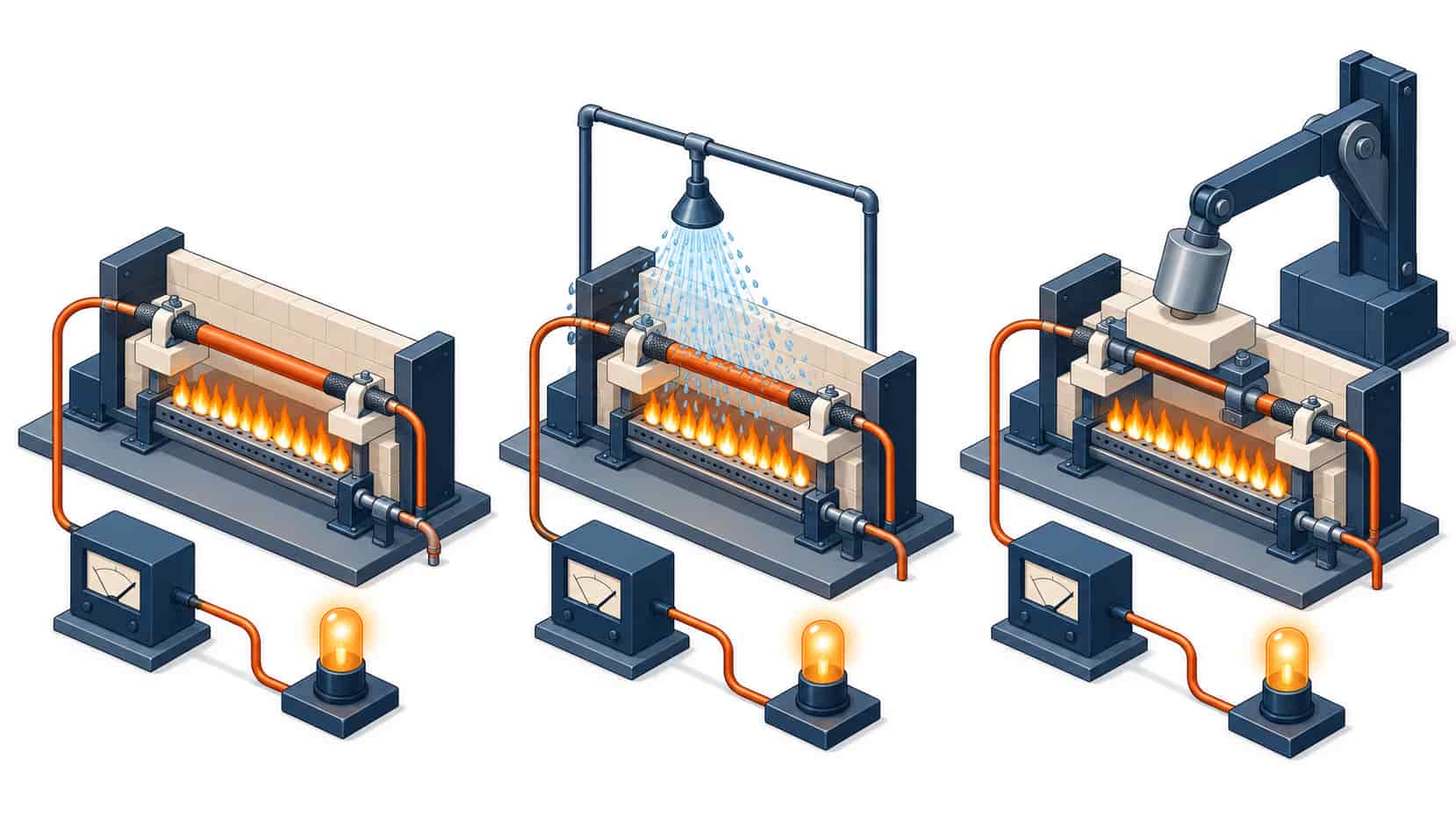
Each category is a distinct scenario staged on the same basic rig — the cable carrying rated voltage through a tube furnace with a controlled flame at a stated temperature. Category C is fire alone: the sample burns for the rated duration and must hold working voltage throughout, with no fuse operation or conductor failure. Category W adds the sprinkler scenario: flame and water spray together, because in a real building the sprinklers open while the fire still burns, and a fire-survival cable that shorts the moment water hits it has failed its actual duty. Category Z adds the mechanical-shock scenario: flame plus periodic hammer blows to the rig, simulating the structural movement, falling debris and thermal expansion that a real fire loads onto the route. The three scenarios are tested separately, and passing one says nothing about the others — which is precisely why the designation concatenates the letters that were actually passed.
| Letter / Suffix | Test Scenario | What It Proves | Typical Demand |
|---|---|---|---|
| C + time | Fire alone at 750°C+ for 30-120 min | Voltage held through fire only | Base survival â alarms, emergency lighting |
| W + time | Fire plus water spray simultaneously | Survival through sprinkler operation | Sprinklered buildings, pump rooms |
| Z + time | Fire plus mechanical shock blows | Survival through structural movement | High-rise risers, tunnels, plant rooms |
| CWZ | All three scenarios passed | Full survival grammar | Life-safety circuits in sprinklered high-rise |
| Time suffix | 30 / 60 / 90 / 120 minutes | Survival duration per scenario | Matched to evacuation and firefighting design |
The Time Suffix: Matching Duration to the Fire Design
Every category carries a duration — the cable must hold voltage for the stated time and no less. The right duration comes from the fire engineering, not from habit: evacuation strategy, firefighting intervention time and the duty of the powered circuit all set the clock. A smoke extraction drive that must run for the full evacuation period, a sprinkler pump that must run until the fire is out, and an alarm loop that must stay intelligible while occupants leave each carry different clocks. The specification should read them off the fire strategy document rather than default to the market’s customary 90 or 120 minutes. Over-specifying duration costs real money on every meter. Under-specifying it converts the fire design’s assumption into an untested hope. Where the fire document names the duration, cite the clause alongside the cable designation — the same discipline as citing the flame-spread category from its own standard.
BS 6387 Beside the Other Survival Standards
The fire-survival landscape has several grammars, and confusing them wastes quotation cycles. IEC 60331 tests fire alone with its own duration classes — the closest international analogue to category C alone, without water or shock. BS 8434 combines fire with both water and shock in one simultaneous test, a harsher single scenario that some UK projects prefer to the BS 6387 letter combinations, and its certificates are not interchangeable with 6387 evidence even where the circuits are the same. German DIN 4102-12 and the French regimes stage their own variations. The practical buyer rule: cite the standard the fire design actually references, and require the test report from an accredited laboratory that names the tested category, duration and construction — the report-evaluation discipline is the one in our power cable certifications checklist. And where the destination market layers national approval on top of the test evidence, both document chains must close, a logic the certification checklist for Chinese-manufactured equipment follows in our China certification guide.
Construction: How a Cable Passes These Tests
Fire survival is built into the cable, not added at the end. The dominant constructions use mica-glass tape wound over the conductor beneath the insulation — a ceramic layer that sinters into a stable dielectric as the organic insulation burns away — or mineral insulation inside a continuous metal sheath, the rigid construction whose behavior under fire conditions is in a different performance class entirely. The sheath and armour choices then decide whether the tested construction survives installation reality: tight bends crack mica tape, and a crushed route damages what the fire test assumed intact. This is why the installation discipline — bend radii, mechanical protection, sealed glands — belongs in the same specification line as the fire evidence, and why the accessory and gland selection follows the matching checklist in our cable accessories guide. A fire-survival cable terminated carelessly is a fire-survival cable no longer.
The Evidence Chain: Reading a BS 6387 Report
A BS 6387 claim is verified by the report, and four details decide whether the report supports the schedule. The category letters on the report must match every letter in the specification — a CW report does not evidence CWZ, however similar the strings look. The duration suffix must match the fire design’s clock, not just the family’s marketing headline. The tested construction must be the offered construction — size, insulation system, armour — because survival behavior is geometry-specific. And the laboratory must be accredited for the specific standard part. Where any of these links is missing, the honest response is a new test on the offered construction, not an inference from a family certificate — the same report identity logic that governs flame-spread evidence, and the same habit of walking the evidence chain that factory-level verification applies in our power cable manufacturer checklist. Failures that trace back to unverifiable fire claims are, fittingly, among the hardest to discover before the fire — the routine entries in our cable failure causes guide cover the electrical ones, but the fire-scenario gap only opens at the worst possible moment.
| Circuit | Fire Scenario Expected | Suggested Category | Duration Basis |
|---|---|---|---|
| Fire alarm and detection loops | Fire alone, occupied evacuation | C at evacuation time | Evacuation strategy clock |
| Emergency lighting | Fire through escape period | C or CW at evacuation time | Escape route design duration |
| Smoke extraction drives | Fire plus structural movement | CZ or CWZ | Smoke-control operation time |
| Sprinkler and fire pumps | Fire with water spray | CW or CWZ | Firefighting intervention time |
| Lift command and control | Fire plus shock in high-rise risers | CZ or CWZ | Evacuation plus firefighting |
When BS 6387 Is Not the Answer
The standard answers one question — which circuits survive which fire scenarios — and no others. It doesn’t certify flame spread, smoke or halogen behavior; a survival cable still needs its flame-spread category and chemistry limits cited separately where the venue demands them. It doesn’t apply to circuits that may die with the fire — ordinary distribution, socket circuits, general lighting — and specifying survival cable for them is money without benefit. It doesn’t replace the fire design: the designer’s scenario list, duration clock and circuit inventory are the specification, and BS 6387 is the measuring instrument for the cable’s part in it. And where the destination market’s code mandates a different survival standard, the local citation governs even when BS 6387 evidence exists — importing a British grammar into a non-British code jurisdiction needs the code official’s acceptance, not just the factory’s certificate.
RFQ Checklist: Specifying Fire Survival
Make the survival requirement auditable, so include:
- Category letters explicit: C, W, Z or the combination — never “fire resistant” alone
- Duration suffix per scenario matched to the fire strategy document, clause cited
- Construction stated: mica-tape or mineral-insulated system with insulation and armour
- Type-test report required naming tested category, duration and construction
- Laboratory accreditation stated on the report
- Flame-spread category and smoke/halogen limits cited separately where required
- Installation discipline included: bend radii, mechanical protection, gland specification
- Circuit inventory listed: which circuits carry the survival requirement
- Destination-market code reference confirmed for the survival standard chosen
- Batch traceability keyed to drum IDs with the type-test certificate on file
Conclusion
BS 6387 reads as a sentence, not a grade: the cable survives fire for a stated time, with water if sprinklers will spray it, with shock if the building will shake it. Specifiers who decode the letters, match the duration to the fire design and demand the matching report get survival cable that does what the fire engineer assumed. Those who write “fire resistant” into a schedule get whatever the market’s least-careful interpretation produces.
Kexingyu Cable Group (KXYE) manufactures fire-survival cable across the BS 6387 categories with accredited type-test evidence per construction and duration, so the letters in your schedule arrive backed by the scenario tests they name — tested and export-ready.
Recent Posts

Power Cable Warranty Terms: What to Demand and What to Watch For
Power Cable Warranty Terms: What to Demand and What to Watch For Quick Answer: A usable warranty names its scope, duration, evidence standard, exclusions and
The Cable Sample Approval Process: What to Test Before Mass Production
The Cable Sample Approval Process: What to Test Before Mass Production Quick Answer: Sample approval tests the supplier’s claims while changes are still cheap —
Cable Drum Packaging for Export: Specs, Marking and Transit Protection
Cable Drum Packaging for Export: Specs, Marking and Transit Protection Quick Answer: Export packaging is a technical specification: drum size for weight and bend radius,