
CCC Certification for Cables: What It Covers and Who Needs It
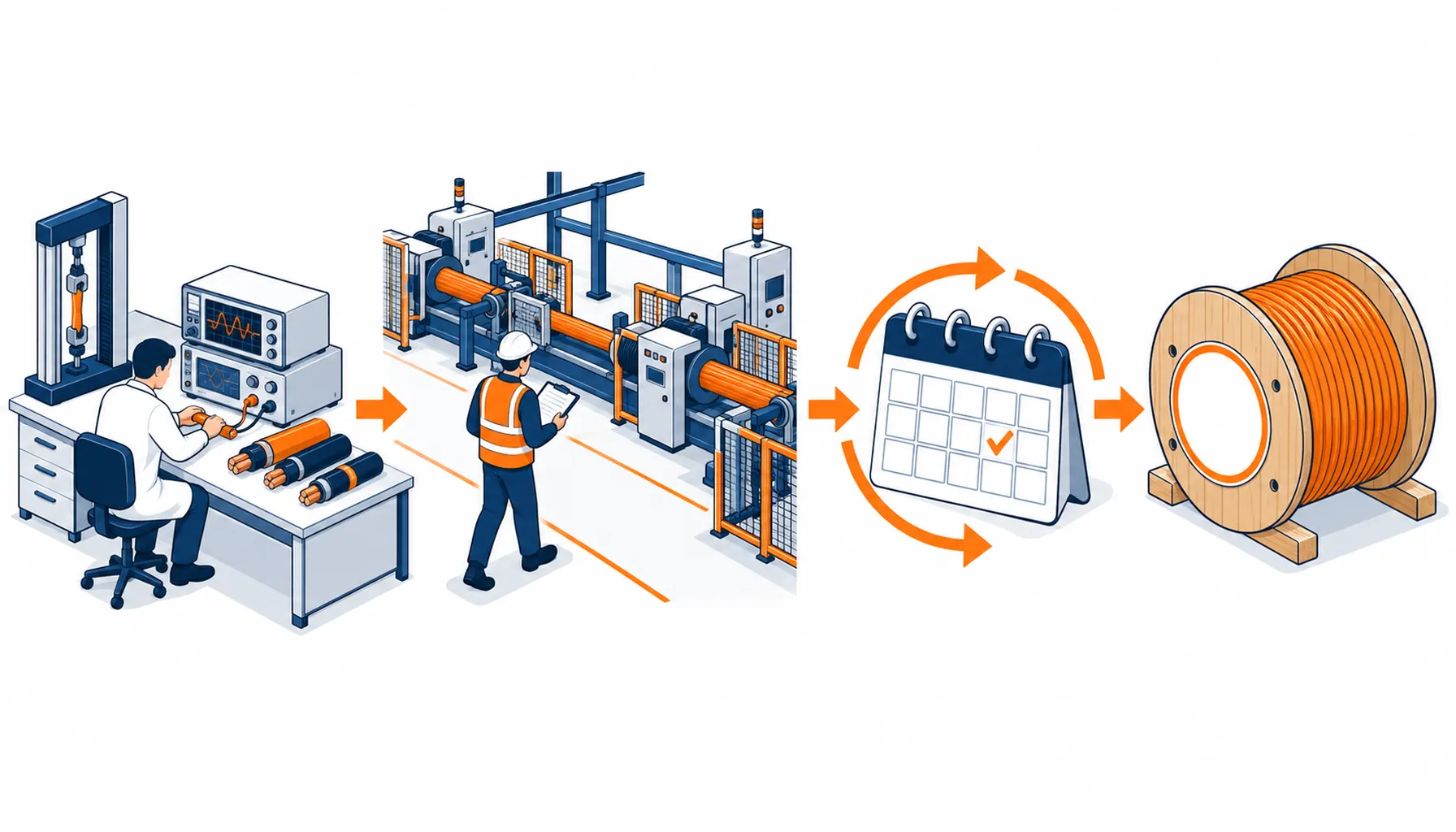
Quick Answer: CCC runs three layers — type testing, factory audit, annual surveillance — and is issued to the plant itself: a certified factory is one the state has visited and revisited.
Among the world’s cable certifications, China’s CCC occupies a special position. It is mandatory for the domestic market, it is issued to the factory rather than the trader, and it never expires into inertia: annual surveillance keeps the certificate alive by re-inspecting the plant. For buyers selling into China, it’s the legal gate. For buyers buying from China, it’s something subtler and often more valuable: a state-run, recurring audit of the factory you’re about to pay. This guide covers both uses.
Introduction
CCC, short for China Compulsory Certification, is the mechanism by which the Chinese state guarantees that products affecting safety can only be made and sold by factories it has certified. Wire and cable sit prominently in the CCC catalog because cable is fire- and shock-critical and famously easy to counterfeit. The scheme’s structure matters more than its acronym. Type testing proves the design, the factory audit proves the plant can reproduce it, and annual surveillance proves both still hold. No self-declaration scheme matches this three-layer regime. The result is that a genuine CCC certificate is hard to fake and expensive to keep, and therefore a meaningful trust signal in cross-border sourcing, the discipline covered in how to vet a Chinese electrical equipment manufacturer. This guide explains which cables CCC covers, what the three layers demand, how to verify a certificate is genuine, and how buyers outside China should read it.
What CCC Covers: The Cable Catalog
CCC applies by catalog. The state publishes the product categories that require certification, and wire and cable occupy a substantial block of it: building wire for fixed installation, power cables for the covered voltage ranges, and common flexible cords and cord sets among them. The catalog is precise about constructions and voltage classes, so the first verification question is always categorical: is this specific construction, at this voltage rating, in the catalog? Products inside the catalog cannot be manufactured, sold or imported into the domestic market without the CCC mark and certificate; products outside it may fall under other regimes or none. The catalog also evolves, with categories added, adjusted and occasionally removed, which is why certificate verification belongs at RFQ time with the current catalog, not in a supplier’s brochure from three years ago. The same current-status discipline governs every export certification, as covered in the power cable certifications checklist.
The Three Layers: Type Test, Factory Audit, Surveillance
The regime’s strength is its layering. The type test proves the design: samples of the exact construction are tested at accredited laboratories against the adopted national standards, covering conductor, insulation, sheath and fire behavior, and the certificate names the construction that passed. The factory audit proves reproduction: assessors visit the plant to verify the quality system, the production consistency and the traceability that connects certified samples to serial production, because a design that passed once is worthless if the line can’t repeat it. The annual surveillance proves persistence: the certificate holder is re-audited every year, samples may be re-tested, and non-compliance suspends or revokes the certificate. The consequence for buyers is structural. A CCC certificate isn’t a document a factory buys once; it’s a relationship with a certification body that visits every year, and a factory that maintains that relationship for years is a factory with a verifiable operating history. This layered logic of design, factory and persistence is the same architecture buyers should demand from any supplier verification, whether or not a state runs it, per the China certification checklist.
| Layer | What It Proves | Buyer Verification |
|---|---|---|
| Type test | The exact construction passed the standards at an accredited laboratory | Certificate names the construction, voltage class and standard |
| Factory audit | The plant can reproduce the certified design consistently | Certificate holder is the manufacturing plant, not a trader |
| Annual surveillance | The certification is currently maintained, not historical | Certificate status and validity checked in the official database |
| Mark on product | The shipped cable belongs to the certified family | CCC mark and certificate number on the cable print or drum label |
Verifying a CCC Certificate: The Practical Checks
Verification runs four checks, and none requires inside knowledge. Check the holder: the certificate names the factory, so match it to the entity you are contracting with. A certificate held by a different company, however related, is not your supplier’s certificate. Check the construction: the certificate’s product description, covering type, voltage class and size range, must include the offered cable. A certificate for one category does not bless another. Check the status: certificates are searchable in the official CCC database by number or holder, and the search returns current validity. A photocopy proves nothing; a database lookup proves everything. Check the product: for domestic-market cable, the CCC mark and the certificate number appear on the cable’s printing or the drum label, tying the physical drum to the certificate. It’s the same identity chain that anchors batch reports. Certificates that pass all four checks are strong evidence. Certificates offered as photographs in a chat thread are the starting point for the four checks, not the end.
| Check | How | Red Flag |
|---|---|---|
| Certificate holder | Match to the contracting factory entity | Holder is a trading company or an unrelated name |
| Construction coverage | Product description vs offered cable type and voltage | "Similar products covered" without naming the type |
| Current status | Official database lookup by certificate number | Only a photocopy offered, status "check later" |
| Product identity | CCC mark and number on print or drum label | Mark missing from the shipped cable |
What Buyers Elsewhere Should Learn from CCC
Even for buyers who never ship to China, CCC is worth studying because it demonstrates what a credible certification regime requires, and those requirements transfer to how buyers should treat any market access claim. Mandatory schemes with factory audits produce certificates with substance; self-declarations produce documents whose substance depends entirely on the declaring party’s discipline. Recurring surveillance keeps certificates honest, while a certificate that no one ever checks again decays into wallpaper. Identity chains, with the mark on product, number on label and holder on record, make verification cheap for strangers, which is exactly what international trade needs. The buyer’s takeaway is a reading habit. When any supplier presents any certification, ask the CCC questions: who holds it, what construction does it name, is it current, and does the product carry it. Suppliers whose answers are strong on those four questions tend to be strong on the factory floor, because the two strengths share a root: a quality system someone checks. That root is what the sourcing discipline in one coordinated power equipment supplier builds its supply chain on.
When CCC Is Not the Answer
Three limits keep the mark honest. CCC certifies the domestic market: it is neither designed for, nor accepted as, market access abroad, and export destinations run their own schemes, mapped in the market access overview of this series. CCC certifies the catalog categories: constructions outside the catalog may be excellent and unmarked, so absence of CCC on a specialized construction is not evidence of absent quality. It’s a question the batch report and type tests answer. And CCC is not a substitute for project specification: passing the compulsory minimum does not mean the cable fits a data hall’s fire strategy or a feeder’s ampacity. The project’s own requirements, verified through the evidence regime in our MV and LV standards guide, remain the buyer’s job.
RFQ Checklist: CCC Lines for the RFQ
Where the order touches the Chinese market or CCC-backed factories:
- Certificate holder named and matched to the contracting factory
- Certificate’s product description covers the offered constructions and voltage classes
- Current validity verified via the official database, certificate number stated
- CCC mark and certificate number printed on cable or drum label where the catalog applies
- Type test reports from accredited laboratories provided per certificate
- Surveillance records available on request for long-term supply agreements
- Export-market certifications handled per the destination scheme, independently of CCC
Conclusion
CCC is mandatory certification at full depth: the design is tested, the factory is audited, and both are re-verified every year. For buyers entering the Chinese market it’s the legal gate. For buyers sourcing from Chinese factories it’s a free, state-run preview of the factory audit they would otherwise commission themselves. Read it with the four checks of holder, coverage, status and mark, and it tells you more about a factory than most audits ever will.
Kexingyu Cable Group (KXYE) maintains CCC certification on its catalog product lines with annual surveillance at its own plants, and supports export buyers with the accredited test reports and market-access documentation each destination requires. Factory-held certificates are matched to the drums that ship.
Recent Posts

157 · Cable Import Certifications by Country: A Global Overview Map
Cable Import Certifications by Country: A Global Overview Map Quick Answer: Market access is country-specific — CCC in China, CE in the EU, SASO/SABER in
156 · Third-Party Cable Inspection: SGS, BV and TUV Pre-Shipment Checks
Third-Party Cable Inspection: SGS, BV and TUV Pre-Shipment Checks Quick Answer: A third-party pre-shipment inspection verifies quantity, marking, construction and documents before the drums sail

Power Cable Warranty Terms: What to Demand and What to Watch For
Power Cable Warranty Terms: What to Demand and What to Watch For Quick Answer: A usable warranty names its scope, duration, evidence standard, exclusions and