Malaysia Cable Imports: SIRIM and Energy Commission Requirements
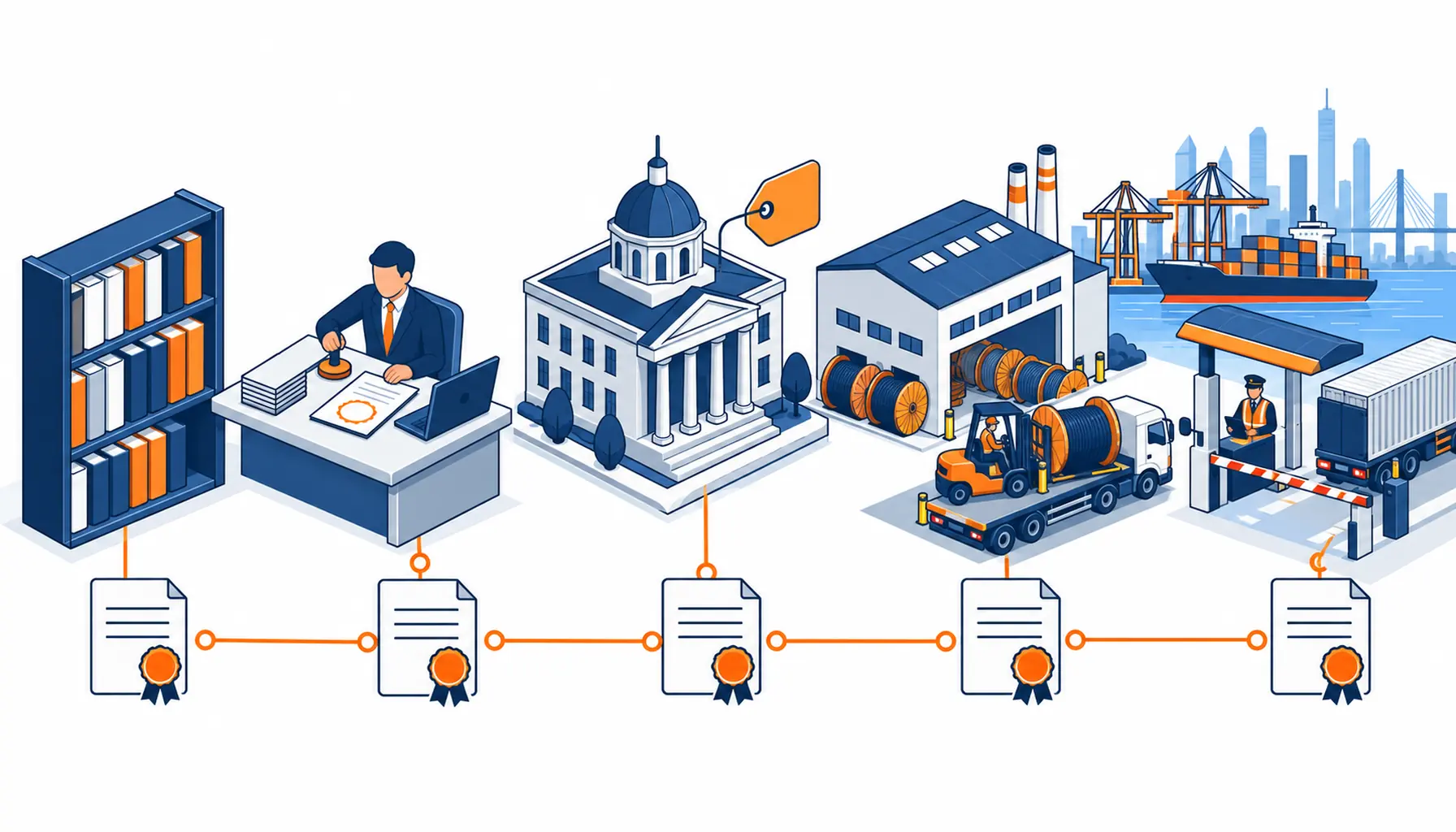
Quick Answer: Cable into Malaysia runs through two linked institutions: SIRIM QAS product certification and the Energy Commission, whose requirements and labeling govern regulated products at the border.
Malaysia regulates cable with a system that is easy to describe and easy to underestimate: certify the product through the national certification body, label it per the regulator’s requirements, and let the importer’s paperwork match the shipment at the border. The underestimation usually happens in the middle. A certification held for one construction gets offered against another, a label goes missing where the regulator requires it, or an importer assumes the exporter handled everything. This guide keeps the three pieces separate so the workflow stays linear.
Introduction
Malaysia’s electrical market runs under the Energy Commission — Suruhanjaya Tenaga — the regulator for electricity supply and regulated electrical equipment, with conformity to the relevant Malaysian standards demonstrated through certification bodies, most prominently SIRIM QAS. For cable, the practical structure is this: the applicable standard defines the construction’s requirements; product certification proves conformity; the regulator’s regime governs what may be sold and how it is labeled; and the importer’s declarations tie the shipment to all of it at customs. The demand context makes Malaysia one of Southeast Asia’s most active cable markets, with manufacturing corridors and one of the region’s fastest-growing data center hubs, per the regional picture in Southeast Asia data center power. The buyers who move fastest there are the ones whose certification files arrive with their quotations. This guide covers the institutions, the certification, and the import workflow.
The Institutions: SIRIM QAS and the Energy Commission
Two institutions, two roles, one workflow. SIRIM QAS is the certification body: it operates product certification schemes under which cable constructions are tested against the applicable Malaysian standards — largely IEC-derived, as in most of the region — audited at the factory where relevant, and certified for a term with surveillance. The Energy Commission is the regulator: it administers the regime under which regulated electrical equipment may be supplied in Malaysia, including the approval and labeling requirements that customs and market surveillance enforce. The division of labor matters for planning. SIRIM answers “is this construction certified, by whom, for what scope”, while the Commission answers “what does the market require for this product to be supplied and labeled”. A buyer who asks both questions separately avoids the classic blur: assuming a certificate alone satisfies a regulatory regime, or that a regulatory listing replaces the need for test evidence. The evidence behind both is the same stack this cluster teaches — accredited reports, construction identity, current standards — per the power cable certifications checklist.
What Certification Covers — and How to Verify It
The verification runs on the cluster’s four checks, localized. Holder: the certificate names the manufacturing facility — and where the scheme certifies the factory, the plant that builds your order must be the plant on the certificate. Group certificates don’t travel between factories. Coverage: the certificate’s scope — cable type, voltage class, size range — must cover the offered construction; a certification for building wire does not bless a control cable. Currency: certificates live through surveillance, and current status is verified with the certification body or in its registers, not from a scanned PDF of unstated age. Marking: certified product carries the scheme’s mark per the regime’s requirements, and the label is the physical link between the drum and the certificate — the same identity chain that anchors every destination in this cluster, from CCC’s database lookup to BIS’s license search. A supplier whose four answers are strong is showing you a state-recognized, audited plant; a supplier whose answers blur has told you where the schedule risk lives. That’s the vetting instinct from supplier vetting, applied with Malaysian specifics.
| Institution / Layer | Question It Answers | Buyer Verification |
|---|---|---|
| Applicable Malaysian standards | What must the construction meet? | Standard and version named in the certification file |
| SIRIM QAS certification | Is this construction certified, by whom, for what scope? | Holder, coverage, currency, mark — the four checks |
| Energy Commission regime | What may be supplied, and how must it be labeled? | Regulatory approval and labeling requirements confirmed per product |
| Importer declarations | Does this shipment match its file at customs? | Document set consistent; drums match certificates |
The Import Workflow: From Certificate to Clearance
The workflow is linear when the files exist. At RFQ, map the constructions to the applicable standards and the regulatory regime, and ask the supplier what certification it holds — the matrix habit, one row per construction. At selection, verify holder, coverage, currency and marking on each certificate, and note which party — factory, local representative, importer — holds the regulatory approval where the regime requires one. At contract, allocate the importer-of-record duties, the labeling obligations and the document supply. Malaysia’s procedures run through the importer’s declarations, so the customer-side contact is a scheduling task, not a courtesy — the ownership pattern every importer-led gate in this cluster shares. At shipment, one document set, generated from one source, descriptions matching the certificates. At arrival, the drum-to-document match per the receiving protocol, with the photographic drum-ID habit that anchors every warranty file. Where the schedule is tight, the lever is upstream: factories that already hold the certification ship in weeks, while certification projects ship in months. That lead-time reality recurs across mandatory schemes and drives the planning in cable sourcing delays and EPC timelines.
| Stage | Action | Classic Trap |
|---|---|---|
| RFQ | Map constructions to standards and regime; ask for held certifications | "Malaysian standards" treated as one generic line |
| Selection | Four-check verification on each certificate | Group certificate assumed to cover a different plant |
| Contract | Allocate importer duties, labeling, document supply | Labeling obligation discovered at packing |
| Shipment | One document set, descriptions matching certificates | Invoice descriptions drifting from certificate scope |
| Arrival | Drum-to-document match, photographic record | Mixed loads with one uncertified family |
Where Malaysian Imports Fail — and the Fixes
The failure list is short and familiar. Scope blur: a certificate offered against a construction it does not name. Fixed by reading the scope line, not the logo. Holder blur: a certification belonging to a different plant or a stale representative. Fixed by the holder check at selection. Label gaps: the regulator’s marking requirements missed at packing. Fixed by writing labeling into the packaging specification, per the export packaging discipline in the sourcing cluster. Importer surprise: the registration duties assumed to be the exporter’s. Fixed by naming the importer of record and its tasks in the contract. Each fix costs minutes at the start of an order and weeks at the end; the pattern and its neighbors live in international power equipment sourcing mistakes. For multi-market Southeast Asian orders, the same matrix extends across the region — Malaysia’s gate alongside its neighbors’, each verified per its own rules, per the regional demand context in the regional data center buildout.
When SIRIM Is Not the Answer
Two boundaries keep the scheme in frame. It is a market gate, not an engineering verdict: certification proves the standard’s minimums, while the project’s ampacity, fire strategy and installation requirements remain the specification’s work, checked through the per-drum evidence regime. And it is Malaysia-specific. The certification has no force across the Causeway or in any neighboring market, each of which runs its own gate — Singapore, Thailand, Indonesia, Vietnam all differ. The regional rule this cluster repeats is the one that ends most confusion: verify per destination, per order, per current status. And where a construction sits outside a regulated scope, let the type test reports and batch evidence answer the engineering question under the standards framework in our MV and LV standards guide.
RFQ Checklist: Malaysia Access Lines for the RFQ
Write the Malaysian requirements into the order:
- Applicable Malaysian standards identified for the offered constructions
- Product certification held: holder, scope, certificate numbers stated
- Certificate currency verified with the certification body or its register
- Energy Commission approval and labeling requirements confirmed per product family
- Importer of record and registration duties named on the customer side
- Labeling written into the packaging specification, not discovered at packing
- Document set generated from one source, consistent with certificate scope
- Drum-to-document match verified per the receiving protocol
Conclusion
Malaysia’s cable gate is two institutions and one habit: SIRIM QAS certifies the construction at the factory, the Energy Commission governs what reaches the market and how it is labeled, and the importer’s paperwork ties the shipment to both at the border. Verify holder, scope, currency and marking. Write labeling into the packaging spec. And let the matrix — constructions against requirements — do the memory work.
Kexingyu Cable Group (KXYE) supports Malaysia-bound orders with accredited test reports against the applicable standards, certification documentation matched to the constructions that ship, and labeling-ready drum marking. The files arrive with the quote, ready for the submittal.