LSZH Data Cables: Why Halogen-Free Matters in Enclosed Data Halls
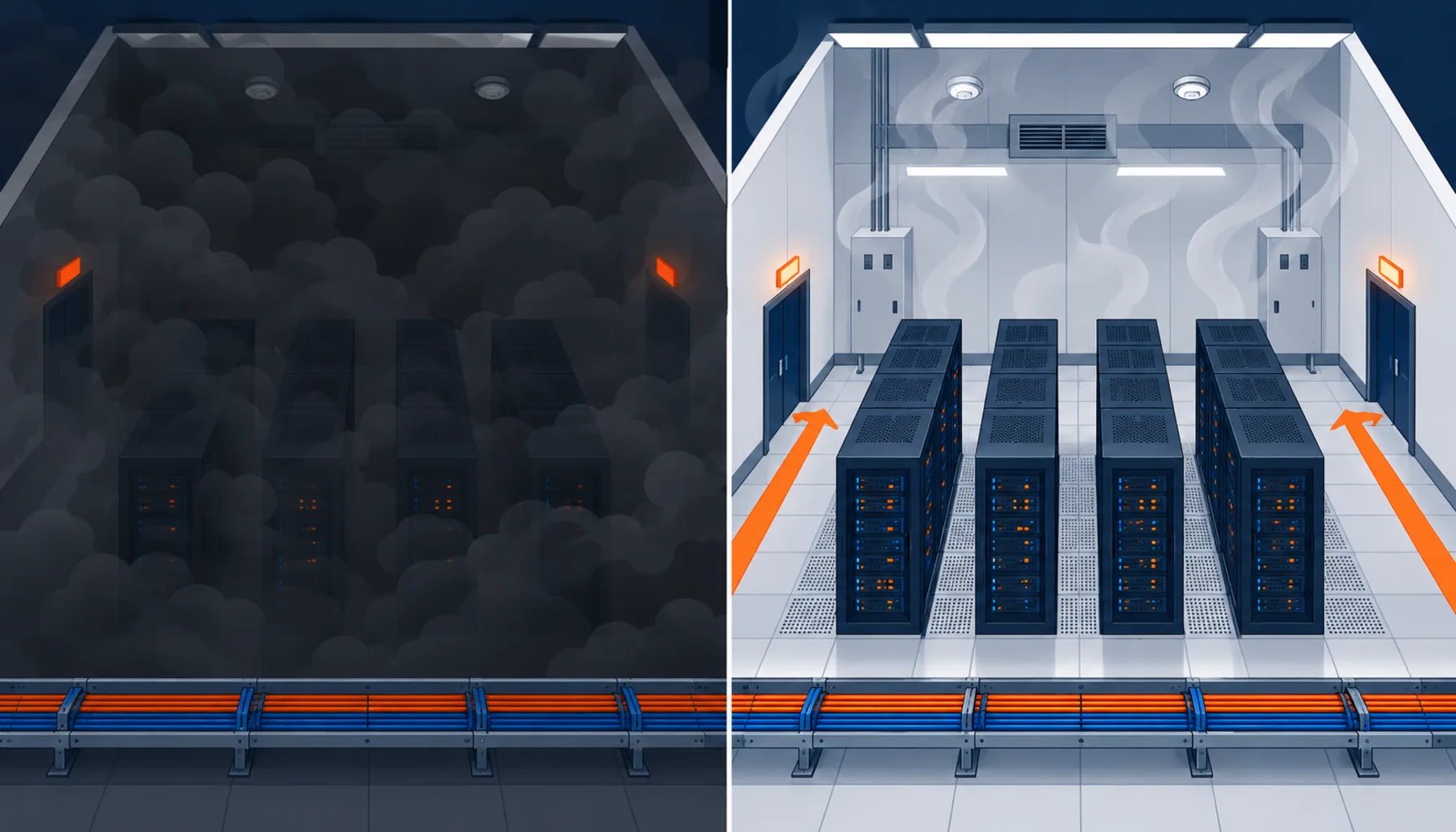
Quick Answer: In an enclosed data hall, burning PVC sheaths release corrosive, obscuring halogen smoke that threatens people and electronics before flames spread. LSZH sheaths trade cost and a little handling ease for smoke that is thin and non-corrosive.
The case for LSZH network cable is not that it burns less — in many tests it does not — but that what it releases when it burns is different: low smoke, and zero halogen acid gas. In an enclosed data hall, that difference is the whole argument. Cable trays under raised floors and above ceilings concentrate kilometers of jacket in spaces that evacuate slowly and vent poorly; a PVC sheath involved in a fire fills those spaces with dense smoke and hydrogen chloride, an acid that corrodes the copper and electronics the fire itself never touches. Occupants are threatened by visibility loss before they are threatened by flame, and the equipment survives the fire only to be chemically wrecked by it. LSZH — low smoke zero halogen — exists for exactly these spaces, and specifying it is really a decision about what happens during the worst minutes of the building’s life. This guide covers what the sheath chemistry changes, where codes and insurers push it, and what a buyer verifies so the letters on the jacket mean what they claim.
Introduction
The chemistry is the argument. Halogenated compounds — PVC foremost — release hydrogen chloride and hydrogen bromide when they burn; the smoke is dense, the gas is acidic, and the acid converts to hydrochloric acid on any moisture it meets, including lungs and circuit boards. Low smoke zero halogen compounds substitute mineral-filled polyolefin chemistry: combustion produces a thin smoke with no halogen acid, buying visibility for evacuation and sparing the hardware the corrosive bath. The trade-offs are real and known: LSZH compounds cost more, historically handled slightly less easily in cold conditions, and some early formulations were less flame-retardant than well-formulated PVC — which is why the flame and smoke questions are specified together, not confused into one label. The comparison that separates the two axes — fire propagation versus smoke chemistry — is laid out in the LSZH versus flame-retardant cable comparison, and it applies to the network tray exactly as to the power feeder. What follows is the data hall reading of that framework.
Where Enclosed Halls Make the Case
Three spatial facts make LSZH the default in modern data halls. Under-floor and over-ceiling plenums: the trays that feed racks live in sealed spaces shared with air circulation, where smoke spreads faster than people move and where evacuation is by corridor, not by window. Density: a single rack row’s worth of network, power and interconnect cable sums to kilometers of jacket within a few cubic meters — the fuel load is the sheath. Asset concentration: the hall’s value sits in the rooms the smoke reaches first; halogen acid that migrates through return air corrodes connectors, boards and contacts in racks the fire never touched, turning a localized event into a facility-wide claim. Codes and insurers have absorbed this logic unevenly by jurisdiction — some mandate LSZH in plenum and enclosed spaces, others accept it through performance-based fire engineering, and insurers increasingly price the sheath chemistry into cover. The buyer’s practical rule: in any enclosed or occupied pathway, the LSZH question is asked by default, and the pathway classification logic that sizes rack-adjacent distribution in the rack power distribution comparison maps the same spaces from the power side.
Specifying LSZH: What the Letters Must Prove
“LSZH” on a jacket is a claim, not a certificate, and the specification should convert it into test references. The evidence lines: halogen content — the standard’s threshold for hydrogen halide evolution, met by compound formulation rather than by marketing; smoke density — the smoke chamber test with its transmittance requirement; flame propagation — the vertical flame or bunched test class the pathway’s code requires, because halogen-free does not mean flame-retardant unless formulated and tested to be; toxicity and corrosivity where the jurisdiction’s standard demands them. Each line is verifiable on the datasheet and in the test report, read the way the datasheet reading guide prescribes: the compound named, the test standard numbered, the result stated — not a sheath described as “environmentally friendly.” For export procurement the verification chain closes at the certificate file, per the China equipment certification checklist, and the market-entry marks — CE, UL, ETL — sit on top of the sheath evidence rather than substituting for it.
| Aspect | PVC Sheath | LSZH Sheath |
|---|---|---|
| Smoke density | Dense, obscures exits | Thin, visibility preserved |
| Halogen acid | HCl released, corrosive | None — non-corrosive smoke |
| Human threat | Visibility and toxicity early | Evacuation time preserved |
| Asset damage | Acid corrodes remote racks | Damage stays with the fire |
| Flame retardance | Well-formulated grades strong | Must be tested, not assumed |
| Cost and handling | Cheaper, easier pulling | Premium, watch cold bending |
The Verification Habit: Making the Jacket Mean It
LSZH’s market weakness is impostor compound — jackets labeled halogen-free that burn like PVC, detectable only by test. The buyer’s defenses are procedural and cheap relative to the hall they protect. Specification first: the RFQ names the sheath requirement by test standard — halogen evolution, smoke density, flame class — so the supplier’s compliance is testable, and the certification checklist provides the frame for the document set. Sample verification: a burn-and-sniff spot check is crude but honest — PVC’s acid smoke is unmistakable — and a formal sample test at a third-party lab closes the question for critical projects. Batch traceability: the compound is a factory input like copper rod; suppliers who track sheath compound by batch can prove what a given drum is made of, and the audit that checks traceability once covers every later drum. Certificate currency: marks verified against issued certificates rather than jacket prints, renewed for the production period actually delivered. The full cable-layer landscape where these sheaths live is mapped in the data center power hub.
When LSZH Everywhere Is Not the Answer
The specification should follow the pathway, not blanket the bill of materials. In outdoor ducts, buried routes and industrial spaces with real ventilation, the halogen argument weakens — nobody evacuates through a duct bank, and the compound premium buys little; there, the flame-rating and environmental requirements govern, and PVC or polyethylene grades may be the honest answer. In pathways where mechanical toughness governs — high-abrasion industrial trays, cold outdoor runs — the compound selection is an engineering balance, and some LSZH formulations trade toughness for their smoke performance; the datasheet’s mechanical rows matter as much as the fire rows. And where the code for a given pathway accepts and properly manages PVC, gold-plating the sheath is spending the fire budget where it does not buy safety. The method is the same zoning used throughout cable specification: read the space, apply the code, specify the minimum construction that meets it with margin — and in enclosed, occupied, high-value spaces, that minimum is very often LSZH.
| Step | Action | Catches |
|---|---|---|
| Pathway class | Enclosed, plenum, occupied zones mapped | Blanket spec, wasted premium |
| Test references | Halogen, smoke, flame standards named | "LSZH" as marketing label |
| Flame class | Propagation requirement set separately | Halogen-free but flammable |
| Sample check | Burn spot check or lab test | Impostor compound at the dock |
| Traceability | Sheath compound batch-recorded | Mystery compound in later drums |
| Certificates | Marks verified against issued files | Expired or borrowed certification |
RFQ Checklist: LSZH Lines for the RFQ
Put the smoke performance in writing:
- Pathways classified: enclosed, plenum, occupied, outdoor
- LSZH required by test standard, not by jacket print
- Flame propagation class specified independently
- Smoke density and halogen limits stated with numbers
- Sample verification written into acceptance
- Sheath compound batch traceability required
- Certificates verified per destination market
Conclusion
LSZH network cable is a decision about the worst minutes of the building’s life: in enclosed data halls, the sheath that burns into thin, non-corrosive smoke protects the people evacuating and the racks the fire never reaches. Specify it by test standard where the pathway warrants, verify the compound at the dock, and leave the flame-rating question answered separately — the letters on the jacket should mean exactly what the test report says.
Kexingyu Cable Group (KXYE) supplies LSZH network and power cables with the compound named and tested: halogen evolution, smoke density and flame class per standard, batch-recorded sheath traceability, and datasheets whose fire rows read like specifications rather than vague adjectives.