IEC 60811 Mechanical Tests: Tensile, Elongation and What They Predict
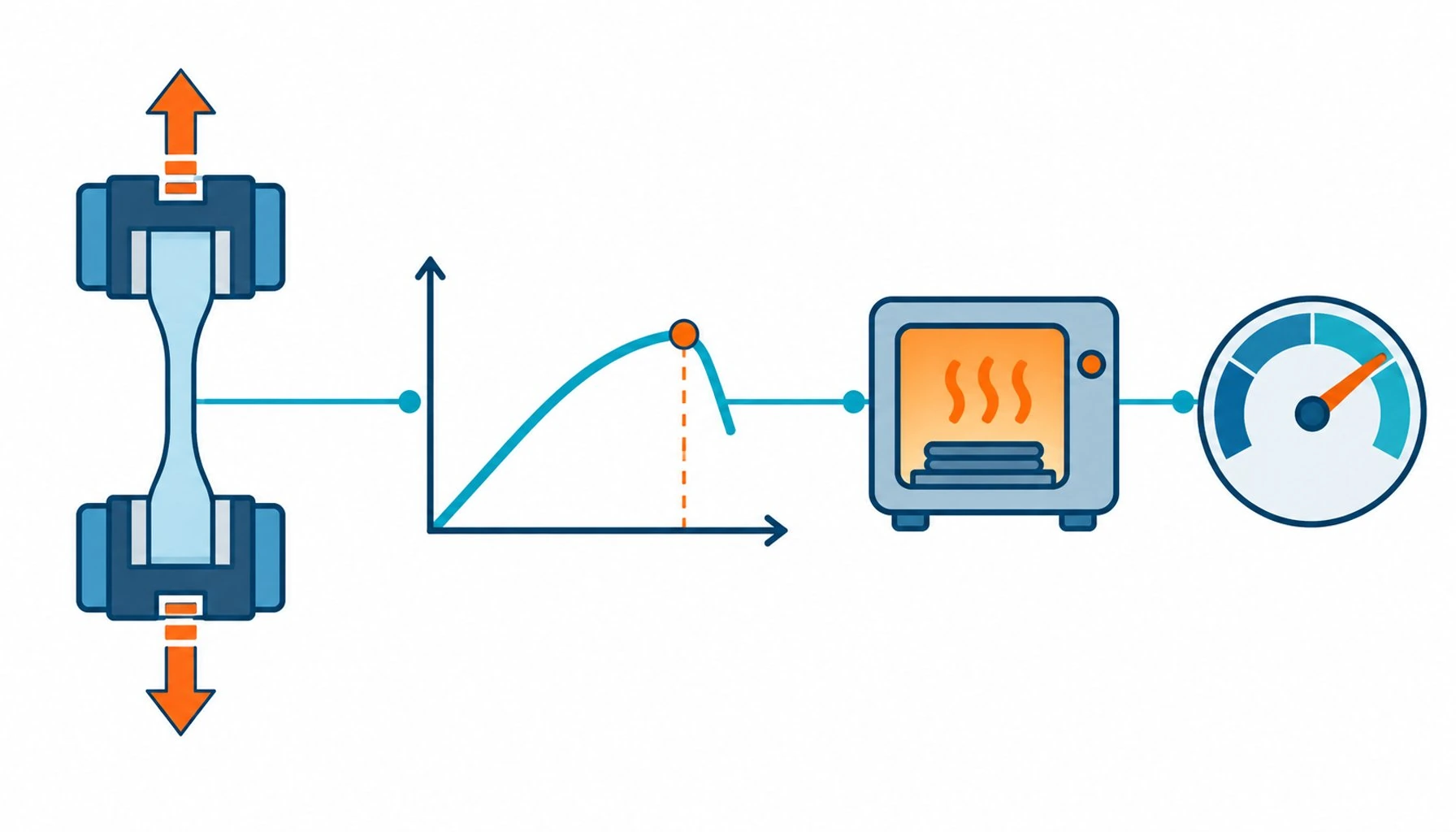
Quick Answer: IEC 60811’s tensile and elongation tests measure how far insulation and sheath materials stretch before they fail, and repeating the tests after oven ageing shows how much of that toughness survives heat, which is the closest thing materials testing has to a health forecast.
Strip away the standards numbering and cable materials testing asks two old questions: how strong is this material, and how much of that strength will remain after years of heat. IEC 60811 is the international answer set, a family of test methods covering the mechanical, thermal and environmental behavior of insulation and sheath compounds, and its tensile-elongation core is the single most quoted pair of numbers in cable datasheets. It is also the most quoted pair buyers cannot interpret, because the raw values mean little until they are read alongside the aged values and the compound type. This guide walks the method itself, the ageing logic around it, and what the results genuinely predict about a cable in service, and what they do not.
Introduction
The 60811 series grew out of the older IEC 811 documents and reorganized them into numbered parts, each a single test method, so a specification citing 60811 is really citing a selection of parts: mechanical tests, thermal ageing, low-temperature behavior, hot pressure, oil immersion and more. Standards bodies reference the parts that matter for the cable type in question, and the manufacturer’s material file records the results. The mechanical core, tensile strength and elongation at break, sits in the series’ five-hundred range for thermoplastic and elastomeric materials, with thermal ageing in the four-hundred range providing the before-and-after comparison that gives the fresh numbers their meaning.
Material tests look abstract from a procurement desk, but they are the layer under nearly every other claim: a sheath’s oil resistance, its cold behavior and its abrasion performance all trace back to the compound’s quality, and the tensile test is the standard’s way of auditing that quality batch by batch. The material families these tests evaluate, cross-linked and thermoplastic among them, are compared in the guide to XLPE versus PVC insulation, and the compound basics behind the tests are introduced in the guide to what XLPE cable is.
The Tensile Test: How the Numbers Are Made
The method takes dumbbell-shaped specimens cut or prepared from the insulation or sheath, grips them in a tensile machine, and pulls at a defined rate until failure. The machine records two values: tensile strength, the force at break relative to the specimen’s cross-section, and elongation at break, how far the material stretched before it gave way. A tough cable compound typically shows moderate strength with high elongation, the profile of a material that deforms before it fails. A degraded or poorly formulated compound shows the opposite warning, brittle behavior with low elongation, often long before its strength number looks alarming.
This is why elongation is the more diagnostic half of the pair for cable work. Insulation and sheaths live in an environment of bending, compression and vibration; their job is to tolerate deformation repeatedly. A material that stretches sixty percent before breaking absorbs installation abuse and mechanical noise without cracking. A material that snaps at low elongation transfers every stress to the weakest point and cracks there, and the crack is where water, oil and interference enter the cable’s story.
Ageing: The Same Test With a History
The fresh numbers only describe the material on the day it was made. The 60811 ageing method places specimens in an air oven at a defined temperature for a defined period, accelerated to represent years of thermal service, and then repeats the tensile test on the aged specimens. The specification expresses the outcome as retention values, the aged result as a percentage of the fresh one, with limits on both how much strength and elongation may fall and, for some materials, how much variation is tolerated. A compound that retains its elongation well through ageing is the compound that will still tolerate a moving machine’s deformation years into service; a compound whose elongation collapses in the oven is one whose service life depends on staying cool and undisturbed, a bet moving machinery rarely wins.
The oven also predicts thermal interaction between layers. In real cables, insulation sits against sheaths and fillers that can migrate plasticizers into or out of each other at temperature, which is why some specifications age specimens while wrapped together. The layered reality of these constructions is described in the guide to XLPE cable construction, where the chemistry behind cross-linking explains why some compounds age flat and others do not.
| Test | Method in brief | What it measures | What it predicts |
|---|---|---|---|
| Tensile strength and elongation | Pull dumbbell specimens to break at a defined rate | Strength at break and stretch at break of the compound | Toughness, compound quality, tolerance of deformation |
| Ageing in air oven | Heat specimens at defined temperature and duration, retest | Retention of tensile and elongation after thermal exposure | Long-term material health at service temperature |
| Hot pressure | Press an indenter into the sheath at temperature | Resistance to deformation under heat and mechanical load | Behavior in bundled, warm, compressed installations |
| Low-temperature tests | Bend, stretch or impact specimens cold | Flexibility and toughness below zero | Installation and service in cold plants and outdoors |
| Oil immersion | Soak specimens in standard oil, retest | Retention of properties after oil exposure | Sheath survival in lubricated and coolant environments |
Reading the Results: What the Numbers Predict, and What They Do Not
The predictive chain runs from material to mechanism. High fresh elongation predicts a compound that tolerates installation abuse, bending at fair radii and mechanical noise. Strong aged retention predicts that the tolerance survives thermal years, which is the difference between a cable that was tough and a cable that stayed tough. Together the pair screens out the compounds that pass a visual inspection and fail a cold morning or a hot drag chain. What the pair does not predict is flex endurance in cycles: a material can pass tensile and ageing with room to spare and still lose a bend-cycle race to a competitor with finer strand and better geometry, because fatigue life is a construction property as much as a material property. The tests audit the compound; the rig audits the cable. Buyers who keep the two layers separate read datasheets correctly, and the reading discipline is treated in the guide to reading equipment datasheets.
| Result pattern | What it suggests | Practical follow-up |
|---|---|---|
| High elongation, strong aged retention | A tough compound that keeps its toughness | Suitable base for dynamic duty; verify flex cycles separately |
| High strength, low elongation | A stiff, brittle-leaning compound | Question suitability for bending duty despite the strength number |
| Fresh values fine, elongation collapses after ageing | Thermal weakness, plasticizer loss or poor formulation | Derate temperature expectations or reject for warm installations |
| Values vary widely between batches | Inconsistent compound control | Audit the supplier's material control and batch testing |
| No aged values quoted at all | The datasheet is showing half the picture | Request the aged retention results before comparing cables |
Where 60811 Fits a Motion Cable Purchase
For robot and machine cable, treat 60811 results as the material gate before the duty gate. The material gate answers whether the compounds are well made and thermally honest; the duty gate, bend cycles, torsion and environment, answers whether the construction survives the machine. A supplier who publishes both layers, batch-consistent material data plus rig data at stated conditions, is showing the complete file a dynamic application deserves. A supplier who publishes neither, or pads the datasheet with adjectives, is asking you to buy on faith, and the vetting questions that convert faith into evidence are covered in the guide to vetting equipment manufacturers.
When Material Testing Is Not the Answer
Honest limits: 60811 tests specimens, not cables, and the translation from a dumbbell strip to a working sheath carries judgment, wall thickness, geometry, processing and quality all matter after the material passes. The tests also say nothing about electrical behavior, shielding, or the mechanical endurance of the finished cable in motion. A cable can pass every 60811 part cited in its specification and still be the wrong cable for a drag chain, which is why material results belong alongside, not instead of, flex and acceptance testing. And for installations with special exposures, aggressive chemicals, sustained high temperature or radiation, the standard tests are a starting point, with application-specific testing still required.
RFQ Checklist: Material Data to Request With a Cable Offer
Attach these items to the RFQ:
- Compound identification: insulation and sheath materials by type, not just color
- Fresh tensile and elongation values for each layer, batch-based
- Aged retention values at the specification’s temperature and duration
- Low-temperature behavior where the installation sees cold
- Oil immersion results where coolants or lubricants contact the sheath
- Test reports traceable to the shipped batch, not generic type-test handouts
For the electrical factory tests that complete the picture on a delivered cable, the acceptance logic is treated in the guide to factory acceptance testing, with material and electrical files together forming the evidence a serious order deserves.
Conclusion
IEC 60811’s tensile, elongation and ageing tests are the quiet foundation under every other cable claim: they audit the compound, expose thermal weakness before the field does, and separate materials that stay tough from materials that merely started that way. Read alongside flex and acceptance data, they give buyers a three-layer picture, material, construction and delivered product, that leaves little to hope and less to marketing.
Kexingyu Cable Group (KXYE) supplies machine cable with material files and duty data delivered together, batch-traceable and stated plainly. Send your cable requirement through the RFQ page, and we will quote with the evidence attached.