The Machinery Directive and Your Cable: What CE Compliance Really Requires
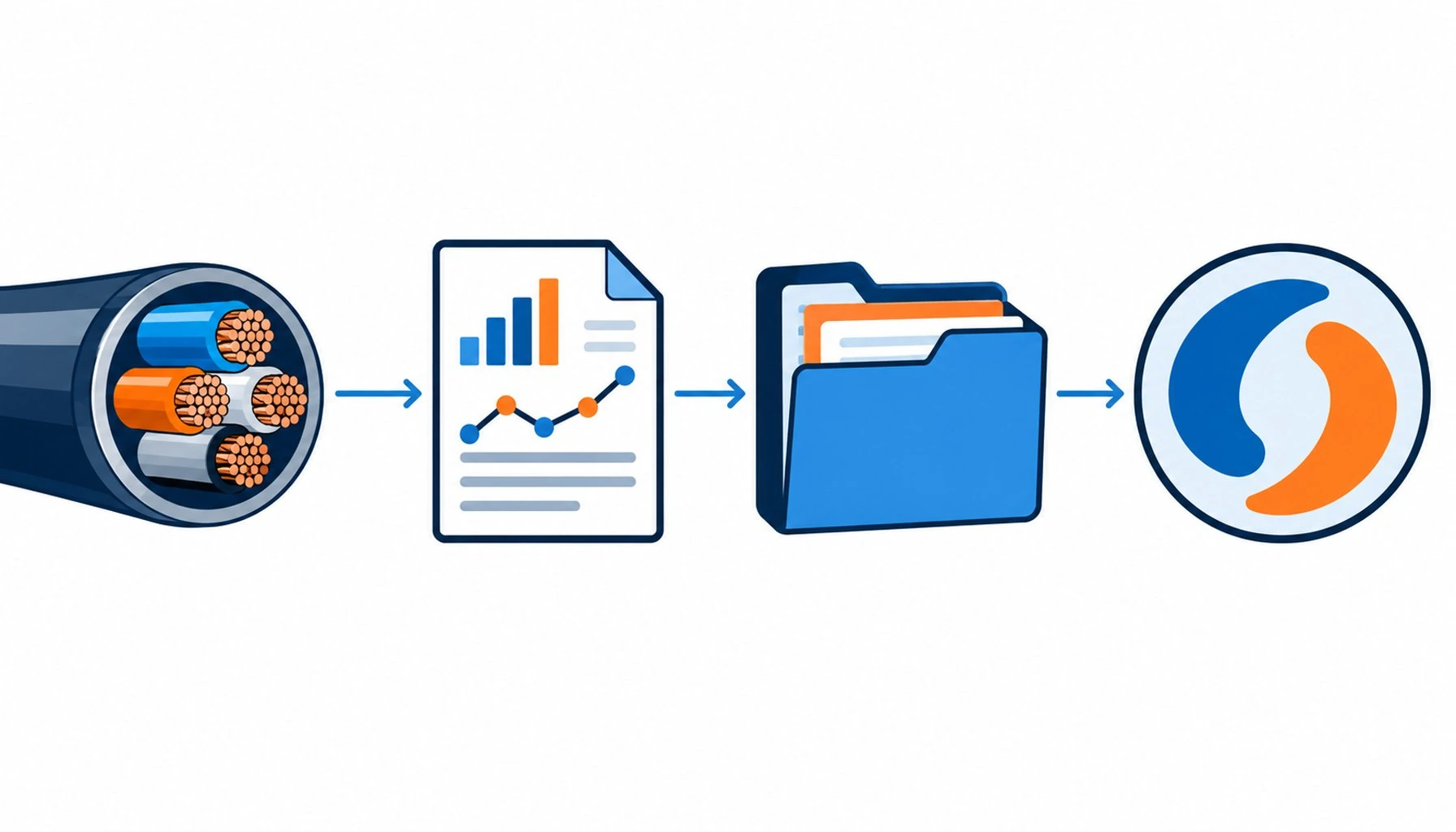
Quick Answer: The machine carries the CE mark and the cable never does. The cable’s job is to supply the evidence the technical file needs, in a form an auditor can trace to a drum.
Ask a machine builder what CE requires of their cable and you get one of two answers. Either a shrug, because the cable was bought from a distributor and the marking is on the machine, or a recitation of directives that turns out, on inspection, not to be supported by any document in the file. Both answers come from the same root cause: the machinery rules are written around the machine, and cable sits one layer below the text, which makes it easy to assume it is somebody else’s problem until an auditor asks a question the file cannot answer.
Introduction
The essential health and safety requirements set the performance the machine must achieve: it must be safe, it must fail safe, it must be documented, and its electrical equipment must be designed to recognised practice. Nothing in those requirements names a cable. What they do is create obligations that can only be discharged with component evidence, because a declaration that the electrical equipment is safe is a claim about parts you did not make.
The cable-specific entries in a technical file are unglamorous and few, which is exactly why they get skipped. A conductor schedule, a sheath declaration, a test report for the insulation, a statement of the standard the cable was made to. Each one is small. Together they are the difference between a file that closes and a file with a hole in it shaped like the wiring. Keeping that evidence current is the ongoing work, and it is the same discipline described in the guide to cable certification checklists.
Why the Cable Is Not the CE Product
Conformity assessment attaches to the machine as a placed-on-the-market product. The cable inside is a component, and components are not individually CE marked unless they fall under their own directive, which most cable does not. This produces a structural consequence that surprises people: a perfectly compliant cable can be bought from a supplier who holds no European documentation at all, and the builder is still responsible for the machine’s compliance. The obligation does not travel with the cable; it stays with the person who puts the machine on the market.
The other consequence is that a component certificate does not approve a machine. Each component can be impeccable and the assembly still fail, because the requirements are about the whole: protective bonding continuity, safe stop behaviour, conductor identification across the system, environmental rating where the machine is used. Cable is an input to those arguments, never a substitute for them. Treating a supplier’s certificate as the answer to a file question is the most common way builders end up with an unsatisfied requirement and a document that appears to address it.
| Instrument | Applies to | What it asks of the cable | Evidence that settles it |
|---|---|---|---|
| Machinery rules | The machine as a placed-on-the-market product | Electrical equipment designed to recognised practice, safe stop behaviour, identified conductors, documented design | Technical file with electrical drawings, component declarations, risk assessment |
| Low voltage rules | Electrical equipment within the stated voltage range | Insulation, dielectric strength and temperature rating adequate for the supply and environment | Type test reports and a declaration naming the standard |
| Electromagnetic compatibility rules | Equipment that may cause or suffer interference | Shielding, pairing and termination adequate to keep drives, encoders and control signals inside limits | Machine-level EMC test results plus cable construction data supporting the design |
| Hazardous substances rules | Electrical and electronic equipment in scope | Restricted substances held below the threshold in every homogeneous material | Manufacturer declaration with supporting analysis or test reports |
| Harmonised electrical standard for machinery | Machinery electrical equipment by voluntary route | Conductor identification, bonding, emergency stop wiring, documentation practice | Declaration citing the standard, matched to the installed construction |
What the Electrical Standard Actually Changes
The last row carries most of the weight in practice. Applying the machinery electrical standard is voluntary, but not applying it means arguing conformity some other way, and no builder wants that argument. So the standard becomes the de facto specification for the wiring, and every cable in the machine has to be consistent with the practice it describes.
What Changes in 2027, and What Does Not
Three parts of the standard touch cable directly. Conductor identification is the first: the practice requires conductors to be identifiable and consistent, which pushes colour coding and numbering into the specification. Protective bonding is the second: continuity and conductor sizing for bonding paths are design requirements, not installation conveniences, which is why a bonding conductor cannot be reduced because the cabinet looked tidier that way.
The third is the one buyers underestimate. Emergency stop and safety-related circuits carry requirements about how they are wired and how they behave on fault, and the cable in those circuits is part of that argument. A safety circuit run in a construction that is not rated for the flex duty on a moving guard, or one whose shielding does not support the signal integrity the safety function depends on, weakens the safety case regardless of what the relay datasheet says. The difference between control and instrumentation construction matters here, and it is drawn out in the comparison of control and instrumentation cable.
The practical upshot for a cable specification is that the machine’s safety architecture determines cable requirements before the drive selection does. Builders who specify cable last, after the cabinet is laid out, end up retrofitting requirements into a design that has already closed.
When the Directive Is Not the Answer
The machinery rules move to a regulation that applies in full from 20 January 2027, replacing the directive, with certain provisions already in force during the transition. The headline additions concern machinery with safety functions that use artificial intelligence and cyber-safety of compliance-relevant software, and the assessment path for higher-risk categories. Cable is not the subject of any of it.
What cable people should notice is narrower and more practical. Digital instructions and declarations become more clearly permitted, which changes documentation workflows. Higher-risk categories face tighter assessment, which raises the bar on component evidence for the machines in those categories. And declarations issued during the transition can reference both instruments where the product satisfies both, which is a useful bridge for long projects that straddle the date. None of this alters what a cable must be; all of it increases the chance that somebody will read the file more carefully.
| File entry | Cable input it needs | Common gap |
|---|---|---|
| Description of the machine and its electrical equipment | Construction list with type designation, size, voltage and temperature rating per circuit | Type nicknames in the bill of materials that no document defines |
| Electrical drawings and conductor schedule | Core identification, shield arrangements, bonding conductors | As-built wiring that drifted from the drawing without a revision |
| Component evidence | Declarations and test reports for the constructions actually installed | Reports for the qualification sample, not the delivered batch |
| Substance compliance | Material declarations covering every homogeneous material | A blanket statement with no material breakdown behind it |
| Safety function description | Construction data for circuits carrying safety signals | Safety circuits specified at the same grade as ordinary control wiring |
| Instructions for use | Cable service limits reflected in maintenance guidance | Maintenance intervals with no basis in the cable's rated duty |
RFQ Checklist: Cable Evidence for a Machinery Technical File
Two honest limits. First, compliance with the machinery rules is not a statement about cable quality in any sense a plant manager would recognise. A machine can be entirely compliant and still eat cables every few months, because the rules ask about safety and interference, not about fatigue life in a cable carrier. Durability is an engineering question that the conformity route never asks, and buyers who assume a compliant file implies a long-lived cable are reading a safety document as if it were a reliability document.
Second, the electrical standard is voluntary, which means two compliant machines can be wired to noticeably different practice. That is not a loophole; it is the price of a system built on essential requirements. What it means for procurement is that the cable specification has to come from the machine’s own engineering, not from a general assumption about what European machines use. And because several of the arguments above depend on the cable’s behaviour under interference, the drive-side picture matters too, which is why the guide to variable frequency drives and soft starters and the sizing guidance in the cable selection guide are worth reading alongside this one. The China-side documentation that feeds the same file is collected in the guide to Chinese electrical equipment certification.
Conclusion
Attach these to the inquiry so the file can be built from deliveries rather than reconstructed later:
- Construction description per circuit: type designation, size, conductor class, shield, sheath compound, voltage and temperature
- Declaration of conformity naming the standards the machine’s file will cite
- Test reports per construction, with the conditions and the batch reference stated
- Material declarations covering each homogeneous material, not a product-level statement
- Print legend content agreed in advance, matching the bill of materials designation
- Statement of any construction change process, so the file can be updated when a compound or a supplier changes