Brazil NR-12 Machine Safety Regulation: What It Means for Cabling
Quick Answer: Brazil’s machine safety regulation is mandatory, enforced, and it names an electrical standard as its technical reference. Cable requirements arrive through the machine’s safety file, not a cable-specific scheme.
Brazil is one of the few markets where a safety regulation, rather than a product certification scheme, decides what cable a machine may use. The regulation governs machinery and equipment safety at work, it applies to machines being placed on the market and to those already installed, and it references an electrical standard for the wiring rather than inventing its own. For a cable supplier or a machine builder, this means the requirements arrive sideways, attached to the machine’s safety documentation, which is exactly why they get missed until an audit.
Introduction
The regulation is a labour ministry instrument, which explains its emphasis. Its purpose is protecting the people who operate and maintain machines, so it is written around guards, interlocks, emergency stops, protective devices, risk assessment and maintenance procedure rather than around product performance. Electrical and electronic devices appear in the text as protective devices, which is the hinge on which cable requirements swing.
The practical consequence is that the machine’s safety architecture determines the wiring requirements. A circuit that carries a protective function is not merely control wiring; it is part of a safety function whose reliability has to be demonstrated. That reframing changes specifications, and it is the reason a construction that would be adequate for ordinary control duty may be questioned in a safety circuit. The market is also one of the faster-growing automation markets in the Americas, so the number of projects meeting these requirements is rising rather than falling. The general structure of cable evidence across markets is surveyed in the guide to cable certification checklists.
What the Regulation Is, and Who It Binds
It binds anyone placing machinery and equipment on the Brazilian market and anyone operating it, and it is enforced through labour inspection rather than through customs, which means the pressure arrives at the plant. That distinction shapes strategy: a machine can clear import formalities and still be refused operation, so the documentation has to be right regardless of how easily the container moved.
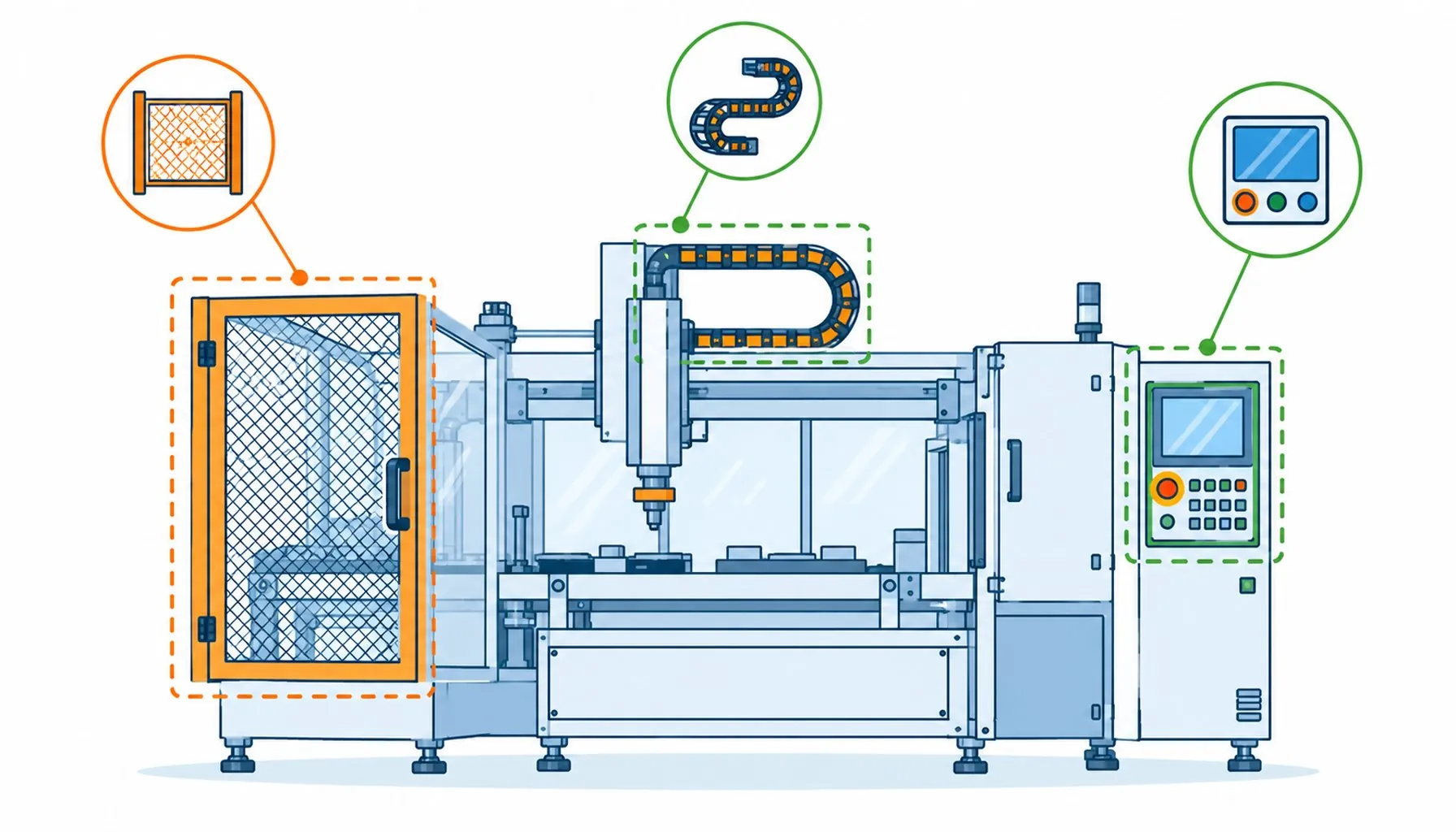
The regulation’s expectations are concrete. Hazardous areas need fixed or interlocked guarding, and an opened guard stops the machine. High-risk stations need protective devices such as light curtains or two-hand controls. Every machine needs an emergency stop that is prominent, reachable and capable of cutting the power. And the machine needs a risk assessment with records, technical documentation, and defined maintenance procedures. Manuals and safety labelling are expected in Portuguese.
The Electrical Standard It Points To
Rather than define electrical practice itself, the regulation points at the international machine-electrical standard, which Brazil adopts as a national standard. That standard covers machine electrical equipment up to a defined voltage range and sets expectations for protection against electric shock, overcurrent protection, control circuit design, conductor identification, protective bonding and documentation. Adopting it as the reference means Brazilian requirements for machine wiring are recognisably the same family as European ones, which is good news for builders who already design to that practice.
| Instrument | What it covers | What it requires of cable | Evidence produced |
|---|---|---|---|
| Machine safety regulation | Machinery and equipment used at work | Protective circuit wiring, mechanical protection of conductors, defined maintenance intervals | Risk assessment, technical file, maintenance procedure |
| Machine electrical standard | Machine electrical equipment within its voltage range | Conductor identification, bonding, emergency stop wiring, documentation practice | Design documentation and component declarations |
| Safety-related control standard | Safety functions on machines | A construction that supports the performance level claimed for the function | Safety function description with component data |
| Installation standard | The electrical installation the machine connects to | Earthing, protection coordination, conductor sizing to the installation | Installation documentation from the plant side |
| Component conformity scheme | Specified electrical components | A conformity mark where the component appears on a compulsory list | Certificate of conformity for the listed component |
What the Regulation Asks That Touches Cable Directly
Three themes run through it. Emergency stop circuits are the first: the stop function has to be reliable, which means the wiring carrying it is part of the safety argument rather than an accessory to it. Protective devices are the second: light curtains, interlocks and similar devices have their own circuits, and the cable serving them has to preserve the signal integrity and mechanical integrity the function depends on. Isolation and lockout are the third, and they set expectations about disconnecting means and about conductors that remain energised in a maintenance scenario.
Two further themes are less obvious and cause more argument. Electrical conductor protection against mechanical damage is an explicit concern, which pushes armoured or mechanically protected constructions into certain runs and pushes routing decisions into the safety file. And installed protection against overload and residual current is expected, which is mostly a device question but affects conductor sizing and identification. The wiring implications of protection and earthing arrangements are covered from the installation side in the guide to industrial power distribution, and the sizing arithmetic that follows from protection choices is set out in the cable selection guide.
INMETRO and Component Certification
Alongside the safety regulation sits a separate conformity framework run by the national metrology and standardisation body, which imposes compulsory certification on specified electrical components. The two are not substitutes: a component conformity certificate does not satisfy the machine safety regulation, and a compliant safety file does not exempt a listed component from its certification obligation.
For a cable supplier the useful question is whether a given construction appears on a compulsory list as a component. Often it does not, and the cable enters the project as a declared component of the machine. Where it does, the certification has to be arranged before shipment, which is a lead-time item rather than a documentation item. The national electrical standards referenced on both sides are compared with their international equivalents in the guide to cable standards across IEC and national systems.
Documentation, Language and the Local Engineer
The documentation burden is real and it is language-specific. Manuals, safety warnings and labelling are expected in Portuguese, the technical file has to be present and usable by the people who operate and maintain the machine, and certain records require sign-off by an engineer licensed in Brazil. None of this concerns the cable directly, and all of it affects how the cable evidence is packaged, because the file that holds the safety argument is the same file that has to hold the construction data.
The pattern of evidence is close to what an assembly-level acceptance process would compile, and the distinction between verifying an assembly at the maker’s works and verifying it on site is explained in the comparison of factory and site acceptance testing. The China-side documentation that supports the same submissions is collected in the guide to Chinese electrical equipment certification.
| File item | Cable input needed | Common gap |
|---|---|---|
| Safety function description | Construction data for every circuit carrying a protective signal | Safety circuits specified at ordinary control grade |
| Mechanical protection of conductors | Armouring or protective routing where damage is foreseeable | Protection assumed rather than designed and documented |
| Conductor identification schedule | Core identification and bonding conductors matching the drawings | As-built wiring that diverged from the schedule without a revision |
| Maintenance procedure | Service limits reflected as inspection and replacement intervals | Intervals with no basis in the cable's rated duty |
| Sizing and protection coordination | Current-carrying capacity corrected for the installed conditions | Nameplate sizing without ambient or grouping correction |
| Manuals and labelling | Portuguese-language content covering cable-related warnings | English material supplied as an interim measure that never gets replaced |
When Compliance Is Not the Answer
Two limits. First, the regulation governs safety, not durability, so a machine can satisfy every requirement and still consume cables quickly if the cable was chosen on price rather than on duty. That is an engineering failure the safety file will never detect. Second, component conformity and machine safety are separate obligations, and satisfying one creates no presumption about the other, so both have to be planned rather than assumed to overlap.
RFQ Checklist: Cable for a Brazilian Machine Project
Send these with the inquiry so the safety file can be built from deliveries rather than reconstructed:
- Which circuits carry safety functions, and the performance level claimed for each
- Runs where mechanical protection is required, and the armouring or routing intended
- Ambient temperature and installation conditions for conductor sizing
- Declarations and test reports against the standards the technical file will cite
- Material declarations, since the same file often carries substance requirements
- Label and print content, including anything that has to appear in Portuguese
- Whether any construction falls on a compulsory component certification list, and the lead time if so
Conclusion
Brazil asks about machine safety and lets the electrical standard do the technical work, which means cable requirements arrive attached to a file rather than as a certificate. Builders who design to the machine electrical standard find the substantive requirements familiar, and the work then lies in documentation, language and the local sign-off. Builders who treat it as a customs question discover the real examination later, in the plant, with the machine already installed.
Kexingyu Cable Group (KXYE) supplies control, servo and robot cable with the declarations and test reports a Brazilian technical file needs, including construction data for safety-related circuits and material statements, and we will say plainly which documentation we can issue and which depends on a partner arrangement. Send the circuits, the environment and the standards your file will name through the RFQ page.