Singapore: High-Density Electronics Manufacturing and Automation Cable
Quick Answer: Singapore runs 818 industrial robots per 10,000 manufacturing employees, second only to Korea, and its electronics and semiconductor plants specify motion cable harder than almost anyone.
Singapore is a statistical outlier hiding in plain sight. A city-state with a manufacturing workforce smaller than most industrial towns runs the second-densest robot fleet on earth. IFR’s World Robotics 2026 puts the figure at 818 robots per 10,000 manufacturing employees, within reach of half again the level of the European leaders and second only to Korea’s 1,220. Density like that does not come from broad industry; it comes from concentration. Singapore’s factories make semiconductors, wafer handling equipment, hard disk components, medical devices and high-value electronics, and they automate every stage they can, in buildings where floor space is the most expensive input on the site.
Introduction
The density figure has a straightforward explanation: Singapore automates because it has no alternative. Land is scarce, labour is expensive and skilled, and the government’s industrial strategy has pushed manufacturing up the value chain for decades, from commodity assembly toward wafer fabrication, advanced packaging, and precision engineering for medical and aerospace customers. In that environment, a robot is not a way to cut costs; it is the only way to fit the required output into the available square metres. Cable, in turn, is specified by the same logic: compact, reliable, and engineered for the highest duty the layout allows.
This article covers what the density number means on the ground, which industries put it there, and what the resulting cable demand looks like. It stays on the demand side; the regional standards picture for machines entering Southeast Asia is treated separately. Buyers sourcing cable for electronics-grade projects can begin with the material and signal fundamentals in the guide to control versus instrumentation cable.
What 818 Robots per 10,000 Workers Looks Like
National density averages hide as much as they show, and Singapore is the extreme case. The figure is not the product of a few very large automotive plants, as in Europe, or of a broad manufacturing base, as in China. It is the product of a narrow industrial structure stacked with the most automation-hungry processes in existence: wafer fabs and their equipment supply chains, semiconductor assembly and test, precision machining, and high-mix electronics. A fab’s automated material handling alone, with overhead vehicles and robotic carriers moving between tools around the clock, would carry a small country’s robot statistics.
The mix matters for cable because these applications stress different properties than a car body shop does. Cleanliness replaces spatter protection as the constraint. Cycle counts exceed automotive norms because material movement never pauses. And floor space pressure shrinks carriers and bend radii below what a European machine builder would consider reasonable, which turns flex-life-at-tight-radius from a datasheet number into the deciding engineering question.
The Three Environments That Define the Cable Requirement
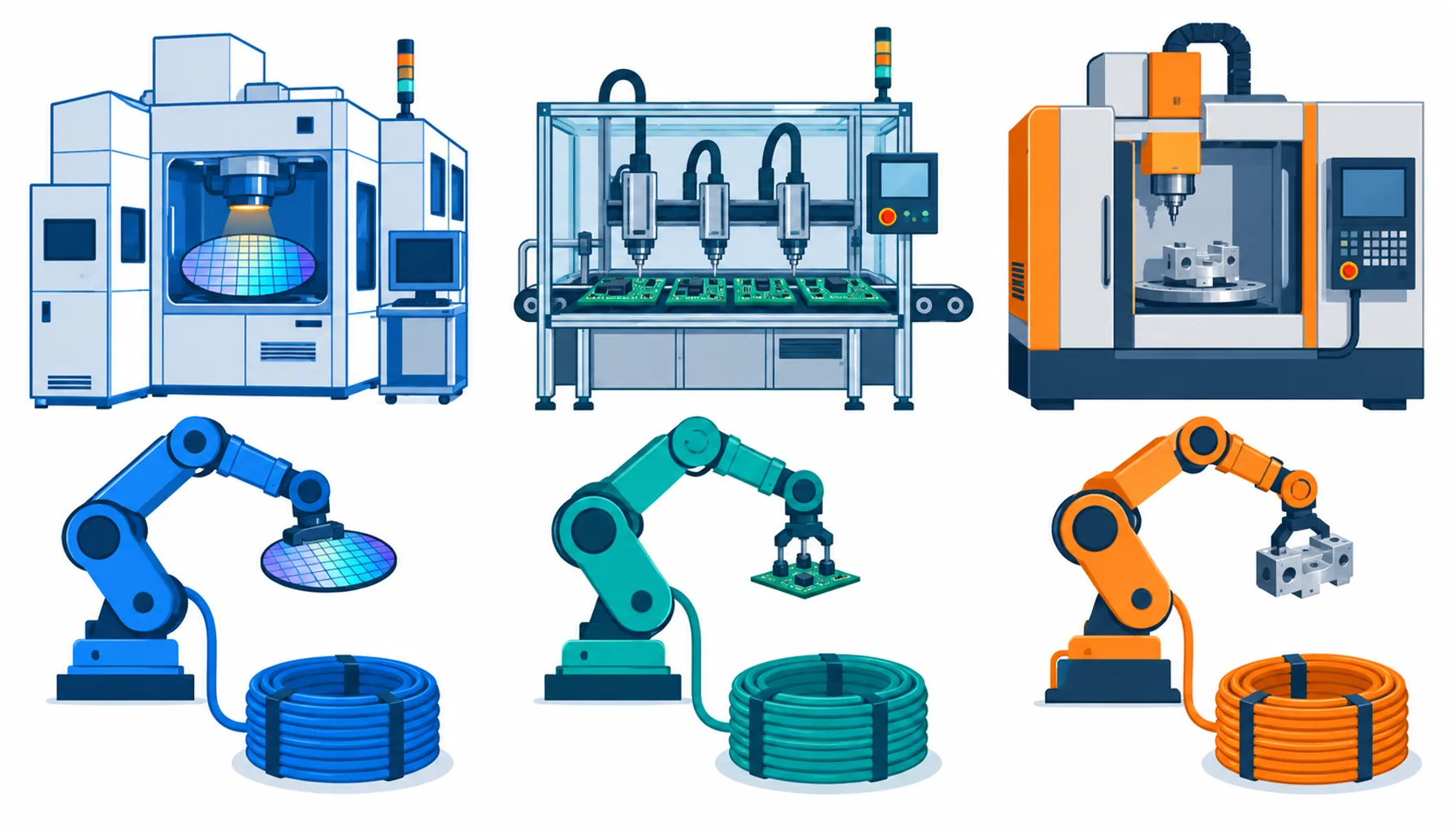
Walk the Singapore demand and it sorts into three environments. The first is the fab and semiconductor tool chain, where motion cable runs inside equipment that must not shed particles, must survive millions of short-stroke cycles, and must keep encoder and sensor signals clean inside some of the most electrically noisy racks in industry. The second is electronics assembly and test, where compact cells, tight carriers and vision-guided handling demand flexible constructions with excellent shield performance. The third is precision engineering and medtech, where mid-sized robots run long duty cycles in air-conditioned halls, and where the cable conversation is less exotic but no less evidence-driven.
Across all three, the purchasing style is recognisably global-grade: Singapore’s plants belong to multinationals or supply them, so specifications inherit the parent company’s standards, which are usually American, Japanese or German in origin. A cable supplier quoting into Singapore is effectively quoting into those standards, with all the documentation expectations they carry. The discipline this demands is exactly what the guide to honest datasheet reading prepares suppliers for, and the failure modes the specifications guard against are catalogued in the analysis of common cable failure causes.
| Environment | Typical machines | Cable duty profile | Deciding questions |
|---|---|---|---|
| Fab and tool chain | Wafer handling robots, EFEM, overhead transport, inspection tools | Very high short-stroke cycles, particle-free jackets, clean signals in dense racks | Particle and outgassing data; flex life at tight radius |
| Electronics assembly and test | Pick-and-place cells, bonding, vision-guided test handlers | Compact carriers, high cycle counts, strong EMI from test equipment | Shield performance; cycle evidence at the real radius |
| Precision engineering and medtech | Machining tending robots, assembly cells, packaging for regulated products | Long duty cycles in conditioned halls, moderate radii, mixed signal cores | Duty-cycle honesty; documentation to parent-company standards |
When Density Figures Are Not the Answer
Two structural points sharpen the table. First, Singapore is a node, not a market island: equipment qualified there flows onward to the region’s fabs and electronics plants, so a cable approval earned with a Singapore operation often becomes the region’s de facto standard. Second, the replacement layer is growing as the installed base matures, and replacements in cleanroom-grade equipment carry the same documentation burden as the original build, which favours suppliers who kept records. Facility-side infrastructure for these plants, from distribution to UPS-backed circuits, follows the planning in the industrial power distribution checklist, while the wider regional build-out that Singapore’s companies serve is described in the analysis of Southeast Asian data centre power.
| Decision | Why it weighs more in Singapore | What to settle before quoting |
|---|---|---|
| Flex life at the real radius | Space pressure shrinks carriers below typical design norms | Cycle evidence at the actual radius, not free-air figures |
| Cleanroom compatibility | Fab tools reject cables that shed particles or outgas | Jacket compound data and, where required, cleanroom test records |
| Shield integrity in motion | Test equipment and drives create dense EMI in small volumes | Braid construction and transfer impedance data, grounding scheme agreed |
| Parent-standard compliance | Multinational owners import their own specs | Map the required certificates before the quote, not after |
| Replacement traceability | Refits in regulated equipment need matching records | Batch records retained and re-issued with replacement drums |
RFQ Checklist: Motion Cable for a Singapore Electronics Project
Three cautions. First, a density statistic describes the average factory, and no one sells to the average; the cable that wins in a Singapore fab loses in a Singapore packaging line if duty is ignored. Second, the high density partly reflects the industry mix, so comparing Singapore with Germany or Japan as if they were the same economy misleads; each buys cable for different reasons. Third, density says nothing about entry barriers: Singapore’s plants specify globally and verify locally, and the certification overview in the cable certification checklist remains the honest map of what the papers must show.
Conclusion
Include these so the quote can be judged on engineering:
- Environment class: fab tool, assembly cell, test handler or precision machine
- Duty per cable: stroke length, cycles per shift, and whether motion runs continuously
- Actual bend radius and carrier dimensions, since space is the binding constraint
- Cleanroom or particle requirements, stated by class where applicable
- Signal types and shield requirements, with the grounding scheme at the machine
- Parent-company standard inherited by the plant, if any
- Flex-life evidence requested at the application’s radius and speed
- Replacement plan and documentation retention expectations