Warehouse Automation: The Cable Behind E-Commerce Fulfillment
Quick Answer: E-commerce fulfillment runs on conveyors, sorters, shuttles and vertical lifts that never stop, and their cable duty, millions of cycles around the clock, is among the most brutal in industry.
A fulfillment centre is a machine the size of a stadium. Thousands of orders per hour flow through sorter lines, shuttle systems, lift modules and conveyor mergers, and the whole organism runs on a duty cycle no other industry matches: peaks at Christmas that become baselines by the next Christmas, operations that pause only for maintenance windows measured in hours. The mobile robots get the headlines, but the fixed motion machinery, the conveyors and sorters and vertical lifts, carries most of the tonnage, and every metre of it moves. This article walks the warehouse from the receiving dock to the shipping door and asks one question at each station: what does the cable here actually do, and what kills it.
Introduction
The growth backdrop is the same engine that drives the mobile robot market: e-commerce throughput as competitive weapon, labour scarcity as permanent condition. PW Consulting’s 2026 review projects warehouse AMR demand growing from about USD 7.6 billion to USD 23.4 billion by 2032, and the fixed automation that surrounds those fleets grows alongside. IFR’s World Robotics 2026 records global industrial installations at roughly 600,000 units for 2025, but a modern fulfilment centre’s automation budget spreads across dozens of equipment classes, most of them invisible in robot statistics and all of them full of moving cable.
What makes warehouse duty special is not any single stress but the compounding of several. Cycles are counted in millions per year. Operating hours run 20 or more per day. Environments swing between freezer and loading dock. And the maintenance model is unforgiving: a sorter line that stops during peak season costs more per hour than the cable budget for the whole building. The failure analysis in the guide to why cables fail on machines applies here with unusual force, because the duty exaggerates every weakness a specification tolerates.
Walking the Building: Where the Cable Lives
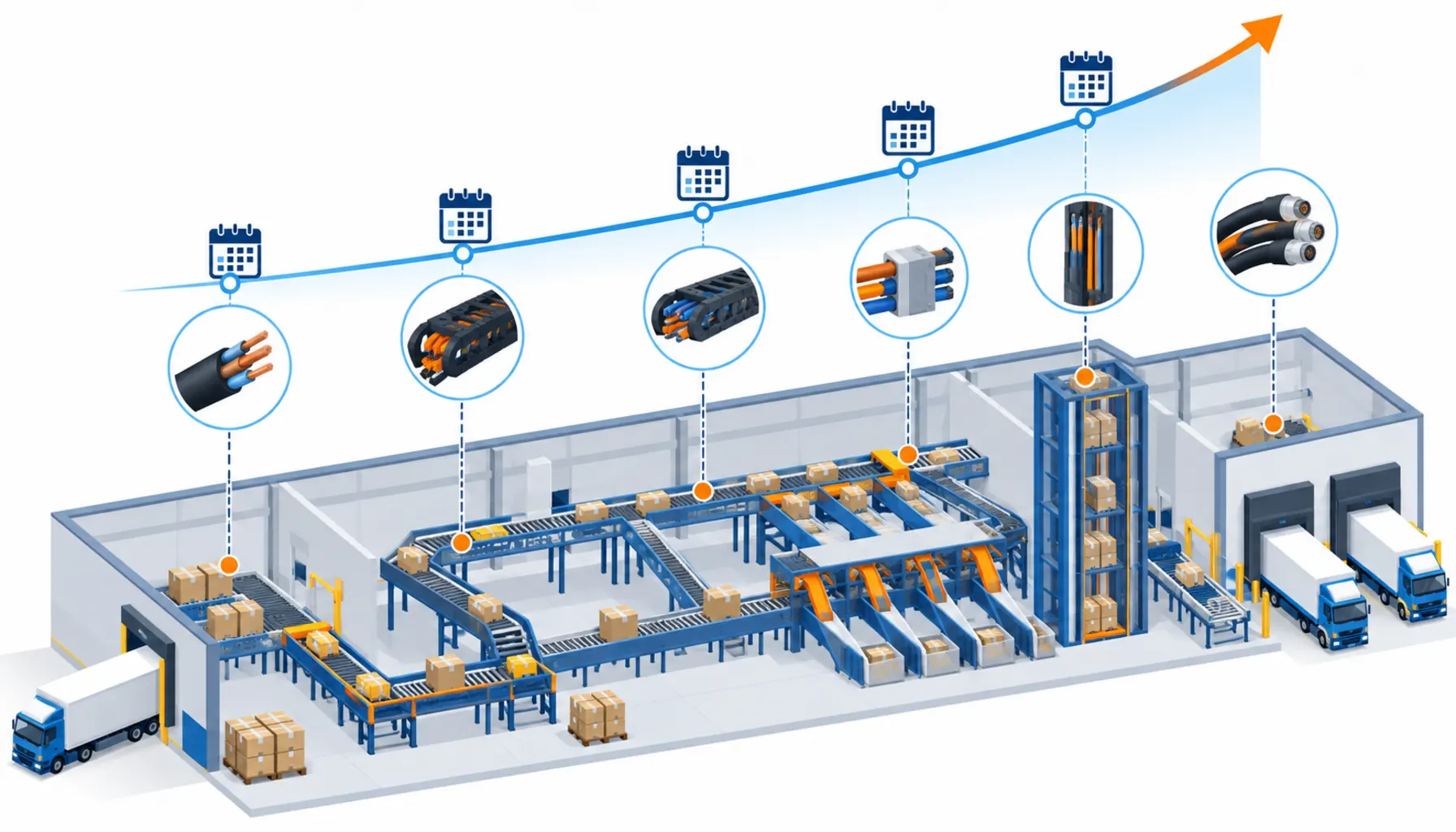
Start at the receiving dock, where telescopic conveyors extend into trailers and retract hundreds of times a season, flexing their whole length at the articulation. Move inward to the conveyor network, where belt drives, diverters and mergers cycle continuously, their motor and sensor cabling flexing at machine joints millions of times a year. Rise to the shuttle systems and small-item sorters, where the highest cycle counts in the building live: each shuttle strokes to a port, drops, returns, thousands of times a day, and the collector rail and harness interfaces take the wear. Descend to the vertical lifts and crane-serve modules, where cable travels on festoons or in chains through full-height strokes, carrying both power and the data that positions the carrier.
Two support systems complete the picture. Motor control centres distribute and protect the drives, and their construction and selection follow the explanation in the guide to motor control centre panels. And the building’s electrical distribution, sized for a load that grows every peak season, follows the planning logic in the industrial power distribution checklist. Both determine how cleanly power reaches the moving machinery, which determines how hard the drives and their cables work to do the same job.
| Zone | Machinery | Cable duty profile | What kills cable here |
|---|---|---|---|
| Receiving and shipping docks | Telescopic and truck-loading conveyors | Full-length flex at articulations, dust and dock fumes | Jacket abrasion and connector strain at the hinge |
| Conveyor network | Belt drives, diverters, mergers | Continuous cycling at machine joints, motor heat | Conductor fatigue at fixed flex points |
| Shuttle and sorter systems | Small-item sorters, shuttle modules, cross-belts | Highest cycle counts in the building, tight radii | Flex-life shortfall at rail and harness interfaces |
| Vertical lifts and crane-serve | Lift modules, storage cranes, festoon runs | Full-height strokes, power plus positioning data | Tension, torsion and drum or chain wear |
The Peak Season Problem
The zones share a sizing principle that separates warehouse work from ordinary industrial duty: cycles dominate. A conveyor joint that moves once a minute in a factory moves every second in a sorter, so a cable adequate by factory intuition fails by an order of magnitude here. Sizing for the real cycle count, with the ambient range the building actually runs, follows the method in the guide to cable size selection, and the signal layer that keeps diverters and sorters synchronised follows the discipline in the guide to control versus instrumentation cabling.
When the Fulfillment Story Is Not the Answer
Warehouse cable has a calendar. Duty that runs hard all year becomes extreme in the weeks around major shopping events, when throughput targets double, maintenance windows shrink to nothing, and every marginal component in the building is asked for one more season. Cable specified with just enough margin for the annual average fails exactly when its failure costs most. The experienced warehouse engineering answer is blunt: size motion cable for peak duty, not average duty, and treat the margin as insurance bought against the most expensive operating hours of the year.
The second seasonal lesson is replacement planning. Peak season is the wrong time to discover a flex-life shortfall, and the right time to be glad for a supplier who can ship matching drums quickly. Fulfilment operators who stock critical cable constructions on site, or hold call-off agreements with realistic lead times, convert cable from a peak-season risk into a managed consumable. The maintenance economics resemble the spare-parts logic in any continuous industry, with the twist that the warehouse’s failure cost is seasonally concentrated rather than flat.
| Decision | Why it matters in the warehouse | Practical handling |
|---|---|---|
| Size for peak, not average | Failure concentrates in the most expensive weeks | Specify cycle counts and duty hours at peak-season rates |
| Cycle-count honesty | Sorter duty exceeds factory intuition by orders of magnitude | Require flex evidence at the building's real cycles per year |
| Cold-zone compounds | Freezers and dock swings age standard jackets early | Match jacket chemistry to the zone's temperature range |
| On-site spares | Peak season leaves no time for a sea crossing | Stock or call-off critical constructions before peak |
| MCC and distribution quality | Dirty power makes drives and cables work harder | Build distribution to the checklist standard from day one |
RFQ Checklist: Cable for Warehouse Automation
Three cautions. First, not every warehouse automates the same way: a spare-parts store and an e-commerce fulfilment centre share a roof shape and nothing else, and cable specified for one can be absurd for the other. Second, the mobile fleet and the fixed machinery age differently; shuttles get redeployed while conveyors get refit, and a single cable standard across both mis-serves each. Third, the seasonal peak is a scheduling fact, not a specification target: the honest approach sizes for peak duty and still plans maintenance windows, because no cable margin replaces the discipline of the guide to understanding why cables fail before the season starts.
Conclusion
Send these so the quote matches the building’s real duty:
- Zone application: dock conveyor, sorter, shuttle, vertical lift or mixed
- Cycle counts per day at peak season, stated separately from annual averages
- Operating hours per day and the maintenance window reality
- Ambient range by zone, including freezer and dock exposure
- Stroke lengths and radii for vertical and shuttle applications
- Signal set: drive power, safety sensors, positioning and sorter communication
- Peak-season spares plan: stocked constructions, call-off terms and lead times
- Test evidence requested at the building’s real cycles and duty hours