Procuring 800V DC Data Center Power: What Changes, What to Specify, and When to Order
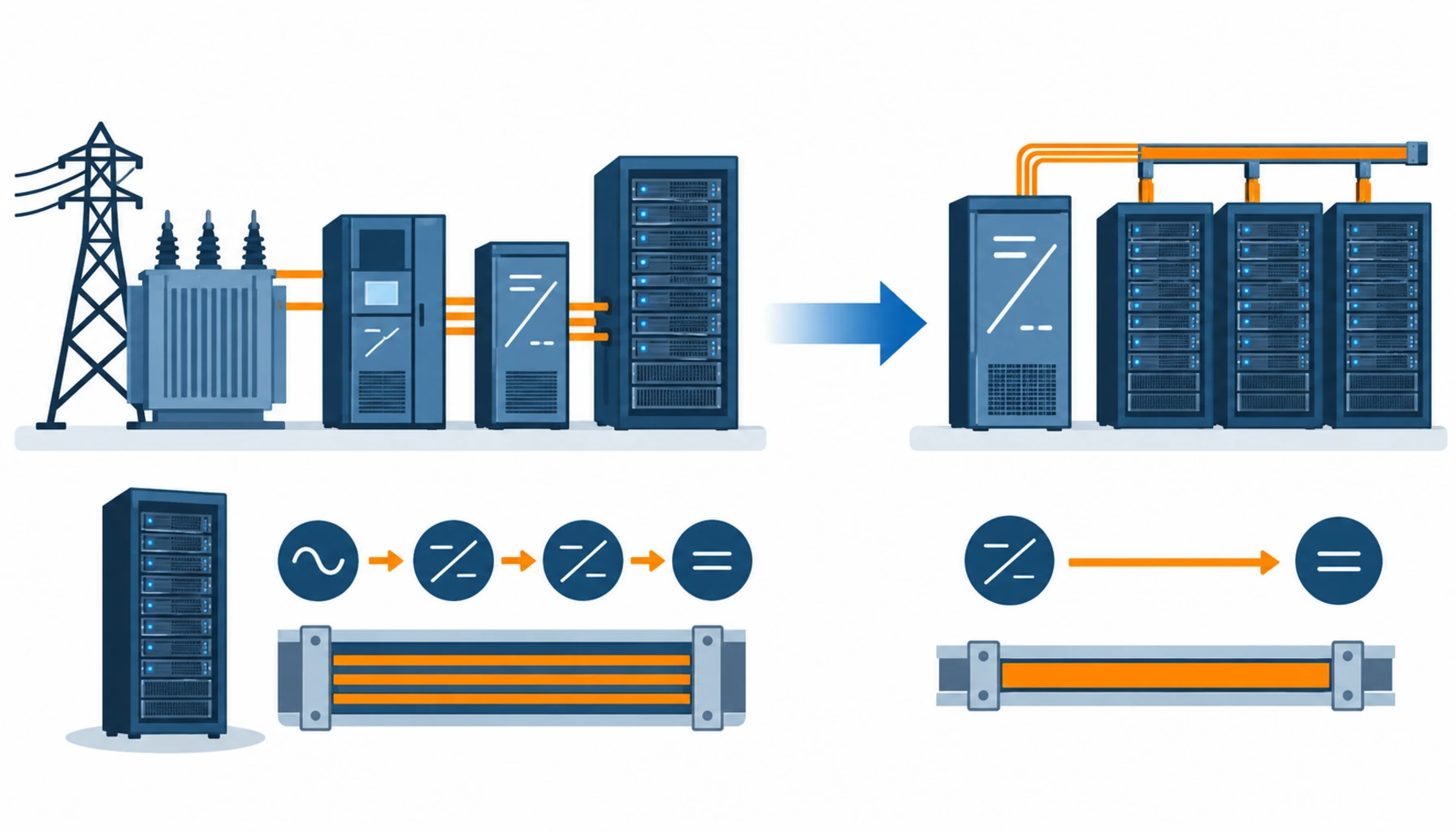
Quick Answer: Moving a hall to 800V DC takes the AC-to-UPS-to-54V chain out and puts one rectification step in. For a buyer that means a different scope of supply — DC-rated breakers, DC busway, DC connectors and tap-off boxes instead of their AC equivalents — plus a specification that has to be frozen months before the racks arrive, because the voltage class you write down decides the insulation, the joints and the protection devices you will be living with.
A data hall designed in 2015 and one being specified now share almost nothing on the electrical side, yet most supplier catalogues are still organised around the older of the two. This article is written for the person holding the purchase orders. It sets out which items move in or out of your scope, which numbers have to be written down before you go to market, and which dates in the roadmap decide when an order has to be placed.
Introduction
The shift is driven by current, not by preference for direct current. A rack of AI accelerators that drew 15 kW five years ago is now quoted at ten to twenty times that, and copper sized for low voltage grows faster than the rack itself. At 54V DC a 1 MW rack would need thousands of amps of busbar, which is neither fittable nor bendable. Raising the distribution voltage moves the last conversion closer to the silicon; the demand side of the same story is set out in our overview of data center power demand growth.
What Moves In and Out of Your Procurement Scope
The fastest way to price a change like this is to walk the single-line diagram and ask, item by item, whether it stays, changes or disappears. The table below does that for the seven categories that carry most of the cost in a hall.
| Scope Item | In a 415V AC Hall | In an 800V DC Hall | What You Must Specify | Lead Time and Supply Risk |
|---|---|---|---|---|
| Medium voltage incoming | MV switchgear and a transformer stepping down to 415 or 480V | Unchanged up to the rectifier, and at room level the step-down is designed out | Voltage ratio, impedance, fault level, and whether the unit sits on the critical path | Switchgear runs 20 to 40 weeks; plan the enquiry around the energisation date |
| AC to DC conversion | UPS rectifier and inverter, then a 54V conversion inside every server | One rectification step to 800V DC, central or at row level | Rectifier rating, redundancy topology, DC output tolerance under load steps | Product lines commit to shipping from the second half of 2026 |
| Distribution | 415V AC busway or cable, then AC rack PDUs | DC busway or DC cable, DC tap-off boxes, rack-level DC-DC converters | DC voltage class including transients, short-circuit withstand, insulation monitoring points | DC busway and joints are a thin catalogue; cable itself is 6 to 10 weeks |
| Protection | AC breakers with coordination studies against mature standards | DC-rated breakers or solid state protection, no current zero crossing to help | DC rating, interruption time, and the scope of the coordination study | The longest lead item and the fewest sources; specify before ordering busway |
| Connectors and terminations | Standard AC connectors, lugs and glands | DC-rated connectors and high-current joints at 800V | Contact resistance, temperature rise data, tooling, inspection method | Where most DC projects lose schedule; treat it as a line item, not an accessory |
| Backup energy | UPS with battery strings on the AC output | Storage placed closer to the DC bus | Interface voltage, isolation arrangement, and who owns the interface | Battery and converter supply is comparatively stable |
| Commissioning | Familiar AC commissioning by any competent contractor | Insulation monitoring, DC test equipment, thermal imaging of joints | Test regime, records to be handed over, acceptance criteria | Fewer contractors carry DC experience; book the witness testing early |
The Roadmap and What It Does to Your Bill of Materials
Two rows in that table drive most of the commercial risk. Protection and connectors are where the catalogue is thinnest and where a late decision turns into a schedule problem, because neither can be substituted quickly once the busway is ordered. Everything else follows the pattern buyers already know from AC projects.
What the New Architecture Does to Cable and Busway Specifications
The 800VDC architecture whitepaper sets out three deployment stages rather than one switchover, and each stage moves the boundary of what a supplier has to deliver. That boundary, not the efficiency figure, is what changes a purchase order.
| Stage | Where Conversion Sits | Power Level and Timing | What It Does to Procurement |
|---|---|---|---|
| Option A, rack level | A power shelf beside the rack converts 415 or 480V AC to 800V DC | Up to 660 kW per power rack; production from Q3 2026 | Building electrical scope barely moves. Rack-level DC connectors, short DC runs and DC-DC converters enter your list, and most of the spend lands with power shelf vendors |
| Option B, cluster level | Central rectification to 800V DC, distributed overhead or underfloor | Around 2 MW per cluster; deployment from Q3 2027 | The distribution supply chain is rebuilt. DC busway, DC breakers, tap-off boxes and joints become the core cable and busway scope, and the specification below is written here |
| Option C, room level | A solid state transformer converts medium voltage AC straight to 800V DC | Whole-hall scale; targeted around 2029 | Step-down transformers, low voltage switchgear and secondary distribution drop out of the scope entirely — fewer items to buy, but fewer suppliers to buy them from |
Freeze the Voltage Class Before You Issue the RFQ
Option A rarely changes what a cable or busway supplier is asked for; most of the spend lands with power shelf vendors. Option B is where the electrical scope is rewritten, and it is the stage the current specification work belongs to. Option C removes equipment instead of adding it, which looks attractive until you inspect the supply base: solid state transformers sat at roughly USD 169 million worldwide in 2024 and are forecast to reach about USD 936 million by 2030, fast growth for power equipment yet small in absolute terms. A 2.4 MW unit has been installed in a Chinese national computing network project, and at least one vendor has announced an NVIDIA MGX-certified product with UL certification targeted for 2026. For a facility energising next year, that belongs in the roadmap discussion rather than the order book.
What to Demand From a Supplier While the Standards Lag
The headline is a large reduction in distribution current, and for the same power that means sharply smaller cross-sections, fewer parallel runs and tray space recovered in halls where tray space is already the binding constraint. The consequences for what you order are more specific than the headline. A single 800V feed can replace several parallel low-voltage feeds per rack, which changes the cable schedule itself rather than just its sizes. How that lands behind the rack is covered in our note on rack-mounted versus floor-mounted PDU arrangements.
None of this makes the cable purchase simpler. DC circuits have no current zero crossing, so arc extinction is harder and protective devices must be DC rated instead of assumed from an AC equivalent. Insulation has to hold the full DC voltage including transients, and where a DC bus shares a route with AC circuits the separation rules need rewriting rather than copying. Above all, the termination layer becomes the weak point: a DC busway joint carrying 800 or 1,000 amps at 800V has thermal and contact resistance requirements that no legacy AC product was designed for, which is exactly why our page on busbar tap-off boxes sits next to the cable ranges rather than separate from them. Redundancy concepts survive the change while the hardware implementing them does not, so the topologies described in our guide to N+1 versus 2N UPS redundancy have to be re-expressed in DC terms before they reach a tender.
When 800V DC Is Not the Answer
Full 800V is not the only DC option, and for the next few years it will not be the most common one either. A bipolar ±400V architecture delivers similar gains over 54V while sitting at a voltage the existing component supply chain supports sooner. Industry estimates put around 60 percent of new AI capacity in the transition period on ±400V rather than 800V, with volume shipments of ±400V power products planned from the second half of 2026 and the full move to 800V aligned with later GPU generations.
The procurement point is that this is a decision you make before going to market, not after. If the RFQ does not state that the distribution layer must be rated for 800V while being energised at ±400V, you will receive offers built on two incompatible assumptions, and the cheap one will win. Insulation thickness, joint design, breaker selection and insulation monitoring all follow from that voltage class, and none can be changed after the busway is extruded. Written into the specification now, the later migration stays a rack-level change; left out, it becomes a distribution rebuild. The comparison is worked through in our note on ±400V against 800V DC architecture. Backup energy moves the same way, closer to the DC bus, a shift we look at from the storage side in data center energy storage backup.
RFQ Checklist: What to Send Your Power Supplier
The technical direction is settled; the rulebook is not. DC distribution at 800V sits above the range most legacy low voltage installation standards cover and below the range medium voltage standards were written for, leaving a gap precisely where safety matters: arc flash boundaries, protective device coordination, insulation monitoring and installation practice for high-current DC joints.
Vendors have committed to shipping anyway. One major power equipment maker announced an 800VDC portfolio covering centralised rectifiers, DC busway, rack-level DC-DC converters and DC backup systems for the second half of 2026, with an early production deployment at a large AI data center in Taiwan, China. What has not kept pace is published installation practice, and realistic projections still put AC uninterruptible power supplies above 80 percent of the market for the next three to five years, with 800V penetration near 10 percent today and roughly 40 to 50 percent in hyperscale AI facilities by 2028.
That gap is a procurement problem, handled the way any immature-technology purchase is handled. Ask for type test reports on the DC ratings rather than a general certificate, and for temperature rise data on the actual construction at rated current. Ask who owns the coordination study, and make the answer a deliverable rather than an assumption. If the standard is still being written, put the test regime you will accept into the purchase order instead of discovering the question during commissioning.
Conclusion
For many facilities being planned today, 800V DC is the wrong purchase, and saying so is more useful than pretending otherwise. Three conditions should stop the order:
- Racks will stay below roughly 100 kW. Conventional AC distribution with in-rack 54V conversion is cheaper to buy, cheaper to staff and easier to service, and every electrician and spare part in the market already fits it.
- Energisation comes before the supply chain matures. DC breakers, busway joints and connectors at these ratings remain a thin catalogue, and thin catalogues mean long lead times and single-source risk. If you must buy early, buy spares and get delivery dates written into the contract, not promised verbally.
- Nobody on the project can operate it. DC at 800V asks for insulation monitoring instead of simple residual current protection, DC-rated test equipment, and a different safe-isolation procedure. A site that cannot train or staff for that should wait rather than learn on a live hall.
The cost of getting this wrong is not the equipment premium. Retrofitting 800V into an existing hall means touching busway, protection, connectors and backup at the same time, which is a rebuild of one layer rather than an upgrade of it, and it has to happen inside an outage window on a hall that is producing revenue. Buying the roadmap instead of your own load profile produces a bill of materials that matches the whitepaper and not the building.