400V HVDC vs 800V DC: Choosing the Data Center Architecture Before the Order Is Placed
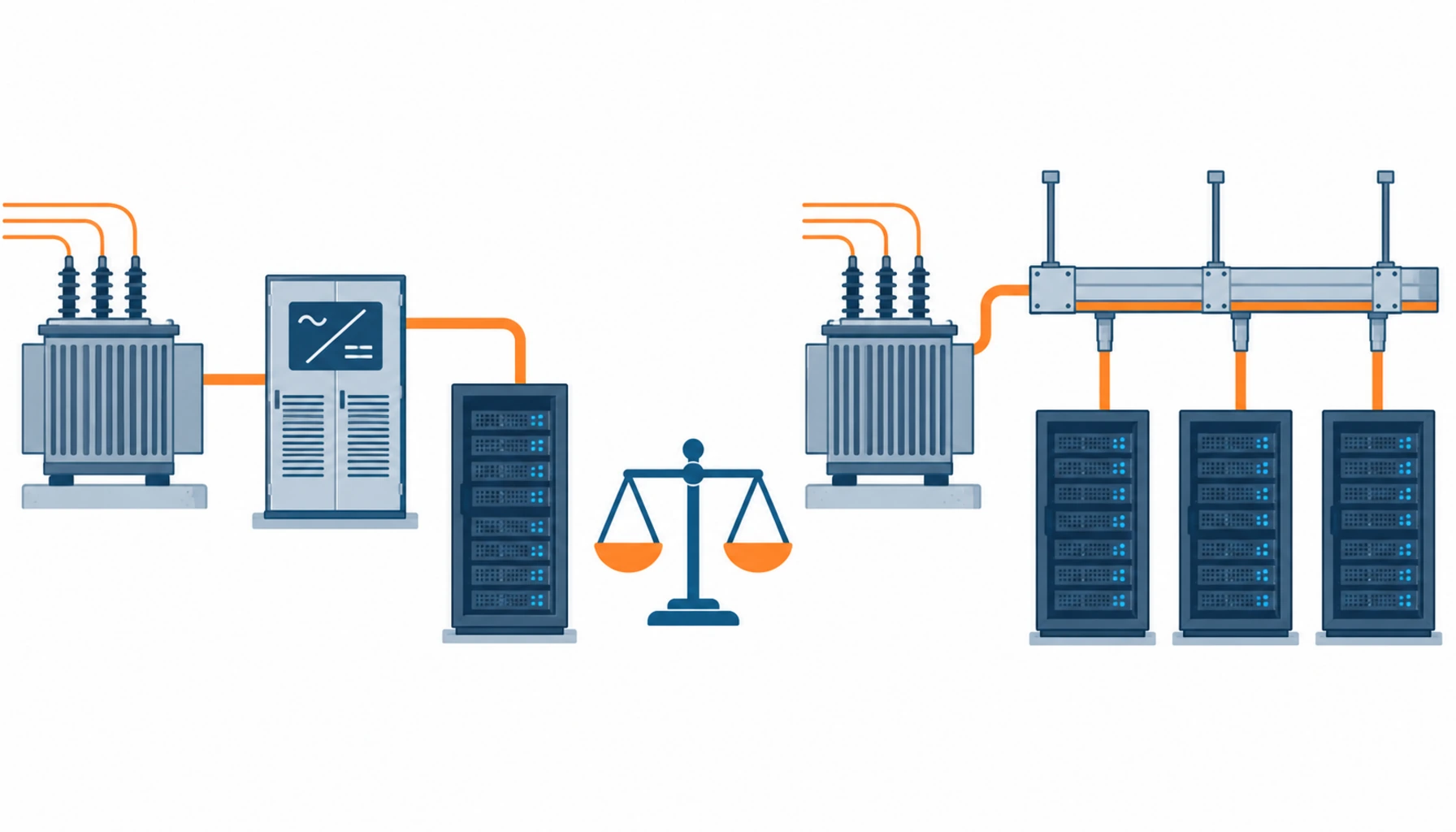
Quick Answer: ±400V and 800V DC are not competing standards you choose between once — they are two stages of the same migration. Most AI halls being specified in 2026 will energize at ±400V with hardware rated for 800V, which keeps the later switch to a rack-level change instead of a distribution rebuild.
By the time this decision reaches a buyer it has usually been framed as a technology question. It is not. It is a question about which hardware exists, who makes it, how long it takes to arrive, and what happens to your order book if you pick the side that loses. That framing is what this article works through.
Introduction
The argument for moving data center distribution to DC has been settled for a while: too many conversion stages, too much copper, too much heat. What has not been settled is the voltage. Two candidate architectures are in the field at the same time. A ±400V system runs 400V from each pole to earth and 800V pole to pole, which lets it reuse a mature 400V-class component supply chain that already exists for industrial drives and traction equipment. An 800V system runs 800V to earth and roughly 1600V pole to pole, which halves the current for the same power but needs a component chain that is only now being built.
Published penetration estimates put around 60 percent of new AI data center builds starting on ±400V rather than straight to 800V, with the first 800V product lines reaching volume production in the second half of 2026. That sequencing is the single most useful procurement fact in this article, because it tells you that the decision is not “which one is better” but “which one will I be able to buy, commission and staff in the year my hall energizes”. The architecture question itself, including the NVIDIA three-step roadmap, is covered in our note on 800V DC data center power.
The Two Architectures Compared on the Purchasing Side
This is the table to bring to a design review with a buyer in the room. It compares the two options on the things that decide budget and schedule rather than on the things that decide efficiency.
| Decision | ±400V DC | 800V DC | Cost and Lead Time | Risk If You Get It Wrong |
|---|---|---|---|---|
| Component supply base | Mature 400V industrial and drive-class parts | New DC-rated parts, limited vendor list in 2026 | ±400V parts are catalogue items with normal lead times; 800V parts carry engineering lead time | Specifying 800V parts too early turns a catalogue purchase into a single-source dependency |
| Current per megawatt | Roughly double that of 800V for the same power | Roughly half of ±400V, so smaller copper | Conductor and busway cross-section is the largest single cost difference between the two | Buying 800V cross-sections to run at ±400V wastes copper; buying ±400V cross-sections blocks the migration |
| Protection and isolation | Well-understood, standard DC breakers available | No natural current zero, fewer qualified devices, standards still settling | DC protection is the pacing item and the least priceable line in the budget | A short-circuit withstand figure that cannot be verified becomes a commissioning dispute |
| Conversion chain | Rectifier plus one rack-side conversion step | Rectifier plus rack-level DC-DC, or direct at room level later | ±400V costs one more conversion; 800V costs more expensive silicon | Buying the wrong conversion topology locks the rack design before the standard exists |
| Staffing and spares | Familiar to most electrical contractors | New training, new test gear, thin spares network | Training and instrumentation are real line items, easy to omit from a capital budget | A hall nobody on site can safely work on is not a cheap hall |
Why ±400V Exists at All
The obvious question from a buyer is why anyone would deploy a 400V DC system when 800V is the stated destination. The answer is that ±400V lifts you out of the 54V trap without requiring the industry to build an entirely new component chain first. Inside a rack, 54V at one megawatt means close to eighteen and a half thousand amps, which is why the copper, not the silicon, was the limit.
Moving to ±400V cuts that current by roughly a factor of fifteen and lands it in the range where busbar, breakers, connectors and cables are all available as standard industrial products. The equipment is familiar to the contractors who will install it, the test gear exists, and the spares network is not a question mark. For a hall energizing in 2026 or 2027, that is the difference between a project and a research programme.
What ±400V does not do is end the migration. The current is still roughly double what 800V would carry, so the copper is still larger than it needs to be, and a hall that builds its distribution around 400V class clearances cannot simply raise the voltage later without redoing the layer. That tension is what pushes operators toward the arrangement described in the next section.
Rate High, Energize Low: The Arrangement Most Buyers Should Specify
The practical compromise that most operators are adopting is to rate the distribution layer for 800V while energizing at ±400V. The incremental cost at construction stage is small — a heavier insulation class, wider clearances, and different joint design — and it converts a future distribution rebuild into a rack-level swap. Nothing about the operating voltage changes on day one.
This works only if the specification says so in writing. If the RFQ does not state that the equipment must be rated for 800V while being energized at ±400V, you will receive quotes built on two different assumptions, and the cheaper one will win on the spreadsheet. Insulation thickness, creeping distance, joint design, breaker selection and insulation monitoring all follow from the voltage class, and none of them can be changed after the busway is extruded or the switchgear is type tested.
The rating also has to reach the items that are easy to forget. Connection hardware, tap-off boxes, cable terminations and monitoring devices all carry a voltage class, and a distribution layer is only as highly rated as its lowest-rated component. Our busbar tap-off box range is a conventional example of the class of hardware involved — what changes at 800V is the dielectric rating and the evidence you can ask for, not the shape of the product.
Where the Supply Base Actually Stands in 2026
Timing matters more here than in most equipment categories, because the answer to “what can I buy” changes within a single procurement cycle. Published positions on the vendor side put the first 800V DC product lines reaching volume production in the second half of 2026, with the major rack and power vendors aligning their next generation around the 800V target date of 2027.
For a buyer that translates into a simple rule: place firm orders only for the equipment that exists today, and place framework agreements for the equipment that is coming. The distribution layer is the exception, because it cannot be bought twice — it has to be rated for the destination voltage on the day it is ordered, whether or not the hall runs at that voltage.
One caution about published roadmaps in general. A vendor timetable is not a delivery commitment, and the equipment that ships in volume in a given quarter is rarely the equipment on the roadmap slide for that quarter. Ask for a delivery schedule with dates on it rather than a product announcement. The supplier-side view of when the bottleneck items actually arrive is in our note on switchgear and transformer shortages.
What to Freeze in the Specification, Voltage by Voltage
Whichever voltage you energize at, the same specification items have to be closed out before the order is released. The table below is the checklist, and the last column is what it costs you to leave each one open.
| Specification Item | What to State | Evidence to Ask For | Cost of Leaving It Open |
|---|---|---|---|
| Rated voltage versus operating voltage | Rate for the destination voltage, energize at the phase one voltage | Type test at the rated class, not the operating class | A layer that has to be rebuilt when the voltage rises |
| Fault level at each distribution point | A declared short-circuit withstand at every tap and joint | Coordinated study covering the rectifier and the rows | Unverifiable withstand figures and a commissioning argument |
| Termination and joint method | Named joint design, torque values, inspection records | Installer qualification and witness testing | Site-practice joints that fail thermally inside the warranty |
| Insulation monitoring | Monitoring philosophy for an unearthed DC system | Device type, alarm thresholds, response procedure | A fault that stays invisible until it becomes a trip |
| Route, derating and cooling | Tray fill, grouping, ambient and liquid-cooling conditions | Derating calculation against the installed layout | A design that only works on the drawing |
| Training and spares | Who is qualified to work on the system, and where spares sit | Training plan and a spares list with delivery dates | A live hall nobody on site can maintain |
When Neither Voltage Is the Right Purchase
DC distribution at either voltage is the correct answer for high-density AI halls and the wrong answer for a lot of ordinary buildings. Three conditions should stop the process.
Rack density below roughly 100 kW. The copper problem that justifies DC barely exists at moderate density, and conventional AC distribution with in-rack conversion is cheaper to build, cheaper to staff, and available from many suppliers with short lead times. That architecture is set out in our note on 415V data center distribution.
A hall energizing before the equipment you need exists. Writing a specification around parts that are announced but not shipping converts a technology choice into a schedule risk that no amount of goodwill can fix. Rate the layer high, energize low, and buy the conversion equipment when it is on a price list rather than a roadmap.
No one on site to own protection coordination. Fault energy and protection coordination get harder as voltage rises, and an unearthed DC system needs a monitoring philosophy as well as a breaker. A facility without that engineering capability is better served by architecture it can support. The wider power chain that sits behind this decision is mapped in our data center power chain overview.
The procurement error behind all three is the same one: buying the destination instead of the journey. A rack rated for 800V that runs at ±400V is a sensible purchase. A hall that buys 800V conversion hardware in 2026 for a 2029 fit-out is buying an obsolete generation at a premium.
RFQ Checklist: What to Send When the Voltage Is Undecided
You can go to market before the voltage is fixed, provided the enquiry carries the decision itself. Send:
- The rack power per row and per hall, with the density profile across fit-out phases
- Which voltage the hall energizes at, and which voltage the distribution layer must be rated for
- Current per feed at both the operating and the rated voltage, so cross-sections can be quoted both ways
- The fault level you are designing to, and who owns the coordination study
- Whether the system is earthed or unearthed, and the insulation monitoring philosophy
- Route conditions: tray fill, grouping, ambient temperature, vertical rises, liquid-cooling proximity
- The DC rating evidence you will accept for breakers, connections and monitoring devices
- Termination and joint responsibility, with torque values and inspection records
- Test documentation: temperature rise at rated current on the actual assembly, conductor resistance, batch traceability
- Training requirements and the spares list, with delivery dates rather than intentions
- Certification for the destination market and the edition of each standard the equipment must meet
Conclusion
The choice between ±400V and 800V DC is a timing decision dressed up as a technology decision. ±400V is what you can buy, install and maintain now; 800V is where the current, the copper and the vendor roadmaps all point. The procurement answer that survives contact with a real schedule is to energize at ±400V while rating the layer for 800V, and to write that intention into the specification rather than leaving it to be inferred.
Two things decide whether that works. The first is evidence — a rated-class type test, a declared fault level, a named joint design and a monitoring philosophy, all demanded in writing before the order is released. The second is restraint about the equipment that does not exist yet. Kexingyu Cable Group (KXYE) supplies the power, control and mineral insulated cable ranges used across these facilities — WDZ-YJY, WDZN-YJY, BTTZ, BBTRZ, NG-A (BTLY), KVV and YJV — together with medium voltage switchgear and transformer product lines, from a single factory group, with copper price linkage available on project-scale orders. Send us your rack power target, operating voltage and rated voltage and we will return a cable and busway schedule sized for both; the fastest start is a request for quotation.