Buying Mining Cable Joints and Terminations: Kits, Labour and Downtime
Quick Answer: A mining cable joint is a trivial purchase and an expensive failure. The kit costs a fraction of the drum, but the hours to install it, the skill it requires and the production lost while the run is down are what actually appear in the accounts. That changes how the kit should be bought: matched to the cable construction, proven by an acceptance test, and stocked in the sizes the mine actually uses.
Introduction
Ask a mine maintenance planner where cable faults cluster and the answer is nearly always the same: at the joints, not in the middle of a run. A joint is a place where the insulation is interrupted, the screen is brought back together, and a field operation replaces what the factory did under controlled conditions. It is also the one part of a cable system that depends on who was standing there on the night shift.
That makes joints a procurement subject rather than a stores subject. The kit has to match the cable, the acceptance test has to prove the joint before the run is restored, and the mine has to hold the right kits in the right sizes. Buying a joint kit on price alone is how sites end up with boxes in stores that fit nothing they own.
Why the Joint Becomes the Weak Point
Four things happen at a joint that do not happen anywhere else on a cable. The insulation is cut back and rebuilt by hand, so the interface between the original insulation and the joint body is a new surface. The screen or armour is broken and remade, which affects earth continuity and the earth fault path. There is a mechanical step in diameter, so the joint is the first thing damaged when the cable is dragged or bent. And on a moving cable, the joint is usually stiffer than the cable, so it concentrates bending strain.
The practical result is that a joint on a fixed feeder, installed correctly and correctly sized, is a permanent repair. A joint on a trailing cable is a temporary fix, and should be treated as one. Sites that identify joints on mobile runs as temporary and plan a replacement get far fewer repeat faults than sites that treat every joint as permanent. Our note on cable damage wear patterns shows how a joint failure looks different from a cable failure when the drum is opened.
The Joint and Termination Types a Mine Actually Uses
Cold shrink straight joint. A pre-stretched rubber sleeve that collapses onto the prepared cable when the support core is pulled out. No heat, so it is the right choice in a gassy roadway or where a torch permit is a problem. It needs care in the stretch and the positioning, and the shelf life of the sleeve matters.
Heat shrink joint. A tube shrunk down with a torch, with an adhesive that flows into the interface. Reliable and well understood, but it needs a hot work permit and a steady hand, and it is the wrong choice where a flame is not permitted.
Resin or cast joint. Used on fixed feeders where moisture is the main enemy and the joint can be protected. Heavy, awkward to install, and effectively permanent, which is fine on a roadway feeder and wrong on anything that moves.
Screened termination. Where the cable enters switchgear, the termination has to control the electric field as well as seal the end. A screened termination is a different product from a joint and is bought against the system voltage, not against the cable size alone. Systems in this range are covered by the standards set out in our note on medium voltage cable standards, and the testing regime is described in our note on termination testing.
Plug-in coupler and repair sleeve. A coupler joins two lengths of trailing cable at a machine, and a repair sleeve covers local damage without cutting the cable. Both are bought as a system with the cable, because the coupler threads, seals and current rating are not interchangeable between suppliers.
The Five Options and What Each One Costs in Practice
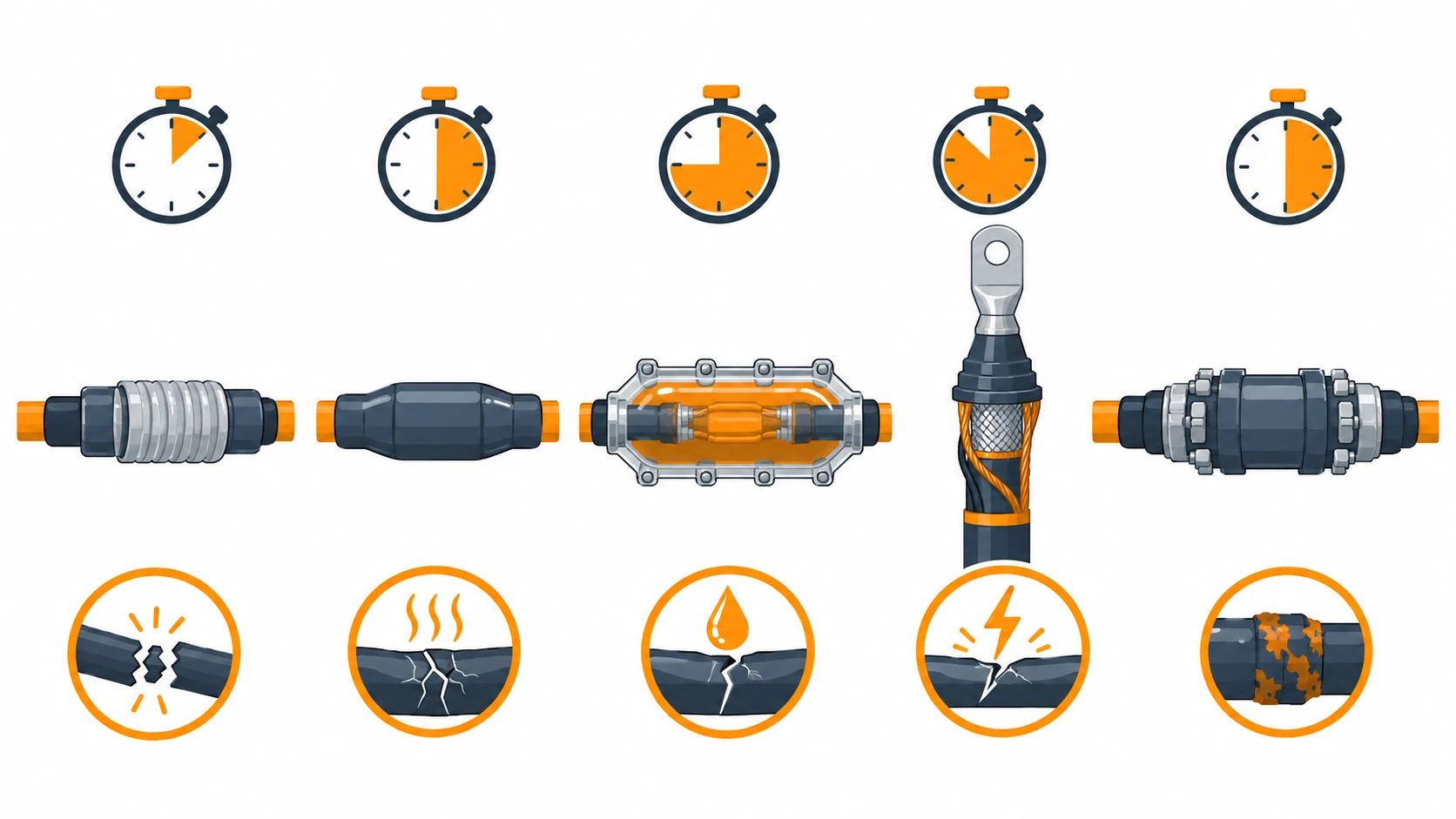
The right column matters more than the left one on a mine, because the labour and the downtime usually exceed the kit.
| Option | Where It Fits | What to Specify | Evidence to Demand | Cost and Downtime | How It Fails |
|---|---|---|---|---|---|
| Cold shrink joint | Roadway feeders, and anywhere a torch is not permitted | Cable type, core count, size range, sleeve shelf life | Type test to the cable standard, shelf life on the pack | Moderate kit cost, half a shift, no hot work permit | Under-stretched or mis-positioned sleeve, then moisture at the interface |
| Heat shrink joint | Fixed feeders with a permit available | Cable type, size range, adhesive and tube wall | Type test plus adhesive data | Lower kit cost, longer to install, permit time added | Overheated or underheated tube and an unbonded interface |
| Resin or cast joint | Buried and fixed feeders where moisture dominates | Resin type, pour volume, curing conditions | Resin data and the installed joint test | Kit is cheap, install is slow, effectively irreversible | A pour in the wrong conditions and a void inside the joint |
| Screened termination | Where a cable enters switchgear or a substation | System voltage, cable type, screen and earth arrangement | Termination test at the system voltage, screen continuity | Higher kit cost, skilled labour, scheduled with the switchboard | Field control problem, tracking across the surface, flashover |
| Coupler and repair sleeve | Machine ends and local sheath damage on trailing cable | Rating, sealing system and compatibility with the cable supplier | Mating and seal test, load and earth continuity check | Moderate cost, fast to fit, saves cutting the cable | Mismatched threads or seals, then water ingress at the machine |
Labour, Skill and the Cost of a Failed Joint
A joint that takes forty minutes in a workshop takes three hours underground with a restricted access and a permit. That difference, multiplied by the production that stops while the run is down, is the real price of a joint, and it is why a kit bought on unit price can be the expensive choice.
Count the skill, not just the hours. A screened termination on a medium voltage feeder is not a job for whoever is available. Where the mine has one qualified jointer, the spares plan should reflect that, because a second failure on a different shift will wait for that person.
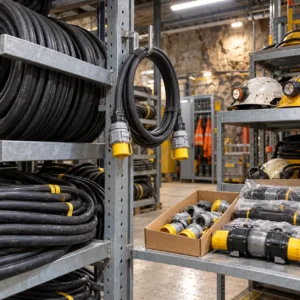
Buy the kit that fits the cable you own. Kits are sized by cable type and diameter range, and a kit that covers too wide a range is a compromise at both ends. Where a mine runs several cable types, standardise on as few types as possible so that one kit covers most of the fleet.
Price the downtime, not the kit. A kit costing a few hundred more that installs in half the time pays for itself on the first fault if the run feeds a hoist, a fan or a conveyor drive. Ask the supplier for the installation time for a trained jointer with the kit, and compare quotations on that basis as well as on price.
Acceptance Testing After Jointing
A joint should never be energised without a test, and the test should be written into the procedure rather than left to the crew. Three checks cover most mining work.
Insulation resistance. Measured between cores and to earth after the joint is complete and the surface is clean. Our note on insulation resistance testing covers the measurement conditions that make the result meaningful, because a reading taken on a wet joint tells you nothing useful.
Continuity of the screen and the earth path. Especially important on a screened or armoured construction, where the joint is where the screen is rejoined. The earth fault protection on the circuit depends on that path, and a joint with a poor screen connection is a joint that trips the whole feeder later. Our note on grounding and bonding verification sets out how the path should be checked.
Termination test where the system voltage calls for it. On medium voltage work, the installed termination is tested before it is energised. Where a third party is involved, agree the method and the pass criteria in advance. Our note on third party cable inspection is written for that conversation.
Record the result against the joint. A joint with no test record is an untested joint as far as the next person is concerned. Keep the reading, the date, the location and the name of the jointer with the cable records. It is the only way to see whether failures cluster on one crew or one kit batch.
What to Freeze Before the RFQ Goes Out
| Decision | What to State | Evidence to Attach | Cost of Leaving It Open |
|---|---|---|---|
| Cable list | Every cable type and size the kits must cover | A cable schedule with construction details | A kit that fits nothing in stores, or nothing on the machine |
| Joint versus temporary | Which runs are allowed permanent joints and which are not | A written repair standard per run class | Permanent joints on trailing cable and repeat failures |
| Kit type and range | Cold shrink, heat shrink or cast, with the size range | Type test to the cable standard, shelf life stated | An install that fails for the wrong reason and no claim |
| Termination performance | System voltage, screen arrangement and earth path | Termination test report and field control data | Tracking and flashover at the switchgear entry |
| Acceptance test | The checks required after every joint, with pass criteria | A written procedure and a test record template | An untested joint energised and a second outage |
| Stock and skill | Kits held per size, plus who is qualified to install them | A spares list and a jointer competency record | A recovered feeder waiting for a jointer and a kit |
Lead Time and Cost Structure
Joint kits are usually short lead items, and that can make a mine careless about them. The exception is a screened termination matched to a particular switchgear, which is often a made to order item and can take weeks. Where a project is commissioning switchgear, order the terminations with the switchboard rather than with the cable, because that is where the delay sits.
The cost structure of a joint package is dominated by the ranges. A kit that covers a narrow size range is cheaper per kit and needs more kits in stores. A kit that covers a wide range is cheaper to stock and slower to install. For a mine with a small number of cable types, the narrow range kits with a defined spares holding usually win; for a site with a scattered fleet, the wider kits reduce the chance of having nothing that fits.
Where the mine buys cable and kits together, ask for the couplers and sleeves to come from the same supplier as the cable. Coupler threads and seal geometry are not standard between suppliers, and a mismatched coupler pair discovered on the machine turns a scheduled job into an unscheduled one. Where a project wants the cable, the joints and the switchgear bought as one coordinated package, that option is described in our note on the coordinated power equipment supplier approach.
When a Joint Is Not the Answer
When the fault is mechanical and local. If the damage is a short section of scored sheath, a repair sleeve restores the cable without cutting it, and it is faster and cheaper than a joint. Cutting a good cable to insert a joint usually makes the run worse.
When the cable is near the end of its life. Jointing a cable that is already at its cycle limit buys a few weeks and a second outage. Where the failure count on a run is rising, replace the section rather than repair it again.
When the joint is being blamed for a supply problem. A feeder that trips after a joint can be telling you about the earth loop rather than the joint. Test the earth path before opening the kit.
When the crew is guessing at the size. A kit stretched beyond its range, or a sleeve positioned by eye, will fail and will fail at the worst time. Where the mine buys kits across many cable types, label the kit boxes by cable type and keep them with the cable.
When nobody will own the test record. A joint with no recorded test result is a risk carried by the next shift. Build the record into the procedure, not into a person’s memory.
RFQ Checklist
- Every cable type and size the joint kits must cover
- Which runs will accept a permanent joint and which need a temporary repair
- Joint type selected for the environment, including hot work restrictions
- Kit size range, and the shelf life of cold shrink sleeves
- Type test evidence to the cable standard for each kit
- Termination type, system voltage and screen arrangement at switchgear
- Coupler rating and sealing system, matched to the cable
- Repair sleeve sizes held for local sheath damage
- Acceptance tests required after jointing, with pass criteria
- Test record template and where records are kept
- Kits held per size, and who is qualified to install them
- Terminations ordered with the switchgear where they are made to order
- Kit and coupler supply aligned with the cable supplier
Conclusion
Buy joints against the cable you own, the environment they go into and the hours they take to install, not against the price on the box. Write the acceptance test into the procedure, keep the record, and treat every joint on a moving cable as temporary.
Kexingyu Cable Group (KXYE) has supplied electrical cable from Quanzhou since 1996, including the rubber-sheathed, screened and reeling-duty constructions that mine joints and terminations sit on, along with the couplers, sleeves and termination kits that match them. Send the cable schedule and the switchgear details, and we will come back with the kits that fit, the installation and test requirements, and a spares holding that covers the sizes you actually run. The fastest route is a request for quotation.