Mine Cable Spares: Stocking the Lengths That Restart Production
Quick Answer: A mine cable spares holding should be sized by how long it takes to restart production without it, not by a percentage of installed length. That test promotes a few odd items into must-hold stock: a pre-terminated jumper for the busiest machine, couplers to match every cable type on site, and a drum of the one construction used underground in gassy roadways. Everything else can wait for a delivery.
Introduction
Every mine has a store full of cable and still stops when a particular run fails. That is because most of what sits on the racks is leftover length from completed jobs, and leftover length rarely matches the circuit that breaks. The spares that matter are the ones that turn a two day outage into a two hour one, and they are usually a small and specific list.
The way to build that list is to work backwards from the outage. For each critical circuit, ask what would have to be on the shelf tonight for the machine to run tomorrow, and how long the alternative would take. That single question sorts a store into spares that pay for themselves and stock that is only there because nobody disposed of it. Where a mine stores switchgear and skid distribution alongside the cable, the same logic applies to that equipment, and the equipment side is covered in our note on the mining power equipment package.
What Restarting Production Actually Requires
It is a time problem, not a quantity problem. A spare that exists but needs a joint, a termination and a trained jointer is not a fast restart. The holding should be measured in hours to restore, and the fastest holdings are the ones where the cable arrives already made up.
It is a matching problem. A drum of the correct conductor size on the wrong drum flange is useless if it will not fit the machine. A coupler that does not mate with the installed type is worse, because it looks like a spare until the moment it is needed.
It is a criticality problem. A mine with forty feeders does not need forty spares. It needs spares for the circuits whose loss stops production, plus enough common material to handle the ordinary faults that can be repaired in a shift.
The Five Classes of Cable Spare
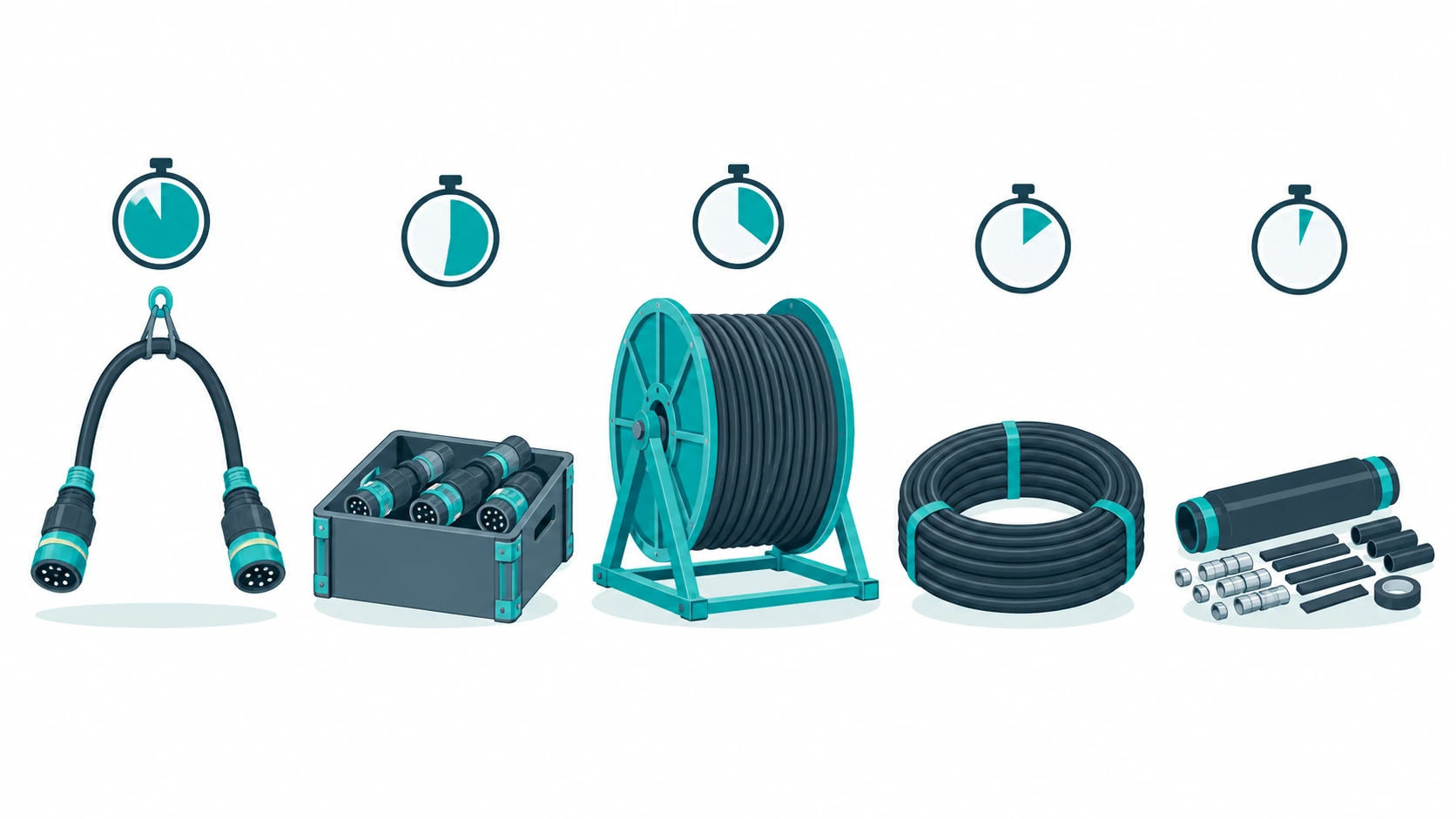
Sorting a holding into these five classes, and giving each one a target restart time, is the fastest way to decide what stays.
| Class | What It Restores | How to Size It | Storage Rule | Holding Cost | If It Is Missing |
|---|---|---|---|---|---|
| Pre-terminated jumper | The busiest mobile machine, in hours | One per critical machine, ends matched to the coupler | Hung on a rack, ends capped, labelled to the machine | Moderate, but it replaces a whole shift of lost output | A two day outage waiting for a made-up assembly |
| Couplers and end fittings | Any machine end that has failed | At least two per cable type and size in service | Sealed box, out of sunlight, with the mating half | Low per item, but the range must match the fleet | A sound cable that cannot be connected to anything |
| Drum of critical construction | A long feeder or a certified underground run | One drum of the construction with the longest lead time | On a proper stand, rotated, ends protected | High, because it ties up copper and floor space | Four to eight weeks of waiting on a certified construction |
| Service length of common cable | Lighting, pump and control circuits | A few working lengths per common size | Coiled, labelled, off the floor, ends sealed | Low, and it turns small faults into same shift jobs | Every minor fault becomes an order |
| Joint kits and repair sleeves | A damaged cable that does not need replacing | Covering every cable type in service, plus one spare | With the cable, in labelled boxes, shelf life checked | Very low, and the highest return of any item on this list | Cutting a good cable because a sleeve was not in stores |
Pre-Terminated Jumpers and Couplers
The single most valuable cable spare on most mines is a pre-terminated jumper for the machine that matters most. It costs more than the equivalent length of plain cable, and it converts an outage into a changeover.
Make it up at the factory, not in the workshop. A jumper assembled on site at two in the morning depends on who is on shift and what tooling is available. One assembled and tested before delivery behaves the same way every time. Our note on factory testing covers what that assembly should be tested against before it ships.
Match it to the machine, not to the store. The jumper should be labelled with the machine it fits and stored where it can be found in the dark. Where two machines of the same model use different couplers because they were bought in different years, that is worth knowing before the outage, not during it.
Hold the mating halves. A coupler is only useful with its counterpart. Where the mine holds plug halves, it should hold socket halves in the same quantity, in the same box. Sites that hold one without the other have discovered this the hard way.
Storage, Shelf Life and Rotation
Cable degrades in a store, quietly and unevenly. A spares holding that is not managed turns into a shelf of aged rubber and a false sense of cover.
Store off the floor and out of the sun. Ultraviolet light hardens a sheath and water finds its way into anything laid in a puddle. A drum on a stand under cover with its ends capped will outlast the same drum on a wet slab by years. Keeping the protection that came with the drum is part of that, and our note on cable drum packaging for export describes what should arrive with it.
Rotate by using the oldest first. A spares drum should be the drum that gets used when the next repair needs cable, and the new delivery goes into the stand behind it. Without that rule, the oldest stock stays in the store until it is too stiff to install and the holding has quietly become worthless.
Watch the items with a real shelf life. Cold shrink sleeves and heat shrink tubing have a shelf life, and resin has a cure window. These are the things that fail silently in a store, and the date on the pack is the only warning. Record the date on the shelf label, not just on the box.
Keep a spares register. What is held, for which circuit, where it is stored, and when it was last checked. The register is what converts a pile of material into a holding, and it is the document that tells a new maintenance planner what cover actually exists.
What to Freeze Before the RFQ Goes Out
| Decision | What to State | Evidence to Attach | Cost of Leaving It Open |
|---|---|---|---|
| Critical circuits | Which circuits stop production when they fail | A criticality list agreed with production | A store full of cable and nothing that restarts the plant |
| Target restart time | Hours to restore per critical circuit | A written target per circuit class | Spares that exist but cannot be installed in time |
| Pre-made assemblies | Which jumpers and tails are bought pre-terminated | Assembly drawings, ends and test records | A factory job done in the workshop overnight |
| Range to cover | Every cable type and coupler in service | A cable and coupler register | A spare that fits nothing on the machine |
| Storage and rotation | Where each class is stored and how rotation works | A spares register with shelf labels and dates | Aged stock that fails on installation |
| Shelf life items | Sleeves, tubing and resin with dates recorded | Date on the pack and on the shelf label | A kit that has quietly expired before the fault |
How Much Is Enough
The honest answer is that the holding should cover the failures you actually get, plus the one that would hurt most. Three inputs get you there.
Failure history by circuit. A circuit that fails twice a year needs a spare on the shelf. A circuit that has not failed in ten years does not, unless its failure would stop the mine. History covers the ordinary cases and criticality covers the exceptional ones.
Lead time per construction. The longer the lead time, the more a holding is worth. A certified underground construction with a long process is the classic case for holding a drum even though the construction is expensive, because the alternative is a month of lost output. Our note on cable MOQ and lead time sets out where the time actually goes.
The cost of the outage. A feeder to a hoist or a main fan justifies a holding that a lighting circuit never will. Put the number on the outage, per hour, and the holding decision becomes an arithmetic question rather than an argument. Where a mine has a framework agreement with a supplier, it is also worth asking whether a consignment holding is available, because that shifts the capital tied up without shifting the cover.
Buying the Holding Better
A spares holding is bought across many orders over many years, which makes the commercial terms worth attention. Three levers usually matter.
Framework terms. A framework agreement that fixes the construction and the copper mechanism but not the quantity lets a mine buy spares at a known price without committing capital. It also keeps the spare identical to the installed cable, which is the point. Our note on cable payment terms covers how the usual commercial terms are structured around that, and our note on power cable warranty terms covers the guarantee that sits alongside it.
Copper movement. Where a holding is bought in advance, the copper basis matters more than the negotiation on margin, because copper is the larger number on a heavy cable. A mine that fixes a spares holding during a rising market pays for it in the holding cost, and the validity window on the copper basis is the clause to read.
Buying the holding with the project. Where a new circuit is being installed, the cheapest time to buy its spare is on the same order. A single extra drum on a project order usually costs less than the same drum bought later as a one-off, and the construction is certain to match. That logic also applies to the couplers and the joint kits, which are easy to forget at project stage and expensive to source during an outage.
When a Spares Holding Is Not the Answer
When the holding is hiding a bad design. If the same circuit fails every few months, the answer is to fix the circuit, not to hold more cable. A holding that keeps a badly routed run going is a way of paying the same bill repeatedly.
When the spares are of the wrong thing. A store holding ten drums of a construction installed nowhere is not a holding. Check the register against the installed fleet before adding to it.
When nobody can install the spare. A holding that depends on one trained jointer is not a one shift restart on any shift but theirs. Either train more people or hold the assemblies pre-made.
When the holding is bought to avoid a framework. Where a supplier offers consignment stock at commercial terms the mine can accept, tying up capital in a drum is often the worse choice. Compare the holding cost against the framework terms before committing.
When the store is being treated as a museum. Material from completed jobs with no circuit to serve should be written off or sold, not counted as cover. A smaller, accurate holding is worth more than a large, misleading one.
RFQ Checklist
- Criticality list identifying the circuits that stop production
- Target restart time per critical circuit, in hours
- Pre-terminated jumpers required, with the machine each one fits
- Assembly drawings, ends and test records for every pre-made item
- Coupler types and sizes in service, with mating halves
- Joint kits and repair sleeves covering every cable type installed
- Drum of the longest lead time construction, where justified by outage cost
- Service lengths held for lighting, pump and control circuits
- Storage requirements, stands and protection for each class
- Rotation rule and the spares register format
- Shelf life items with dates recorded on the shelf label
- Framework or consignment terms offered against a capital holding
- Copper basis and validity window on any advance purchase
Conclusion
Size the mine cable spares holding by restart time and criticality, not by a percentage of installed length. Buy the jumpers made up, match the couplers to the fleet, rotate the stock, and write the whole thing into a register so the next planner inherits cover rather than a room of material.
Kexingyu Cable Group (KXYE) has supplied electrical cable from Quanzhou since 1996, including the rubber-sheathed, screened and reeling-duty constructions used on mine duty, along with the couplers, joint kits and pre-terminated assemblies a spares holding depends on. Send the circuit list, the criticality ranking and the coupler types in service, and we will come back with a holding that matches the fleet, the lead times that apply, and the commercial terms for keeping it in place. The fastest route is a request for quotation.