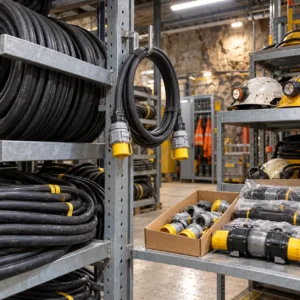
Metro Cable for Stations and Running Tunnels: What to Specify and Why It Is Bought Differently
Quick Answer: Metro cable is supplied into a project with three constraints that a normal building package does not have: a fire strategy that dictates material class and circuit survival, a possession calendar that decides when anything can be delivered and installed, and an assurance regime that tests batches rather than relying on certificates. The cable itself is largely conventional. What makes the package difficult is proving it, delivering it into short night windows, and getting the sheathing and marking right for the environment.
Introduction
Transit work is where ordinary cable procurement meets public infrastructure rules. A station is a public building with a high occupancy density and a hard egress problem, and its running tunnels are confined spaces that are occupied by people and by traction power at the same time. Both have to work for a design life that runs into several decades.
Suppliers who quote metro cable as if it were a commercial building package tend to lose on the assurance requirements rather than on price. This guide sets out what the scopes are, why two fire requirements get confused in every tender, and what to freeze before the order.
What a Transit Project Does to a Cable Package
A fire strategy that names materials and circuits. Transit fire strategies are written around evacuation from confined spaces and firefighting access. They set a reaction-to-fire class for cable along occupied routes and a circuit integrity requirement for the systems that must keep working, and both attach to the installed assembly rather than to the drum.
A possession calendar. Cable arrives in the small hours between traffic windows, on a date the operator fixes and the contractor cannot move. Deliveries that miss a window sit in a compound for a week, and material that is staged on a platform overnight becomes a safety issue rather than a storage problem.
Batch testing and witnessed inspection. Transit owners and their engineers routinely require samples to be taken from the delivered batch and tested independently, and they often require factory tests to be witnessed. That changes the commercial structure: the supplier needs to price testing and documentation, and the contractor needs to schedule inspection visits rather than collect a certificate at handover. Our note on third-party cable inspection covers how that regime is normally organised.
Long design life and early freeze. The cable is chosen once and then lives for the life of the line, in an environment where replacement means closing it. That pushes specification decisions earlier than in a building project and makes a rework far costlier than a heavier construction.
Station and Tunnel Cable Scopes
| Scope | Duty | What to Specify | Evidence to Demand | Cost and Lead-Time Driver | How It Fails |
|---|---|---|---|---|---|
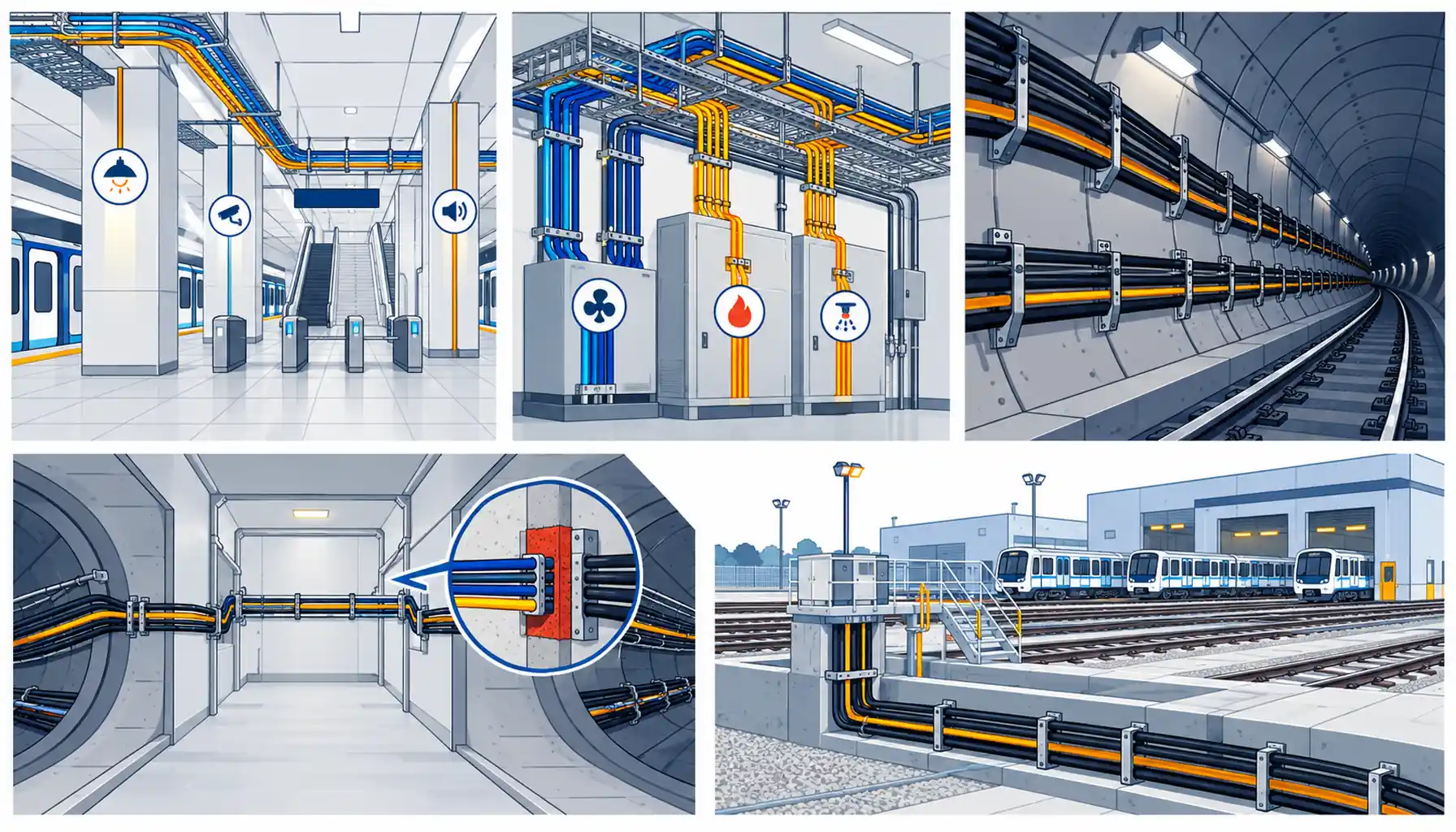
| Station public areas | High occupancy, long evacuation distances, cable in sight or in accessible voids | Reaction-to-fire class for the route, low smoke and halogen-free construction, sheath colour and marking, containment that matches the architecture | Class declaration for the exact construction, drum marking records, fire test reports at batch level | The class of the sheath rather than the copper; this is where the biggest premium sits | A class declared for the compound and not for the finished cable, discovered at commissioning |
| Station plant and equipment rooms | Dense power and control cabling, trays shared with other services, hot and humid | Circuit integrity grade for life safety systems, screening convention, derating for the tray condition, segregation from the class-rated routes | Survival test evidence, system approval for terminations and fixings, derating calculation for the installed condition | Copper and switchgear; the survival grade narrows the supplier list more than it adds cost | A life safety circuit that passes a continuity test and does not survive, or a tray that cannot take the extra ways |
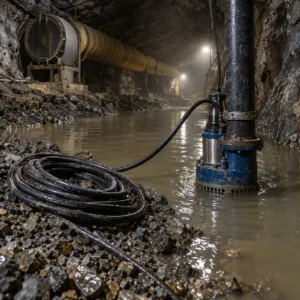
| Running tunnel, fixed installation | Confined, humid, dust-laden, subject to piston effect and vibration, inaccessible for replacement | Armoured or mechanically protected construction, cleat and bracket spacing for vibration, longitudinal water blocking where gradients allow drainage into joints | Dimensional and armour records, cleat and support schedule, water blocking test data | Armour, water blocking and the pull lengths that decide drum sizes | Sheath damage during installation into an unreachable route, repaired at permanent-way access rates |
| Cross passages, shafts and portals | Fire compartment boundaries, pressure differences, drainage | Penetration and seal system as a package, class and survival grade carried through the boundary, drainage detail below the cable | System approval for the whole penetration, not the sealant alone, plus installation records per boundary | The approved penetration system and the labour to install it to the tested detail | A penetration that meets the class on paper and fails a visual inspection years later |
| Depots and stabling areas | Outdoor and semi-outdoor, washdown, maintenance access, long routes | Sheath for ultraviolet and water, armour or duct where exposed, container and cable handling equipment at the loading point | Construction declaration, ultraviolet and water test data, drum handling and storage plan | The cable is a smaller share here than the access, lighting and handling around it | Sheath cracking within a few years, or a drum that cannot be moved where it was delivered |
Two Different Fire Requirements, One Confused Tender
Almost every metro tender mixes up two requirements that are tested in different ways and bought on different documents.
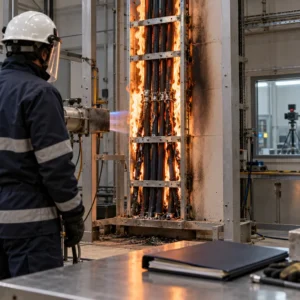
Reaction to fire. This is how the cable behaves when it burns: flame spread, heat release, smoke production and, in some frameworks, acidity of the gases and burning droplets. It is a declared class attached to the construction, and it is what stops a fire in a cable tray in a public area from becoming a smoke event in an evacuation route. Our notes on the GB 31247 B1 building cable class and on LSZH versus fire retardant cable set out how the declarations are read and where the two get confused.
Circuit integrity. This is whether the circuit keeps working during a fire, which is a survival performance tested on the installed assembly at a stated grade and duration. Alarm, evacuation lighting, tunnel ventilation control, communications and the systems the fire strategy depends on are bought this way. It is a different document from the class declaration, tested differently, and a cable can satisfy one requirement and fail the other. Our note on fire survival grades covers how the test conditions differ between schemes and why a grade quoted without the standard behind it is not a specification.
Why it matters commercially. A tender that asks for a class when it needs a survival grade will be answered with the cheapest product that meets the class, and the gap is only found by the commissioning engineer. A tender that asks for both, with the standard and the duration named, is answerable in one round and comparable line by line.
Installing Cable in a Running Tunnel
Drum sizes follow the route, not the factory. Long tunnel pulls between access points mean long drum lengths, but a long drum is useless if it cannot be taken down a shaft or around the last bend. Drum lengths should be agreed with the installation method rather than optimised for unit price. Our note on vertical riser and shaft cable covers the same trade in a building, and the geometry is comparable.
Pulling tension and sidewall pressure. The limits that matter on a transit pull are the pulling tension at the drum end and the sidewall pressure at every bend. Both are often exceeded on jobs where the pull is long and the bends are tight, and both cause damage that is invisible until the cable is energised. Our note on cable pulling tension and sidewall pressure sets out how those limits are calculated and what to require from the installer.
Support and vibration. Trains produce a low-frequency vibration that loosens fixings, so cleat and bracket spacing in a running tunnel is normally tighter than the manufacturer’s minimum and should be agreed with the structural discipline. Where services cross a movement joint or pass close to the track, seismic and dynamic bracing detail becomes a real line item rather than a formality. Our note on seismic bracing for cable tray covers the hardware and the approval path.
Segregation and fire stopping. Traction power, signalling and life safety cabling share the tunnel and must not compromise one another. Segregation has to be designed, drawn and inspected, and every crossing of a compartment boundary needs an approved penetration system that carries the class and the survival grade through the wall rather than stopping at it. Our note on firestop cable penetrations covers what the detail has to include.
What to Freeze Before the Order
| Decision | What to State | Evidence to Attach | Cost of Leaving It Open |
|---|---|---|---|
| Class by route | The reaction-to-fire class for each occupied route, drawn on the route plan | A class schedule mapped to locations | A premium construction bought for the whole line, or the wrong class in a public area |
| Survival circuits | Which circuits must keep working, at what grade and for what duration | Survival test report and the approval covering terminations and fixings | A life safety system that cannot be signed off after the tunnel is closed to traffic |
| Batch and witness regime | How many samples per batch, which tests, and which tests are witnessed | A written inspection and test plan agreed before manufacture | Testing priced as an afterthought, or a batch held at port waiting for a decision |
| Drum lengths and access | Drum length per pull, weight limit, and the route the drum travels to the track | Installation method statement with the drum handling detail | Jointing in a tunnel where jointing is slowest and most expensive |
| Support and segregation | Cleat and bracket spacing, segregation distance and crossing method | Support schedule and a segregation drawing | Rework in a live tunnel at permanent-way access rates |
| Penetration system | The approved system for each boundary, as an assembly | System approval for the complete detail and installation records | Re-opening a sealed boundary during assurance, with the whole line affected |
| Delivery windows | Possession dates, drop points and the staging plan between deliveries | A delivery plan matched to the possession calendar | Material stored on a platform, or a gap in the programme with labour standing |
Delivery, Documents and Assurance
On a metro package the paperwork is part of the product. Three items cause more delay than the cable itself.
Marking and traceability. Each drum has to be identifiable back to a batch, and the marking has to survive the environment. Where the client requires a specific marking convention, agree it before manufacture; re-marking after the fact means re-reeling, and re-reeling damages the cable.
Test reports per batch. The reports have to match the drums that arrived, not the type test of a similar product. Check that the batch references line up at goods-in rather than at handover, because a mismatch found at handover is a claim, and one found at goods-in is a delivery note.
Local certification. Transit projects are usually publicly funded and therefore subject to local approval regimes. Where the line is outside China, the certification route has to be established early; our experience on a Brazilian metro and light rail package is summarised in our note on cable supply for Brazil and Latin America, and it illustrates how early the approval path has to be mapped.
When a Transit-Grade Specification Is Not the Answer
When the class is being used instead of segregation. If a route is unprotected, a better class does not fix it. The answer is the route or the compartment, and spending the class premium instead is money that does no work.
When the depth of assurance exceeds the criticality. Witnessing every production run on a depot lighting circuit adds cost and programme for no benefit. Grade the assurance regime by scope and put the effort where the line cannot be closed to fix it.
When the cable is being bought before the fire strategy is fixed. Freezing the construction early is right; freezing it before the strategy is written is how a package ends up carrying a class the strategy never asked for, or missing one it did.
When the drum lengths were set at the factory rather than at the access point. The cheapest unit price per metre is worthless if the drum cannot reach the track. Price the pull, not the reel.
RFQ Checklist
- Route plan with the required reaction-to-fire class marked on each section
- Life safety circuits named, with survival grade, duration and the standard behind it
- Construction description for each scope, including armour and water blocking where used
- Drum length per pull, weight limit and the access route to the track
- Cleat and bracket spacing for the vibration condition, plus the segregation drawing
- Approved penetration systems listed by boundary, as complete assemblies
- Batch sampling plan, tests to be performed and the tests to be witnessed
- Marking convention and the traceability requirement per drum
- Certification route for the destination country, mapped before manufacture
- Delivery and staging plan matched to the possession calendar
Conclusion
Metro cable is conventional cable bought by an unconventional process. Fix the class and the survival grade separately and write both into the specification with their standards, price the batch testing and the witnessing rather than assuming they are included, size the drums around the access route rather than the factory, and build the delivery plan backwards from possession dates. Do that and the cable package stops being the item that holds up assurance.
Kexingyu Cable Group (KXYE) has manufactured cable in Quanzhou since 1996, supplying fire-rated, armoured, low smoke halogen-free and control constructions for infrastructure work, with the batch records and test documentation that transit assurance expects. Send us the route plan, the circuit list with grades and the possession dates, and we will come back with the constructions, the evidence pack for each scope and a delivery plan that fits the windows. A request for quotation is the fastest route.