Brazil INMETRO and Latin America: Cable Certification Roundup
Quick Answer: Brazil regulates cable through INMETRO conformity certification, with a separate ANATEL regime for data cable — and Latin America beyond runs a country-by-country patchwork, each mapped per market.
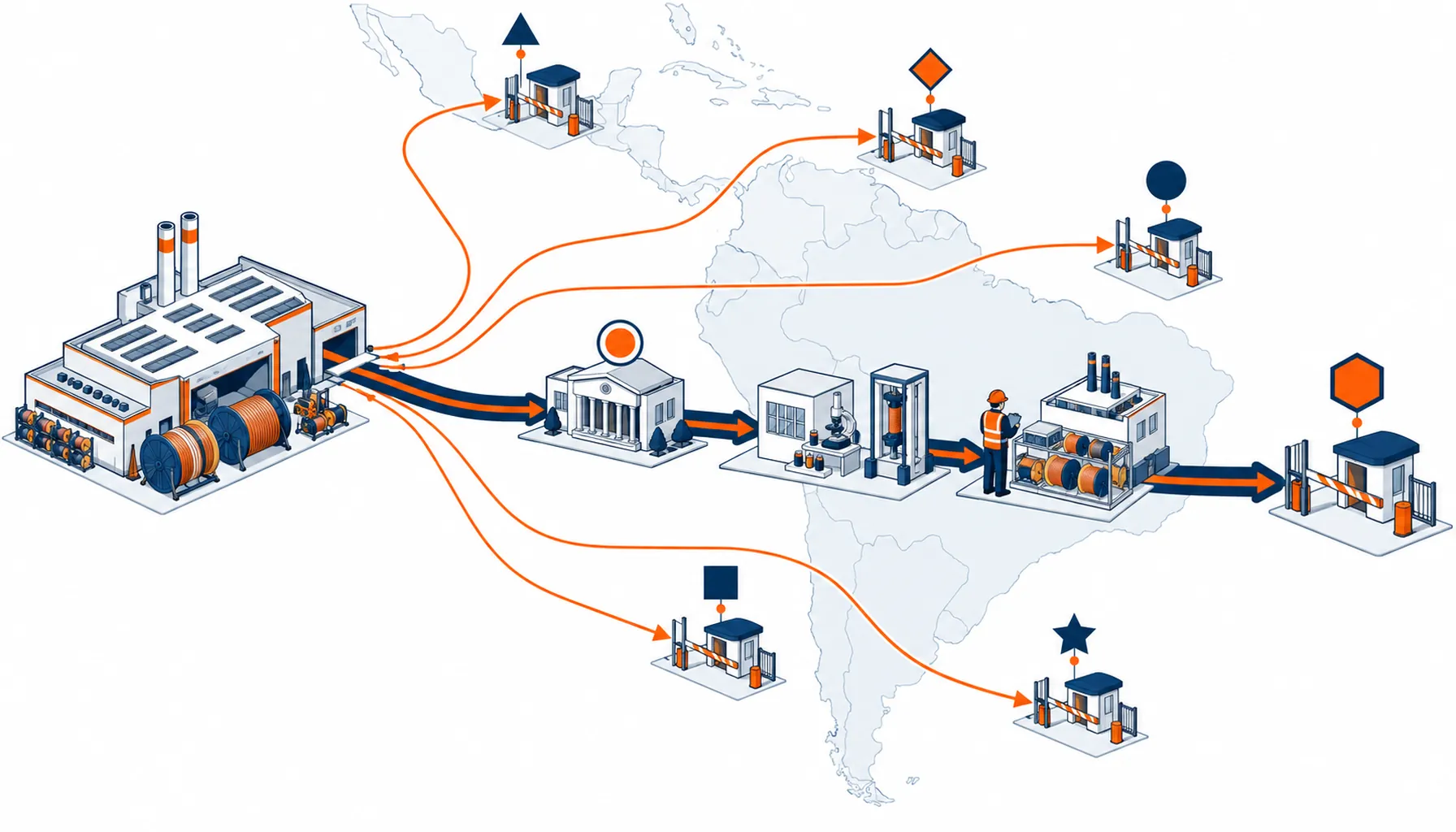
Latin America is a continent of real cable demand — Brazil’s grid and industrial base, Mexico’s nearshoring factories, the Andean and Southern Cone grids — and of regulatory fragmentation: nearly every border runs its own scheme, its own mark, its own certifier. Brazil, the largest market, is also the most structured, with INMETRO conformity certification built on a factory-audit backbone. This guide takes Brazil in depth and the region as a map, one read that replaces “Latin America” with actual entry routes.
Introduction
The demand logic is familiar from this series: grid investment, industrial estates and a data infrastructure buildout keep import volumes growing — the data-center dimension of global demand is tracked in data center power demand growth. The supply logic is regional and specific: cable entering Brazil faces INMETRO’s conformity regime for regulated electrical products, and where the cable carries data — structured cabling, telecom constructions — ANATEL’s regime adds its own approval. Around Brazil, each neighbor runs a national scheme with its own authority and mark, derived from the IEC family to varying degrees. The buyer’s task is the cluster’s standard sequence — map the construction to the scheme, verify the credential, schedule the gate — executed market by market, which is why the four checks detailed in the power cable certifications checklist earn their keep again here.
Brazil: How INMETRO Certification Works
INMETRO — the National Institute of Metrology, Standardization and Industrial Quality — administers Brazil’s conformity assessment system, and regulated cable families sit inside it. The mechanism is the plant-license model again, with Brazilian features. The standards: conformity is assessed against the applicable NBR standards — Brazil’s national standards, largely IEC-derived — for conductors, insulation and the constructions themselves. The certifier: assessment runs through an accredited product certification body, an OCP, that tests samples against the NBR requirements and audits the manufacturing plant; the license is issued to the plant, by name, for the certified scope. The mark: certified product carries the INMETRO conformity mark, tying each drum to the license. The surveillance: recurring monitoring keeps the license current, the same life-cycle that governs CCC, BIS and SNI. For foreign manufacturers the route is open and the weight is real: months-scale, audit-bound, and scoped per construction family. That again makes a current INMETRO certificate among the strongest factory-credibility signals, per the vetting logic in supplier vetting. Where the cable carries data, ANATEL — the telecom regulator — runs its own approval for telecom products, a second layer with its own certifiers and mark. A structured-cabling program to Brazil plans both, and the allocation of application duties and costs belongs in the contract per the incoterms framing in FOB vs CIF for power equipment.
The Region: A Country-by-Country Map
North and west of Brazil, the patchwork begins. Mexico’s market runs on NOM standards with certification through accredited bodies — and the nearshoring boom makes it the region’s fastest-growing cable market. Argentina runs its safety regime through the IRAM-based certification system with the S-mark. Chile’s SEC approves electrical products against its listed standards. Colombia’s RETIE regime requires certification from accredited bodies before electrical products enter its grid-connected world. Peru and the smaller markets add their own variations. The pattern underneath is constant — national standards derived from IEC, accredited testing, and a mark or certificate per market — but the authorities, scopes and rhythms differ enough that a regional program is a portfolio of small projects, not one project scaled. The matrix discipline is the market-by-market mapping from this series’ overview, applied with regional specifics: verify each market’s current scope at RFQ, because schemes evolve and yesterday’s exemption is today’s requirement. That’s the register-not-memory rule that governs every market in this series and the sourcing discipline behind international power equipment sourcing mistakes.
| Market | Scheme and Authority | Buyer Note |
|---|---|---|
| Brazil — power cable | INMETRO conformity certification via accredited OCP, NBR standards, INMETRO mark | License issued to the plant; surveillance keeps it current |
| Brazil — data/telecom cable | ANATEL approval regime for telecom products | Second layer on top of INMETRO where the cable carries data |
| Mexico | NOM standards, certification through accredited bodies | Nearshoring demand makes scope checks high-value at RFQ |
| Argentina | IRAM-based safety certification, S-mark | Scheme details evolve; verify current scope |
| Chile | SEC approval against listed standards | Per-product approval route; plan evidence early |
| Colombia | RETIE regime, certification by accredited bodies | Grid-connected product needs the RETIE certificate |
Planning a Regional Program
The planning consequences follow the fragmentation. Map per market and per construction: the same building cable faces INMETRO in Brazil, NOM in Mexico and RETIE in Colombia — three evidence sets, three schedules, three cost lines, and a program plan that shows them as separate workstreams rather than one line item. Verify credentials down to the plant: INMETRO licenses and their regional siblings name the manufacturing facility, so the holder check is the same four checks — holder, coverage, currency, marking — that anchor this cluster, with the register-not-memory rule applied to every certificate. Schedule the gates honestly: first-entry programs in Brazil carry months of certification calendar where licenses do not exist, and the milestone discipline — application, test report, audit, grant — anchors them in the contract, the calendar honesty of cable sourcing delays and EPC timelines. And keep one document story across the region: invoices, packing lists and drum markings that reconcile with each market’s certificate, generated from one source — the discipline that prevents the scope-blur and document-drift failures this series catalogs everywhere.
| Stage | Action | Classic Trap |
|---|---|---|
| RFQ | Map each construction to each target market's scheme and current scope | "Latin America" quoted as one market |
| Selection | Four-check verification per certificate: holder plant, scope, currency, marking | One market's certificate accepted as regional proof |
| Contract | Certification milestones, ANATEL layer, costs and duties allocated per market | Brazil calendar treated as a paperwork week |
| Shipment | One-source documents; markings reconciled per market's certificate | Invoice descriptions drifting from the certified scope |
| Arrival | Customs match per market; identity chain closed | Mixed loads pairing certified and uncertified families |
When a Regional Certificate Is Not the Answer
Two boundaries frame the region. Certificates are market gates, not engineering verdicts: INMETRO and its siblings prove national-standard minimums at audited plants, while the project’s ampacity, voltage drop and fire strategy remain specification work, evidenced by type test reports and batch data under the IEC-derived framework mapped in our MV and LV standards guide. And no certificate travels: the INMETRO mark is not valid proof in Bogotá, the S-mark is not proof in Santiago, and the region’s shared IEC ancestry supports conformity work without replacing national gates. Where a construction sits outside a market’s current scope, absence of the mark isn’t a quality verdict. The engineering question is answered by test reports and batch evidence, and the market-entry question by a scope check with the local authority or importer at RFQ time.
RFQ Checklist: Brazil and LatAm Lines for the RFQ
Put the region’s questions in writing:
- Each offered construction mapped to each target market’s scheme and current scope
- Brazil: INMETRO certificate held — holder plant, NBR standards, certified scope, number stated
- Brazil: ANATEL status confirmed where the construction carries data
- Mexico, Argentina, Chile, Colombia: applicable certificate or approval identified per market
- Test reports against the relevant national standards from accredited laboratories
- Certification gaps scheduled as milestones with owners, dates and cost bearing
- Documents and drum markings generated from one source, reconciled per market
Conclusion
Latin America rewards the buyer who refuses the regional shortcut: Brazil runs a structured, audit-backed INMETRO regime with an ANATEL layer for data cable, and each neighbor runs its own gate with its own mark. Map per market, verify per certificate, schedule per calendar — the same three moves this series has applied from CCC to SNI, now with a wider map.
Kexingyu Cable Group (KXYE) supports Latin America-bound programs with accurate certificate-status disclosure per market, accredited test reports aligned to the relevant national standards, and one-source document sets that keep each border’s gate a schedule line rather than a surprise.