Cable Drum Length and Joint Placement: An Ordering Strategy That Cuts Waste
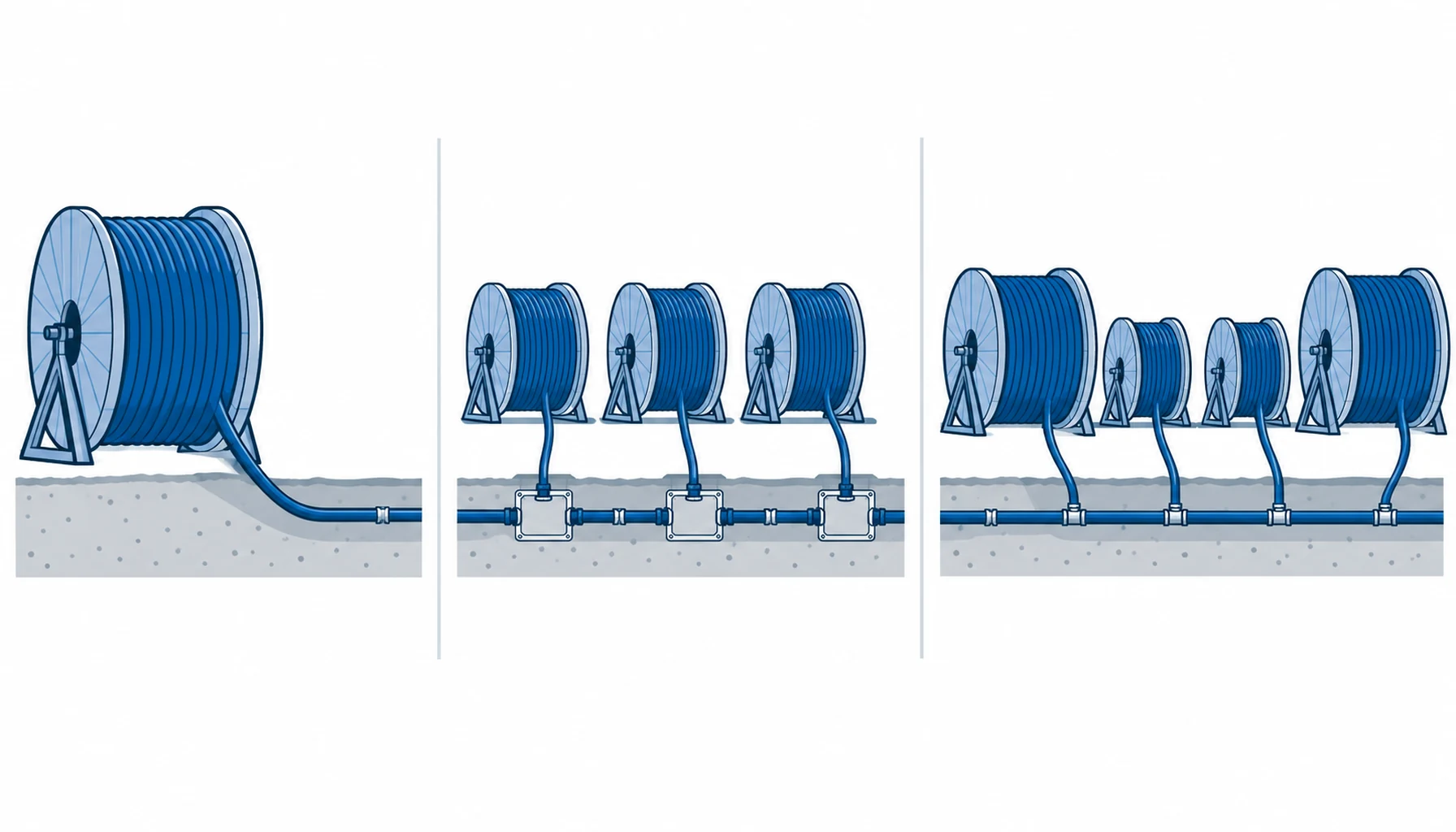
Quick Answer: The cable drum length you order decides how many joints a route carries, how much cable is scrapped and how the price moves. Standard drums are cheapest and quickest but rarely match a run, so the route ends up jointed every drum length. Long or cut-to-length drums cost more per metre but remove joints from the expensive places. The buying job is to set drum lengths against the real run schedule, decide where a joint is acceptable, and freeze the tolerance and the marking before the order goes out.
Introduction
Drum length looks like a packing detail. On a large order it is one of the biggest levers the buyer has, because it sets the joint count, the scrap and, on a long route, the amount of site labour the cable will cost before it ever carries current.
This guide is written for the person building the requisition. It shows why drum length is a cost decision, where joints help and where they hurt, how to work out the order from the run schedule, and what to freeze in the order. Drum handling and the packing itself are covered in our note on cable drum packaging for export.
Why Drum Length Is a Cost Decision
Every drum boundary is a potential joint. A route pulled in drum lengths carries one joint per drum on average, and each joint is a termination the installer has to make, test and record. On a low-voltage distribution route that is routine work. On a 500 metre feeder it is a risk point that follows the cable for its whole life.
Joints cost more than the accessory. The joint kit is the smallest part of the bill. Excavation to expose a buried run, a joint bay, a permit, the outage window and the test afterwards are the real cost, and they recur at every joint.
Joints are where cables fail. A well-made joint is as reliable as the cable, but the workmanship sits on site rather than in a controlled factory, and that is where moisture ingress and partial discharge begin. Fewer joints means fewer places for that to happen.
But long drums cost money too. A non-standard or extra-long drum takes more time on the line, is heavier and harder to move, and may need stronger handling on site. The trade is between the price of the cable metre and the cost of the joint, and on most projects the joint wins when the route is buried or hard to reach.
A second cost hides in the offcut. A route of four hundred and thirty metres run from five-hundred-metre drums leaves seventy metres on the drum, and that offcut is paid for and then either scrapped or stored as a spare. Setting drum lengths to the run schedule turns that offcut into a planned spare rather than waste.
Drum Length Strategies and What Each One Answers
The table sets out the ordering strategies a buyer can choose, where each fits, what to state and how each one fails when it is applied to the wrong route.
| Strategy | Where it suits | What to Specify | Evidence to Demand | Cost and Lead-Time Driver | How It Fails |
|---|---|---|---|---|---|
| Standard stock drums | Short runs, distribution routes, work where joints are routine | Standard drum length, quantity in whole drums, spare allowance | Marked length per drum and a length test on arrival | Cheapest and quickest, usually ex stock in standard sizes | Offcut scrap on every run, and joints landing in awkward places |
| Cut-to-run lengths | Long feeders, buried runs and any route where a joint is costly | The measured run length per pull plus a defined installation allowance | A drum schedule matched to the run schedule, with lengths certified | Made-to-order lengths, longer line time and a firm order commitment | Over-cutting leaves an unusable offcut; under-cutting forces an unplanned joint |
| Jointed at planned bays | Tunnels, ducts and routes with a designed access point for joints | The joint locations, the accessory kit and the test regime at each bay | A joint schedule with locations, kits and test records | Accessory kits and site labour rather than cable cost | Joints placed where there is no access, so repairs mean excavation |
| Continuous pull, no joint | Critical feeders, subsea and long horizontal bores where a joint is unacceptable | The exact pull length, the maximum drum the route can handle, and the handling limits | Length certification and a pull plan from the drum to the far end | Very long drums, special transport and heavier handling equipment | Drum too large to move to the pull position, or a length that misses by metres |
| Mixed drum schedule | Projects with one long feeder and many short branches | A schedule that sets long drums for the feeder and standard drums for branches | A single drum schedule covering every circuit on the order | More line changeovers, but the lowest total scrap and joint count | Ordering one length for everything, so some circuits carry extra joints and others scrap |
Working Out the Order From the Run Schedule
Start from the pulls, not the total metreage. List every pull with its measured length, the route it follows and whether a joint is acceptable on it. Two hundred metres in one pull and two hundred metres in five pulls of forty are the same metreage and completely different orders.
Add the installation allowance on purpose. Every pull needs slack for the termination, the bend allowance and the ground movement, and the amount depends on the route. State it as a number per pull rather than letting it be discovered on site, and be careful not to inflate it, because the allowance is paid for on every drum.
Then decide the joint policy. Some routes accept joints freely and some do not. A buried feeder, a subsea section and a riser usually carry the highest joint cost, so they get the longest drums. A distribution branch can be jointed at a box without a second thought, so a standard drum length is fine and cheaper.
Then group the drums. Where a factory has to make special lengths anyway, grouping similar lengths onto one order line reduces changeovers and protects the lead time, which is the same logic that sits behind order sizing in our note on cable MOQ and lead time.
Then check the handling. A long drum is heavy, and the site has to be able to lift it, stand it and pull from it. Where access is tight, the longest practical drum sets the joint count whether the buyer likes it or not, which is where the minimum bend radius and drum weight data come back into the picture.
What to Freeze Before the Order Goes Out
Six clauses decide whether the drums that arrive match the route. Each is cheap to write now and expensive to argue about later.
| Decision | What to State | Evidence to Attach | Cost of Leaving It Open |
|---|---|---|---|
| Pull-by-pull schedule | Each pull length, route and whether a joint is permitted | A run schedule matched to a drum schedule | Joints landing on the routes that can least afford them |
| Installation allowance | The slack per pull and the basis for it, separately from the run length | A rule for the allowance agreed with the installer | Over-ordering on every drum, or an unplanned joint at the far end |
| Joint policy | Which routes take joints, where the bays are, and the kit to be used | A joint schedule with locations and accessory kits | Repairs that mean excavation because the joint was in the wrong place |
| Length tolerance | The permitted minus tolerance on each drum and the test that proves it | A length measurement method and an acceptance figure | Short drums discovered on site, after the pulls have started |
| Drum identification | Marking of each drum with its length, circuit and order reference | Photographs of drum markings before cutting | Doubt about which drum went into which circuit |
| Spare allowance | The length and number of spare drums for the route's repair regime | A spares list against the joint and repair plan | A stored offcut, or a rush order for cable that has since become expensive |
Length Tolerance and Marked Length
Every drum length carries a tolerance, and the tolerance works one way in the buyer’s favour. A drum marked as a nominal length may be a little short or a little long, and where the route has no slack, a short drum is the problem. State the permitted minus figure, and check the delivered lengths rather than trusting the mark. The discipline behind this is the same one covered in our note on cable length tolerance, and it applies to every drum on the order.
Where a length matters, ask for it to be measured and certified per drum rather than taken from a nominal count, and agree the measurement method so both sides mean the same thing. On a buried route, a two-metre shortfall across fifty drums is a hundred metres of cable that nobody ordered and cannot easily source on the site programme.
Constructions, Accessories and What They Cost
The joint itself is a purchase in its own right. Our cable accessories checklist and the companion jointing and termination accessories list set out what a joint bay needs beyond the kit, and buying them on one order line with the cable avoids a late scramble when the drums arrive without them.
Stock drums are the fastest and cheapest per metre, and where the route can take a joint they are usually the right answer. Cut-to-length drums cost more per metre because the line has to change over, but they remove joints and scrap from routes where those cost far more. Special long drums run the longest and the heaviest, and on a fixed date they are also the ones that can move the least. Copper and steel again drive the material cost, so the same two questions come back: how the copper is counted, and how the price is held, as set out in our note on the cable price breakdown.
Incoming Inspection and What to Record
Count and measure. Count drums against the packing list and check the marked length against the order before anything is cut. Photograph the drum markings so a length dispute later can be traced to the drum.
Check the ends. Look at the drum ends and the sealing of the cable ends, because a long drum travels further and spends longer in transit. A sealed end and a sound drum barrel are the two things that protect the first metres of a cable on the outside of the coil.
Match the schedule. Confirm that the long drums go to the long pulls and the standard drums to the branches, so the installer works from the schedule rather than discovering the mismatch half way through a pull.
Record the as-pulled lengths. Note the length actually used in each pull and the offcut returned to the drum. Over a project, that record is what makes the next order’s drum schedule accurate rather than optimistic.
When a Joint Is Not the Answer
When the route is buried or hard to reach. A joint you cannot access is a liability for the life of the cable. Pay for the longer drum rather than accept a joint in a place nobody can reach.
When the joint would sit in water. Where a route passes through a wet duct or a chamber that floods, joints are the first failure point. Long drums that avoid the joint altogether are usually cheaper over the life of the line than a kit designed to survive immersion.
When the drum is too big to handle. The opposite mistake is just as real. A drum the site cannot lift to the pull position forces a joint that nobody planned, so check the access before you set the longest drum on the order.
When the offcut is the answer instead. On a short route, a standard drum and a stored spare is often better than a cut-to-length drum that arrives late. The decision follows the route, not the habit.
RFQ Checklist
- Pull-by-pull schedule with route, length and access for each circuit
- Where joints are permitted and where they are not, with the reason
- Installation allowance per pull, stated separately from the run length
- Permitted minus tolerance on each drum, and how the length is measured
- Drum marking requirements: length, circuit and order reference
- Joint bays and accessory kits, if joints are planned
- Maximum drum size the site can move, stand and pull from
- Spare allowance and how it is identified on the delivery
- Length certification per drum where the route has no slack
- Copper basis and price validity, and the delivery and freight terms
Conclusion
Drum length is where the cable order meets the construction programme, and it is decided long before the drums arrive. Work from the pulls rather than the total metreage, decide which routes can carry a joint and which cannot, and set the drum schedule to match. The most expensive drum length is a standard one used on a route that needed a long pull, because the saving on the drum is paid back many times over in a joint nobody can reach.
Kexingyu Cable Group (KXYE) has manufactured cable in Quanzhou since 1996 and supplies stock lengths, cut-to-length drums and special long constructions against a run schedule, with lengths marked and certified as the order requires. Send us your pull schedule and the joint policy for each route, and we will come back with a drum schedule, the accessory list and a delivery plan against your programme. A request for quotation is the fastest route.