Buying Power Cables for Tajikistan: BOQ Review, Quotes and Acceptance
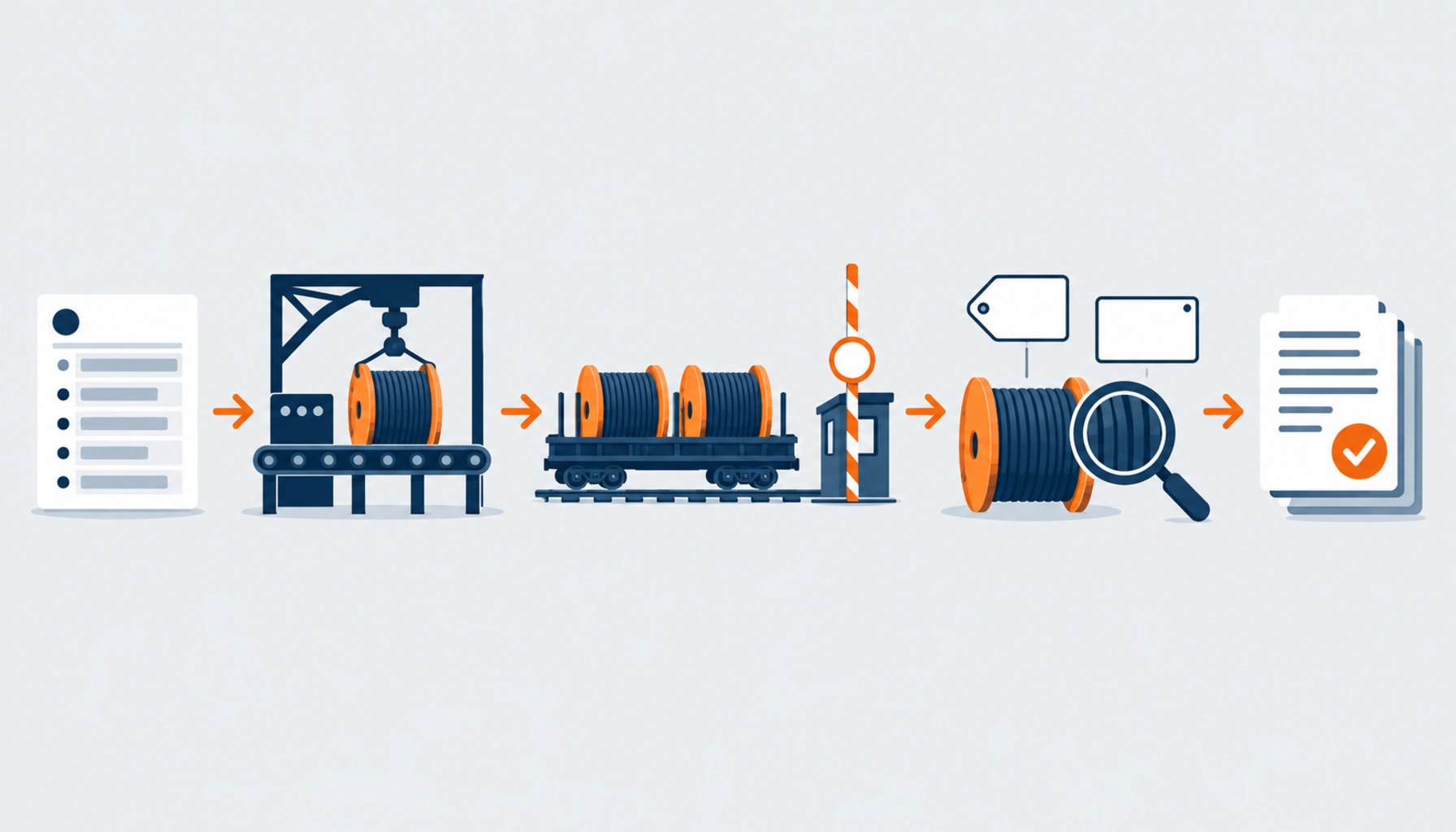
Quick Answer: A power cable order for Tajikistan succeeds or fails on traceability: every acceptance check at receipt must trace back to a requirement written before the order. The path runs from the BOQ review through the quotation to the order’s technical annex, and it ends at the laydown yard, where quantity, marking and condition are checked against documents, not memory. Write the requirements so they can be evidenced, ask for the reports that carry them, and agree the nonconformance route before the goods move. This guide follows that path end to end.
Introduction
Cable that arrives at a Tajikistan project is checked twice: once by the buyer’s inspector with a document in hand, and once, informally, by everyone who unloads it. The first check works when the requirements were written to be evidenced; the second is what catches what the first cannot. Between the BOQ and that yard check sits the whole procurement chain, and the chain is only as strong as the links between what was ordered and what can be proven on arrival.
This guide is for project buyers and EPC purchasers handling power cable for Tajikistan. It follows the order from BOQ review to acceptance: the technical annex that carries the requirements, structure and lengths, packaging for the route, the test reports that accompany the delivery, the receipt checks for quantity, marking and condition, what to do about document gaps, and how nonconforming deliveries are handled. The supplier prequalification that happens before this path is covered in the country articles of this series, and the construction basics behind the power lines are set out in our note on XLPE cable construction.
Turn the BOQ Into an Order Technical Annex
The annex is where requirements become checkable. The line list with constructions and standards, quantities and drum splits, marking content, packaging, documents, delivery basis and the claim route: two or three pages attached to the purchase order. Each requirement in it is written so that a receipt inspector can prove it was met, because that is the only form in which it survives the route.
Requirements written as evidence are requirements that get met. “Test reports with the shipment” is an intention; “routine test results for each drum, tied to the drum number, delivered before unloading” is a requirement. The difference is not legalism. It is the difference between a handover that proceeds and one that waits while two parties describe different memories.
The annex travels with the order, not with the relationship. Staff change on both sides between the order and the delivery months later, and the annex is what the new people read. The BOQ review that fed it, and the deviation decisions behind it, were covered in the prequalification stage; the annex is where those decisions take their final written form.
How competing offers were compared before that annex was drafted is set out in our guide to comparing cable quotations for Central Asia.
Fix Structure and Lengths Before Production
The construction is frozen at confirmation. Every line carries its accepted construction, including accepted deviations, and production proceeds against that freeze. Changes after the freeze are new decisions with new consequences, not administrative edits, and treating them casually is how a checked order becomes an unchecked one.
Lengths and drum splits follow the installation plan. The route’s jointing strategy, the pull lengths and the drum handling at the site decide the split, and the available drum lengths decide what is possible. Confirming both before production is what keeps the delivered drums from reshaping the installation plan on arrival. The trade-off behind the split is set out in our note on drum length and jointing strategy, and the tolerance on ordered lengths is covered in our note on ordered length and drum tolerance.
Marking content is fixed in the same pass. Drum numbering, label content, language and batch references are production inputs, agreed before the drums are built. Marking agreed late is the most common receipt dispute, and it is entirely avoidable.
Specify Packaging for the Real Route
Packaging is an acceptance requirement, not a preference. The route to a Tajikistan site passes through rail and road legs with several handovers, and the drums that arrive are the ones that were packed for that journey. The annex names the drum type, the flange and cable-end protection, and the packing for each leg, because damaged drums are a nonconformance like any other.
Ask for the packing evidence before the shipment moves. Photographs of the packed drums before loading, or a packing specification confirmed in writing, cost the supplier minutes and give the buyer a baseline. The export packaging practice that makes this routine is set out in our note on export drum packaging.
Shipment identity survives on purpose. Drum numbers that survive reloading, packing lists that reconcile drum by drum, and labels that match the documents: identity is a designed outcome of the packaging and marking requirements, not a hope that the handlers are careful.
Require the Test Reports That Carry the Requirements
Routine batch reports are the delivery’s own evidence. For each drum: conductor resistance, withstand and insulation results, tied to the drum number. These are the documents the receipt check works from, and the annex requires them with the shipment, in a form the site can read.
Type reports answer the specification. Where a line requires a type test for its construction, the current report is part of the delivery’s document set, and its scope, the construction, standard and date it names, is checked against the line before the order is confirmed, not after the goods arrive. Where independent verification of critical lines is wanted, the arrangements are described in our note on third-party inspection.
Document gaps are found before shipment or at handover. The annex should require the document set before unloading, because documents that arrive after the drums are spread across a site are documents nobody reads. A pre-shipment document check, by the buyer or by an inspector, is the cheapest acceptance step in the whole chain.
Check Quantity, Marking and Condition at Receipt
Quantity: a count against the packing list, at unloading. Drums and coils counted as they come off, against a packing list that reconciles drum by drum. The check takes minutes and it is the one acceptance step that cannot be reconstructed later. Shortfalls found here are claims with evidence; shortfalls found at installation are arguments.
Marking: labels match the documents and the order. Drum numbers readable, batch references matching the reports, and any agreed marking content present. Where the marking fails, the traceability chain breaks at its first link, and the claim conversation starts with the label rather than the cable.
Condition: the visual check that catches what reports cannot. Drum damage, cable-end sealing, sheath condition at the accessible ends, and anything the transport did to the goods. Photographed at unloading, noted on the delivery document, and raised through the claim route the annex defined. The criteria for what is repairable, acceptable or replaceable are set out in our note on site inspection and replacement criteria.
Handle Document Gaps Without Inventing Answers
A gap is a record, not an improvisation. Where a required report is missing or a marking does not match, the finding is written down with the drum number and the requirement it fails. Improvised acceptance, a handshake where a document should be, is how a traceability chain quietly ends.
Classify the gap before deciding what happens to the goods. Some gaps are administrative: the report exists and travels late. Some are substantive: the batch evidence for a drum does not exist. The first can be closed with a deadline; the second is a nonconformance with a route. The classification discipline is the same one prequalification uses, carried through to the delivery.
Write the resolution into the file. Every gap, its classification and its outcome, recorded against the drum or line it affects. The file is what the handover, the auditor and the next order all read, and it is what turns an awkward delivery into a managed one.
Handle Nonconforming Deliveries Through an Agreed Route
The route is written before the goods move. Who inspects, how a claim is raised, what evidence each side provides, and the window for each step. A claim route agreed in the annex runs on facts; the same dispute without a route runs on leverage, and the buyer far from the factory rarely has more.
Nonconformance has three usual outcomes. Repair or rework where the condition allows, replacement against a production slot, or rejection with credit. Which one applies is a function of the requirement that failed and the site’s schedule, and the annex’s claim clause is what keeps the conversation on those outcomes instead of on blame.
Traceability is what makes any outcome possible. The drum number links to the batch report, the batch to the order, the order to the accepted construction. Where the chain is intact, a claim is a documented conversation. Where it is not, the buyer is asking the supplier to accept an argument, and acceptance is rare. The acceptance discipline this section describes is the same one used for specialist constructions, described further in our note on acceptance testing practice.
Order Requirements and Acceptance Evidence
The table is the acceptance chain in one sheet: each requirement the annex should carry, the evidence that proves it at receipt, and who checks it.
| Order Requirement | Acceptance Evidence | Checked By |
|---|---|---|
| Construction per line, as confirmed in the annex | Approved sample record; accepted deviation list; type report naming the construction | Receiving inspector with the annex |
| Quantity per line with drum splits | Drum count at unloading against a packing list that reconciles drum by drum | Site store or laydown yard staff |
| Marking content and batch references | Drum labels readable and matching the packing list and the reports | Receiving inspector |
| Routine batch test results | Reports per drum, tied to drum numbers, delivered before unloading | Document controller with the inspector |
| Type test reports where required | Current reports naming the construction, standard and date | Document controller before order confirmation and at handover |
| Packaging for the route | Packed drums as specified; pre-loading photos where agreed; drums intact at unloading | Site staff at unloading, photographed |
| Delivery basis and risk transfer | Delivery documents naming the destination and the handover point | Project procurement |
| Claim route and windows | Findings recorded on the delivery document within the window, with photographs | Receiving inspector, then procurement |
Cost and Lead Time Through the Acceptance Chain
Acceptance is cheap; non-acceptance is not. The checks in this guide cost minutes at unloading and an afternoon of document review. The failures they prevent cost installation delays, re-orders and disputes that run for months. The economics are not close, which is why the chain is written into the annex rather than performed from memory.
Document timing is a schedule item. Reports that must arrive before unloading are a shipping requirement, and a supplier who agrees the annex has agreed to that timing. Where documents travel late, the handover waits, and the waiting is a cost neither party priced. Requiring the set early is a schedule protection as much as a quality one.
Nonconformance outcomes carry different calendars. Rework at the site, a replacement production slot, or a credit and a new order each have a lead time, and the site’s programme decides which is tolerable. Knowing the route and the evidence in advance is what lets the buyer choose the outcome instead of receiving one.
The next order inherits this one’s file. Gaps closed, deviations accepted and claims resolved become the baseline the repeat order starts from, and the supplier’s quote reflects the relationship the file records. Traceability, once built, is an asset that compounds quietly across the programme.
| Outcome | Typical Trigger | Calendar Effect | Evidence Required |
|---|---|---|---|
| Repair or rework | Local damage that does not affect the cable's electrical integrity: drum scarring, sheath abrasion over a short span | Shortest; handled at the site on the installation schedule | Photographs at unloading; the inspector's finding against the annex requirement |
| Replacement | Construction or quantity nonconformity: wrong section, missing drums, unidentifiable marking | A production slot plus the transit time, planned against the programme | The packing list, the batch reports and the annex line list, showing the mismatch |
| Rejection with credit | Substantive failure: missing batch evidence for a drum, or construction outside the accepted deviations | A new order cycle; the programme decides whether the source can be retried | The full traceability chain: order, annex, drum number, and the document that failed |
When a Full Acceptance Chain Is Not the Answer
When the delivery is a single replacement drum. Check the construction, the length and the condition, and file the report with the order. The full chain earns its keep on purchases where the traceability will be read again.
When the supplier has a clean record on the same lines. The annex still travels with the order, but the receipt check can lean on the batch documents rather than on full re-inspection. The file is maintained; the ceremony is not repeated.
When the site has no inspection capacity at handover. Then the pre-shipment check, by the buyer or an inspector, carries the weight, and the annex says so. Acceptance happens somewhere; the chain just moves to where the eyes are.
When the requirement cannot be evidenced by anyone. A requirement no supplier can prove is a specification problem, not an acceptance problem. It goes back to the specifier, and the order proceeds on what can be proven.
RFQ Checklist
- The technical annex attached to the order: lines, constructions, standards, quantities, splits, marking, packaging, documents, delivery basis, claim route
- Requirements written as evidence: reports per drum tied to drum numbers, marking content named, windows stated
- Constructions frozen at confirmation, with accepted deviations recorded
- Drum splits fixed against the installation plan, tolerance confirmed
- Packaging specified for the real route, with pre-loading evidence where agreed
- Routine batch reports required before unloading; type reports scoped against the lines
- Receipt checks by circuit and drum: quantity, marking, condition, photographed
- Document gaps classified, administrative or substantive, and resolved in writing
- Nonconformance route agreed before the goods move, with the three outcomes named
- The file kept as the baseline for the next order
Conclusion
Buying power cable for Tajikistan is a traceability exercise with a delivery at the end of it. Requirements written so they can be evidenced, a construction frozen before production, packaging and marking designed for the route, reports that travel with the drums, and a receipt check that proves what the annex promised. Where the chain is intact, acceptance is routine and claims, when they come, are documented conversations. Where it is not, the buyer discovers that a cable without its trail is just a heavy object on a drum.
Kexingyu Cable Group (KXYE) manufactures power constructions in Quanzhou and supplies Central Asian projects on orders whose every requirement can be evidenced: drum-level batch reports, agreed marking and packaging, and a claim route written before the goods move. Send us your BOQ, quantities and destination, or upload your technical specification, and we will deliver against the annex as written. A request for quotation is the fastest route to start.