Choosing a Cable Supplier for Tajikistan: A Procurement Checklist
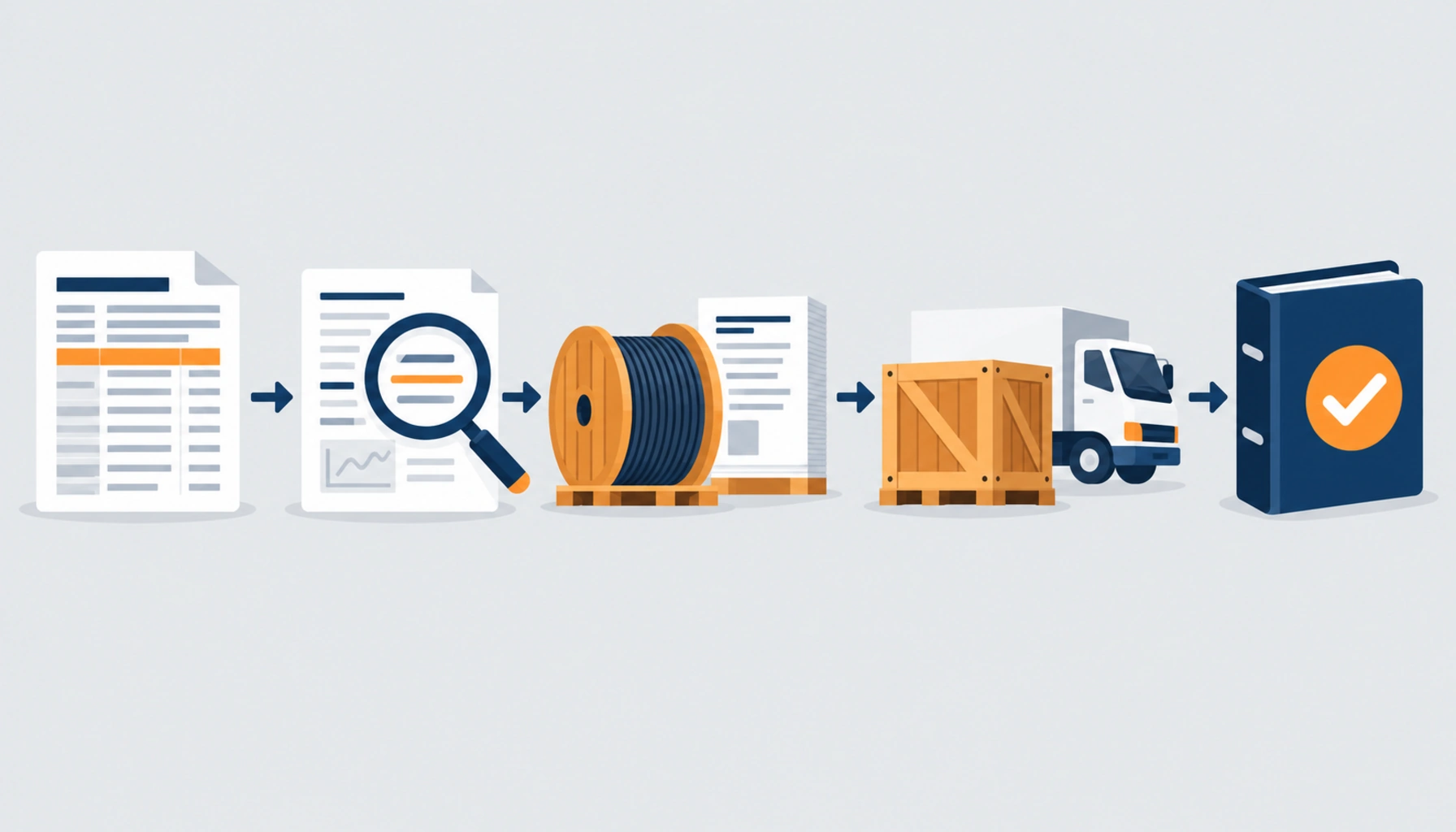
Quick Answer: Prequalifying a cable supplier for a Tajikistan project comes down to a document exercise with a fixed sequence: check specification coverage against your BOQ line by line, collect the technical documents and samples that back each line, verify the supplier’s in-house testing and the scope of its reports, confirm packaging for the real transport route, and settle quotation and delivery conditions in writing. Where a document is missing, record the gap as an open item and decide whether it is acceptable, rather than discovering it during handover.
Introduction
Prequalification is the stage where a buyer for a Tajikistan project decides which suppliers are worth quoting at all. Done well, it is mostly paperwork: a list sent in a form the factory can answer, evidence collected against each line, and gaps recorded while they are still cheap. Done late, the same gaps surface as a failed handover, a customs delay or a cable that does not match the approved construction.
This checklist is for project procurement teams and EPC buyers running supplier prequalification. It follows the document sequence: specification coverage, technical documents and samples, testing and report scope, packaging, quotation and delivery conditions, and the handling of documentation gaps. The acceptance work that follows the order is deliberately left to a later stage; this list only gets the supplier to the starting line. Power, control and instrumentation constructions for project BOQs are shown in the product range.
Check Specification Coverage Against the BOQ
Send the BOQ lines as they will be enforced. Rated voltage in full, conductor material and class, cores and section, insulation, screen, armour and sheath, and the standard each line is checked against. A prequalification answer against a structured list is a usable document; an answer against a project name and a goodwill phone call is not.
Require a coverage answer per line, in three states. Covered as specified, covered with a proposed deviation, or not covered. The three-state answer is what makes the next step possible, because each state needs different evidence: a matching report for the first, a deviation sheet for the second, and a sourcing decision for the third. How the covered-with-deviation case is worked is described in our note on the industrial cable RFQ checklist.
Look at the constructions behind the labels. Where the BOQ names insulation systems, the buyer should know what the designation implies for temperature rating and test regime, because this is where substitution quietly happens. The insulation comparison behind many project lines is set out in our note on XLPE cable.
Collect Technical Documents and Samples
The document set is the prequalification’s main output. For each covered line: a type test report naming the construction, the routine test regime the batch will carry, and the certificates applicable to the destination. Collect them per line into the prequalification file, with the report dates noted, so the file shows coverage and age at a glance.
Sample the lines where the report alone is not enough. High-value power constructions and special lines usually justify a sample: the buyer checks conductor count and section as measured, compounds as declared, and marking as agreed. The sample record then becomes part of the file, and the production batch is checked against it at receipt rather than against memory.
Read the report scope before accepting it. A report proves what it names, at the date it carries. Check that the voltage class, core count and section match the BOQ line, and that the standard tested is the one the project enforces. A report for a neighbouring construction is a signal about capability, not evidence for the line, and treating it as evidence is the most common prequalification error.
Verify In-House Testing and Report Scope
Ask what the factory tests on its own equipment. Routine electrical tests, conductor resistance, insulation and sheath measurements are the tests that will accompany every batch, so they matter more for a repeat supply than a one-off type test held by a third-party lab. The answer tells you what the batch documents will actually contain.
Ask who runs the tests the factory does not. Third-party type tests and any project-witnessed testing are arranged, scheduled and paid by someone. For prequalification purposes the question is whether the supplier can produce the required evidence within the project calendar, and at whose cost. Where the project wants its own eyes on the process, the arrangements are described in our note on third-party inspection.
Record the report scope in the file. One line per report: construction named, standard, date, laboratory. This is the sheet that the project’s document controller will eventually ask for, and building it at prequalification costs minutes. Rebuilding it after award costs weeks.
Confirm Packaging and the Quotation Conditions
Packaging follows the route. Goods for Tajikistan travel long land legs with several handovers, so drum type, protection and packing for the transport mode are prequalification questions, not afterthoughts. Ask for the packing specification and, ideally, photographs of a previous packed shipment. The export packaging practice behind this is set out in our note on export drum packaging.
Quotation conditions belong in prequalification, not after the shortlist. MOQ and drum lengths per line, copper basis, validity window, included documents and the delivery basis with a named destination. Collecting these now means the quotations that follow are comparable, and the structure of the terms is covered in our note on cable MOQ and lead time.
How those conditions are worded in the enquiry is set out in our guide to requesting a cable quotation from a Chinese factory.
Weight the file by the purchase. A project with a single delivery weighs report scope and delivery discipline most heavily. A programme with repeat orders weighs batch consistency and the supplier’s willingness to hold terms across orders. The same checklist serves both; the weighting is a procurement decision, not a formality.
Handle Documentation Gaps Deliberately
Every prequalification produces gaps. A report that has aged, a construction without a matching test, a certificate whose scope is narrower than the line. The purpose of the checklist is not a perfect file; it is a file where the imperfections are visible and priced.
Classify each gap before deciding. Some gaps are closable: the supplier retests, or produces the document from an existing file. Some are closable at a cost the project may or may not accept. Some are structural and move the line to a different supplier or a different construction. A gap with a classification is a decision; a gap without one is a risk carried silently.
Write the residual gaps into the award decision. The award memo, or simply the order file, should state which gaps were accepted and why. That record is what protects the buyer when the same gap is noticed by someone else at handover, and it is the difference between a managed exception and an unmanaged one. How audit findings and open items are handled across a project is covered in our note on supplier audits for projects.
Prequalification Document Checklist Table
The table sets out the prequalification file as a single sheet: the document or record to collect, what it proves, what happens when it is missing, and the gap handling that keeps the decision honest.
| Document / Record | What It Proves | Handling When Missing |
|---|---|---|
| Coverage answer per BOQ line | The supplier builds what the project buys, or names the deviation | Not closable by the buyer; move the line to another source or change the construction |
| Type test report per covered line | The construction passed the named standard, at the named date | Ask for a retest with the cost and time stated; record both in the award decision |
| Routine test regime description | Every batch will carry its own test evidence tied to drum numbers | Treat as a high-risk gap for repeat supply; require it as an order condition |
| Sample record | The buyer's measured record of the approved construction | Order a sample for the highest-risk lines; accept report-only for low-risk lines, noted in the file |
| In-house test capability statement | What the factory tests itself versus outsources | Ask for the outsourcing route and who schedules and pays for it |
| Packing specification | Drums and packing survive the real transport mode and handovers | Request photographs of a previous packed shipment as interim evidence |
| Written quotation conditions | MOQ, drum lengths, copper basis, validity, included documents, delivery basis | Do not shortlist a supplier who will not state these in writing |
| Gap register | Which gaps were accepted at award, and why | Build it as you go; an unrecorded gap is an unmanaged risk |
How Prequalification Hands Over to the Order
The file becomes the order’s technical annex. The coverage answer, the report scope, the sample records, the packing specification and the quotation conditions convert directly into the annex that travels with the purchase order. Prequalification done as a filing exercise pays itself back here, once, quietly.
The shortlist reflects the file, not the impression. Two suppliers with equal prices are not equal if one file has current reports and a gap register and the other has assurances. The comparison discipline that keeps this honest is covered in our note on comparing cable quotes.
Keep the register alive after award. Gaps that were accepted at award, such as a retest scheduled during production, become tracked items on the order calendar. The register is the bridge between prequalification and receipt, and it is where the acceptance stage, covered separately for this market, will look first.
That acceptance route, from annex to receipt check, is set out in our guide to buying power cable for Tajikistan.
| Gap Class | Typical Example | Response | Cost of Ignoring It |
|---|---|---|---|
| Closable, no cost | Report exists in the supplier's file but was not sent | Request the full document; verify the match to the line | A file weaker than the supplier's actual position |
| Closable at a cost | Aged report or missing type test for a specific section | Retest quoted with cost and duration; decide against the project calendar | A surprise test bill or a slipped programme after award |
| Structural | Construction outside the supplier's capability entirely | Different source for that line, with the interface managed | A line delivered to someone's improvisation |
| Accepted and recorded | Report-only evidence where the buyer accepts the risk | Write the acceptance and reason into the award decision | The same gap rediscovered by someone else at handover |
Cost and Lead Time Inside the Prequalification File
Testing has a calendar, and the calendar belongs in the decision. A type test that must be arranged, witnessed or repeated takes weeks that no production plan can compress afterwards. The prequalification file should carry the test status per line alongside the report itself: current, aged, pending or missing. An award made on a file without those dates inherits a schedule risk it never priced.
The retest question is a cost question. Where a gap means a retest, the quotation for closing it should say who pays, how long it takes and what happens to the production slot meanwhile. A buyer who accepts a retest without those three answers has accepted a cost and a delay in unpriced form. The retest clause then goes into the order annex like any other accepted condition, with the trigger, the cost split and the calendar effect written down rather than assumed.
Packaging requirements move the price honestly. Steel drums, extra protection and export packing are cost items that vary by supplier habit. Asking each shortlisted supplier to quote the same packaging specification is what keeps the comparison clean; accepting each supplier’s default packaging compares their habits instead of their cable. It also protects the goods, because the specification is written for the actual transport mode rather than for whatever the factory packs by default.
Lead time quoted at prequalification is an estimate, and the file should say so. Production planning firms up against a real order, so the file records the quoted lead time and the basis it assumed. The check at order stage is then a comparison, not a discovery. Where the project calendar has no slack, the prequalification stage is where a supplier’s honesty about slots is first visible, and it tends to be the same honesty that shows up later at delivery.
Total the prequalification effort against the order size. The file’s cost is mostly staff time, and for a large programme it is the cheapest risk reduction available. For a small order, the same file trimmed to coverage, reports and quotation conditions still captures most of the value. Proportionality is a decision made here, where it is visible, rather than at handover, where it is not.
When Full Prequalification Is Not the Answer
When the supplier is already qualified for the construction. An existing approved source with current reports needs its file refreshed, not rebuilt. Requalification is triggered by a new construction family, a changed production base or slipping performance, not by a new project number.
When the purchase is small and the file cost dominates. For a minor order, confirm coverage, price basis and delivery terms, and record that the deeper checks were not run. Proportionality is part of the discipline; the register just needs to say so.
When the project documents are still moving. Prequalifying against an unsettled BOQ produces coverage answers that expire before award. Run the exercise against the frozen specification, or accept that it will be rerun.
When the gap is in the specification, not the supplier. If several suppliers return the same three-state answer against the same line, the BOQ is asking for something the market does not build as written. That finding goes back to the specifier, and no amount of supplier screening resolves it.
RFQ Checklist
- BOQ lines as enforced, with voltage in full and the standard per line
- Coverage answer requested in three states: covered, covered with deviation, not covered
- Type test reports per covered line, with construction, standard, date and laboratory recorded
- The routine test regime that will accompany each batch, tied to drum numbers
- Sample plan for the highest-risk lines, with the approval record format
- In-house test capability and the outsourcing route for the rest
- Packing specification for the real transport mode, with prior-shipment photos
- MOQ, drum lengths, copper basis, validity window and included documents in writing
- Delivery basis with the destination named and the risk transfer point stated
- A gap register recording every accepted gap and its reason
Conclusion
Prequalification for a Tajikistan project is a filing discipline. Coverage answered per line, reports read for scope rather than reputation, testing verified where it will actually happen, packaging matched to the route, and quotation conditions collected while they still shape the comparison. Gaps are classified and recorded instead of carried silently, and the file that results becomes the order’s annex without further work.
Kexingyu Cable Group (KXYE) manufactures power, control and instrumentation constructions in Quanzhou and answers prequalification requests line by line, with the reports and the batch documentation to back them. Send us your BOQ, quantities and destination, or upload your technical specification, and we will return the three-state coverage answer this checklist asks for. A request for quotation is the fastest route to start.