How to Request a Cable Quotation from China for Central Asian Projects
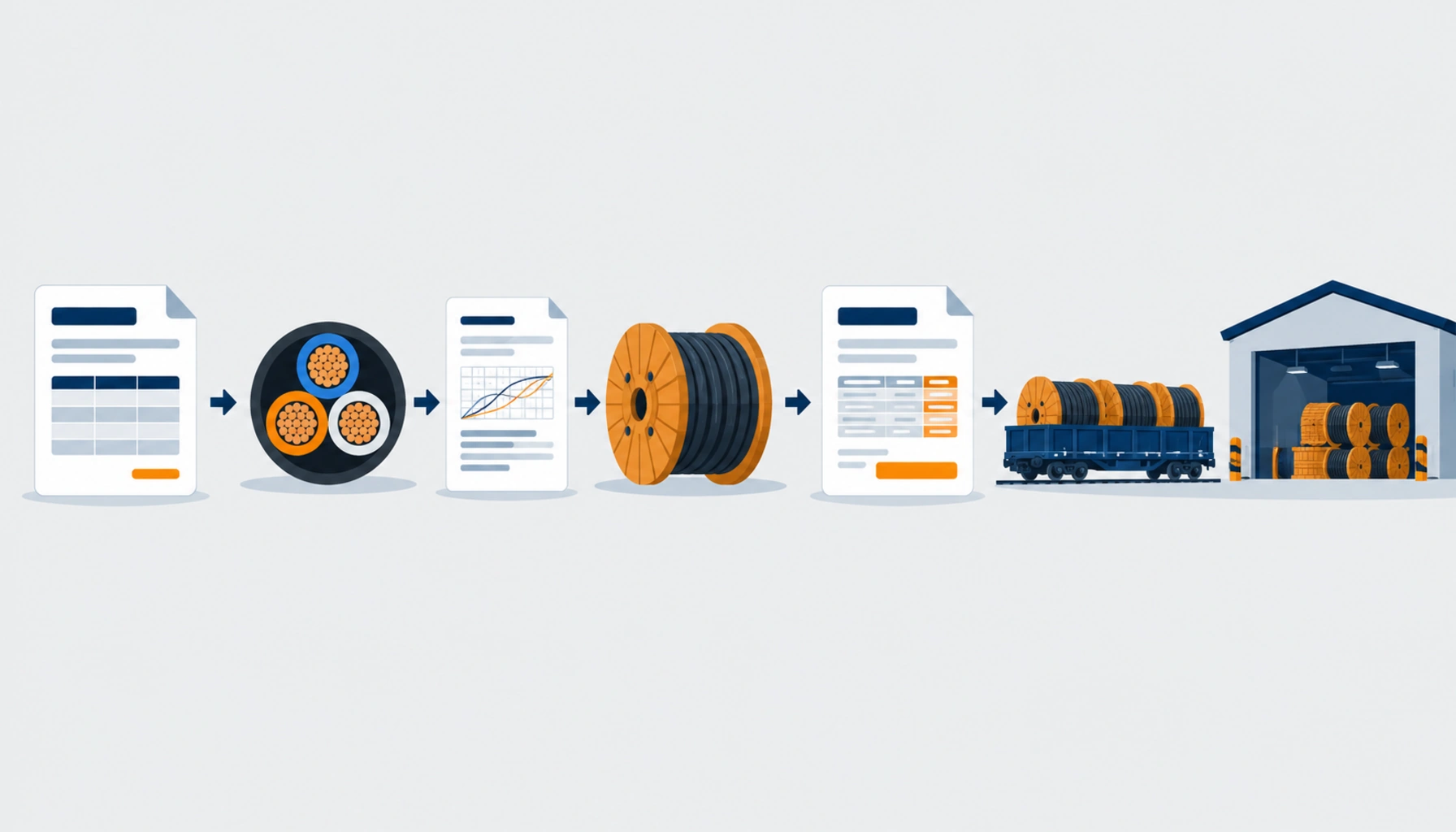
Quick Answer: A cable quotation is only as good as the request behind it. To get an offer you can compare and order against, send one structured enquiry that states the model or construction and standard per line, the rated voltage in full, conductor material and class, cores and cross-section, screen, armour and sheath, quantities with drum lengths, the tests the delivery must carry, the drum splits and the destination. Where information is missing, ask the supplier to state what they will build instead of leaving the gap to interpretation, and mark budget prices as budget prices.
Introduction
Most disappointment with Chinese cable quotations is not caused by the quotations. It is caused by requests that left the important decisions to the supplier’s interpretation: a voltage written as “1kV”, a quantity without drum lengths, a standard named “or equivalent”. The factory answers what it was asked, and the buyer discovers the gaps when two offers arrive that cannot be compared, or when the goods arrive as a reasonable reading of an unreasonable request.
This guide is for buyers in Kazakhstan, Uzbekistan, Kyrgyzstan, Tajikistan and Turkmenistan preparing a request for quotation to a Chinese factory. It works through the enquiry line by line: model and standard, voltage, conductor, cores and section, screen, armour and sheath, tests, drum splits and destination, the difference between a budget price and a formal one, and what to do when your own information is incomplete. The supplier screening that should happen before or alongside the RFQ is covered in the country articles in this series, which run through Kazakhstan, Uzbekistan, Kyrgyzstan, Tajikistan and Turkmenistan, and the product range a factory can answer against is shown in the product range.
State the Model or Construction and the Standard Per Line
Name the construction the way the factory builds it. A designation such as an IEC construction name, a national model number or a written structure description all work, provided the line reads the same to you and to the factory. Where your project uses a local designation, add the structure in words, because the designation alone may not travel. A line that says “as our sample” is a line the factory will quote against its memory of a photograph.
Name the standard the delivery will be checked against. GOST-based specifications and IEC-referenced requirements both appear across Central Asian tender documents, and the designations do not map one-to-one. Write the standard per line, and if you will accept an equivalent, say so and require the equivalence to be demonstrated with a report rather than asserted. Where you cannot verify the standard yourself, ask the supplier to quote against the standard named in your documents and to list the tests that standard requires.
Keep the line list in one table, one file. Enquiries split across emails and calls get answered in fragments, and the fragments never reconcile at comparison time. One table with one row per line, sent as one file, gets one offer that covers the same list.
Write the Electrical Parameters in Full
Rated voltage, written completely. “0.6/1kV (1.2kV)”, “6/10kV”, “12/20kV” as the project states it. The fraction matters: it defines the insulation thickness, the test regime and the price band, and “1kV” or “10kV” alone lets the supplier choose. Where the project documents give a system voltage rather than a cable rating, convert once, correctly, before the enquiry goes out.
Conductor material and class. Copper or aluminium, and the class: solid, stranded, compacted, or flexible for the constructions that offer the choice. Conductor is the largest cost element in the cable and the first place where quotations quietly diverge, so the material and class belong on every line, not in a cover note.
Cores and cross-section. “4×240” is a line; “240mm² 4-core” is an interpretation. Where a neutral is reduced, say so. Where the project allows two sections, ask for both quoted rather than choosing in the dark, because the price difference is often the information you needed.
Length per line, with the delivery form. Total metres, and how the metres should be delivered: one length per drum, a maximum drum length, or the factory’s standard lengths. The length question drives both the price and the installation, and the jointing consequences of short drums are set out in our note on drum length and jointing strategy.
Specify Screen, Armour and Sheath Where They Exist
Screening, stated as structure. Individual screens, an overall screen, copper tape or wires, and the cross-section where it is specified. Instrumentation and control lines live or die by the screen detail, and an enquiry that says “screened” will be quoted in whatever the factory considers standard. The structural difference between control and instrumentation constructions is set out in our note on control versus instrumentation cable.
Armour, stated as type and material. Steel wire or steel tape, galvanised where required, aluminium wire where magnetic effects matter. For buried and long-distance runs the armour is part of the mechanical specification, not an accessory, and the quotation should price the armour you named rather than the armour the factory had on the line.
Sheath, stated as compound and any service condition it must meet. PVC or PE as a baseline; where the line has a real condition, oil contact, UV exposure, low-temperature installation or rodent exposure, attach the condition to the line and require evidence for it. A condition written as a line property gets quoted as a material choice; a condition left in a cover email gets quoted as nothing at all.
Name the Tests the Delivery Must Carry
Routine tests ride with every batch. Conductor resistance, voltage withstand and insulation checks on the delivered drums, tied to drum numbers. State that the batch documents must show them, because this is the evidence your receiving team will work from.
Type tests and special tests are named items. Where the project requires a type test report for a construction, name it and ask whether the supplier holds a current one or would test. Where a witness test at the factory is wanted, ask whether it can be arranged and on what terms. Tests have lead times and costs of their own, and the quotation is where they should surface, not after the order.
Ask what the price includes in documentation. Reports per batch, certificates as applicable, packing lists matched to drums. A price without its document set is a smaller delivery than it looks, and the packaging side of the shipment is part of the same question, set out in our note on export drum packaging.
Give the Drum Splits and the Destination
Ask for available drum lengths per line. Factories hold different drum sizes, and the available lengths decide how your quantity is actually delivered. Requesting the lengths per line, and then fixing the splits, is what makes the delivered cable match the site’s installation plan. The tolerance allowed on ordered lengths is worth confirming at the same time, covered in our note on ordered length and drum tolerance.
Name the destination precisely. The city, the terminal or the site, with the delivery basis: who arranges transport, who insures, where risk transfers. “CIF Central Asia” is not a delivery term, and offers priced to different assumed destinations are not comparable. Where the route involves rail and road legs, say what the receiving point can accept, because drum size and packing follow the unloading reality.
Give the real quantity picture. Firm quantities for the first delivery, and the expected repeat volume where it exists. Factories plan slots and material on what they are told, and a realistic quantity picture gets a realistic slot answer. The structure of MOQ and lead-time terms, and how they move with order size, is set out in our note on cable MOQ and lead time.
Where the order runs to many specifications, our guide to wholesale cable orders from China handles the MOQ and drum arithmetic that follows.
Budget Prices and Formal Quotations Are Different Documents
Ask for a budget price when you are shaping a project, and say so. A budget request with an honest quantity range and a stated purpose gets a useful number quickly, and the supplier knows not to book a slot against it. What corrupts a budget price is treating it later as a formal offer; the formal quotation re-confirms the construction, the basis and the validity, and the two documents should never be mixed in one negotiation.
A formal quotation answers the enquiry line by line. Construction and standard per line, copper basis and validity window, MOQ and drum lengths, included documents and packaging, delivery basis to the named destination, and deviations listed with reasons. Anything the offer does not state is a gap the comparison stage will trip over, and the method for reading an offer line by line is set out in our note on comparing cable quotes.
Comparing two of them is the next step, and our guide to comparing cable quotations line by line shows the sheet that makes the differences visible.
Keep the enquiry and the offer together in the file. The pair is the contract’s technical core, and the order annex later is assembled almost entirely from them. Buyers who archive the exchange can rebuild any decision; buyers who worked from calls rebuild nothing.
What to Do When Your Own Information Is Missing
Mark the gap and ask for the assumption. Where a sheath compound, an armour type or a drum length is undecided, write “to be advised, please quote your standard and state it” on the line. The supplier then quotes a stated assumption you can change later, instead of a hidden one you discover at receipt. This single habit keeps an incomplete list quotable without making it misleading.
Do not let the supplier fill electrical gaps silently. Voltage, conductor material and cross-section are not assumptions for a supplier to choose. Where your documents genuinely lack them, resolve them with the specifier first, because every offer quoted against a guessed electrical parameter is a wasted comparison.
Sequence the enquiry when the list is long. Where half the lines are firm and half are indicative, split the RFQ and label the parts. Firm lines get formal prices; indicative lines get budget figures. Mixing them in one undifferentiated list produces one undifferentiated offer that serves neither purpose.
RFQ Template: Required and Optional Fields
The table below is a copyable RFQ skeleton. The required fields are what make an offer comparable and orderable; the optional fields improve accuracy where the information exists. Fill one row per construction line, and send the whole enquiry as one document.
| Field | Required / Optional | What to Write | What It Prevents |
|---|---|---|---|
| Line number and description | Required | A row per construction, numbered, with the model or written structure | Lines answered selectively or merged without notice |
| Standard per line | Required | The standard the delivery is checked against; equivalence policy stated | Offers quoted against different standards |
| Rated voltage | Required | In full, e.g. 0.6/1kV (1.2kV), 6/10kV | Insulation and test regime chosen by the factory |
| Conductor | Required | Copper or aluminium; solid, stranded, compacted or flexible | The largest cost element left to interpretation |
| Cores and cross-section | Required | e.g. 4×240, reduced neutral marked | A different cable arriving than the one designed |
| Screen, armour, sheath | Required where they exist | Structure and compound; service conditions attached to the line | Standard construction quoted where a specified one was needed |
| Quantity and drum lengths | Required | Total metres per line; available lengths requested; splits to be fixed | Delivery that does not fit the installation plan |
| Tests and documents | Required | Routine batch tests tied to drum numbers; type reports named; document set listed | A shipment that fails handover for want of papers |
| Destination and delivery basis | Required | Named city, terminal or site; transport, insurance and risk transfer stated | Offers priced to different assumed destinations |
| Copper basis and validity | Required of the offer | The basis, the date and the validity window stated in the quotation | Prices that cannot be compared or held |
| Service conditions | Optional, where real | Temperature, fluid contact, UV, mechanical duty, per line with evidence expected | Conditions met by label instead of by material |
| Marking and packaging | Optional, fixable later | Label content and language; packing for the transport mode | Drums unidentified at the border or the site |
| Sample requirement | Optional | Which lines are sampled, judged against which conditions | A batch judged against memory instead of a record |
| Project stage | Optional | Budget or formal, and the expected order timing | A budget number treated as a binding offer |
Cost and Lead Time Around the RFQ
The RFQ fixes what the price means. Two offers on the same day can differ by a visible margin and still be the same price, once the missing packaging, documents and delivery legs are added back. The enquiry’s required fields exist precisely to pull those items inside the number, and the buyer who sends them compares cable instead of reconstructing offers.
Ask for the production slot alongside the price. A formal offer should carry an indicative production time per line, and the enquiry should ask for it. The slot answer also reveals the supplier’s real order book position, which no price reflects on its own. Where the project calendar is fixed, the slot is often the deciding column, not the unit price.
Price the delivery route once, correctly. Transit time and freight to a named destination are part of the offer, and a quotation that leaves them open has left the largest variable in your hands. Confirming the route with your forwarder before the enquiry, and naming it in the delivery basis, keeps the offers honest and the comparison short.
Validity is part of the price. Thirty days, sixty, or tied to a metal basis with a movement clause: the window and the mechanism are what let a quotation survive the weeks between offer and order. Agreeing them at RFQ stage is cheaper than renegotiating them at order stage, and the pattern repeats on every order after.
| Attribute | Budget Price | Formal Quotation |
|---|---|---|
| Purpose | Shaping the project: feasibility, costing, programme planning | Selecting a supplier and ordering against it |
| Fields required | Construction families, quantity ranges, destination in outline | Every RFQ field filled, per line, with standards named |
| Quantity basis | An honest range, with the upper end stated as possible | Firm quantities per line, with drum splits to fix |
| Pricing basis | Indicative, with the metal basis noted | Copper basis, date and validity window stated |
| Documents and packaging | Noted as included or excluded, in outline | Itemised: reports per drum, marking, packing per leg |
| What it can be used for | Internal approvals and early design decisions only | The comparison, the award and the order annex |
| What corrupts it | Treating it later as a binding offer | Sending it before the specification is settled |
When a Better RFQ Is Not the Answer
When the specification itself is unsettled. An RFQ against a moving BOQ produces offers that expire before award. Freeze the lines first, or split the enquiry into firm and indicative parts and treat the answers for what they are.
When you have not chosen who to ask. A perfect RFQ sent to an unscreened supplier still returns an offer you cannot rely on. The screening questions in the country articles of this series belong before or alongside the enquiry, not after the award.
When the purchase is a single replacement drum. A breakdown order needs the construction, the drum length and the fastest honest delivery. The full template is for purchases where comparison and repeatability matter; proportionality is part of the discipline.
When the answers will not be read carefully. An RFQ is an investment of the buyer’s own attention as much as the supplier’s. Where nobody will compare the offers line by line, the template’s discipline is wasted, and the purchase will be decided by something other than the documents.
RFQ Checklist
- One file, one table, one row per construction line
- Model or written structure per line, and the standard the delivery is checked against
- Rated voltage in full, conductor material and class, cores and cross-section
- Screen, armour and sheath stated as structure, with service conditions attached to the lines they affect
- Routine batch tests tied to drum numbers, and type test reports named where required
- Quantities per line, available drum lengths requested, splits to be fixed on the lengths
- Destination named precisely, with the delivery basis and risk transfer point
- Copper basis, validity window and included documents requested in the offer
- Gaps marked with a request for the supplier’s stated assumption, never left silent
- Budget and formal requests labelled for what they are
Conclusion
A cable quotation from China is a mirror of the request. The enquiry that names the construction, the standard, the electrical parameters, the drum plan and the destination gets an offer that can be compared, held and ordered against. The enquiry that leaves decisions to interpretation gets a price that was never really about your project. The template above exists so that the first kind of request is the easy one to send.
Kexingyu Cable Group (KXYE) answers Central Asian RFQs line by line, against the standards and conditions as written, with the copper basis, validity, documents and delivery basis stated in the offer. Send us your list, quantities and destination, or upload your BOQ and technical specification, and we will return the offer this guide describes. A request for quotation is the fastest route to start.