Red Flags When Buying Cable for Central Asia: A Buyer Avoid List
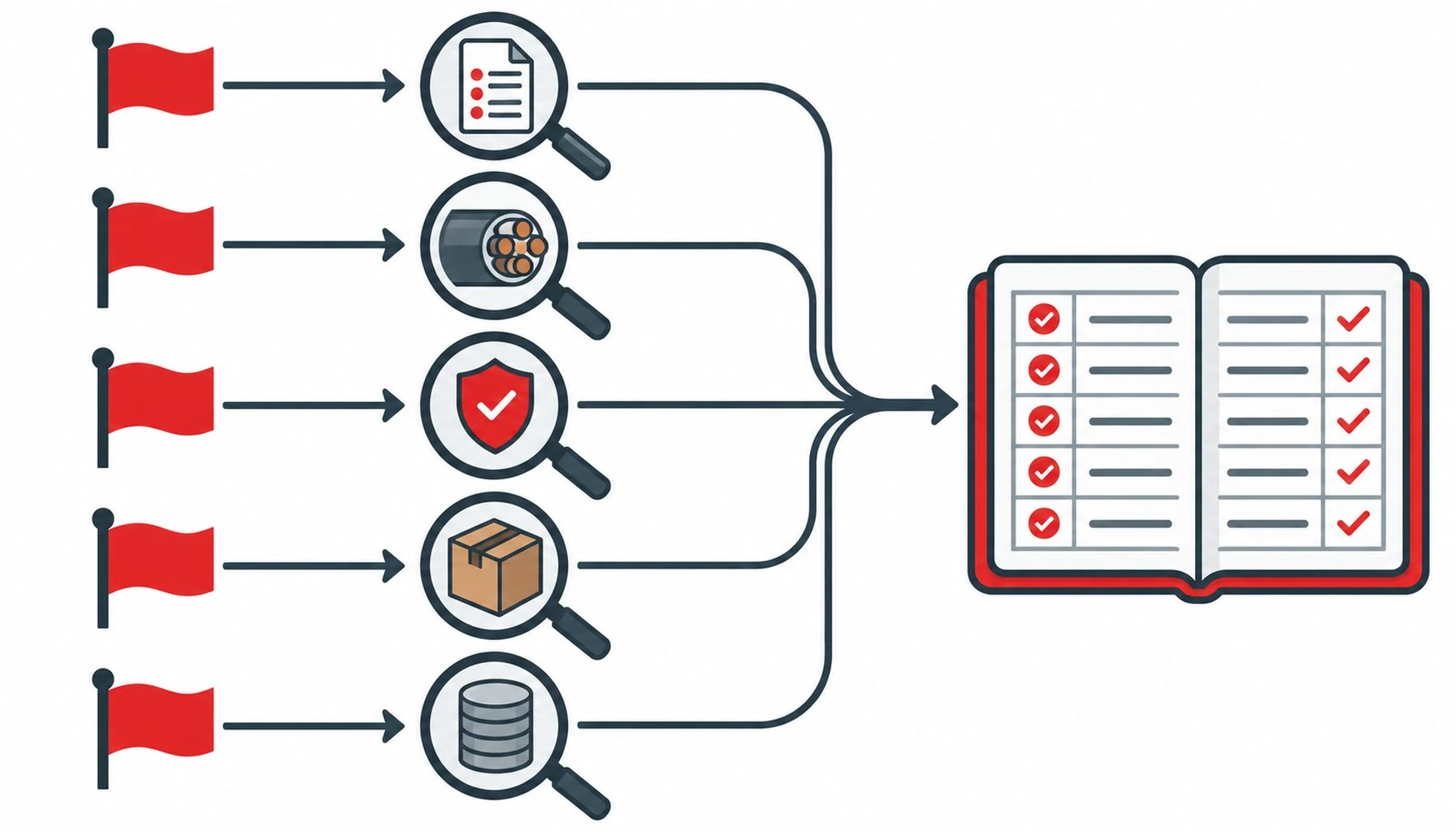
Quick Answer: Most bad cable outcomes announce themselves before the order, in the shape of a discount nobody can explain, a specification restated in vaguer words, evidence that never quite arrives, a factory nobody can visit, a payment demand with no stages, or a packing plan that treats a rail crossing as a short drive. Each flag has a fast verification, and the buyer who runs the checks before award rarely meets the flags again after it.
Introduction
This page collects the warning signs that recur across the whole Central Asia series and turns them into one avoid list. It draws on the country guides, the quotation and comparison pages, the logistics and payment notes and the industry pages, because the same failures surface in every market wearing local clothes. Each flag below comes with its fastest verification, most of which costs a letter or a video call, not a site trip.
A flag is not a verdict. It is a reason to verify before awarding, and the verification steps are the point of the page. Used that way, the list is a filter that serious suppliers pass in a day and problem suppliers fail by going quiet.
Price and Quote Red Flags
The loudest flag in the trade is the quote that sits far below every other offer with no arithmetic behind it. Copper has a market price, freight has a corridor price, and a construction has a real cost floor; a number that ignores all three is not a bargain but a different product, and the difference hides in conductor mass, compound grade or evidence. The comparison discipline in our checklist for comparing supplier quotations in Central Asia is exactly the tool that makes such numbers visible.
Two quieter flags travel with it. One is the quote with no copper basis and no validity window, which is not a price at all but a mood, stale on arrival. The other is the answer that rewrites the specification in vaguer words, “equivalent construction”, “same quality”, “as per standard”, because the requested line item was never in the bidder’s catalogue. Vagueness is rarely carelessness; it is the cheapest way to stay in a comparison one is not technically in.
The verification is written and fast: recompute the offer against the named basis, and require line-by-line written confirmation against the schedule. A supplier with the product confirms in a day. A supplier without it explains, and the explanation is the answer.
Product and Test Red Flags
Product flags concentrate where the copper is. A conductor resistance value suspiciously comfortable for the claimed cross-section, insulation walls at the minimum with no tolerance statement, or a jacket compound unnamed by class all suggest a construction being described rather than measured. The verification lives in metallurgy and paper at once: demand the test report behind the number, and check conductor purity against the grades and verification methods in our note on copper purity in cable conductors.
The sample is another flag carrier. A perfect sample with no link to the batch it represents is theatre; the approval process exists precisely to bind sample to production, and the binding steps are set out in our note on the cable sample approval process. A supplier who resists batch-linked samples, or offers certificates older than the product family it claims to make, has flagged itself.
The response to a product flag is escalation, not intuition: batch-linked samples, named tests, and where the stakes justify it, third-party verification. When a delivered batch does fail inspection anyway, the handling path from hold to claim is its own procedure, described in our note on handling cable non-conformance, and knowing it exists is what lets a buyer refuse a suspicious offer calmly.
Documentation Red Flags
Documentation flags are the ones customs finds first. A type-test report that does not name the issuing laboratory, a licence whose validity window has quietly closed, a cable passport promised but never attached per drum, or certificates bearing a factory name different from the one invoicing the order. Each is small on paper and expensive at the border, because the acceptance regimes in this region run on documents as much as on drums.
The fastest verification is a completeness test against a named list: type test within five years, routine certificate per batch, factory licence, passport per drum, all matched to the same legal entity. The independent layer, where used, closes most of the remaining gap, and the scope and limits of third-party pre-shipment inspection are described in our dedicated note.
Treat every documentation gap as information about the supplier rather than a clerical accident. Factories that produce evidence cleanly tend to produce cable the same way, and the correlation survives contact with reality far better than reassurance does.
Supplier Red Flags
The classic flag of the region, as everywhere, is the paper factory: impressive certificates, no production floor anyone has seen, and answers to technical questions that read like brochure copy. Its cousin is the supplier whose lead time is impossibly short for the quantity quoted, promising campaigns that real lines cannot run. Both flags verify the same way, by looking at the factory.
The audit is the definitive check, and its structure, what to inspect and what to ask, is set out in our guide on auditing a cable factory before you award the order. Where a visit is not yet justified, a live video walk through the extrusion line and the test laboratory settles most questions in half an hour, and the refusal to walk is itself the flag confirmed.
The deeper principle is capability over paperwork, the distinction drawn in our note on auditing an industrial cable supplier: certificates describe intention, capacity and test results describe ability. Award against ability.
Commercial Red Flags
Commercial flags cluster around the money block. A demand for full advance payment on a first order removes every incentive for the supplier to perform and every protection for the buyer when it does not. A quote with no copper basis invites retroactive repricing. A validity measured in hours, or a discount that expires before the comparison can finish, is pressure wearing the costume of generosity.
The verification is structural. Instrument per stage, with the options and their protections compared in our note on payment terms for international cable orders; basis clause in every quote, per the mechanics in our note on copper basis and price locking. A supplier who accepts the structure was never going to be the problem. One who needs the structure dissolved deserves the question the structure was designed to ask.
Commercial flags deserve the coldest reading of all, because they arrive precisely when the deal feels warmest. Pressure and urgency are not terms; they are terms that have not been written down yet.
Logistics Red Flags
Logistics flags are quiet until the border. A quote that leaves packing unspecified, or names thin drums for a long rail crossing, has quietly moved transit risk onto the buyer. An Incoterms line left as “negotiable later” hides the freight difference between two corridors. A delivery promise that ignores the season, with no alternative route named, means the winter will be spent renegotiating from weakness.
The verification is the packing and route sheet: drum type and length per the transit, packing standard named, lifting points stated, and the route table with an alternative. The standard that makes drums survive the corridor is set out in our note on cable drum packaging for export, and a supplier who already works to it will recognise the sheet on sight.
Logistics is also where the cheapest honesty check lives: suppliers who ship into the region regularly talk about gateways and queues fluently, and those who do not, invent them. The fluent answer to “which gateway in winter” is worth an hour of documents.
When a Flag Is Only Yellow
Not every oddity is a warning. A slower answer may be a time zone and a holiday calendar. A higher price may be a better compound, a fuller evidence set or a corridor the buyer had not priced. Country-specific document demands that look like obstacles are, in this region, usually just the paperwork that the market genuinely requires, and the country guides exist to tell requirement from evasion.
The distinction that keeps the list honest is verification. A yellow flag becomes red when it survives a reasonable request for evidence: the vague spec that cannot be confirmed in writing, the factory that will not walk, the payment that must be all-advance. A flag that dissolves under one polite question was a cost of doing business across borders, and the supplier who answered it well has just earned credit.
Log the flags anyway, in the programme ledger or the supplier file, with what verified them. The second order is where the log pays, because patterns form faster than incidents.
The Red Flag Verification Map
Table 1 lines up the five loudest flags against their appearance and their fastest verification, on the principle that every flag earns its place by being checkable before award.
| Red Flag | What It Looks Like | Fastest Verification |
|---|---|---|
| Unexplained price | Offer far below peers, no arithmetic | Recompute against named copper basis |
| Spec restatement | "Equivalent" instead of the named line | Line-by-line written confirmation |
| Evidence silence | Reports, licences or passports never arrive | Named list, dated, entity-matched |
| Paper factory | Certificates fine, floor never seen | Audit or live video walk |
| Unbalanced payment | Full advance on a first order | Instrument per stage, in writing |
The Verification Freeze List
Table 2 is the set of checks to freeze before award, because running them is cheaper than any single failure they prevent.
| Check to Freeze | How to Run It | Evidence to Keep | Cost of Skipping It |
|---|---|---|---|
| Copper check | Recompute price against named basis | Basis clause per quote | The too-good quote wins |
| Spec lock | Line-by-line match to schedule | Written confirmation | An "equivalent" cable arrives |
| Evidence set | Named list, dated, entity-matched | Reports, licence, passports | Acceptance argued at the border |
| Factory proof | Audit before award, or live walk | Audit report, recording | A trading desk with a story |
| Payment shape | Instrument and stages in writing | Term sheet | Cash sent ahead of evidence |
| Packing standard | Drum and packing spec per transit | Packing and route sheet | Transit damage, no recourse |
| Flag log | Flags and outcomes recorded | Ledger or supplier file | The same lesson paid twice |
When "Too Good to Check" Is Not the Answer
When the discount answers a question you did not ask. A price far under the field is information about the product, not about your negotiating skill. Recompute the arithmetic before the offer gets comfortable, because comfort is how the wrong drum ships.
When the certificate is beautiful and the factory is invisible. Paper describes intention. One video walk through the line and the lab separates the mills from the merchants faster than any document review, and the refusal to walk is an answer too.
When the sample is perfect and the batch is the product. An unlinked sample is theatre. Batch-linked approval samples, named tests and, where stakes justify, third-party inspection bind the promise to the drum that actually arrives.
When the advance is the only route offered. Full advance on a first order transfers the entire risk of the trade to the buyer. Staged instruments exist for exactly this moment, and a supplier who rejects all of them has answered the qualification question.
When the flag list becomes an accusation tool. Flags are verification triggers, not verdicts. Run the check, record the outcome, and let the evidence decide; the buyer who verifies politely builds better suppliers than the one who insults them.
RFQ Checklist
- Every quote recomputed against a named copper basis before shortlisting
- Line-by-line written confirmation of the specification schedule
- Evidence list enforced: type test, routine certificate, licence, passport per drum
- Factory verified before award: audit, or a live walk of line and lab
- Payment instrument and stages agreed in writing, no full advance on first orders
- Validity window and basis trigger stated in every offer
- Drum type, length and packing standard fixed per corridor
- Route table with an alternative and a winter note
- Flags logged per supplier with their verification outcome
- Non-conformance path agreed before delivery, not after it
Conclusion
The red flags in Central Asian cable buying are few and repetitive: a price without arithmetic, a spec restated in soft words, evidence that never lands, a factory without a floor, money without stages, drums without a standard. None of them requires an expert to spot, and all of them verify before award with a letter, a calculation or a video call. The buyer who runs the freeze list treats flags as what they are, cheap information delivered early, and the avoid list quietly becomes the reason the deliveries keep being boring.
Kexingyu Cable Group (KXYE) welcomes the checklist: named constructions, dated reports, an open door to the line and the lab, basis-clause pricing and staged terms as standard practice. Send the enquiry and run the verification. A request for quotation is the fastest start.