Airport Cable for Terminals and Airside: What to Specify and How to Phase It
Quick Answer: Airport cable is bought into a building that does not close. Works run in phases behind hoardings, at night and in areas that are only released for a few hours, and much of the route crosses a security boundary or an airside safety zone. That makes the cable package less about the cable and more about phasing, segregation, redundancy and the approvals that have to be in place before anyone can open a trench. Specify for a design life of decades, phase it against the operational calendar, and treat the route approval as part of the product.
Introduction
An airport terminal is a public building with a retail centre and a data centre inside it. The apron and airfield outside are industrial installations with their own safety regime. Cable crosses all of it, usually underground or above a public ceiling, and almost never along a route that can be opened again easily.
That combination drives the procurement approach. The specification has to carry the durability of an infrastructure asset, the fire performance of a building people evacuate from, and the availability of a system that cannot be switched off during a shift change. This guide covers the scopes and the decisions to freeze.
What Makes Airport Cable Procurement Different
The building is never empty. Terminal works are phased so that a proportion of the concourse, the check-in hall or the baggage system keeps working. A cable route that requires a whole zone to be shut is a route that will be delivered in fragments over a year, and the cable package has to be scheduled that way rather than as a single delivery.
Labour and access have their own approvals. Airside work requires security clearance, escorted access and a permit system that is administered by the operator. The practical effect on cable is that a delayed delivery has to be re-booked rather than stored, and a staged drum on the apron is a foreign object debris problem, not a storage decision.
Redundancy is designed, not added. Terminal power is usually configured with dual supplies and automatic transfer for the loads that matter. That means duplicated routes, physically separated so a single incident cannot take both, which roughly doubles the containment and the cable on the critical paths. Our note on redundant power feeds covers how the separation is normally achieved and where the duplication is unnecessary.
Power quality on shared infrastructure. Baggage handling, escalators, lifts and the airfield all share a distribution system with sensitive IT and control loads. Screening, earthing and the segregation of noisy circuits are specified for that reason, not for tidiness.
Terminal and Airside Cable Scopes
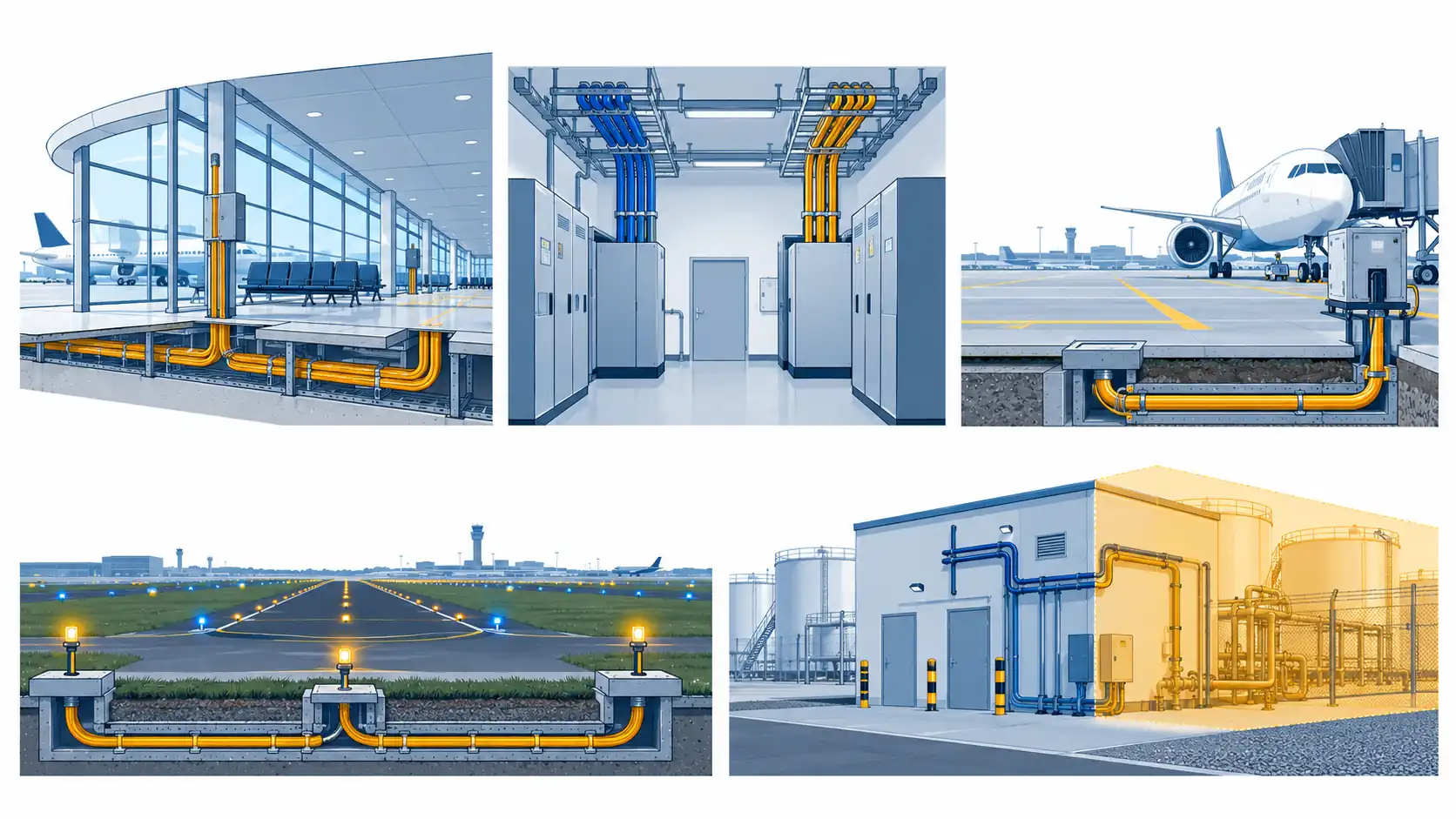
| Scope | Duty | What to Specify | Evidence to Demand | Cost and Lead-Time Driver | How It Fails |
|---|---|---|---|---|---|
| Landside public areas | High occupancy, long evacuation distances, cable above public ceilings and in accessible voids | Reaction-to-fire class for the route, low smoke halogen-free construction, containment approved for the ceiling void | Class declaration for the exact construction, fire test reports, containment approval | The class of the construction, not the copper; retail fit-out rework is the hidden cost | A construction class approved for the shell and altered by a tenant fit-out without review |
| Terminal plant and IT | Dual-fed critical loads, dense data distribution, no acceptable downtime during works | Circuit integrity for life safety and critical systems, screened construction for IT, physical separation of redundant routes | Survival test evidence, screen continuity records, separation drawing approved by the operator | The second route; duplication is what the budget line is really buying | Both feeds in one duct, so a single incident removes the redundancy the design paid for |
| Apron, stands and gates | Outdoor, wet, salt-laden, vehicle and aircraft movement overhead, restricted access | Armoured or ducted construction, ingress protection at boxes, ground-level protection against vehicles | Construction declaration, armour and sheath test data, protection detail on the drawing | Access and out-of-hours working; a small cable package with a large labour bill | A cable route damaged by ground support equipment and repaired in a live apron |
| Airfield lighting and navigation aids | Safety-critical, series-fed in many installations, widely dispersed over long routes | Construction to the airport authority standard, jointing system and enclosure approval, fault location and monitoring provisions | Approval of the complete circuit assembly, joint records, loop test results per circuit | The jointing system and the approval path rather than the conductor | A high impedance joint that passes a continuity check and fails a loop resistance test |
| Fuel farm and utility buildings | Hazardous area classification, outdoor routes, tight inspection regime | Construction suitable for the classified zone, glands and terminations matching the enclosure protection, cable routing away from drainage | Certification for the hazardous area duty, gland and enclosure approvals, route and drainage drawing | Approved accessories and the documented installation, both of which narrow the supplier list | A gland that meets the enclosure rating but not the area classification, found at inspection |
Power Quality, Segregation and Earthing
An airport concentrates load types that interfere with one another. Variable speed drives on baggage and escalator systems, rectifiers in the UPS rooms, and large motors on the apron all sit close to signalling, control and IT cabling.
Segregate by function, not by convenience. Power, control and data routes should be separated by design, with the separation drawn and inspected at the containment stage. Where a route must cross another service, the crossing should be at right angles and documented. Our note on cable derating factors also applies here: a tray shared with other circuits carries less current than an isolated one, and the calculation has to use the real condition.
Screen and earth deliberately. For drive circuits and any analogue signal, the screen has to be terminated in a defined way at defined ends. A screen earthed at both ends on a long run carries circulating current; a screen earthed at neither end is an aerial. Agree the convention on the drawing and check it at each panel. Our notes on shielded connectors and EMC and on grounding and bonding verification cover how that is tested rather than assumed.
Provide uninterruptible supply where transfer is too slow. Baggage sorters, security screening, the airport management system and the airfield control equipment do not tolerate a transfer gap, and are normally fed through an uninterruptible system rather than relying on the generator. Our note on UPS and critical power covers how the cabling around that system is arranged, including the point at which the supply stops being protected. A dual-supply changeover cabinet is the other half of the arrangement; our dual power ATS cabinet page shows the hardware and where the cable interfaces land.
Data, Signage and Systems Cabling
The terminal is also a data building, and its cable requirements change faster than any other part of the package. Security screening equipment, passenger information displays, self-service bag drops and the operator’s own networks all need structured cabling into locations that are decided late and changed often.
Two procurement consequences follow. First, buy categories that suit the environment rather than the cheapest compliant category: a concourse with high ceilings, long channels and a long replacement cycle is not the place to save on a lower grade. Our network data cables range and the note on Cat 6A U/UTP construction set out the trade. Second, leave spare capacity and spare route space, because the systems added after opening are the ones nobody planned for.
What to Freeze Before the Order
| Decision | What to State | Evidence to Attach | Cost of Leaving It Open |
|---|---|---|---|
| Class by route | The reaction-to-fire class for each occupied route, mapped for the shell and for tenant fit-out | A class schedule with the route plan | Tenant fit-out unwinding an approved class, or a premium construction used everywhere |
| Redundancy and separation | Which loads are dual-fed and how far apart the two routes must run | A separation drawing approved by the operator | Duplicated cable that shares one duct and provides no redundancy |
| Critical circuit integrity | Grade and duration for life safety, evacuation and airfield control circuits | Survival test evidence plus the approval covering fixings and terminations | A system that cannot be commissioned in the operational window |
| Airside construction | Armour, ingress protection and vehicle protection level for apron and stand routes | Construction declaration and the protection detail drawing | Repairs in a live apron with ground support equipment working around them |
| Phasing and release windows | Which zones are released in which phase, and the delivery plan built on it | A phasing drawing and a delivery plan matched to the operational calendar | Material waiting for a zone, or a zone released with no material on site |
| Screen and earthing convention | Where screens are earthed and how the convention is marked at each panel | Schematic with the convention stated, plus continuity test records | Noise on control circuits and a commissioning phase spent chasing it |
| Spare capacity and route space | Spare ways, spare pairs and spare containment space in each zone | A schedule with the allowance stated | Every later system opening a new route through a finished ceiling |
Installation Constraints and Delivery
Airside installation is scheduled around aircraft movement, weather and the permit system rather than around the contractor’s programme.
Work windows are short and weather-dependent. Apron lighting and airfield cable work is often done at night, and a wet night can stop a cable pull that has already been released. Where the cable is being installed in an open trench, drainage matters: heavy rain in an open trench is a common cause of damage that is only found later. Our note on flood risk and cable routes covers how the route should be designed against water rather than protected afterwards.
Security of the drum and packaging. Cable delivered airside has to be inspectable and identifiable without opening it, and it has to arrive with the packaging intact because a damaged drum is a foreign object risk. Our note on cable drum packaging for export covers what that documentation and packaging should include.
Delivery phased against zones, not against tonnage. A single large delivery into a restricted zone creates a storage problem rather than efficiency. Split the order into zone-sized lots with agreed dates, and make the supplier responsible for holding stock so a slipped zone does not slip the whole programme.
When an Airport-Grade Specification Is Not the Answer
When the class is being applied to routes nobody evacuates through. The premium belongs on the occupied routes and the critical circuits. Buying it for every plant room and service void spends money the design does not need.
When redundancy is being bought as duplicated cable in one duct. Two feeds in the same trench are one feed with extra copper. Separation is the requirement; duplication without separation is cost without benefit.
When the route approval is left to the installer. Airside routes cross boundaries owned by different parties, and the approval is the long item. Agree it at design stage or plan for the programme to be set by it.
When a single delivery date is assumed for the whole terminal. No airport releases the whole building at once. A cable contract written around one date will be renegotiated repeatedly, and the renegotiation costs more than phasing it properly at the start.
RFQ Checklist
- Route plan with the required class marked on each occupied section
- Dual-fed loads listed, with the separation distance and routing constraint for each pair
- Critical circuits named, with survival grade, duration and the standard behind it
- Construction and protection level for apron, stand and airfield routes
- Screening and earthing convention stated and marked on the schematic
- Containment and penetration approvals, listed by area and by system
- Zone phasing plan with delivery dates and the holding arrangement for slipped zones
- Drum packaging, marking and airside inspection requirements
- Spare ways, spare pairs and spare route space per zone
- Certification and approval documents required before delivery to site
Conclusion
Airport cable is bought against an operational calendar and a set of approvals that a normal building package does not have. Fix the class by route, design the redundancy including the separation, name the circuits that have to survive and the standard behind the requirement, and phase the order against the zones the airport will actually release. Treat the route approval and the airside access as part of the specification and the package stops surprising the programme.
Kexingyu Cable Group (KXYE) has manufactured cable in Quanzhou since 1996, supplying fire-rated, armoured, screened control and data constructions for infrastructure work, with the documentation and drum packaging that restricted-access sites need. Send us the zone plan, the critical circuit list and the delivery windows, and we will come back with the constructions, the evidence for each scope and a phased delivery plan. A request for quotation is the fastest route.