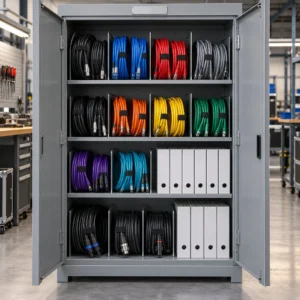
Control Cables for BMS and Monitoring in Data Centers
Quick Answer: A data center's BMS runs on a modest cable scope — KVV for dry contacts, RVVP in noisy areas — specified for signal integrity and separated from power. Power cable gets the attention because its failures are loud. Control cable fails quietly: a shield grounded at both ends turns into an antenna, a 24 V signal sharing a tray with a VFD feeder starts reporting ghosts, and the building management system that is supposed to catch the real problem is busy reporting imaginary ones. Specifying the control layer well is cheap; retrofitting it after commissioning is not.
Introduction
The building management system in a data center watches everything the electrical and mechanical plant does: breaker positions, temperature and humidity in every zone, leak detection under raised floors and around coolant lines, damper and valve positions, generator and UPS status. Almost none of that intelligence travels over the network — it travels over kilometric quantities of small multi-core control cable between field devices, I/O panels and the BMS head end.
This article covers the control scope the way a specifier needs it: which constructions match which signals, how KVV and RVVP differ and where each belongs, the separation and grounding rules that keep signals clean next to heavy power, and the RFQ lines that separate a quotable control schedule from a guess. The distinction between control and instrumentation cable — closely related families that buyers often conflate — is developed further in our control versus instrumentation cable comparison, and the power equipment the BMS watches is covered in our data center power collection.
What the BMS Asks the Cable to Do
Control signals in a data center fall into three families, and each makes a different demand on the cable. Binary status and alarm signals — breaker auxiliary contacts, float switches, door switches — are forgiving: any sound multi-core carries them, and their main enemy is a crossed core, not noise. Analog measurements — temperature, humidity, pressure transducers — need stable low-voltage signals and benefit from individually shielded pairs when the run is long or the environment noisy. Fieldbus and serial links — RS-485, Modbus, BACnet MS/TP — are the most demanding: they need characteristic-impedance twisted pairs, correct shielding and disciplined grounding to run at all.
The construction choice follows the signal. Multi-core unshielded control cable in the KVV family — PVC insulated, 0.75 to 2.5 mm², anything from 7 to 61 cores — covers status and 24 V duties economically. Where analog or bus signals share the building with VFDs, switchgear and busway, the shielded RVVP construction wraps the cores in an overall screen that drains interference to earth instead of into the signal. The physics of why the shield matters, and what happens when it is grounded wrongly, is the heart of the specification. And because control cable terminates in panels and cabinets as often as in trays, the enclosure side of the same scope is covered in our guide to custom control cabinets.
| Signal Family | Typical Duty | Recommended Construction | Critical Spec Point |
|---|---|---|---|
| Binary status and alarms | Breaker aux contacts, floats, door switches | KVV multi-core 0.75-1.5 mm² | Core count with 20% spare pairs |
| 24 V control power | Dampers, valves, relay coils | KVV multi-core 1.5-2.5 mm² | Voltage drop over the run |
| Analog measurements | Temperature, humidity, pressure transducers | RVVP with overall screen, or paired screen | Shield grounding scheme; single point |
| Fieldbus and serial links | RS-485, Modbus, BACnet MS/TP | Twisted pair with shield, characteristic impedance | Pair twisting; termination resistance |
| Leak detection | Under-floor and coolant-line sensing cable | Specialized sense cable per BMS vendor | Vendor compatibility; routing coverage |
| Fire alarm interface | Monitoring and control ties to fire systems | Fire-rated control cable where mandated | Survival rating per jurisdiction |
KVV and RVVP: What Each One Is For
KVV is the workhorse multi-core control cable: copper conductors, PVC insulation and sheath, laid up in compact multi-core configurations. It is inexpensive, easy to terminate, and entirely correct for binary and short analog duties in benign electrical environments. Its weakness is noise: an unscreened cable in a power room is a pickup coil, and a signal that reads fine at the panel can carry enough induced voltage to chatter relays or corrupt readings.
RVVP adds the defense: a helically wound or braided screen over the laid-up cores, under the sheath, drained to earth at one controlled point. The specification details that matter are the screen material (copper braid or tape, with coverage percentage stated), the drain wire, and the grounding convention — the shield is grounded at the panel end only, never both ends, because a shield grounded at both ends carries ground-loop current that injects exactly the noise it exists to block. Facilities that state the grounding convention in the cable schedule avoid the most common commissioning argument in the control scope.
Separation and Routing: Keeping Signals Clean Next to Power
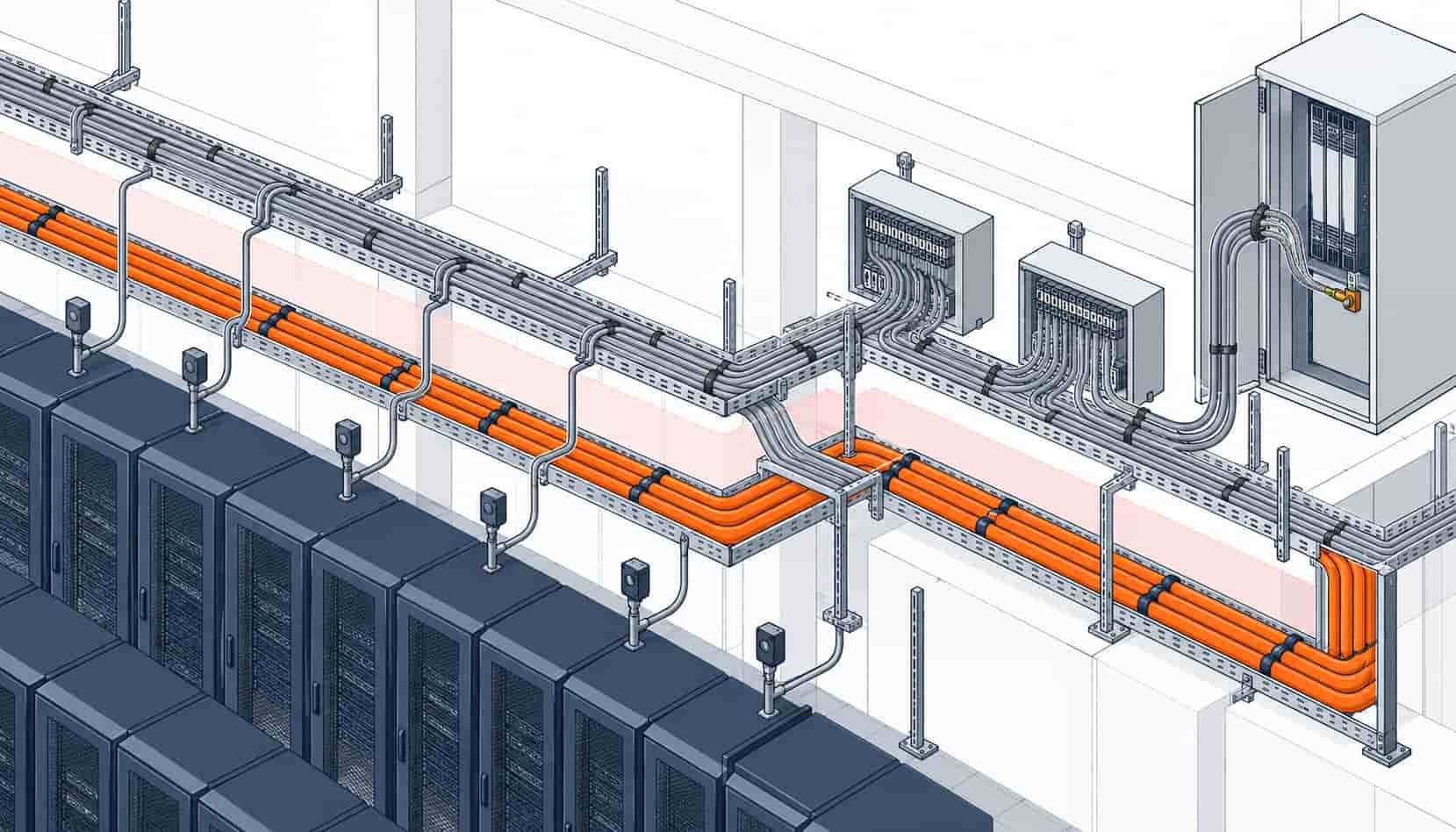
The cheapest noise reduction is physical distance. Control cable belongs on its own trays, separated from power feeders by the distance or barrier the project EMC plan specifies — and where crossings are unavoidable, they should be perpendicular and brief rather than parallel and long. Inside shared corridors, the hierarchy is: separate trays first, barriers second, and shielded constructions third; relying on the shield alone to fix a routing problem pays for the distance you did not take, every year, in commissioning time.
Routing also decides maintainability. Control scope changes constantly — every rack row added, every monitoring point upgraded touches it — so control trays need spare capacity and orderly dressing the same way power trays do, and the core count with 20% spare pairs is the standard hedge against the next monitoring upgrade. Where the control route passes through fire compartments or serves fire alarm interfaces, fire-rated control constructions join the specification, following the same survival logic as the life-safety power circuits — the distinction between the two fire behaviors is laid out in our LSZH versus fire retardant comparison.
| Check Item | Recommendation | Why It Matters |
|---|---|---|
| Construction per signal | KVV for binary, RVVP for analog and bus | Right-sized cost; right-sized noise defense |
| Screen grounding | Single point at panel end, convention stated | Both-end grounding injects ground-loop noise |
| Power separation | Own trays; perpendicular crossings; EMC plan distances | Distance is the cheapest filter |
| Core count | 20% spare pairs per multi-core run | Monitoring scope always grows |
| Pair twisting | Twisted pairs for RS-485 and analog buses | Cancels induced noise differentially |
| Sheath and fire class | LSZH in technical rooms; fire-rated where mandated | Matches the hall's life-safety strategy |
When Shielded Cable Is Not the Answer
RVVP everywhere is not a strategy; it is a budget with a comfort blanket. Where the real problem is a control cable run parallel to a VFD feeder for thirty metres, the fix is rerouting or barriers — the shield will reduce the pickup but not eliminate it, and the signal will still be marginal in the worst corner. Diagnose the noise source first, fix the routing second, and let the shield be the last layer of defense rather than the first excuse.
Vendor cable is the other boundary. Leak detection sense cable, some proprietary bus media and certain fire alarm loops are specified by the system vendor for compatibility and warranty reasons; substituting generic equivalents in those runs trades a small saving for a support conversation at the worst possible time. The control schedule should mark vendor-locked routes explicitly so the factory quotes the generic scope and the vendor supplies the locked one.
RFQ Checklist: Ordering the Control Scope
Control cable RFQs fail on missing signal context, so include:
- I/O schedule or signal list by type: binary, analog, bus, vendor-locked
- Construction assignment per route: KVV, RVVP, vendor cable
- Core counts with 20% spare pairs, and pair twisting where required
- Screen specification: material, coverage, drain wire
- Shield grounding convention stated in the schedule
- Routing plan showing power separation and crossing points
- Sheath class: LSZH in technical rooms; fire-rated where mandated
- Lengths per route with service loops and termination slack
- Marking: both-end labels matching the I/O schedule
- Batch continuity and insulation test reports per delivery
Control cable is small copper and large consequence: a factory that answers the signal-type questions precisely — Kexingyu Cable Group (KXYE) produces both the KVV and RVVP families alongside the power scope — will deliver a control layer that behaves on day one and survives every upgrade after it. The wider supplier vetting discipline that covers the whole electrical order is detailed in our guide to vetting Chinese equipment manufacturers.
Conclusion
The BMS is only as trustworthy as the cable that feeds it. Match the construction to the signal, ground the shield at one point, separate control from power physically, and leave spare pairs for the monitoring scope you know is coming. None of it is expensive; all of it is difficult to retrofit.
Kexingyu Cable Group (KXYE) supplies the complete control scope — multi-core KVV, shielded RVVP, fire-rated control constructions and the power families they live beside — from one factory group, with batch test documentation and copper price linkage across the whole electrical order.