Buying SIP Cable for Central Asian Networks: Self-Supporting Insulated Conductors
Quick Answer: SIP cable is bought by type first, then by section. Decide whether the neutral is bare or insulated, because that choice separates SIP-1 from SIP-2 and it changes the fittings, the earthing practice and the price. Then state the phase section, the messenger section and material, the insulation compound and thickness, and the span the line will use. Add the fittings family, the drum lengths and the tests. A purchase order that names the type and the sections can be built; one that says “SIP 4×25” leaves three of those fields to the factory.
Introduction
Overhead distribution in Central Asia has largely moved from bare wire to bundled insulated conductor, and the Russian-language designation for that product, SIP, is what appears in tenders across the region. It is a compact way to rebuild a low-voltage network: no wide phase spacing, less tree cutting, fewer outages from brush contact. It is also a product family where four letters hide several quite different constructions.
This guide is for distributors, utility buyers and EPC teams buying SIP for 0.4 kV networks in Kazakhstan, Uzbekistan, Kyrgyzstan and Tajikistan. It covers the type decision, the conductor and messenger sections, the insulation limits that matter in a continental climate, the fittings that have to come with the conductor, and the span and drum questions that decide the installation. Overhead conductor for higher voltages is a different purchase, covered in our note on grid interconnection for large loads.
Which SIP Type the Network Actually Needs
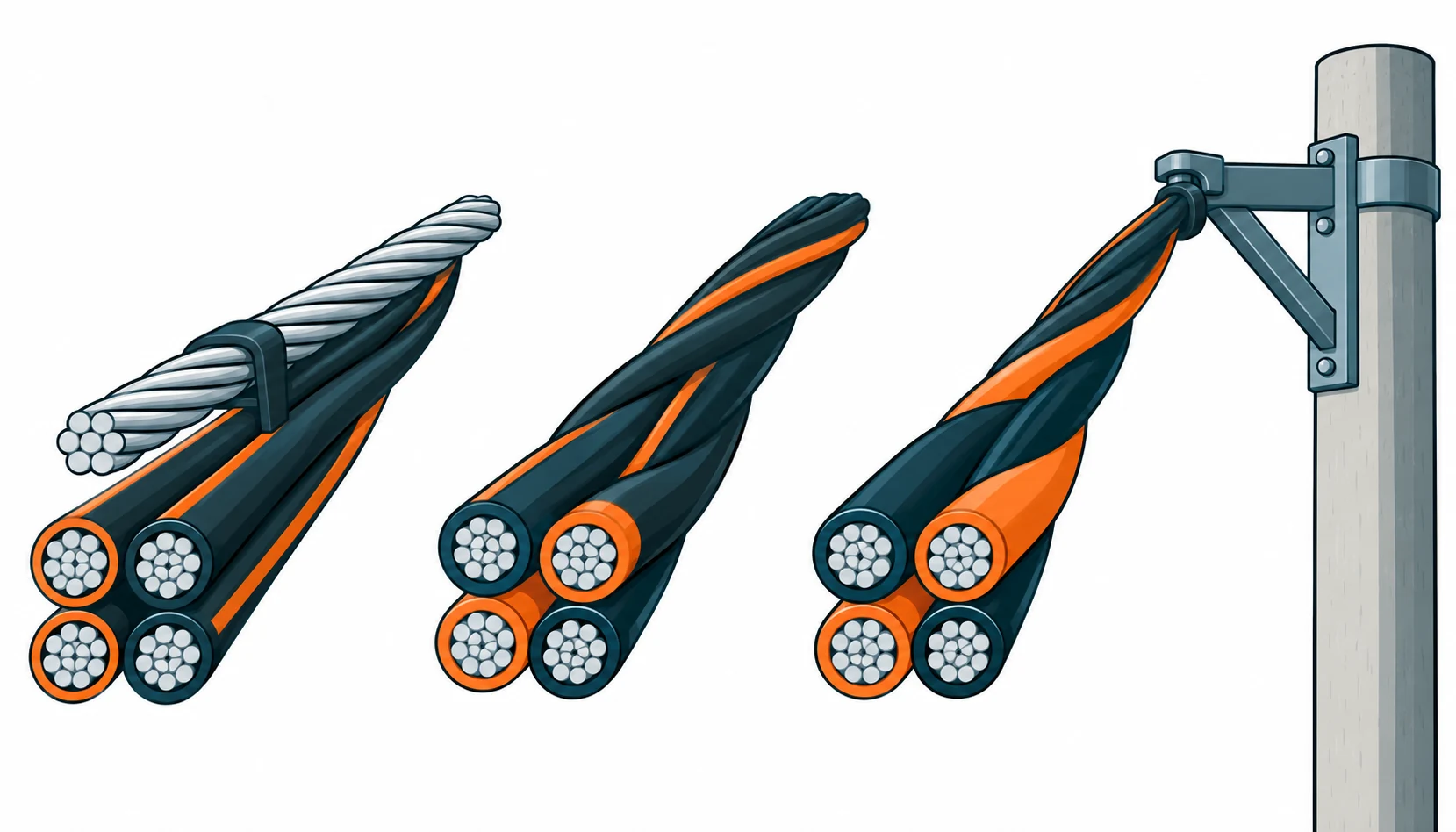
SIP-1 carries a bare neutral messenger. Three insulated phase conductors are twisted around an uninsulated carrier that also serves as the neutral and takes the mechanical load. It is the cheapest arrangement and the one that requires the neutral to be treated as a live part wherever it is accessible.
SIP-2 insulates all four conductors. The messenger is insulated as well, which removes the bare conductor from pole tops and service entries, and costs more per metre. Where the local practice or the utility’s standard requires an insulated neutral, this is the product, and no amount of price negotiation makes SIP-1 acceptable.
SIP-4 has no separate messenger. All four conductors are insulated and twisted together, and one of them carries the mechanical load. It suits short spans and service connections where the pole hardware is designed for it, and it is often confused with SIP-2 in enquiries because both look like a bundle of four insulated cores.
Conductor and Messenger Sections
Phase and messenger sections are stated separately. A bundle described as 3×70+54 has three phase conductors of one section and a carrier of another, and the two numbers serve different purposes. The phase section follows the load and the voltage drop; the messenger section follows the span, the ice load and the tension.
Aluminium is standard, and the temper matters. The conductors are aluminium, usually in a hard or half-hard temper so that they survive stringing without stretching. State the temper where the standard allows a choice, and ask for the conductor class, because the termination and the piercing connector are selected on it. The class system is explained in our note on conductor classes.
Do not shrink the messenger to save metal. Reducing the carrier section is the easiest way to cut cost per metre and the fastest way to a line that sags below clearance after two winters. The span the design assumes and the messenger section have to be confirmed together, in writing, in the offer.
Insulation, UV and Temperature Limits
The insulation is the product’s whole value. SIP is insulated with cross-linked polyethylene or a light-stabilised compound, and the thickness is specified per voltage class and per standard. Ask for the nominal thickness and the minimum at any point, and check both, because an average thickness inside tolerance still allows a thin wall at one spot.
UV stability is a climate requirement, not a marketing line. A conductor strung across open steppe sees full sun and a wide temperature swing, and the compound has to be stabilised for it. Ask which weathering test the compound has passed and how the supplier evidences it; the same family of questions is covered in our note on UV-resistant cable construction.
Temperature limits set the rating and the sag. Continuous conductor temperature, short-circuit temperature and the low-temperature installation limit all appear in the standard, and the line’s rating is calculated from the first of them. In a market where winter installation happens well below freezing, the low-temperature limit decides whether the conductor can be strung at all in January.
SIP Options on a Central Asian Distribution Line
The table compares the constructions that appear in regional tenders, with the commitments each one carries.
| Option | What to Declare | Evidence to Ask For | Cost and Lead Time | Risk If Left Open |
|---|---|---|---|---|
| SIP-1, bare neutral messenger | Phase sections, carrier section and material, insulation thickness | Spark test record and thickness measurements per drum | Lowest cost per metre; widest supply | Bare neutral refused at inspection or at commissioning |
| SIP-2, all conductors insulated | Four sections, messenger section, insulation on the neutral | Thickness and adhesion results; UV test evidence | Higher per metre; standard stock regionally | Fittings for a bare carrier do not fit the insulated one |
| SIP-4, no separate messenger | Which core carries the load; span limit; hardware family | Span and tension confirmation for the section | Cheapest bundle; short spans only | Used on a span it cannot carry, sag below clearance |
| Bundled aerial cable to an IEC-style standard | The standard cited, plus sections and insulation | Type test to the cited standard | Comparable; fewer mills in the region | Dimensions and fittings differ from SIP practice |
| Covered overhead wire for spurs | Cover thickness, conductor section, fitting type | Cover thickness measurements | Low cost; not a load-bearing bundle | Treated as a bundle and tensioned as one |
Pole Hardware and the Fittings Family
SIP is bought with its fittings or not at all. Anchor clamps, suspension clamps, piercing connectors, hooks, brackets and lighting attachments are all sized to the bundle diameter and the conductor section. A conductor delivered without the matching fittings sits in a store while someone sources them locally at twice the price.
Piercing connectors are the weak point in most installations. They are selected on the section range, filled with gel or compound, and torqued to a value. A connector rated for a range that does not include your section, or installed without the specified torque, is where a low-voltage network develops hot spots that nobody finds until the joint fails.
Ask for the fittings list with the quotation. The list is short: anchoring, suspension, connection, protection. Quoting the conductor alone and the fittings later splits responsibility across two suppliers, and the argument at commissioning is about which of them got the diameter wrong.
Spans, Sag and Drum Lengths
The span is a design input that the supplier must confirm. A bundle’s permissible span depends on the messenger or carrier section, the ice and wind loads and the sag limit over the ground. The supplier should confirm the span in the offer rather than leaving the crew to discover it, and the confirmation should name the load case it assumes.
Sag is measured, not estimated on site. Ask for the sag-tension table for the construction at the installation temperature, and compare it with the design. A crew pulling to feel on a cold morning is how a line ends up low over a driveway that gets resurfaced two years later.
Drum length follows the span count, not the kilometre. Bundles are delivered in lengths that have to cover a run between two anchor points, so the drum plan should be built from the pole schedule. Ordering by total metres produces leftover ends that cannot be spliced economically; the tolerance question is covered in our note on ordered length and drum tolerance.
Short spans are not automatically safe spans. A bundle on a 25-metre span between two poles at the bottom of a valley carries less tension but also less clearance, and the ice and wind case for that location, not the average for the region, is what the design has to survive. State the load case per section of route, and ask the supplier to confirm the span against it rather than against a generic table.
MOQ, Mixed Sections and Delivery to Site
Every section and every type is a separate minimum. A bundle in one phase section is one production line, and a route that needs three sections needs three quantities, each with its own minimum. Consolidating sections where the design allows is the cheapest way to clear a minimum, and it is worth asking what the price steps look like before the schedule is fixed. The structure of these terms is set out in our note on cable MOQ and lead time.
Seasonal demand moves the slot, not the price. Overhead work in the region runs with the construction season, and orders placed at the start of it queue behind everyone else’s. Asking for the production time per section at quotation stage is how a route gets built in the month it was planned for, rather than in the month after.
Mountain routes constrain the drum before the factory does. Shorter drums and lighter packages are often the only ones a site access track will take, and a bundle delivered on a drum that no truck can reach is a delivery that has to be rewound at the bottom of the valley. Give the supplier the real access conditions, including the last few kilometres, and set the drum plan from them. The regional sourcing picture is in our Kyrgyzstan supplier checklist, and the drum and jointing trade-offs in drum length and jointing strategy.
SIP Order Freeze List
These are the fields to settle before the purchase order is placed.
| Item to Freeze | How to Write It Into the Order | Evidence to Attach | Cost of Leaving It Blank |
|---|---|---|---|
| Type and neutral arrangement | SIP-1, SIP-2 or SIP-4 named, neutral stated as bare or insulated | Construction sheet for the offered bundle | Bundle rejected at inspection, or accepted and non-compliant |
| Phase and messenger sections | Both sections written separately, per line | Section and resistance test values | Carrier undersized, sag out of limit after a winter |
| Insulation compound and thickness | Compound type, nominal and minimum thickness | Thickness measurements and UV test evidence | Cracking on exposed spans within a few seasons |
| Temperature limits | Continuous, short-circuit and installation limits quoted | Standard clause reference | Stringing in winter damages insulation |
| Permissible span | Span confirmed in the offer with the load case | Sag-tension table at installation temperature | Clearance breaches that need re-stringing |
| Fittings family | Anchoring, suspension, piercing connectors, brackets listed | Connector section range and torque value | Hot spots at connectors, sourcing delays on site |
| Drum lengths and marking | Lengths built from the pole schedule; marking standard | Drum schedule per run | Waste at every anchor point, unmarked drums |
When SIP Is Not the Answer
When the run is short and the load is small. A single service drop is often cheaper as a conventional insulated cable in a duct. Bundling needs poles, anchors and tension, and a fifty-metre spur rarely earns that.
When the corridor is underground anyway. New build in a town with ducting already in place does not need an overhead bundle, and switching to one late in design adds poles to a project that had none.
When the utility’s standard names a different product. Where the network operator specifies an IEC-style bundled cable or a covered wire system, offering SIP because it is cheaper is not a commercial argument, it is a rejection waiting to happen at technical evaluation.
When the price is per metre and nothing else. Two bundles at the same phase section can differ in messenger section, insulation thickness and UV performance. Comparing them on metres alone is comparing the label, not the product.
RFQ Checklist
- Type named: SIP-1, SIP-2 or SIP-4, with the neutral arrangement stated
- Phase sections and messenger section written separately per line
- Messenger material and conductor temper confirmed
- Insulation compound, nominal thickness and minimum thickness required
- UV and weathering test evidence requested with the offer
- Continuous, short-circuit and low-temperature limits quoted
- Permissible span confirmed against the design load case
- Full fittings list quoted: anchors, suspensions, piercing connectors, brackets
- Piercing connector section range and torque value stated
- Drum lengths built from the pole schedule, with marking standard
- Routine test values per drum, including spark test and thickness
Conclusion
SIP buying goes wrong at the type letter, not at the price. Whether the neutral is bare or insulated decides the fittings, the earthing practice and whether the bundle is acceptable at all; the messenger section decides whether the line still has clearance after five winters. Both are single lines in an enquiry and both are expensive to revisit once the drums are on site.
Kexingyu Cable Group (KXYE) supplies self-supporting insulated conductor bundles and their fittings from Quanzhou, quotes Central Asian enquiries against type, sections and span as written, and packs to a drum schedule built from the pole plan. Send your route schedule, the span and load case, and the destination. A request for quotation is the fastest route to start, and the enquiry format for the region is set out in our Uzbekistan supplier checklist.