Procuring Grid Connection for Large Data Center Loads: Approvals, Sequence and What It Changes
Quick Answer: A large data center load is not connected, it is approved. The sequence runs from an application through studies to an agreement, and every stage produces conditions that land on the equipment order: protection settings, reactive power capability, telemetry, metering and sometimes a contribution to network upgrades. Buying the electrical scope before those conditions are known is the most reliable way to buy it twice.
Introduction
This is the last of a group of notes on how power reaches a data hall, and it is deliberately the one that sits furthest from the cable. The preceding notes cover the architecture inside the fence, the way it is built and tested, the way it is operated and expanded, the incoming supply that feeds it and the code and environmental constraints around it. All of those are decisions the project controls.
Interconnection is the part it does not control. A network operator has its own process, its own queue and its own view of what a large load costs the system, and the outcome changes the equipment that has to be bought. This note makes that dependency explicit and closes the group by showing where the earlier decisions connect to it. Our notes on utility grid expansion and on data center power demand growth cover the network side and the demand side of the same conversation.
What a Large Load Looks Like to a Network Operator
A data center is an unusual customer, and the four characteristics below are what make the process long.
Size relative to the network. A campus load can be a significant fraction of what a local network supplies. That changes the analysis from a connection study into a system study, and it is the reason upgrades elsewhere on the network can be attributed to a single project.
Load profile. Demand is high, flat and persistent, with a step change at commissioning and further steps as halls fill. The operator plans for peaks, so a flat load at the top of the range is a different proposition from an industrial load with the same maximum and a much lower average.
Power quality behaviour. A modern hall presents a power factor that depends on the conversion technology in use, and at high penetration of electronically coupled load the operator takes an interest in reactive capability, harmonics and the response to voltage disturbances. That interest turns into equipment requirements at the connection point.
Sensitivity and expectations. The customer expects continuity, frequently with redundancy on its own side that the operator does not replicate, which is part of why the connection discussions are detailed.
The Interconnection Sequence, Stage by Stage
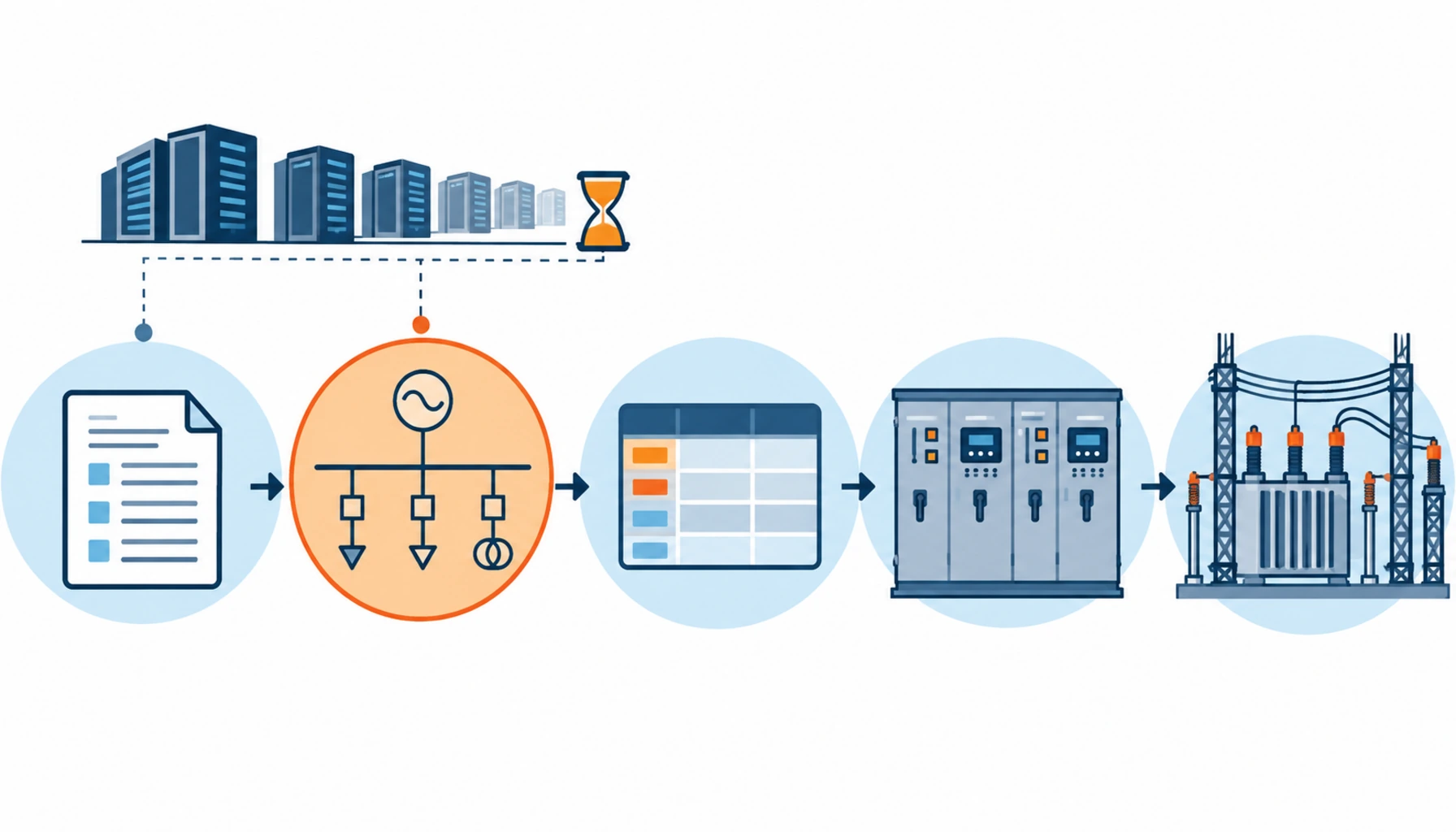
The stages differ between markets, but the shape is consistent and each one produces an output the buyer needs.
Application and queue position. The application defines the capacity requested and the point of connection. Where the capacity is amended later, the project may lose its position or be studied again, which is why a defensible capacity figure matters more than a generous one.
Feasibility and system impact study. The operator examines what the connection does to the network: thermal limits, fault levels, voltage behaviour and the upgrades needed. The output is a list of impacts, and the impacts carry cost.
Cost allocation and agreement. The study results become a set of works, some on the network and some at the connection point, with an allocation of who pays. This is where the commercial case can change materially, and where alternative configurations are worth testing.
Technical requirements and settings. The operator specifies protection, control, metering, telemetry and power quality requirements, and these translate most directly into the equipment order.
Design review, construction and witness testing. The connection design is reviewed, the works are built, and the tests are witnessed against the agreement. Witness scheduling is an administrative dependency with a date attached.
Energisation and commercial operation. Energisation is followed by a demonstration period, and the conditions of the agreement then remain in force for the life of the connection.
The Decision Table: Four Connection Routes and What Each One Demands
The routes below are the strategic choices. Most projects start with the first and reconsider it when the study returns.
| Route | What You Are Buying | What to Specify | Evidence You Should Receive | Cost and Schedule Shape |
|---|---|---|---|---|
| Conventional firm connection | Full requested capacity, with the network works and connection assets that support it | Capacity, connection point, protection and telemetry requirements, and the upgrade allocation | Study results, executed agreement, approved settings and witness records | Longest queue and the largest share of network upgrade cost; the clearest long term position |
| Flexible or non firm connection | Capacity with agreed curtailment or import limits under defined network conditions | The curtailment scheme, the conditions that trigger it, and the control and telemetry that implement it | Control scheme drawings, telemetry test records and the operating procedure | Faster and cheaper to obtain; requires the site to tolerate a defined reduction in import |
| Partial connection with on site generation | Grid capacity sized to the site minimum, with generation covering the remainder | The split between import and self generation, and the export position in writing | Agreement conditions, generation approvals, protection coordination study | Reduces the network works attributable to the project; adds a generation programme to the critical path |
| Island capable campus | Connection sized for normal operation with a full island capability behind it | Islanding scheme, transfer sequence, load management and the synchronising arrangement | Islanding and transfer test records, black start procedure where claimed | Highest internal cost and the lowest dependence on the operator; suits sites where continuity dominates |
What Each Stage Imposes on the Equipment Order
The value of understanding the sequence is that its outputs convert into purchase order clauses with dates attached.
Protection requirements into switchgear design. Operators specify relays, settings, trip logic and sometimes duplication at the connection point. Those requirements change the bay arrangement, the control scheme and the test regime, and they must be known before that package is ordered. Our notes on incoming supply at 33kV and 110kV and on dual source incoming supplies cover the equipment side.
Fault level and coordination into every downstream rating. A new large load changes the fault current the campus switchgear sees, and the change propagates inward. A coordination study including the new contribution belongs at design stage, and it connects this note to the architecture decisions described in our note on the 800VDC roadmap.
Reactive power and power quality into compensation equipment. Requirements for power factor, harmonic limits and voltage disturbance response turn into equipment: compensation, filtering and the control that operates them. Where those requirements arrive after the main switchgear is ordered, the compensation package becomes a separate procurement with its own lead time, and the connection date can depend on it. Our note on inverter grid code compliance covers the equivalent position for electronically coupled generation.
Telemetry and metering into the control and communications scope. The operator will require measurement at the connection point, remote indication and often remote control of the connection breaker. This scope has its own testing and witnesses, and it is frequently under-estimated because it is neither power equipment nor building services.
Conditions on operation into the operating procedures. Import limits, curtailment conditions, islanding rules and notification requirements survive the project and belong in the operating procedure and the training that goes with it. Our note on islanding and grid transfer covers the internal arrangements these conditions interact with, and the generation side is covered in our note on behind the meter generation.
Lead times on the internal scope continue regardless. Switchgear, transformers and cable have lead times that do not shorten because the queue is long. The internal order still has to be placed against its own schedule, and the judgement is which items can be ordered against a provisional design and which cannot. Our note on the switchgear and transformer supply position covers how those lead times have behaved.
What to Freeze Before the Application
| Item | What to State | Evidence to Attach | Cost of Leaving It Open |
|---|---|---|---|
| Capacity requested | The firm capacity required, by phase, with the load model behind it | A load schedule showing the build out over time | A queue position studied for a figure that changes, and a study that has to be repeated |
| Connection point | The voltage level and point of connection proposed, with alternatives | Single line diagram of the intended connection | Studies run against a configuration the project later abandons |
| Route preference | Firm, flexible or generation supported, with the reason stated | A comparison of the routes with their constraints | A firm connection pursued on principle, at a cost the site did not need to carry |
| Reactive power capability | The range required, and whether the site will provide compensation or rely on the plant | Power factor and harmonic study for the intended load | Compensation bought as an afterthought, on the critical path to energisation |
| Protection and control scope | Relays, settings, duplication, trip logic and remote facilities at the connection point | The operator's technical requirements, referenced in the equipment order | Switchgear modified or re-tested after the agreement is issued |
| Telemetry and metering | Measured quantities, remote indication and remote control, with the protocol required | A metering and telemetry schedule agreed with the operator | A communication package discovered late, with its own testing and witnesses |
| Upgrade allocation | Which network works are attributed to the project, and who pays for which | The study output with the allocation stated | A cost that arrives after the investment case is approved |
| Programme assumptions | Queue position, study iterations, witness booking times and the energisation date assumed | A programme showing each administrative step as a dated activity | An energisation date lost to a process nobody had in the programme |
Where Interconnection Programmes Fail
Capacity requested without a defensible model. A number chosen to leave room for growth will be studied, priced and charged for. Reviewing it against the load schedule before the application is cheaper than amending it afterwards, and in some markets amending it costs the queue position.
The commercial case tested before the study returns. Approval is often granted against an assumed connection cost. Where the study produces a larger upgrade allocation, the project has an approved case and a different set of numbers.
Equipment ordered before the technical requirements arrive. The internal scope has its own lead time and pressure to be ordered. The items that depend on operator requirements are the switchgear control scheme, the protection package and the telemetry, and separating them from the parts that do not change is the practical mitigation.
Witness testing treated as a formality. Witnesses are booked and settings are approved rather than agreed. A programme that does not show these as dated activities will discover them at the worst moment.
The operating conditions dropped at handover. Import limits, curtailment triggers and notification duties are part of what was bought, and where they are not carried into the operating documents the site can breach its agreement during an unremarkable week. Our note on when 800V DC is not the answer sets out the equivalent long lived consequences on the architecture side.
When Grid Connection Is Not the Answer
Where the queue is longer than the business case. In some markets the wait for a firm connection exceeds the time in which the capacity is needed. The options are a flexible connection, generation on site, or a different site, and all three are cheaper chosen early than late.
Where the site needs continuity the network cannot offer. Redundancy on the customer side does not protect against an event upstream, and where continuity is the dominant requirement the grid connection becomes one of two sources rather than the only one.
Where the capex for network upgrades exceeds the value of the connection. A large upgrade allocation can make a self supplied configuration rational even at a higher internal cost, and that comparison is worth making explicitly because the two options are usually evaluated separately.
Where the project has bought the connection and not the integration. The agreement defines the boundary, and everything inside it still has to be designed, ordered, installed and tested. Treating approval as the end of the power programme leaves the internal scope on the same critical path with less time. The order to review that scope in is the order the power travels: architecture first, then the incoming supply and generation, then construction and verification, then operation and expansion, then the code and environmental constraints that bound all of it.
RFQ Checklist
- Firm capacity stated by phase, with the load model that produced it
- Connection point and voltage level defined, with alternatives recorded
- Connection route chosen with the reason documented, including the flexible and generation options
- Reactive power and harmonic requirements stated, with the compensation scope identified
- Operator protection and control requirements listed and referenced in the switchgear order
- Telemetry and metering schedule agreed, with the protocol and the testing required
- Upgrade allocation stated in writing, with the paying party named
- Fault level study updated for the new contribution and applied to downstream ratings
- Commissioning and witness tests requested when the equipment is ordered, not when it is installed
- Internal equipment lead times planned against their own schedule, independent of the queue
- Operating conditions carried into the operating procedures and the training
- Programme shows every administrative step as a dated activity with an owner
Conclusion
A grid connection is the one part of a data center power programme that is bought on someone else’s terms. The capacity is studied rather than chosen, the cost is allocated rather than quoted, and the date depends on a queue. What the buyer controls is how prepared the application is and how much of the internal scope is insulated from requirements that have not yet been issued.
Seen from the end of this group, the sequence is consistent. The architecture decides what has to be built, the incoming supply and generation decide what feeds it, construction and verification decide whether it works, operation and expansion decide how long it lasts, and codes and environment decide the constraints it must satisfy. The connection is where all of that meets an external process.
Kexingyu Cable Group (KXYE) supplies cable and distribution equipment across that whole sequence, including the WDZ-YJY, WDZN-YJY, BTTZ, NG-A (BTLY), KVV and YJV ranges, the data center cable range used on incoming and distribution routes, the medium voltage switchgear and GGD power distribution cabinet used on the connection and distribution bays, and the protection and metering devices used at the connection point, all from one factory group with copper price linkage available on project-scale orders. Send the connection conditions, the voltage levels and the equipment schedule you are working to, and we will return the ratings, the constructions and the records that support them; the fastest route is a request for quotation.