Procuring Behind-the-Meter Generation: Permits, Fuel and Interconnection Before You Order
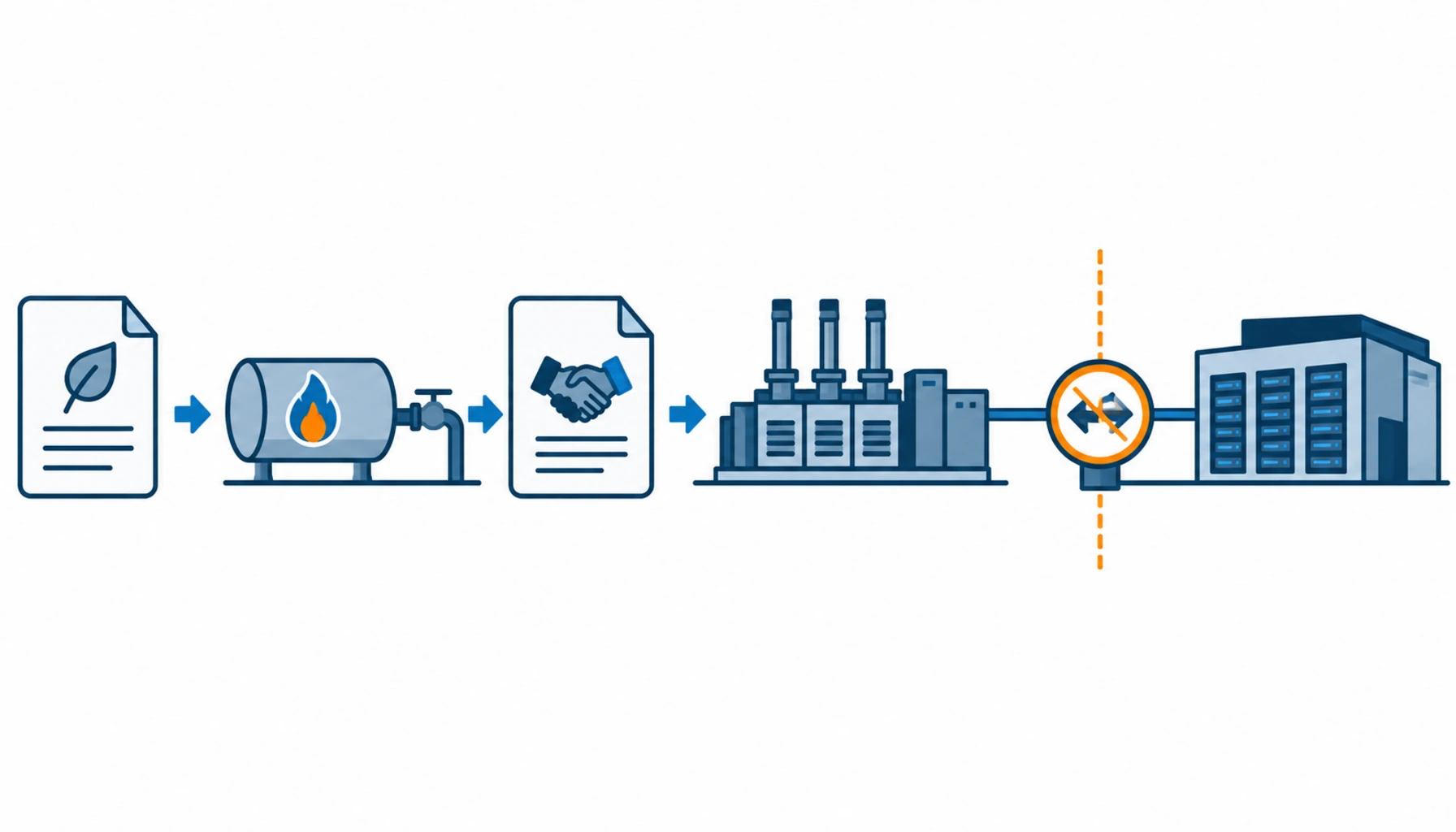
Quick Answer: Behind-the-meter generation is approved before it is bought. The air permit, the interconnection agreement and the fuel arrangement each impose conditions that become equipment requirements, including whether the plant may export, how many hours it may run and what protection must be fitted. Ordering generation before those conditions are known is the most expensive way to discover them, because the changes land on equipment already in manufacture.
Introduction
On-site generation at a campus is usually discussed as an equipment purchase, then discovered to be a permitting exercise. The permitting exercise is longer, it runs in parallel with nothing, and its output is a set of constraints that the equipment has to satisfy.
The technologies involved are covered elsewhere in this group, in our notes on on-site gas turbines and on islanding and grid transfer. This note deals with the sequence that comes first: what has to be approved, what each approval imposes on the specification, and why the grid queue is often the item that decides the programme. Our note on utility grid expansion covers the same constraint from the network side.
The Approvals That Shape the Purchase
Four approvals sit between the decision to generate on site and the ability to run. Each one changes what is bought.
The air permit. Emission limits, and often an annual run hour ceiling. A ceiling written into a permit turns a generation asset into a restricted one, and the restriction has to be reflected in the capacity case rather than discovered when the hours are exhausted in September.
The interconnection agreement. Whether the plant may export, the protection and control the network operator requires, the settings that must be applied and the tests that must be witnessed. Export permission is the item most often assumed and least often granted.
Land, zoning and noise. Setbacks, noise limits at the nearest sensitive receptor, fuel storage arrangements and access. These are local approvals with local timelines, and they can be the longest item on a site that is near anything occupied.
Fuel. A pipeline connection with a contracted capacity, or a delivered fuel arrangement with storage, delivery access and the inventory policy. Fuel approval and fuel contracting are separate from the generation permit and frequently slower.
The Decision Table: Behind-the-Meter Configurations Compared
The four configurations below differ mainly in what the network operator has to approve.
| Configuration | What You Are Buying | What to Specify | Evidence You Should Receive | Approval Load and Risk |
|---|---|---|---|---|
| Self-consumption, no export | Generation sized to the site load, with a hard export block rather than a control setting | Reverse power protection, export blocking scheme, maximum import and export limits, run hour ceiling | Interconnection agreement with no export condition, protection test records, single line diagram as approved | Simplest interconnection case; the plant cannot be used to sell power and the block must be proven |
| Self-consumption with conditional export | Generation plus the protection, control and communication that allows a defined export under stated conditions | Export limit, curtailment method, communication channel, remote trip facility and the settings for each mode | Approved protection settings, communication test records, curtailment demonstration | Longer approval and more equipment; the export limit is a hard figure, not a target to be managed |
| Parallel operation with the grid | Generation running continuously in parallel with the utility supply, sharing the load | Synchronising, protection coordination, anti islanding, and the fault contribution added by the plant | Coordination study, protection settings, anti islanding test, updated fault level study for the site | Highest approval burden; the plant changes the fault level the campus switchgear sees |
| Fully off-grid | Generation and storage sized for the whole load with no utility connection at all | Redundancy step, storage duration, fuel endurance, load management and the black start sequence | Capacity and endurance calculations, black start test, documented load management scheme | No interconnection approval at all, replaced by a fuel and endurance obligation that never relaxes |
What Each Approval Imposes on the Equipment
The value of doing the approvals first is that their conditions convert directly into purchase order clauses.
Run hour ceiling to operating strategy. Where the permit limits annual hours, the plant cannot be the base load source. The hours have to be allocated between standby duty, peak shaving and test running, and the allocation decides the fuel contract size and the maintenance interval.
No export to hardware. A no-export condition is implemented by protection that detects reverse power and trips, not by a setting that someone is expected to respect. The device, its setting and its test record are all part of the interconnection agreement, and the campus should own that it works rather than assume it.
Export limit to curtailment control. An export limit requires measurement at the point of connection, a control loop fast enough to respect it, and often a communication channel to the operator. These are equipment items with their own specification and their own testing, and they sit inside the campus scope.
Protection requirements to switchgear design. Network operators specify relays, settings, trip logic and sometimes duplicate equipment at the point of connection. Those requirements land on the switchgear and control package and change the bay arrangement, so they should be known before that package is ordered. Our note on inverter grid code compliance covers the equivalent position for inverter based generation.
Noise and setback to layout. The noise limit determines enclosure selection, acoustic treatment and where the plant can sit. Moving a generator after the layout is fixed is a civil and permitting cost, and it is cheaper to design the plant to the limit than to argue the limit afterwards.
The Sequence, and Where Programmes Fail
Approvals before equipment. The interconnection application and the environmental permit take longer than the equipment in most jurisdictions. Where equipment is ordered first, the deposit is exposed to conditions that may change the specification.
Fuel before generation. A plant without a firm fuel arrangement cannot run at the capacity it is credited with. Fuel contracting runs on its own timeline and involves a different counterparty from the equipment supplier.
Settings before commissioning. Protection settings are approved by the network operator, and the approval takes time. Where settings are requested at commissioning, the energisation date depends on an administrative process that was not in the programme.
Tests before energisation. The witness tests required by the agreement should be planned with the utility at the same time as the equipment order, because the witnesses are booked rather than requested. Our note on energy storage backup covers where storage changes this sequence by reducing the generation capacity that has to be approved.
What to Freeze Before the Order
| Item | What to State | Evidence to Attach | Cost of Leaving It Open |
|---|---|---|---|
| Operating role and hours | Whether the plant is standby, base load or peaking, and the annual hours assumed | A run hour model against the permit ceiling | A plant that exhausts its permitted hours before the year does, or a permit that has to be amended |
| Export position | Whether any export is permitted, and the limit if it is | The draft or agreed interconnection conditions in writing | Protection and control bought for a mode the network operator will not allow |
| Protection requirements | Relays, settings, trip logic and any remote facilities required at the connection point | The network operator's technical requirements, referenced in the switchgear order | Switchgear that has to be modified or re-tested after the agreement is issued |
| Fault contribution | The fault current the plant adds at each busbar, and the equipment affected | An updated fault level study including the generation | Existing switchgear operating beyond its rating during a fault, discovered in a study or in an event |
| Fuel arrangement | Firm capacity, delivery point, storage and the interruption terms | A fuel contract or a letter of intent with capacity and pressure stated | A plant unable to run at its credited capacity, and a capacity case built on nothing |
| Emission and noise limits | The limits, the measurement method and the load range they apply over | The permit application and the expected conditions | Acoustic treatment or abatement retrofitted after the plant is built |
| Curtailment and control | How an export limit is enforced, and what the control loop depends on | A control scheme drawing with the measurement point marked | Agreement breaches during operation, with penalties and possible disconnection |
| Witness tests and settings | The tests required, who witnesses them and when settings are submitted | The agreement's test schedule, with dates requested from the operator | An energisation date lost to a witness booking or a settings approval |
When Behind-the-Meter Generation Is Not the Answer
Where the permit will not allow the run hours. A plant restricted to a few hundred hours a year is a reliability asset, not a capacity one. Where the campus needs capacity, the permit position has to be established before the business case is written.
Where the export assumption is doing the work. Some projects are justified by power sales that the agreement later refuses. Where the case depends on export, the interconnection position should be confirmed before the generation is ordered, not after the equipment is on site.
Where fuel cannot be firmed up. A plant with an interruptible fuel supply has an availability figure that depends on someone else. Where firm fuel is not achievable, storage, dual fuel or a smaller plant with a realistic capacity credit is the honest answer.
Where the campus has not considered the distribution inside its own fence. Approvals cover generation, but the power still has to reach the halls through switchgear, transformers and cable with their own lead times. Treating the generation approval as the whole power programme leaves the same gap. Our note on on-grid and off-grid arrangements sets out where each connection mode belongs.
RFQ Checklist
- Operating role and annual run hours stated, checked against the permit ceiling
- Export position confirmed in writing, with any limit expressed as a number
- Network operator protection requirements listed and referenced in the equipment order
- Fault level study updated to include the generation contribution at every busbar
- Anti islanding protection method and detection time agreed with the operator
- Firm fuel capacity contracted, with delivery point, pressure and interruption terms
- Emission, noise and water limits stated as specification values with measurement methods
- Curtailment control scheme defined, including the measurement point and the communication path
- Reverse power or export blocking device specified and its test required
- Settings submission and approval dates written into the project programme
- Witness tests requested from the operator at the same time as the equipment order
- In-fence distribution equipment ordered against its own lead time, not after generation arrives
Conclusion
Behind-the-meter generation is one of the few purchases where the sequence matters more than the price. The approvals come first because they write the specification, and the specification is what the equipment is built to. A buyer who runs the approvals and the equipment order in parallel is not saving time, they are buying the right to pay for modifications later.
Kexingyu Cable Group (KXYE) supplies the equipment inside the fence that the approvals assume, including the medium voltage and low voltage switchgear, the transformers and substation equipment, the protection and metering devices used at the connection point, and the cable and terminations for the generation and distribution routes, from one factory group with copper price linkage on project-scale orders. Send the interconnection conditions you have been given and the run hour position you expect, and we will return the ratings, the protection arrangement and the records that let the scheme be tested against the agreement; the fastest route is a request for quotation.