BV and BVR Building Wire: What International Buyers Should Know
Quick Answer: BV and BVR are China's standard single-core building wires — BV solid conductor for fixed conduit runs, BVR stranded where bends and vibration demand it. Bulkier cables get the attention, but buildings are actually wired in single cores: kilometers of insulated copper pulled through conduit and trunking, one color-coded core at a time. In Chinese procurement that copper is specified as BV or BVR — two letters and one letter of difference, carrying a solid-versus-stranded decision that touches cost, installation speed and long-term reliability. This guide decodes both, and places them inside the wider letter system covered in the designation decoders of this series.
Introduction
International buyers meet BV and BVR in three places: Chinese-built project material lists, panel-shop quotations, and comparison shopping against THHN, 6491X or H07V-U equivalents from home catalogs. The wires are simple — copper, PVC, one core — but the simplicity hides the decisions that matter: conductor class, insulation temperature class, the color code, and the sizing arithmetic that keeps circuits safe inside conduit. Getting those four points into the specification turns a commodity purchase into an inspectable one.
The Letters, Decoded
B is bu — fixed wiring, the building-wire family. V is PVC, the single insulation layer, with no sheath: these are wires, not cables. So BV is “fixed wiring, PVC insulated” over a solid conductor, and BVR inserts R — ruan, flexible — for the same insulation over a stranded conductor. The voltage class is 450/750 V, comfortable for the 230/400 V circuits the wires serve, and the insulation temperature class is 70°C in standard PVC, with a BV-90 variant available where the extra 15°C headroom is worth specifying. Cross-sections run from 0.5 mm² control sizes to 400 mm² riser sizes, with 1.5, 2.5, 4 and 6 mm² the volume heart of the market.
| Aspect | BV (solid) | BVR (stranded) |
|---|---|---|
| Conductor class | Class 1 solid rod | Class 2 (or 5) stranded copper |
| Insulation | PVC, 70°C standard; 90°C variant available | PVC, 70°C standard; 90°C variant available |
| Voltage class | 450/750 V | 450/750 V |
| Cost per meter | Lower â simplest construction | Higher â stranding labor and copper packing |
| Pulling through conduit | Stiff; fights long runs and tight bends | Flows around bends; faster pulls, less damage |
| Terminal behavior | Holds shape, stable under screws | Needs ferrules below 10 mm² in fine-strand terminations |
| Vibration tolerance | Poor â work-hardens at terminations | Good â stranding absorbs movement |
| Typical habitat | Fixed conduit runs, buried conduit, risers | Panel interiors, vibrating equipment, tight geometry |
Solid Versus Stranded: The Real Decision
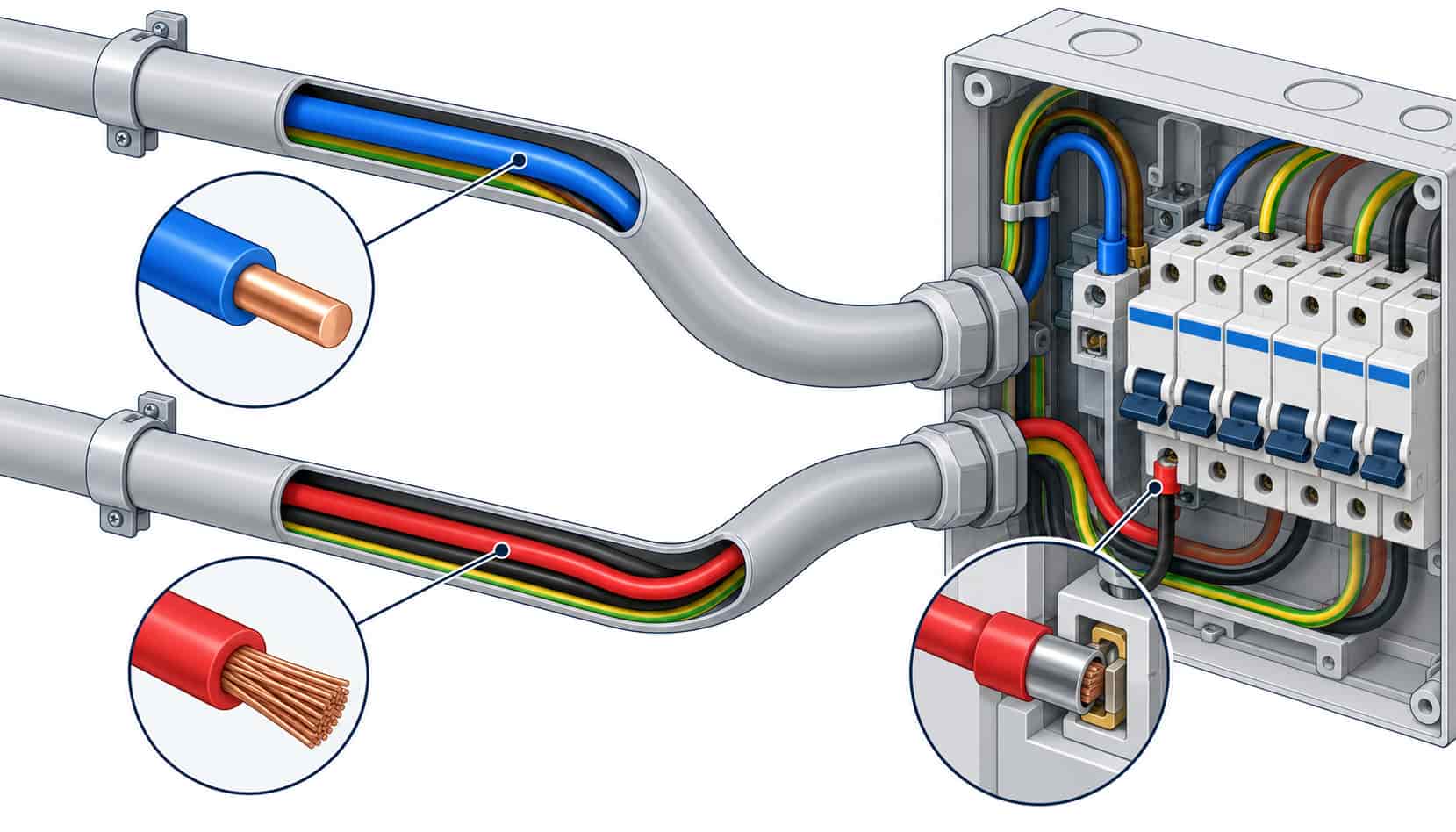
The choice is not about quality — both are sound constructions — but about the route and the terminations. Solid BV is cheaper per meter and utterly stable in fixed runs: once pulled into conduit it stays put, terminates under screw terminals without fuss, and its stiffness is an installation nuisance but an electrical virtue. BVR costs more and buys flexibility where the route is geometrically hostile — crowded panel interiors, short runs with many bends, connections to vibrating equipment — and where movement would work-harden a solid conductor until it snaps at the terminal. One caution travels with BVR: fine-stranded conductors below 10 mm² should be ferruled at terminations, because stranded copper splayed under a screw is the classic loose-connection factory. The failure mechanisms that loose terminations seed — hot spots, insulation degradation, intermittent faults — are catalogued in our cable failure causes guide.
Sizing and Color Code
Single-core building wire is sized by the circuit arithmetic, not by habit: ampacity in the conduit grouping, voltage drop to the far outlet, and protection coordination — the full logic is worked through in our cable size selection guide. The color code in Chinese practice follows GB conventions: yellow-green reserved for protective earth, blue for neutral, and phase colors by circuit discipline — typically yellow, green and red on three-phase work, with brown a common single-phase live choice. International buyers should state the required color scheme explicitly in the RFQ, because a container of European-project wire in Chinese phase colors is a conversation nobody enjoys at customs inspection. The insulation platform questions — PVC versus the XLPE alternatives — are compared at material level in our XLPE versus PVC guide.
| Circuit | Typical Size | Construction Note |
|---|---|---|
| Lighting circuits | 1.5 mm² | BV standard in conduit; drop rarely governs |
| Socket outlet circuits | 2.5 mm² | BV or BVR; check grouped ampacity in shared conduit |
| Air conditioning and water heaters | 4â6 mm² | Dedicated circuits; verify breaker coordination |
| Risers and distribution sub-mains | 10â70 mm² | Solid becomes hard to pull; BVR or cable preferred |
| Panel interior wiring | 1.5â6 mm² | BVR wins on bends and terminal access |
| Earthing connections | Per protection sizing | Yellow-green exclusively; continuity matters over ampacity |
Copper Quality and Batch Discipline
Two quality points travel with every coil of building wire. The first is copper itself: 99.95 percent pure electrolytic copper is the standard behind every legitimate datasheet, and the recycled-copper compromises that surface in the bargain tier show up as higher resistance, brittle draws and terminations that run hot long before the breaker notices — the supplier verification logic is the one in our power cable manufacturer checklist. The second is batch discipline: insulation thickness and concentricity drift with extrusion-line condition, so the batch test report — resistance per kilometer, insulation thickness, spark test — keyed to the printed batch ID is the only evidence that the coil in hand matches the sample that won the order. Neither point is visible to the eye at delivery; both are decisive over a thirty-year service life.
Export Mapping: Translating BV and BVR
The translation is direct: BV is “450/750 V single-core PVC-insulated cable, solid class 1 copper conductor” — the same product international catalogs sell as 6491X in the UK, H07V-U in IEC Europe, and THHN-adjacent single conductors in the US (where the UL construction differs and must be treated as its own certification). BVR maps to the stranded equivalents: 6491B or H07V-R. State the conductor class per the IEC 60228 vocabulary, the insulation temperature class, the color code, and the cross-sections — and attach the certification paperwork per the discipline in our power cable certifications checklist. Where the destination is a certification-driven market, name the mark in the RFQ, because PVC building wire is exactly the category where marks are enforced hardest — the marks landscape is navigated in our China electrical equipment certification checklist.
When Building Wire Is Not the Answer
Single-core building wire is not cable: it has no sheath, no armor and no outdoor qualification, and using it exposed, buried or in wet locations is a code violation that fails inspections predictably. It is not flexible-cord territory either — appliance connections that move belong to the RVV family, not to BVR doing a cord’s job. And above the largest cross-sections the economics flip: once a riser circuit needs many cores or mechanical protection, a proper multi-core cable beats a bundle of single cores on installation speed and long-term reliability alike. Knowing where the single-core economy ends is part of specifying it well.
RFQ Checklist: Ordering BV / BVR
Make the building-wire scope quotable, so include:
- Full designation: BV or BVR, voltage class 450/750 V
- Cross-sections per circuit, in mm², sized by calculation
- Conductor class stated: solid class 1 or stranded class 2/5
- Insulation temperature class: 70°C standard or 90°C variant
- Color code per destination-market convention, yellow-green for earth
- Destination-market certification named explicitly
- Ferrule policy for BVR terminations below 10 mm²
- Packaging: coil lengths and drum sizes matched to site logistics
- Batch test reports and copper certificates keyed to batch IDs
- Copper price linkage across the delivery calendar
Conclusion
BV and BVR are the simplest products in the cable catalog and the most frequently ordered, which makes the specification discipline around them disproportionately valuable: right conductor class, right color code, right temperature grade, sizes backed by arithmetic. Get those four details into the RFQ and a commodity purchase becomes an inspectable, bankable line item.
Kexingyu Cable Group (KXYE) manufactures BV and BVR in the full size and color range with batch test reports and export documentation, so the copper that wires the building arrives with evidence behind every coil.